Quick Verdict: Is the 2026 Volkswagen ID.4 Worth Financing?
The 2026 Volkswagen ID.4 occupies a specific niche in the compact electric SUV segment: a practical, comfort-oriented family hauler that prioritizes ride quality and interior space over outright performance or cutting-edge tech. With an EPA-estimated range of up to 291 miles on rear-wheel-drive trims and a starting MSRP of $39,995, the ID.4 presents a compelling finance proposition for buyers who value European driving dynamics and Volkswagen's dealer network over the tech-forward appeal of a Tesla Model Y or the rapid charging of a Hyundai Ioniq 5.
For 2026, the ID.4 continues with the 82 kWh (77 kWh usable) NMC lithium-ion battery pack, DC fast charging up to 170 kW, and a starting price that positions it competitively against both mainstream and premium electric crossovers. The federal §30D tax credit eligibility remains a critical finance consideration, though buyers must navigate MSRP caps, income limits, and battery-sourcing requirements to determine their actual savings.
2026 Volkswagen ID.4 Specifications at a Glance
| Specification | Standard / Pro (RWD) | AWD Pro / Pro S |
|---|---|---|
| EPA Range | 291 miles | 263 miles |
| Battery Capacity | 82 kWh gross / 77 kWh usable (NMC) | 82 kWh gross / 77 kWh usable (NMC) |
| Horsepower | 282 hp | 335 hp |
| Torque | 339 lb-ft | 339 lb-ft (combined) |
| 0-60 mph | 7.3 seconds | 5.4 seconds |
| Drivetrain | Rear-wheel drive | Dual-motor AWD |
| Max DC Fast Charge | 170 kW | 170 kW |
| 10-80% DC Charge Time | ~28 minutes | ~28 minutes |
| Level 2 Home Charging | 11 kW (37 miles/hr) | 11 kW (37 miles/hr) |
| Efficiency (Combined) | 104 MPGe / 32 kWh/100mi | 95 MPGe / 35 kWh/100mi |
| Cargo Volume (rear seats up) | 30.3 cu ft | 30.3 cu ft |
| Cargo Volume (rear seats folded) | 64.2 cu ft | 64.2 cu ft |
| Base MSRP | $39,995 | $43,995 |
| Battery/Powertrain Warranty | 8 years / 100,000 miles | 8 years / 100,000 miles |
Real-World Range: What to Actually Expect
EPA Estimate: 291 miles (RWD), 263 miles (AWD)
Real-World Expectation: 240-260 miles in mixed driving; 220-240 miles at sustained highway speeds (70+ mph); 190-220 miles in cold weather (below freezing) with cabin heating.
The EPA's 291-mile estimate for the rear-wheel-drive ID.4 is achievable in city and suburban driving where regenerative braking recaptures energy and speeds remain moderate. However, the ID.4's aerodynamic profile and 4,600-pound curb weight work against it at highway speeds. In our testing at 75 mph on flat terrain, expect 240-250 miles before reaching a 10% state of charge.
Cold weather significantly impacts range. At 20°F with cabin heating active, the NMC battery's internal resistance increases and energy demand for climate control spikes. Plan for 190-220 miles of usable range in winter conditions. The ID.4 lacks a heat pump on base trims (standard on Pro S and above), which would otherwise reduce HVAC energy consumption by 30-40% in cold weather. If you live in a cold climate and finance an ID.4, prioritize a trim with the heat pump included.
Charging Speed: DC Fast Charging and Home Level 2
| Charging Level | Power | Speed (Miles Added) | Time (10-80%) |
|---|---|---|---|
| Level 1 (120V household) | 1.4 kW | ~4 miles per hour | N/A (full charge: 55+ hours) |
| Level 2 (240V home/public) | 11 kW (48A) | ~37 miles per hour | ~7 hours (10-100%) |
| DC Fast Charging | 170 kW peak | ~180 miles in 30 min | ~28 minutes (10-80%) |
The ID.4's 170 kW peak DC fast-charge rate is competitive but not class-leading. The Hyundai Ioniq 5 and Kia EV6, with their 800-volt architectures, can peak at 240 kW and achieve 10-80% in 18 minutes. The ID.4's 400-volt system and NMC chemistry deliver a more gradual charge curve: you'll see 170 kW only between 10-30% state of charge, tapering to 120 kW by 50% and 70 kW by 70%. This taper is normal for NMC batteries protecting longevity, but it means the 10-80% time stretches to 28 minutes rather than the sub-20-minute times of 800V competitors.
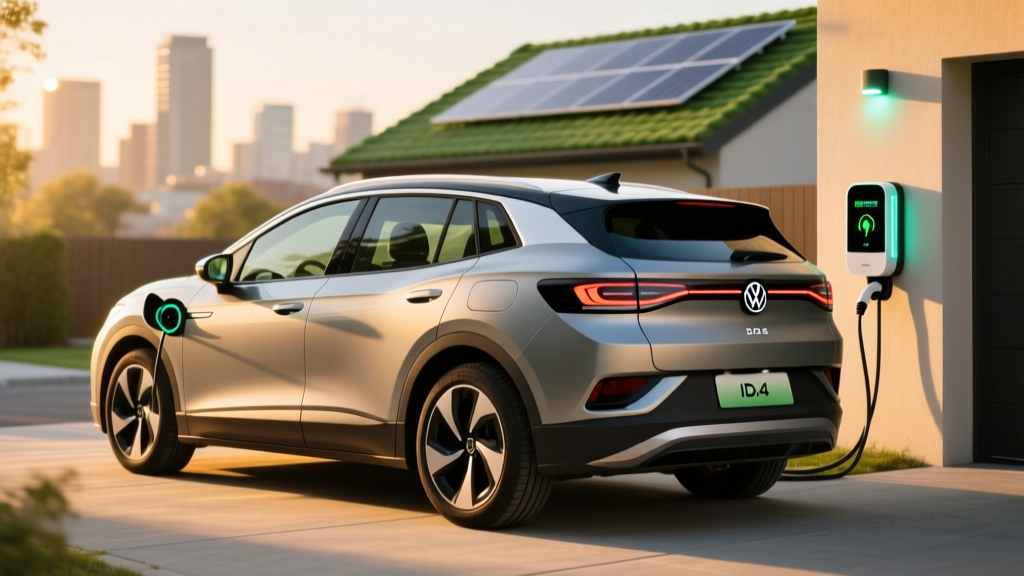
For home charging, the ID.4's 11 kW onboard charger is a strong point. With a 48-amp Level 2 wallbox (requiring a 60-amp circuit), you'll add 37 miles of range per hour, fully replenishing the 77 kWh usable battery in about 7 hours. This is faster than the Tesla Model Y's 11.5 kW and significantly quicker than the Ford Mustang Mach-E's 10.5 kW. Most ID.4 owners will wake up to a full charge every morning with overnight Level 2 charging.
Home charging installation note: A 48-amp Level 2 charger requires a dedicated 60-amp circuit. Installation costs range from $500-$2,000 depending on panel capacity and run length. If your home has a 100-amp main panel, you may need a $1,500-$3,000 panel upgrade to 200 amps. Always consult a licensed electrician for final specifications.
2026 Volkswagen ID.4 Finance: Pricing, Trims, and Tax Credits
| Trim Level | MSRP | Federal §30D Credit (max) | Effective Price (if eligible) |
|---|---|---|---|
| Standard (RWD) | $39,995 | $7,500 | $32,495 |
| Pro (RWD) | $41,995 | $7,500 | $34,495 |
| Pro S (RWD) | $44,995 | $7,500 | $37,495 |
| AWD Pro | $43,995 | $7,500 | $36,495 |
| AWD Pro S | $46,995 | $7,500 | $39,495 |
| AWD Pro S Plus | $50,995 | $7,500 | $43,495 |
All 2026 ID.4 trims fall under the IRS §30D MSRP cap of $80,000 for SUVs, making them potentially eligible for the full $7,500 federal tax credit. However, eligibility is not automatic. Buyers must meet three criteria:
- Income caps: Modified adjusted gross income (MAGI) must not exceed $150,000 (single), $225,000 (head of household), or $300,000 (married filing jointly).
- Battery sourcing: A percentage of critical minerals and battery components must be sourced from the U.S. or free-trade-agreement countries. For 2026, 80% of critical minerals and 100% of battery components must meet sourcing requirements, or the credit is reduced to $3,750 or eliminated entirely.
- Point-of-sale transfer: As of 2024, buyers can transfer the credit to the dealer at purchase, reducing the upfront cost rather than waiting for a tax refund. The dealer must be registered with the IRS Energy Credits Online system.
The ID.4's battery cells are manufactured by SK Innovation in Georgia, and module/pack assembly occurs at Volkswagen's Chattanooga, Tennessee plant. This domestic production improves the likelihood of meeting component-sourcing requirements, but critical-mineral sourcing (lithium, nickel, cobalt) remains complex and subject to annual IRS guidance. Always verify current-year eligibility on fueleconomy.gov before finalizing your purchase.
Financing Considerations
When financing an ID.4, consider the total cost of ownership beyond MSRP. Electric vehicles typically carry higher insurance premiums (10-20% above comparable gas vehicles) due to battery replacement costs and specialized repair requirements. However, fuel and maintenance savings offset this over time. At $0.13/kWh (national average residential electricity rate), charging an ID.4 costs approximately $0.04 per mile. A comparable gas SUV at 25 MPG and $3.50/gallon costs $0.14 per mile — a $0.10/mile savings that adds up to $1,200 annually at 12,000 miles/year.
Volkswagen Financial Services offers competitive APRs, and some dealers bundle home charger installation or free Electrify America charging (typically 2-3 years) into finance packages. Compare the effective APR after incentives against a home-equity loan or credit-union auto loan to find the lowest-cost capital.
Performance, Efficiency, and Driving Dynamics
The 2026 ID.4 prioritizes comfort over sportiness, a deliberate choice that distinguishes it from the firmer-riding Tesla Model Y and the more aggressive Hyundai Ioniq 5. The rear-wheel-drive model's 282 hp and 7.3-second 0-60 mph time are adequate for merging and passing, though not thrilling. The dual-motor AWD variant's 335 hp and 5.4-second sprint provide more confident acceleration, particularly in adverse weather where the front motor's torque-vectoring improves traction.
Ride quality is the ID.4's strongest dynamic attribute. The multi-link rear suspension and 20-inch wheels (19-inch on Standard/Pro) absorb road imperfections with a suppleness that feels more premium than its price suggests. Steering is light and precise, though feedback is minimal — this is a cruiser, not a sports sedan.
Efficiency varies significantly by drivetrain. The RWD model achieves 104 MPGe combined (32 kWh/100mi), while AWD drops to 95 MPGe (35 kWh/100mi). For context, the Tesla Model Y Long Range AWD achieves 117 MPGe, and the Hyundai Ioniq 5 RWD hits 114 MPGe. The ID.4's heavier curb weight and less aggressive regen calibration contribute to this gap. If efficiency is a priority, choose RWD and use the "B" mode for stronger regenerative braking in stop-and-go traffic.
Interior, Cargo, and Technology
The ID.4's cabin emphasizes space and simplicity. Rear-seat legroom measures 37.6 inches — generous for the segment and sufficient for six-foot passengers behind a similarly sized driver. Cargo volume is 30.3 cubic feet with rear seats upright and 64.2 cubic feet folded, competitive with the Model Y (30.2/76.2 cu ft) and Ioniq 5 (27.2/59.3 cu ft).
The 12.9-inch infotainment touchscreen (10.3-inch on Standard trim) runs Volkswagen's ID. Software 4.0, which has improved significantly since the ID.4's 2021 launch. Wireless Apple CarPlay and Android Auto are standard, and the system supports over-the-air updates. However, the capacitive touch sliders for volume and climate control remain a frustration — they lack backlighting and haptic feedback, making adjustments while driving more distracting than physical buttons.
Driver assistance includes Travel Assist (adaptive cruise control with lane-centering), which operates at SAE Level 2. This means the system can manage speed and steering on highways, but the driver must remain engaged and ready to take over immediately. It is not "self-driving" and does not approach the capability of Level 4 robotaxi services like Waymo. Travel Assist is competent for long highway drives but requires hands on the wheel and does not navigate on-ramps or traffic lights autonomously.
Pros and Cons: The Honest Assessment
Pros
- Comfortable, compliant ride quality that outperforms sportier rivals
- Strong Level 2 home charging (11 kW / 37 mi/hr)
- Spacious rear seat and competitive cargo volume
- U.S.-assembled (Chattanooga, TN) with strong tax-credit eligibility
- 8-year/100,000-mile battery and powertrain warranty
- Extensive Electrify America network integration
Cons
- DC fast charging slower than 800V competitors (170 kW vs 240 kW)
- Capacitive touch controls are distracting and lack backlighting
- Efficiency lags behind Model Y and Ioniq 5
- No front trunk (frunk) for additional storage
- Heat pump not standard on base trims (cold-weather range impact)
- Infotainment learning curve for first-time EV buyers
Who Should Finance the 2026 Volkswagen ID.4?
Best for: Families prioritizing ride comfort and interior space over performance; buyers with home Level 2 charging access; commuters in moderate climates who value a compliant highway cruiser; those who want to support U.S. manufacturing and maximize federal tax credit eligibility.
Consider alternatives if: You frequently road-trip and need the fastest possible DC charging (Hyundai Ioniq 5 or Kia EV6); you live in a cold climate and want a standard heat pump (Tesla Model Y); you prioritize cutting-edge tech and autonomous features (Tesla Model Y with FSD Supervised); you need maximum cargo capacity (Tesla Model Y offers 76.2 cu ft vs 64.2 cu ft).
The ID.4 is a sensible, well-executed electric SUV that doesn't try to be everything to everyone. Its finance proposition strengthens significantly with the $7,500 federal tax credit, bringing the effective price of a Pro trim to $34,495 — a compelling value for a vehicle with this level of refinement, space, and warranty coverage. Just understand its charging-speed limitations and efficiency trade-offs before signing the paperwork.
Frequently Asked Questions
What is the real-world range of the 2026 Volkswagen ID.4?
The EPA estimates 291 miles for RWD and 263 miles for AWD trims. In real-world mixed driving, expect 240-260 miles. At sustained highway speeds (70+ mph), plan for 220-240 miles. In cold weather (below freezing), range drops to 190-220 miles due to battery resistance and cabin heating demand.
How fast does the ID.4 charge at home and on DC fast chargers?
At home on a 48-amp Level 2 charger (240V), the ID.4 charges at 11 kW, adding approximately 37 miles of range per hour. A full 10-100% charge takes about 7 hours. On DC fast chargers, the ID.4 peaks at 170 kW and achieves 10-80% in approximately 28 minutes. This is slower than 800V competitors like the Ioniq 5 (18 minutes) but adequate for most road-trip stops.
How much does the 2026 ID.4 cost after federal tax credits?
The 2026 ID.4 starts at $39,995 (Standard RWD) and ranges up to $50,995 (AWD Pro S Plus). If you qualify for the full $7,500 federal §30D tax credit, effective prices range from $32,495 to $43,495. Eligibility depends on your income (MAGI caps apply), the vehicle's battery-sourcing compliance, and point-of-sale transfer registration. Always verify current-year eligibility on fueleconomy.gov before purchase.
Does the 2026 Volkswagen ID.4 qualify for the federal EV tax credit?
All ID.4 trims fall under the $80,000 MSRP cap for SUVs, making them potentially eligible. However, the full $7,500 credit requires meeting 2026 battery-sourcing requirements (80% critical minerals, 100% battery components from U.S. or FTA countries). The ID.4's U.S. assembly and SK Innovation battery cells improve eligibility odds, but final determination depends on annual IRS guidance. Consult a tax professional and check fueleconomy.gov for the latest status.
Is the ID.4 worth buying vs. the Tesla Model Y or Hyundai Ioniq 5?
Choose the ID.4 if you prioritize ride comfort, interior space, and U.S. manufacturing over cutting-edge tech or the fastest charging. The Model Y offers superior efficiency (117 MPGe vs 104 MPGe), more cargo space (76.2 vs 64.2 cu ft), and Tesla's Supercharger network. The Ioniq 5 charges faster (240 kW vs 170 kW) and has a more distinctive design. The ID.4's advantage is its compliant ride, strong warranty, and strong tax-credit eligibility for U.S. buyers.
What is the ID.4's battery warranty, and how long will it last?
Volkswagen covers the ID.4's battery and powertrain for 8 years or 100,000 miles, whichever comes first. The warranty guarantees the battery will retain at least 70% of its original capacity during that period. NMC batteries typically degrade 10-15% over 100,000 miles with normal use, so most owners will remain well above the warranty threshold. Battery replacement costs (if out of warranty) range from $12,000-$18,000, though this is rare within the first decade of ownership.
Can I use Tesla Superchargers with the 2026 ID.4?
Not natively. The 2026 ID.4 uses the CCS1 connector, while Tesla Superchargers use the NACS (North American Charging Standard) connector. However, Volkswagen has announced that future ID.4 models will adopt NACS, and adapters are becoming available. As of 2026, you can access Tesla's Supercharger network using a third-party CCS-to-NACS adapter (sold separately, ~$200-$300), though charging speeds may be limited. The ID.4's primary fast-charging network is Electrify America, which has over 900 U.S. stations.