Quick Answer: The 2026 Mercedes-AMG GT four-door electric sedan is Mercedes-Benz's flagship performance EV, built on the dedicated MB.EA platform. Expected to start around $150,000, it targets 300+ miles of EPA range, features a 800-volt architecture for ultra-fast DC charging, and produces up to 1,341 horsepower in its top trim. Because its MSRP far exceeds the $55,000 federal tax credit cap for sedans, buyers should not expect the §30D credit. Real-world ownership will demand reliable Level 2 home charging and a budget for premium insurance and performance-tier maintenance.
What the Electric AMG GT Actually Is
The electric AMG GT four-door is not a conversion of the gas-powered AMG GT 4-Door Coupe. It rides on Mercedes-Benz's new MB.EA (Mercedes-Benz Electric Architecture) large-car platform — a dedicated EV skateboard with structural battery integration, 800V electrical architecture, and permanent-magnet synchronous motors on both axles. Mercedes-AMG announced the production model in late 2025, with customer deliveries beginning in mid-2026.
Two primary trims are expected at launch:
- AMG GT 55 4MATIC+ Electric — dual-motor AWD, approximately 670 horsepower, targeting 320 miles EPA range.
- AMG GT 63 S 4MATIC+ Electric — dual-motor AWD with AMG performance tuning, up to 1,341 horsepower (with launch control overboost), targeting 300 miles EPA range.
The battery pack uses an NMC (nickel-manganese-cobalt) chemistry with an estimated usable capacity of approximately 100–110 kWh, paired with a liquid-cooled thermal management system and a standard heat pump for cold-climate efficiency.
| Spec | GT 55 Electric | GT 63 S Electric |
|---|---|---|
| Drivetrain | Dual-motor AWD | Dual-motor AWD |
| Horsepower | ~670 HP | Up to 1,341 HP (overboost) |
| 0–60 mph | ~3.5 seconds | ~2.5 seconds |
| Battery (usable, est.) | ~105 kWh NMC | ~105 kWh NMC |
| EPA Range (target) | ~320 miles | ~300 miles |
| DC Fast Charge (peak) | ~320 kW (800V) | ~320 kW (800V) |
| 10–80% DCFC Time | ~18 minutes | ~18 minutes |
| Level 2 AC Charge | 11 kW (est. 9 hrs 0–100%) | 11 kW (est. 9 hrs 0–100%) |
| Base MSRP (est.) | ~$150,000 | ~$200,000+ |
| Battery Warranty | 8 yr / 100,000 mi | 8 yr / 100,000 mi |
Note: Specifications are based on Mercedes-Benz and Mercedes-AMG announcements as of early 2026. Final EPA-certified figures may differ. Source: Mercedes-AMG.
Real-World Range: What the EPA Sticker Won't Tell You
EPA Target: ~300–320 miles
Expect in real-world highway driving: ~250–280 miles
Cold weather (below 32°F): ~210–240 miles
The AMG GT Electric's 800V architecture and large NMC pack are engineered for range, but physics governs the real numbers. At sustained 75 mph highway speeds, any EV — even one with a heat pump and active aero — will consume 15–25% more energy than its combined EPA cycle suggests. The GT's performance-oriented tires, heavy curb weight (likely exceeding 5,500 lbs), and aggressive regenerative-braking calibration all factor in.
In cold weather, the NMC chemistry will see reduced efficiency. Even with the heat pump (which recovers waste heat from the drivetrain rather than using resistive heating alone), expect 20–30% range reduction in sub-freezing temperatures. This is standard for NMC packs and consistent with what we see in the Porsche Taycan and Tesla Model S Plaid under similar conditions.
For daily commuting under 80 miles round-trip, range is a non-issue — you'll charge at home overnight and start each day at 90–100% SoC (state of charge). The range question only matters for road trips, where the 800V fast-charging architecture becomes the real differentiator.
Charging Speed and Infrastructure: The 800V Advantage
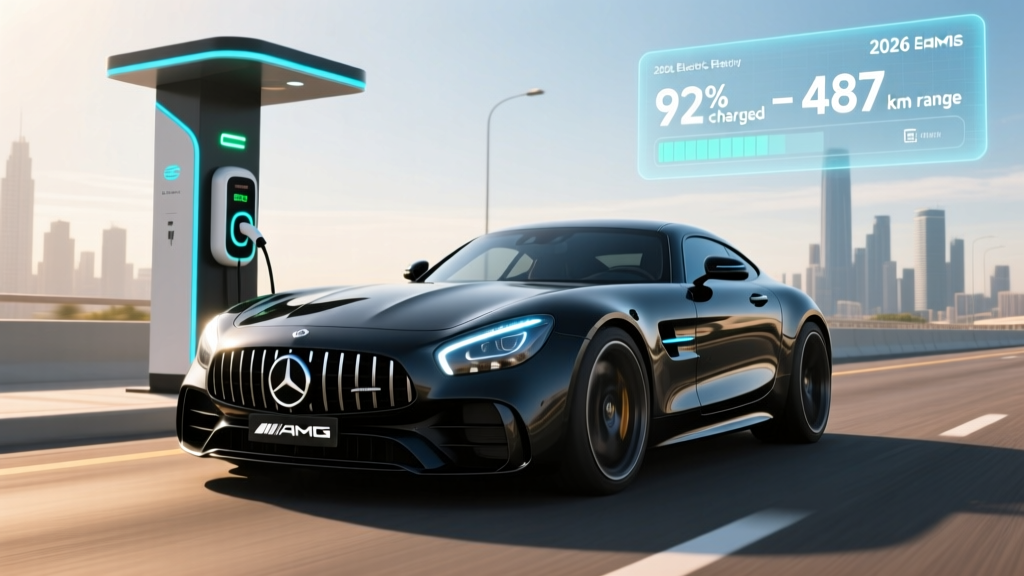
The AMG GT Electric's 800-volt electrical architecture allows it to accept DC fast-charging rates up to approximately 320 kW at compatible stations. This puts it in the same tier as the Porsche Taycan, Hyundai Ioniq 5, and Kia EV6 — vehicles that demonstrably sustain high charge rates longer than 400V competitors.
| Level | Power (kW) | Approximate Rate | Use Case |
|---|---|---|---|
| Level 1 (120V household) | ~1.4 kW | ~4–5 miles/hour | Emergency trickle only |
| Level 2 (240V home/public) | 11 kW | ~35 miles/hour | Daily overnight charging |
| DC Fast Charge (800V) | Up to 320 kW | 10–80% in ~18 min | Road trips |
The charge-curve reality: The 320 kW peak rate is not sustained across the entire session. Expect peak rates between 10–50% SoC, tapering to ~150 kW by 60%, and dropping sharply above 80%. A 10–80% session at a 350 kW Electrify America or Ionity station should take roughly 18 minutes, adding approximately 200 miles of range. Above 80%, charging slows dramatically to protect the NMC cells — plan your road-trip stops to charge to 80%, not 100%.
The GT Electric will use the NACS (North American Charging Standard) connector, giving it native access to the Tesla Supercharger network (now open to non-Tesla vehicles via NACS) in addition to Electrify America, EVgo, and other CCS-to-NACS-transitioning networks. This is a significant infrastructure advantage over older CCS1-only vehicles.
Home Charging Requirements
At 11 kW Level 2, you'll need a 48-amp dedicated circuit on a 60-amp breaker (per NEC 80% continuous-load rule). Most modern homes with 200-amp electrical panels can accommodate this, but older homes with 100-amp service may require a panel upgrade ($1,500–$3,500). Budget $800–$2,000 for the Level 2 EVSE (charger hardware) plus electrician labor and permits. Always get a quote from a licensed electrician before committing — do not assume your panel has spare capacity.
Electric AMG GT vs. Gas AMG GT: Cost and Performance Comparison
The most direct comparison is the outgoing gas-powered AMG GT 63 S 4-Door Coupe. Here's how the numbers stack up:
| Metric | Electric GT 63 S (2026) | Gas GT 63 S 4-Door (2024) |
|---|---|---|
| Horsepower | ~1,341 HP | 630 HP |
| 0–60 mph | ~2.5 sec | 3.1 sec |
| Range / Tank | ~300 mi (EPA target) | ~340 mi (15.8 gal × 21 mpg hwy) |
| Fuel/Energy Cost per Mile | ~$0.05–0.07 (home charging) | ~$0.22–0.28 (premium 93 octane) |
| Annual Fuel/Energy (12k mi) | ~$600–$840 | ~$2,640–$3,360 |
| Annual Maintenance (est.) | ~$400–$700 | ~$1,200–$2,000 |
| Base MSRP | ~$200,000+ | ~$182,000 (2024) |
| Federal Tax Credit | Not eligible (MSRP cap) | N/A |
The takeaway: The electric GT 63 S demolishes the gas version in straight-line performance (more than double the horsepower, half a second quicker to 60) and running costs (roughly $2,000–$2,500/year savings on fuel and maintenance). The trade-off is a higher starting price, range that falls short of the gas car's total driving radius on a single fill, and dependence on charging infrastructure for road trips. For a $200K+ buyer, the fuel savings are almost incidental — the decision comes down to driving character, tech appeal, and whether the performance gains justify the premium.
Total Ownership Cost Breakdown (5-Year Estimate)
| Category | Estimated Cost | Notes |
|---|---|---|
| Purchase Price | $200,000–$220,000 | Base + options + destination |
| Federal Tax Credit | $0 | MSRP exceeds $55K sedan cap under §30D |
| Home Charger Install | $1,500–$3,000 | Level 2, 48A circuit, panel permitting |
| Energy (5 yr, 60K mi) | $3,000–$4,200 | Home + DCFC mix, $0.15/kWh avg |
| Insurance (5 yr) | $25,000–$40,000 | Performance EV, high MSRP, varies by state/driver |
| Maintenance (5 yr) | $2,000–$3,500 | Tires, cabin filter, brake fluid, wipers; no oil changes |
| Depreciation (5 yr, est.) | $80,000–$110,000 | ~40–50% based on luxury EV trends |
| Total 5-Year Cost | ~$311,500–$380,700 | Incl. purchase, energy, insurance, maint., depreciation |
Insurance is the wildcard. High-performance EVs with $200K+ MSRPs and sub-3-second 0–60 times command premium rates. Expect quotes in the $5,000–$8,000/year range depending on your driving record, state, and coverage levels. Shop multiple insurers — some (like Hagerty or specialty carriers) may offer better rates for low-mileage collector-type usage.
Depreciation is the largest ownership cost, as it is with any luxury vehicle. The Porsche Taycan Turbo S has historically retained 45–55% of value after 5 years; the Tesla Model S Plaid has fared worse (35–45%). The electric AMG GT's depreciation will depend heavily on Mercedes-Benz's long-term software support, battery replacement pricing, and market demand for used high-performance EVs.
Federal Tax Credit and Incentive Reality
§30D Federal EV Tax Credit — Does the Electric AMG GT Qualify?
- MSRP Cap: Sedans must be ≤$55,000. The AMG GT Electric starts at ~$150,000+. Does NOT qualify.
- Buyer Income Cap: AGI ≤$300,000 (MFJ) / $150,000 (single). Many AMG buyers exceed this.
- Battery Sourcing: Critical minerals and battery components must meet escalating domestic-content thresholds. Moot given MSRP disqualification.
- Point-of-Sale Transfer: Available for qualifying vehicles — but again, the AMG GT does not qualify.
Source: IRS §30D Clean Vehicle Credit. Consult a tax professional for your specific situation.
The electric AMG GT is a luxury performance vehicle, and the federal incentive structure is designed for mass-market EV adoption. Buyers in this price bracket should not factor the $7,500 credit into their purchase decision. Some states offer additional rebates or HOV-lane access for zero-emission vehicles regardless of price — check your state's DMV or energy office for specifics.
Common Misconceptions About the Electric AMG GT
| Myth | Fact |
|---|---|
| "It qualifies for the $7,500 federal tax credit." | It does not. The MSRP far exceeds the $55,000 sedan cap under IRS §30D rules. |
| "300 miles of range means I can drive 300 miles at highway speed." | EPA range is a combined cycle. Sustained 75 mph highway driving will yield ~250–280 real miles. Cold weather drops it further. |
| "I can charge it on any public charger quickly." | The 320 kW peak rate requires an 800V-capable DCFC station (350 kW class). Many older 50–150 kW stations will charge it much more slowly. |
| "Electric means zero maintenance." | No oil changes, yes. But tires (performance compounds wear fast at 5,500+ lbs), cabin filters, brake fluid, coolant, and wiper fluid still require service. |
| "The battery will need replacing in 5 years." | NMC packs with active thermal management are warrantied for 8 years/100,000 miles at ≥70% capacity retention. Most modern EV batteries outlast their warranty by significant margins. |
Decision Framework: Should You Buy the Electric AMG GT?
Choose the Electric AMG GT if:
- You have reliable Level 2 home charging (garage or dedicated driveway circuit).
- Your daily driving is under 150 miles and road trips are occasional.
- You want the most powerful sedan Mercedes-AMG has ever built and value instant torque delivery over engine sound.
- You accept that running-cost savings are marginal relative to the purchase price — you're buying for performance and tech, not economics.
- You live in a region with decent DC fast-charging infrastructure (Electrify America, Tesla Superchargers, EVgo) for road trips.
Consider a gas or hybrid alternative if:
- You lack home charging access and rely entirely on public infrastructure.
- You regularly drive 400+ miles between stops in rural or charging-desert regions.
- You prioritize long-term depreciation resilience — the used luxury EV market remains volatile.
- You want a proven platform with 5+ years of real-world ownership data (the gas AMG GT 4-Door has that track record).
Consider the Porsche Taycan Turbo GT or Tesla Model S Plaid if:
- You want similar performance with more established charging ecosystems (Porsche's 800V Taycan is well-proven; Tesla's Supercharger network is the most reliable).
- You want to compare real-world range and charging data from thousands of existing owners before committing.
What First-Time EV Buyers Should Know Before Committing
If the electric AMG GT is your first EV, prepare for these ownership realities:
- Home charging is essential. At this price point, relying solely on public charging is impractical and expensive. Budget for a professional Level 2 installation before taking delivery.
- Learn the charge curve. Plan road-trip stops to charge from 10–80%, not to 100%. The last 20% can take as long as the first 80%.
- Precondition the battery. Use the vehicle's navigation-based preconditioning to warm the battery before arriving at a DC fast charger. This can shave 5–10 minutes off your charge time in cold weather.
- Tires wear faster. A 5,500+ lb EV with 1,341 HP will consume performance tires quickly. Budget $1,500–$2,500 for a set of replacement tires every 15,000–25,000 miles.
- Insurance quotes vary wildly. Get quotes from at least three carriers before purchasing. Your current insurer may not be competitive for a $200K performance EV.
Frequently Asked Questions
What is the expected EPA range of the electric AMG GT?
Mercedes-AMG targets approximately 300–320 miles of EPA range depending on trim. Real-world highway driving will likely yield 250–280 miles, and cold-weather driving may reduce that to 210–240 miles.
Does the electric AMG GT qualify for the $7,500 federal tax credit?
No. Under IRS §30D rules, sedans must have an MSRP of $55,000 or less to qualify. The electric AMG GT starts around $150,000, well above the cap. Consult IRS guidance for details.
How fast does the electric AMG GT charge?
On an 800V-capable 350 kW DC fast charger, the GT Electric can accept up to ~320 kW peak, charging from 10–80% in approximately 18 minutes. On a standard Level 2 home charger at 11 kW, a full charge takes roughly 9 hours.
What connector does the electric AMG GT use?
The vehicle is expected to use the NACS (North American Charging Standard) connector, providing native access to the Tesla Supercharger network and other NACS-equipped public chargers.
How much will it cost to charge at home vs. fueling the gas AMG GT?
At an average residential electricity rate of $0.15/kWh, a full charge (~105 kWh) costs roughly $15.75. The gas AMG GT 63 S requires premium fuel and averages about 16 mpg combined, costing approximately $45–$55 to fill its 15.8-gallon tank. Annual energy savings for the EV at 12,000 miles/year: roughly $1,800–$2,500.
What is the battery warranty?
Mercedes-Benz typically provides an 8-year / 100,000-mile high-voltage battery warranty guaranteeing at least 70% capacity retention. Final warranty terms for the AMG GT Electric will be confirmed at launch.
Is the electric AMG GT self-driving?
No. The vehicle will feature Mercedes-Benz's latest driver-assistance systems, which are SAE Level 2 — meaning the driver must remain fully engaged and attentive at all times. Mercedes does offer a certified Level 3 system (Drive Pilot) in limited markets and conditions, but this is not a self-driving vehicle in the Level 4 sense of a Waymo robotaxi.
Specifications and pricing in this article are based on manufacturer announcements and preliminary data available as of early 2026. Final EPA-certified range, official MSRP, and tax-credit eligibility should be verified at the time of purchase. Always consult fueleconomy.gov for certified efficiency data and a licensed electrician for home charging assessments.