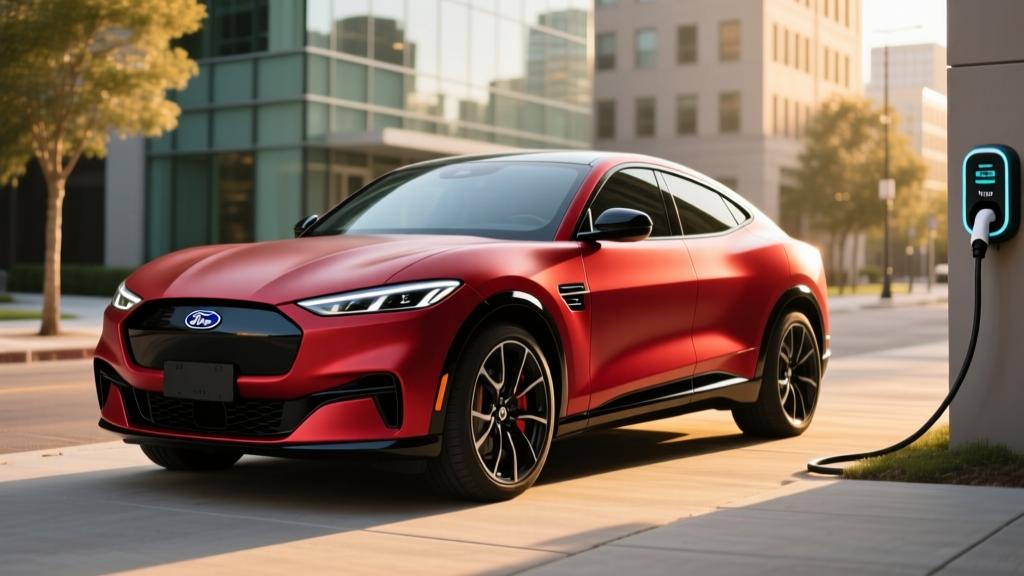
If you're researching Ford Mustang Mach-E offers in 2026, you're looking at one of the most competitively priced electric SUVs on the market — especially after recent price cuts and federal incentive stacking. The Mach-E has matured from a polarizing nameplate into a genuinely compelling daily-driver EV, with real-world usability that rivals the Tesla Model Y and Hyundai Ioniq 5.
Below, we dissect the 2026 Mach-E lineup with the exact numbers buyers need: EPA and real-world range, DC fast-charging curves, trim pricing before and after the §30D federal tax credit, and the ownership trade-offs Ford doesn't put on the billboard.
2026 Mach-E Lineup at a Glance
| Spec | Select RWD (Std Range) | Premium AWD (Ext Range) | GT AWD |
|---|---|---|---|
| EPA Range | 250 mi | 320 mi | 280 mi |
| Battery (usable) | 70 kWh (LFP) | 91 kWh (NMC) | 91 kWh (NMC) |
| Horsepower | 266 hp | 346 hp | 480 hp |
| 0–60 mph | 6.3 sec | 5.1 sec | 3.5 sec |
| Drivetrain | RWD single motor | AWD dual motor | AWD dual motor |
| Max DC Charge | 115 kW | 150 kW | 150 kW |
| 10–80% DC Time | ~33 min | ~36 min | ~36 min |
| Level 2 Rate | 10.5 kW (~32 mi/hr) | 10.5 kW (~32 mi/hr) | 10.5 kW (~32 mi/hr) |
| MPGe (combined) | 105 MPGe | 101 MPGe | 86 MPGe |
| Base MSRP | $39,995 | $48,995 | $59,995 |
Source: fueleconomy.gov, Ford Motor Company 2026 spec sheets. Prices exclude $1,395 destination.
Real-World Range: What the EPA Sticker Doesn't Tell You
EPA sticker: 320 miles
Real-world highway (70 mph, mild weather): ~265–280 miles
Cold weather (below 32°F, mixed driving): ~220–245 miles
Best-case city/regen-heavy driving: ~300–315 miles
The 320-mile EPA figure on the Extended Range AWD is competitive, but EPA testing favors low-speed, stop-and-go driving where regenerative braking recovers energy. On sustained 70-mph interstate runs, expect to use about 32–34 kWh per 100 miles, which translates to roughly 265–280 miles before the buffer runs out.
Cold weather compounds this. The Mach-E uses a resistive PTC heater on lower trims (a heat pump is standard on Premium and GT for 2026), but even with a heat pump, lithium-ion cells lose charge acceptance and cabin heating draws heavily. Plan on a 25–30% range reduction in sub-freezing conditions, consistent with NMC chemistry behavior across the segment.
The Standard Range models use LFP (lithium iron phosphate) chemistry. LFP cells tolerate regular 100% charging better than NMC — Ford actually recommends periodic full charges for LFP packs to maintain cell balancing — but the trade-off is lower energy density and worse cold-weather performance. Expect the 250-mile Standard Range to deliver closer to 185–200 miles in winter highway driving.
Charging Speed: Home, Public, and the Curve You Need to Know
The Mach-E's charging architecture is the area where Ford's competitors have pulled ahead. Here's the full picture:
| Charging Level | Power | Speed (mi/hr) | Use Case |
|---|---|---|---|
| Level 1 (120V) | 1.4 kW | ~3–4 mi/hr | Emergency / trickle |
| Level 2 (240V, 48A) | 10.5 kW | ~32 mi/hr | Home overnight (full charge in ~9 hr for ER) |
| DC Fast (Std Range) | 115 kW peak | ~190 mi/hr at peak | Road trips; 10–80% in ~33 min |
| DC Fast (Ext Range) | 150 kW peak | ~250 mi/hr at peak | Road trips; 10–80% in ~36 min |
The charging-curve reality: The 150 kW peak on Extended Range models only holds between roughly 15–40% State of Charge. By 60% SoC, power tapers to ~95 kW, and above 80% it drops below 40 kW. This is normal for NMC packs with conservative thermal management, but it means your average charging power on a 10–80% session is closer to 90–100 kW, not 150 kW. The Hyundai Ioniq 5's 800V architecture, by contrast, sustains over 200 kW for longer, completing 10–80% in ~18 minutes.
For home Level 2, the Mach-E's onboard charger maxes at 10.5 kW (48 amps on a 60-amp circuit). A full overnight charge on the 91 kWh Extended Range pack takes about 9 hours — adequate for commuters who plug in every evening. Installation of a 240V/60A circuit typically runs $800–$2,000 depending on panel proximity; budget for a 200-amp panel upgrade ($1,500–$3,500) if your home has older 100-amp service.
For 2026, the Mach-E ships with the NACS (Tesla-style) charge port natively, giving direct access to the Tesla Supercharger network (now over 20,000 stalls in North America) without an adapter. This is a meaningful usability advantage over older CCS-equipped EVs that still rely on adapter dongles.
Pricing, Trims, and the §30D Federal Tax Credit
Ford has aggressively repositioned the Mach-E for 2026 after rounds of price cuts in 2024–2025. Here's how the lineup stacks up before and after incentives:
| Trim | MSRP (incl. dest.) | §30D Credit (max) | Effective Price |
|---|---|---|---|
| Select RWD Std Range | $41,390 | $3,750* | ~$37,640 |
| Premium RWD Ext Range | $48,490 | $3,750* | ~$44,740 |
| Premium AWD Ext Range | $50,390 | $3,750* | ~$46,640 |
| GT AWD | $61,390 | $3,750* | ~$57,640 |
*Tax credit amounts reflect 2026 critical-mineral and battery-component sourcing requirements under IRS §30D. The Mach-E qualifies for a partial credit — typically $3,750 for the battery-component half — because some critical minerals in the supply chain do not yet meet FTA-country sourcing thresholds. Full $7,500 eligibility may shift as Ford's sourcing evolves. Always verify current eligibility at purchase.
- MSRP cap: SUVs/vans must be ≤ $80,000 — all Mach-E trims qualify
- Buyer income cap: AGI ≤ $150,000 (single), $225,000 (head of household), $300,000 (joint)
- Battery sourcing: Partial credit ($3,750) for battery components; critical-minerals half varies by batch
- Point-of-sale transfer: You can transfer the credit to the dealer to reduce your purchase price at signing (effective Jan 2024 onward)
- Assembly: Final assembly in North America — Mach-E is built in Cuautitlán, Mexico (qualifies)
Some states layer additional rebates on top — California's CVRP, Colorado's innovative motor vehicle credit, and various utility-company incentives can stack with the federal credit. Check your state energy office and local utility for current programs, as amounts vary by jurisdiction and funding availability.
Performance and Driving Impressions
The Mach-E GT remains one of the quickest SUVs under $65,000, with a 3.5-second 0–60 time from its 480-hp dual-motor setup. But the volume seller — the Premium AWD Extended Range — delivers a 5.1-second run with 346 hp, which is more than adequate for highway merging and passing.
Ride quality is firm but controlled. Ford tuned the Mach-E with a sportier bias than the Ioniq 5 or Volkswagen ID.4, which translates to confident cornering but slightly more road harshness over broken pavement. The steering is precise and well-weighted — a welcome contrast to the numb electric steering in some competitors.
One-pedal driving is strong, with aggressive regen that brings the Mach-E to near-stop without brake intervention. The brake pedal feel, a common complaint in early EVs with blended regen/friction braking, is reasonably linear in the 2026 model year after software refinements.
Interior Space, Cargo, and Daily Livability
Passenger space is generous for the compact-EUV segment:
- Front legroom: 43.3 inches
- Rear legroom: 38.1 inches (adequate for 6-foot adults)
- Cargo (behind rear seats): 29.7 cu ft
- Cargo (seats folded): 59.7 cu ft
- Front trunk (frunk): 4.7 cu ft — enough for a charging cable bag and small grocery run
The 15.5-inch portrait touchscreen running SYNC 4A dominates the dash. It's responsive, supports wireless Apple CarPlay and Android Auto, and includes an integrated navigation system with EV-aware route planning and charge-station preconditioning. The physical volume knob at the base of the screen is a welcome ergonomic choice.
Build quality is solid, with soft-touch materials on the dash and door uppers, though some lower plastics feel cost-reduced compared to the Tesla Model Y's minimalist interior or the Hyundai Ioniq 5's retro-modern cabin.
Tech, Driver Assistance, and Safety
Ford's BlueCruise hands-free highway driving system is available on Premium and GT trims (included for the first year, then a subscription). BlueCruise is an SAE Level 2 system — it controls steering, acceleration, and braking on pre-qualified divided highways, but requires continuous driver monitoring via an infrared camera. You cannot sleep, read, or look away. This is not autonomous driving; it's an advanced cruise-and-lane-centering system.
BlueCruise handles steering, speed, and lane-centering on approved highways. The driver must remain attentive and ready to take over instantly. The system monitors eye gaze via cabin camera and will issue escalating warnings if attention lapses.
Standard safety tech across all trims includes Ford Co-Pilot360 2.0: automatic emergency braking with pedestrian detection, blind-spot monitoring, rear cross-traffic alert, lane-keeping assist, and evasive steering assist.
The Mach-E earned the IIHS Top Safety Pick designation and a 5-star overall NHTSA rating.
Who Should Buy the Mach-E — And Who Shouldn't
- Native NACS port = seamless Supercharger access
- Strong driving dynamics; best-in-class steering feel
- Competitive pricing after incentives (~$37K entry)
- LFP option on Std Range for daily 100% charging
- Spacious rear seat and cargo area
- DC charging slower than 800V rivals (Ioniq 5, EV6)
- BlueCruise subscription cost after year one
- Partial $3,750 federal credit, not full $7,500
- Std Range cold-weather range drops sharply (LFP)
- Firm ride may not suit comfort-priority buyers
Choose the Mach-E if: You want a sporty-handling EV SUV with native Supercharger access, value a traditional dealer network for service, and your daily commute is under 100 miles round-trip (making even the Standard Range viable with home charging).
Look elsewhere if: You road-trip frequently and want the fastest DC charging available (Ioniq 5/EV6), you need the full $7,500 tax credit to make the math work, or you prefer a softer, more comfort-oriented ride (ID.4, Equinox EV).
Warranty and Long-Term Ownership
Ford covers the Mach-E with:
- Bumper-to-bumper: 3 years / 36,000 miles
- Powertrain: 5 years / 60,000 miles
- Battery: 8 years / 100,000 miles (capacity retention ≥ 70% of original)
The 70% retention threshold over 8 years is industry-standard (Tesla, Hyundai, and VW use similar terms). Independent fleet data from Recurrent Auto suggests most NMC packs in liquid-cooled systems like the Mach-E's retain 90–93% capacity at 60,000 miles, with degradation curves flattening significantly after the initial 10–15% drop in the first year.
Battery replacement out of warranty is expensive — estimated at $15,000–$20,000 for the Extended Range pack — but is rarely needed before 150,000+ miles in liquid-cooled systems. The LFP Standard Range pack may prove even more durable; LFP chemistry is rated for 3,000+ full charge cycles before significant degradation, which translates to well over 300,000 miles of equivalent use.
Frequently Asked Questions
What is the real-world range of the 2026 Mustang Mach-E?
The Extended Range AWD is EPA-rated at 320 miles, but expect 265–280 miles on sustained highway driving and 220–245 miles in cold weather. The Standard Range LFP model (250 EPA) delivers about 185–200 miles in winter conditions. City driving with regenerative braking gets closest to the EPA sticker.
How fast does the Mach-E charge at home and on the road?
At home on a 240V Level 2 charger, the Mach-E adds about 32 miles of range per hour (10.5 kW), fully charging the Extended Range pack overnight in ~9 hours. On DC fast chargers, the Extended Range peaks at 150 kW, reaching 10–80% in about 36 minutes. The Standard Range peaks at 115 kW with a 10–80% time of ~33 minutes.
Does the 2026 Mustang Mach-E qualify for the federal EV tax credit?
Yes, but partially. Under current IRS §30D rules, the Mach-E qualifies for $3,750 (the battery-component half of the credit). The critical-minerals half depends on sourcing that varies by production batch. The MSRP is well under the $80,000 SUV cap, and buyers must meet income limits ($150K single / $300K joint). The credit can be transferred to the dealer at point of sale to reduce your purchase price directly.
Is the Mach-E worth buying vs. the Tesla Model Y or Hyundai Ioniq 5?
It depends on priorities. The Mach-E offers better steering feel and a native NACS port for Supercharger access. The Model Y has a larger Supercharger network footprint and more cargo space. The Ioniq 5 charges significantly faster on DC (10–80% in ~18 min vs. ~36 min) and qualifies for the full $7,500 credit. If driving engagement and dealer-based service matter, the Mach-E wins; if charging speed and maximum incentives are your priority, the Ioniq 5 is the stronger pick.
What are the biggest pros and cons?
Pros: Sporty handling, native NACS/Supercharger access, competitive post-incentive pricing, LFP battery option for daily full charges, roomy interior. Cons: DC charging is slower than 800V competitors, only partial federal tax credit, BlueCruise requires a paid subscription after year one, LFP Standard Range struggles in cold weather, and the ride is firm for comfort-oriented buyers.
Can I tow with the Mustang Mach-E?
The Mach-E is rated for up to 2,300 pounds with the available Class II hitch receiver (Extended Range models). This covers a small utility trailer or a pair of dirt bikes, but not a camper or boat. Towing also cuts range roughly in half — plan for 140–160 miles between charges when towing near the limit.