Quick Answer: Does Toyota Have an Electric Car?
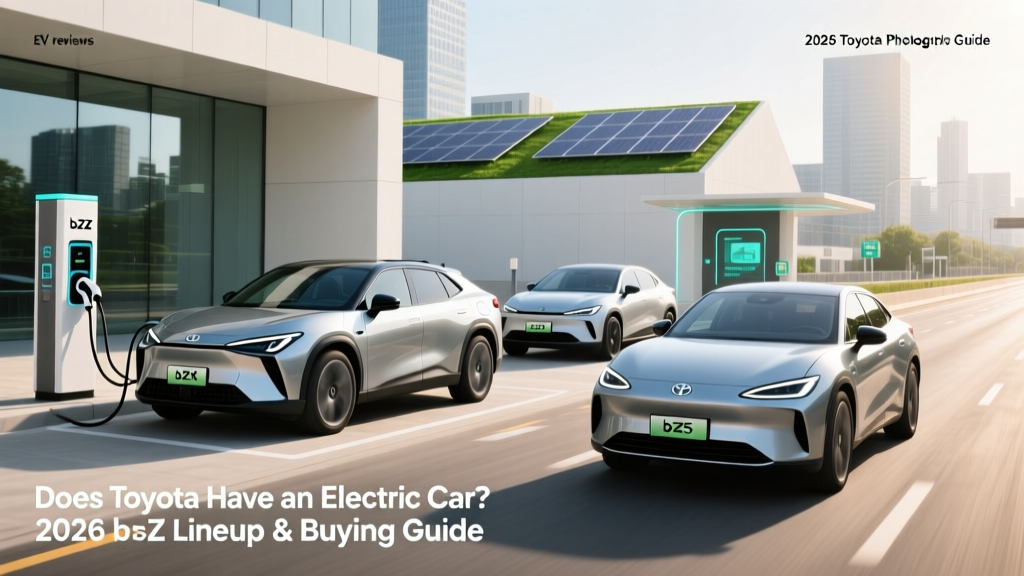
Yes. As of the 2026 model year, Toyota sells two fully electric vehicles (BEVs) in the United States: the bZ4X compact crossover and the newly launched bZ Woodland midsize SUV. The bZ4X offers up to an EPA-estimated 252 miles of range and starts at $38,465, while the bZ Woodland delivers up to 286 miles and starts at $42,895. Both qualify for varying levels of the federal §30D tax credit depending on battery sourcing and buyer income. Toyota also sells a wide lineup of hybrids (HEVs) and plug-in hybrids (PHEVs) — which we'll compare below.
The 2026 Toyota bZ4X: Specs, Range, and Real-World Expectations
The bZ4X is Toyota's volume electric offering and the most accessible entry point into the brand's EV lineup. Built on the e-TNGA platform, it competes directly with the Hyundai Ioniq 5, Volkswagen ID.4, and Tesla Model Y. Here's what the numbers look like for the 2026 model year:
| Specification | bZ4X XLE (FWD) | bZ4X Limited (AWD) |
|---|---|---|
| EPA Range | 252 miles | 228 miles |
| Battery Capacity (usable) | 71.4 kWh (NMC) | 71.4 kWh (NMC) |
| Horsepower | 201 hp | 214 hp |
| 0–60 mph | 7.1 seconds | 6.5 seconds |
| Peak DC Fast Charge Rate | 150 kW | 150 kW |
| 10–80% DC Fast Charge Time | ~30 minutes | ~30 minutes |
| Level 2 Charge Rate | 7.2 kW (~23 mi/hr) | 7.2 kW (~23 mi/hr) |
| Combined MPGe | 131 MPGe | 113 MPGe |
| Starting MSRP | $38,465 | $43,015 |
| Battery/Powertrain Warranty | 8 years / 100,000 miles | |
Real-World Range Reality Check
The EPA-estimated 252 miles for the FWD XLE trim is achievable in mixed city/suburban driving at moderate temperatures. However, expect approximately 210–225 miles on sustained highway trips at 70+ mph, and 175–200 miles in sub-freezing winter conditions without preconditioning. The AWD Limited trim's lower EPA rating (228 miles) reflects its heavier curb weight and dual-motor consumption. If your commute involves regular 200+ mile highway stretches in cold climates, plan charging stops accordingly.
The 2026 Toyota bZ Woodland: The Rugged Electric SUV
New for 2026, the bZ Woodland is a larger, more capable electric SUV aimed at buyers who find the bZ4X too compact. It rides on an updated e-TNGA platform with a larger battery pack and standard AWD.
| Specification | bZ Woodland |
|---|---|
| EPA Range | 286 miles |
| Battery Capacity (usable) | 84.0 kWh (NMC) |
| Horsepower | 338 hp (AWD) |
| 0–60 mph | 5.4 seconds |
| Peak DC Fast Charge Rate | 175 kW |
| 10–80% DC Fast Charge Time | ~27 minutes |
| Level 2 Charge Rate | 11.5 kW (~37 mi/hr) |
| Towing Capacity | 3,500 lbs |
| Starting MSRP | $42,895 |
| Battery/Powertrain Warranty | 8 years / 100,000 miles |
The Woodland's 175 kW peak charge rate is an improvement over the bZ4X, but it still trails the Hyundai Ioniq 5's 240 kW capability and the Tesla Model Y's ~250 kW on V3/V4 Superchargers. The charge curve tapers noticeably above 80% State of Charge (SoC), so plan to unplug at 80% on road trips to avoid spending 15+ extra minutes squeezing in the last 20%.
Toyota EV vs. Toyota Hybrid: Which Actually Saves You More?
Toyota built its reputation on hybrids — the RAV4 Hybrid, Camry Hybrid, and Prius are segment leaders. For many buyers asking "does Toyota have an electric car?" the more relevant question may be whether an EV or a hybrid makes more financial sense. Let's compare the bZ4X against the RAV4 Hybrid over five years and 75,000 miles.
| Cost Factor | bZ4X XLE (BEV) | RAV4 Hybrid XLE |
|---|---|---|
| Base MSRP | $38,465 | $33,975 |
| Estimated Federal Tax Credit (§30D) | Up to $7,500* | $0 (HEV ineligible) |
| Effective Purchase Price (after credit) | ~$30,965* | $33,975 |
| Fuel/Energy Cost (75k mi) | ~$3,375 (home charging at $0.14/kWh) | ~$7,500 (40 MPG at $3.20/gal) |
| Maintenance (75k mi) | ~$900 (no oil, fewer brakes) | ~$2,800 (oil, filters, brake pads) |
| Estimated Insurance (5 yr avg) | ~$9,200 | ~$7,800 |
| 5-Year Total Cost of Ownership | ~$44,440 | ~$52,075 |
*Federal §30D tax credit eligibility depends on buyer income caps (AGI ≤ $150K single / $300K joint), vehicle MSRP caps ($55K for SUVs), battery critical-mineral and component sourcing requirements, and point-of-sale transfer elections. Credit amounts vary; verify current rules at irs.gov. Consult a tax professional before relying on credit estimates.
The bZ4X wins on operating costs, but the RAV4 Hybrid has no charging-infrastructure dependency. If you lack access to reliable home or workplace Level 2 charging, the hybrid's advantage grows substantially. Public DC fast charging at $0.35–$0.50/kWh can push the bZ4X's per-mile energy cost close to or even above the RAV4 Hybrid's fuel cost.
Charging at Home vs. Public Networks: What Toyota EV Buyers Need
Home charging is the backbone of practical EV ownership. Both the bZ4X and bZ Woodland use the NACS (North American Charging Standard) connector as of the 2026 model year, giving them native access to Tesla Supercharger stations — a significant advantage over the CCS1 connector used on the original 2023–2024 bZ4X models.
| Charging Level | Power (kW) | Miles Added per Hour | Typical Use Case |
|---|---|---|---|
| Level 1 (120V household) | 1.2–1.4 kW | ~3–5 miles | Overnight trickle; emergency only |
| Level 2 (240V home/work) | 7.2–11.5 kW | 23–37 miles | Daily home charging; full overnight refill |
| DC Fast Charge (public) | 150–175 kW peak | ~200+ mi in 30 min (to 80%) | Road trips; quick top-ups |
Home Level 2 installation for a 240V/48A circuit typically costs $800–$2,200 including the charger ($400–$700), electrician labor ($300–$1,200), and permits ($50–$300). If your home's electrical panel needs an upgrade to 200A service, add $1,500–$3,500. Always get a quote from a licensed electrician before purchasing equipment.
On public networks, Toyota bZ owners can access Tesla Superchargers (via the native NACS port), Electrify America, EVgo, and ChargePoint. Expect to pay $0.30–$0.50/kWh at DC fast chargers depending on your region and network membership. A full 10–80% charge on a bZ4X at a public station costs roughly $12–$18.
Federal Tax Credits and Incentives: What You Actually Qualify For
The federal §30D Clean Vehicle Credit can reduce your effective purchase price by up to $7,500, but eligibility is layered with requirements that trip up many buyers:
- Income caps: Modified AGI ≤ $150,000 (single) or $300,000 (married filing jointly)
- MSRP caps: ≤ $55,000 for SUVs (both bZ4X and bZ Woodland qualify)
- Battery sourcing: A percentage of critical minerals and battery components must be sourced from the US or free-trade-agreement partners — this threshold increases annually and affects the credit split ($3,750 for minerals + $3,750 for components)
- Point-of-sale transfer: You can elect to transfer the credit to the dealer at purchase, reducing your out-of-pocket cost immediately rather than waiting for tax filing
- Final assembly: Vehicle must undergo final assembly in North America (verify VIN at fueleconomy.gov)
Because battery sourcing requirements tighten each year, the exact credit amount available for a specific Toyota bZ can change. Always confirm eligibility for your specific VIN and tax year before signing a purchase agreement.
Common Misconceptions About Toyota EVs
| Myth | Fact |
|---|---|
| "Toyota doesn't make electric cars." | Toyota sells the bZ4X (since 2023) and bZ Woodland (new for 2026), with more bZ models announced through 2028. |
| "The bZ4X battery will need replacing in a few years." | Toyota warranties the battery for 8 years/100,000 miles against defects and capacity loss below 70%. NMC batteries in liquid-cooled packs typically retain 85–90% capacity after 100,000 miles based on industry degradation data. |
| "EVs are more expensive to own than gas cars." | When the federal credit applies and home charging is available, a bZ4X's 5-year TCO can be $5,000–$8,000 lower than an equivalent gas-only RAV4. However, without home charging or in states with high electricity rates, the advantage narrows or reverses. |
| "You can't take a Toyota EV on a road trip." | With NACS access to the Supercharger network, bZ owners can DC fast charge every ~200 miles on most interstate corridors. A 300-mile trip requires one 25–30 minute stop — comparable to a gas-car bathroom break. |
| "Toyota hybrids are basically the same as EVs." | HEVs like the RAV4 Hybrid cannot plug in and run exclusively on gasoline (the battery is charged by the engine and regen braking). PHEVs like the RAV4 Prime offer 42 miles of electric-only range but still require gas for longer trips. Only BEVs like the bZ4X operate entirely without gasoline. |
Decision Framework: Should You Buy a Toyota EV, Hybrid, or PHEV?
Choose the Toyota bZ4X or bZ Woodland (BEV) if:
- You have reliable Level 2 home or workplace charging
- Your daily driving is under 150 miles round-trip
- You qualify for the federal §30D tax credit (income and sourcing requirements met)
- You want the lowest per-mile operating cost and minimal maintenance
- You're comfortable planning DC fast-charge stops on road trips
Choose the Toyota RAV4 Prime (PHEV) if:
- You want 42 miles of electric-only range for commuting but gas flexibility for longer trips
- You have Level 2 charging at home but frequently drive 300+ miles without stopping
- You live in a region with sparse DC fast-charging infrastructure
- You want to reduce fuel consumption without full BEV commitment
Choose the Toyota RAV4 Hybrid (HEV) if:
- You have no access to home or workplace charging
- You live in an apartment or street-park your vehicle
- You regularly tow, haul, or drive in extreme cold where EV range loss is a concern
- You want the lowest upfront purchase price with no charging behavior change
Frequently Asked Questions
Does Toyota have a fully electric SUV?
Yes. The 2026 Toyota bZ4X is a compact electric crossover SUV with up to 252 miles of EPA range, and the 2026 bZ Woodland is a midsize electric SUV with up to 286 miles of range. Both seat five and offer AWD configurations.
Can I charge a Toyota EV at a Tesla Supercharger?
Yes — the 2026 bZ4X and bZ Woodland both use the NACS connector natively, which is the same plug used by Tesla Superchargers. No adapter is required. This gives Toyota EV owners access to over 25,000 Supercharger stalls across North America.
How long does the Toyota bZ4X battery last?
Toyota warranties the bZ4X's NMC battery pack for 8 years or 100,000 miles against defects and capacity degradation below 70%. Industry data from similar liquid-cooled NMC packs suggests most will retain 85–92% of original capacity at 100,000 miles under normal use. Full battery replacement (if ever needed outside warranty) currently costs approximately $8,000–$12,000 depending on the pack.
Is the Toyota bZ4X eligible for the $7,500 federal tax credit?
The bZ4X and bZ Woodland both fall under the $55,000 MSRP cap for SUVs. However, the full $7,500 credit depends on meeting both the critical-minerals requirement ($3,750 portion) and the battery-components requirement ($3,750 portion), which change annually. Your personal eligibility also depends on income caps. Verify your specific VIN's credit status at fueleconomy.gov and consult the IRS clean vehicle credits page.
How does the bZ4X compare to the Hyundai Ioniq 5 or Tesla Model Y?
The bZ4X trails both competitors in DC fast-charge speed (150 kW vs. 240 kW for the Ioniq 5 and ~250 kW for the Model Y) and interior cargo space. Its EPA range is competitive, but its real-world highway efficiency is slightly lower. Where the bZ4X wins is in Toyota's dealer network, brand trust among conservative buyers, and the addition of NACS for Supercharger access starting in 2026. If charge speed on road trips is a top priority, the Ioniq 5 or Model Y still hold an edge. According to IIHS ratings, all three vehicles earn top safety marks in their respective test cycles.
What should a first-time EV buyer know before purchasing a Toyota bZ?
First, confirm you can install a Level 2 (240V) home charger — this is the single biggest factor in EV satisfaction. Second, understand that EPA range is a best-case mixed-driving estimate; plan for 15–25% less on highways and 25–35% less in freezing weather. Third, learn to precondition your battery before DC fast charging (the bZ's navigation system does this automatically when a charger is set as your destination). Finally, check your homeowner's insurance quote before buying — EV insurance premiums run 10–20% higher than comparable gas vehicles due to battery replacement costs in collision claims.