The Quick Answer: Who Should Buy a Suburban EV?
A suburban EV makes strong financial and practical sense if you meet three criteria: (1) you can install a Level 2 home charger, (2) your daily round-trip commute plus errands stays under 80 miles, and (3) your household has access to a second vehicle or a reliable public fast-charging corridor for road trips. Under those conditions, a suburban EV driver in 2026 typically saves $1,200–$2,100 per year in fuel and maintenance compared to a comparable gas crossover, with a break-even on the higher upfront purchase price in 3–5 years depending on local electricity rates and whether you qualify for the federal §30D tax credit (up to $7,500, subject to income, MSRP caps, and battery-sourcing rules). If you lack home charging access or regularly drive 100+ miles daily in extreme cold, a plug-in hybrid (PHEV) may serve you better.
Why Suburban Driving Is Actually the EV Sweet Spot
Suburban driving patterns — moderate-speed commutes, school runs, grocery trips, and stop-and-go traffic — align almost perfectly with where electric vehicles are most efficient. Unlike sustained 75 mph highway driving (where aerodynamic drag slashes range by 15–25%) or dense urban cores (where range is excellent but charging access can be limited by apartment living), suburbs offer a blend of moderate efficiency demands and high home-charging feasibility.
The EPA rates most mainstream 2026 electric crossovers between 2.5 and 3.5 miles per kWh in combined driving. In suburban conditions — think 30–50 mph surface roads with regenerative braking recapturing energy at every stoplight — you'll often beat the combined EPA figure. A Hyundai Ioniq 5 (84 kWh usable battery, NMC chemistry) rated at 310 miles EPA can realistically deliver 280–300 miles in mixed suburban driving in mild weather, dropping to roughly 230–260 miles in freezing temperatures due to cabin heating demands and reduced battery chemical efficiency.
For the typical suburban driver covering 35–45 miles per day (U.S. average is ~37 miles according to FHWA data), even a conservative real-world range of 230 miles means charging only twice per week on a Level 2 home charger — a routine that quickly becomes invisible.
The Real Costs: Suburban EV vs. Gas Crossover
The purchase price of an EV remains higher than a comparable gas vehicle, but the total cost of ownership (TCO) story shifts dramatically once you factor in fuel, maintenance, and available incentives. Below is a 5-year TCO comparison for a typical suburban household driving 14,000 miles per year.
| Category | 2026 EV Crossover (e.g., Ioniq 5 SEL) | 2026 Gas Crossover (e.g., Toyota RAV4 XLE) |
|---|---|---|
| Base MSRP | $45,500 | $33,500 |
| Federal Tax Credit (§30D, if eligible) | –$3,750 to –$7,500* | $0 |
| Home Level 2 Charger Install | $800–$2,000 | $0 |
| 5-Year Fuel/Energy Cost** | $3,150–$4,900 | $9,800–$11,200 |
| 5-Year Maintenance | $1,200–$1,800 | $3,500–$4,500 |
| 5-Year Insurance (avg.) | $9,500–$11,500 | $7,500–$9,000 |
| Estimated 5-Year Depreciation | $18,000–$22,000 | $14,000–$17,000 |
| Net 5-Year Cost | $52,000–$62,000 | $55,000–$65,000 |
* §30D credit eligibility depends on buyer AGI (≤$150k single / ≤$300k joint), vehicle MSRP caps ($80k SUVs / $55k sedans), and critical-mineral/battery-component sourcing requirements. Verify at IRS.gov.
** EV energy cost assumes $0.14–$0.18/kWh residential rate; gas assumes $3.30–$3.80/gal at 28 MPG combined. Source: fueleconomy.gov.
The takeaway: the EV typically breaks even or wins on 5-year TCO when you qualify for at least a partial tax credit and charge primarily at home. Insurance and depreciation remain the EV's weak points — EV premiums run 15–25% higher on average, and resale values have softened as new-model pricing has dropped.
Home Charging: The Make-or-Break Factor
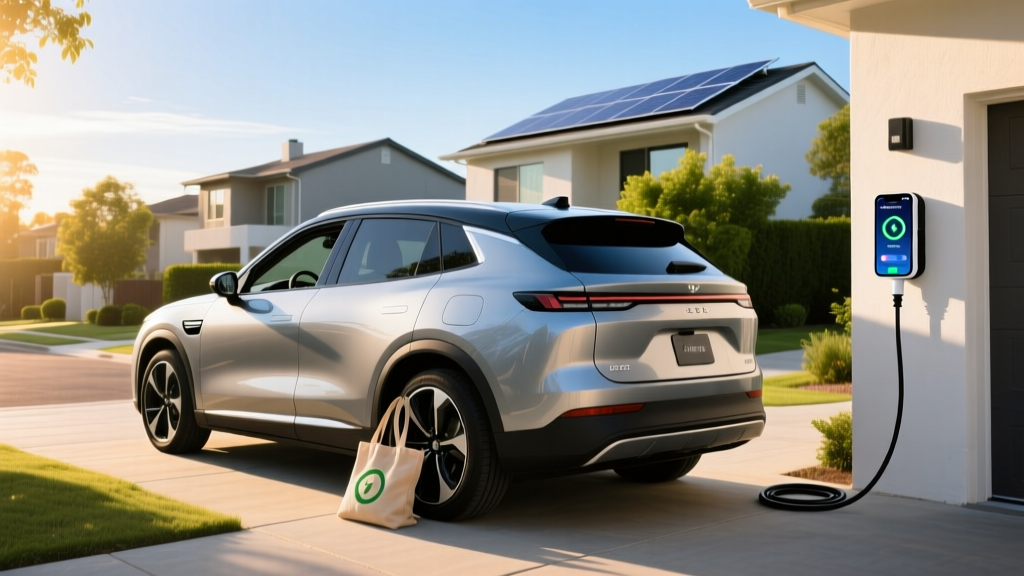
For suburban EV ownership, home charging isn't optional — it's the foundation. Roughly 80–85% of all EV charging happens at home, and suburban homeowners have a structural advantage: dedicated parking (garage or driveway) and electrical panels that can usually support a Level 2 circuit.
| Charging Level | Power (kW) | Miles Added per Hour | Time for 20→80% (84 kWh Battery) | Typical Suburban Use Case |
|---|---|---|---|---|
| Level 1 (120V outlet) | 1.2–1.9 kW | 3–5 mi/hr | ~45+ hours | Emergency/overnight top-off only |
| Level 2 (240V, 32A) | 7.7 kW | 25–30 mi/hr | ~7 hours | Standard daily charging — covers most needs |
| Level 2 (240V, 48A) | 11.5 kW | 37–44 mi/hr | ~5 hours | Faster overnight; good for larger batteries |
| DC Fast Charge (public) | 150–350 kW | N/A | 18–28 min (10–80%) | Road trips; not for daily use |
Installation cost reality: A 240V/48A Level 2 circuit (NEMA 14-50 outlet or hardwired EVSE like the ChargePoint Home Flex or Emporia Level 2) typically costs $800–$1,500 if your electrical panel has spare capacity and the run from panel to garage is under 50 feet. If you need a panel upgrade from 100A to 200A service — more common in older suburban homes — add $1,500–$3,000. Always get a licensed electrician to assess your panel before purchasing equipment.
A critical concept new EV buyers should understand: kW (kilowatts) measures power — the rate of charging — while kWh (kilowatt-hours) measures energy, or battery capacity. Think of kW as the width of a hose and kWh as the size of the bucket. An 84 kWh battery charged at 7.7 kW takes roughly 11 hours from empty; at 11.5 kW, about 7.3 hours.
Range Anxiety vs. Range Reality for Suburban Commuters
Range anxiety is the most cited barrier to EV adoption, but for suburban drivers with home charging, it's largely a psychological hurdle rather than a practical one. Here's the math that matters:
| Myth | Fact (with Numbers) |
|---|---|
| "I'll run out of charge on my commute." | A 35–45 mile daily round trip uses 12–18 kWh from an 84 kWh battery — roughly 15–21% of capacity. You'll plug in each evening with 75%+ remaining. |
| "EVs can't handle cold weather." | Cold reduces range 15–30% (data from IIHS/AAA testing). A 310-mile EPA vehicle drops to ~230 miles at 20°F. Still 5× a typical suburban daily drive. |
| "Charging takes too long." | Home Level 2 charging happens while you sleep — 7–8 hours adds 200+ miles. You start every morning "full." Public DC fast charging is only needed for road trips. |
| "The battery will need expensive replacement." | 2026 EV batteries carry 8-year/100,000-mile warranties (mandated minimum; many offer 10-year). NMC degradation averages 10–15% over 8 years. LFP chemistry degrades even less. Full replacement: $8,000–$15,000 if out of warranty, but rarely needed. |
| "EVs cost more to insure." | True: premiums run 15–25% higher on average due to repair costs. Shop quotes before buying — the gap varies widely by insurer and model. |
Suburban EV vs. PHEV vs. Gas: A Decision Framework
Not every suburban household is best served by a full battery-electric vehicle. Here's a practical decision framework based on real ownership variables:
Choose a Suburban BEV (Full EV) If:
- You can install a Level 2 charger at home (garage or driveway with 240V access)
- Your daily driving stays under 80 miles round-trip
- You qualify for at least a partial §30D tax credit (check income and MSRP limits at IRS.gov)
- Your household has a second vehicle or you're comfortable planning road-trip charging stops
- You live in a region with moderate winters or have access to preconditioning and garage parking
Choose a PHEV (Plug-in Hybrid) If:
- You can charge at home but regularly drive 80–150+ miles daily
- You take frequent long road trips and don't want to plan around DC fast chargers
- You live in an area with extreme cold (below 0°F) where EV range loss is severe
- You want electric-only commuting (25–45 miles) with gas-engine backup — models like the Toyota RAV4 Prime (42 miles electric, 94 MPGe) bridge both worlds
Stick With Gas (or HEV Hybrid) If:
- You cannot install any home charging (street parking, HOA restrictions, rental)
- Your daily driving exceeds 120 miles and public charging infrastructure in your area is sparse
- You tow heavy loads regularly (trailers over 3,000 lbs drastically cut EV range)
- Your budget is strictly under $30,000 and you need a new vehicle today
What a First-Time Suburban EV Buyer Should Actually Do
If you're seriously considering the switch, here's a concrete action checklist based on thousands of ownership transitions we've tracked:
- Get an electrician quote before you shop. Know your panel capacity and Level 2 install cost first. A $2,500 panel upgrade surprise can sour the experience.
- Track your actual daily mileage for two weeks. Most suburban drivers overestimate — the real number is usually 30–50 miles. This tells you the minimum battery size you need.
- Check your utility's EV rate plan. Many suburban utilities (PG&E, ConEd, Xcel, Dominion) offer time-of-use plans with off-peak rates of $0.08–$0.12/kWh overnight — that's roughly $7–$10 for a full charge on an 84 kWh battery.
- Verify §30D eligibility for your specific vehicle VIN. Battery-sourcing requirements tighten annually. A model that qualified in 2024 may not in 2026. Use the IRS lookup and confirm with your dealer.
- Get three insurance quotes before signing. EV insurance varies wildly — some insurers have caught up, others still penalize. GEICO, Progressive, and State Farm all price EVs differently.
- Test the charge curve, not just peak kW. A vehicle advertising "350 kW peak" may only sustain that rate from 10–30% SoC before tapering to 150 kW. The 10–80% time (typically 18–28 minutes for mainstream 2026 crossovers) is the number that matters on road trips.
Frequently Asked Questions
Do I need a 200-amp electrical panel for a home EV charger?
Not always. A 240V/32A Level 2 circuit draws about 7.7 kW — roughly the same as an electric dryer. Many 100-amp panels can support this if you have few other large electric loads (electric range, heat pump, etc.). A 48A circuit draws 11.5 kW and is more likely to require a panel upgrade. Have an electrician perform a load calculation before committing.
How much does it cost to charge a suburban EV at home per month?
For a driver covering 1,200 miles per month in a vehicle averaging 3.0 mi/kWh, you'll consume about 400 kWh monthly. At the national average residential rate of ~$0.16/kWh, that's $64/month — compared to $145–$165/month for a 28 MPG gas crossover at $3.50/gallon. With an off-peak utility rate of $0.10/kWh, the EV cost drops to $40/month.
What happens to EV range in suburban winter driving?
Expect a 15–30% reduction at freezing temperatures (32°F and below). The primary culprits are cabin heating (resistive heaters draw 2–5 kW continuously) and reduced battery chemical efficiency. Vehicles with a heat pump (standard on many 2026 Hyundai, Kia, and Tesla models) reduce heating energy draw by 30–50%, limiting cold-weather range loss to closer to 15–20%. Preconditioning the battery and cabin while still plugged in at home also recovers significant range.
Is a suburban EV practical for families with kids and activities?
Yes — and often more practical than a gas vehicle for this use case. The instant torque makes merging onto highways with a full cabin effortless, the low center of gravity improves handling, and the "frunk" (front trunk) adds cargo space for groceries or sports gear. The silent powertrain also makes for a calmer cabin on school drop-offs. Models like the Kia EV9 (3-row, 300+ mile EPA range, starting ~$56,000) address the family-SUV segment directly.
Should I buy an EV with an LFP or NMC battery for suburban use?
For suburban drivers who charge at home nightly, LFP (lithium iron phosphate) batteries are an excellent choice — they tolerate daily 100% charging without accelerated degradation, have longer cycle life (3,000+ cycles vs. ~1,500 for NMC), and cost less. The trade-off is lower energy density (heavier for the same range) and poorer cold-weather performance. NMC (nickel manganese cobalt) batteries offer more range per pound and better cold-weather output, making them preferable if you need maximum range or live in northern climates. For a suburban commuter charging at home, LFP's longevity advantage usually outweighs NMC's density advantage.