The Short Answer: Yes, You Pay — But Usually Less Than Gas
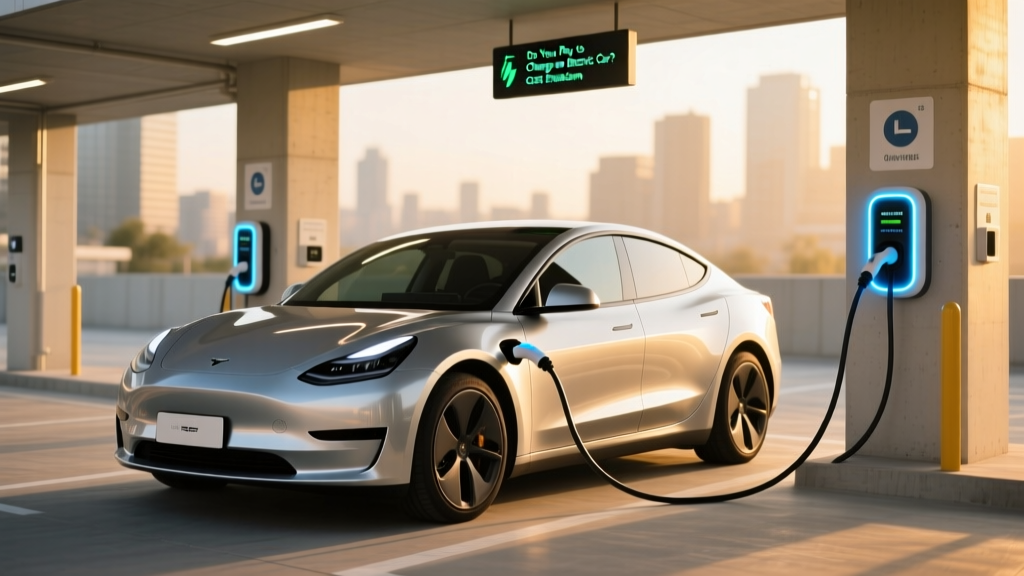
Do you pay to charge an electric car? Yes. Electricity isn't free, and unless your workplace, apartment building, or a promotional network covers it, every kilowatt-hour (kWh) you add to your battery costs money. The difference is how much and where you pay.
- Home charging (Level 2): Roughly $0.12–$0.28 per kWh depending on your utility — about $3.50–$8.50 to fully recharge a 30 kWh daily commute.
- Public DC fast charging: Typically $0.30–$0.60+ per kWh at networks like Electrify America, EVgo, and Tesla Superchargers — closer to gas-car fueling costs.
- "Free" charging: Still exists at some workplaces, hotels, and older ChargePoint or Tesla destination locations, but it's shrinking as networks monetize.
For most owners who charge at home overnight, fueling an EV costs 40–65% less per mile than fueling a comparable gas car in 2026. Public-only charging flips that math.
Where You Charge Determines What You Pay
Charging an EV is not like filling a gas tank at a single price-per-gallon. The rate you pay swings dramatically based on location, time of day, and the power level (kW) of the charger. Here is the real hierarchy of cost, from cheapest to most expensive, based on current 2026 rates.
| Charging Location | Power Level | Typical $/kWh | Cost for 300 Miles* | Notes |
|---|---|---|---|---|
| Home (off-peak utility rate) | Level 2, 7–11 kW | $0.10–$0.16 | $9–$14 | Time-of-use plans reward overnight charging |
| Home (standard residential rate) | Level 2, 7–11 kW | $0.16–$0.28 | $14–$25 | Varies widely by state; CA/HI highest |
| Workplace / free destination | Level 2 | $0.00 | $0 | Shrinking perk; often capped at 2–4 hours |
| Tesla Supercharger (member rate) | DC, 150–250 kW | $0.25–$0.35 | $22–$31 | For Tesla and NACS-equipped non-Teslas |
| Electrify America / EVgo | DC, 150–350 kW | $0.35–$0.58 | $31–$52 | Subscription plans reduce per-kWh rate |
| Public Level 2 (paid) | Level 2, 6–19 kW | $0.25–$0.49 | $22–$44 | Common in urban garages; often hourly + kWh |
*Based on a vehicle averaging 3.0 miles/kWh (e.g., 2026 Hyundai Ioniq 5, Tesla Model Y). Your efficiency varies with speed, temperature, and terrain.
The gap between the cheapest and most expensive option is roughly 5x. That's why the single biggest predictor of EV ownership satisfaction isn't the car — it's whether you can charge at home.
EV vs. Gas: The Per-Mile Cost Reality
To make the comparison concrete, let's stack a popular 2026 EV against its closest gas counterpart using EPA efficiency data from fueleconomy.gov and a national gas price of $3.45/gallon (early 2026 average).
| Vehicle | Powertrain | Efficiency | Home Charging @ $0.16/kWh | Public DC @ $0.48/kWh | Gas @ $3.45/gal |
|---|---|---|---|---|---|
| Tesla Model Y Long Range AWD | BEV (75 kWh usable, NMC) | 3.6 mi/kWh (122 MPGe) | $533 | $1,600 | N/A |
| Toyota RAV4 AWD | Gas (ICE) | 30 MPG combined | N/A | N/A | $1,380 |
| Hyundai Ioniq 5 SE Std Range | BEV (58 kWh usable, NMC) | 3.5 mi/kWh (114 MPGe) | $549 | $1,646 | N/A |
| Honda CR-V AWD | Gas (ICE) | 29 MPG combined | N/A | N/A | $1,428 |
| Toyota RAV4 Prime (PHEV) | PHEV (18.1 kWh, 42 mi EV range) | 94 MPGe / 38 MPG gas | $360 (EV portion) | $1,080 (EV portion) | $740 (gas portion) |
Two takeaways jump out:
- Home-charged EVs save $800–$900/year vs. gas equivalents. Over a 5-year ownership cycle, that's $4,000–$4,500 in fuel savings alone.
- Public-only DC charging erases the advantage. At $0.48/kWh, the Model Y costs more to "fuel" than the RAV4. This is why apartment dwellers without charging access should seriously consider a PHEV like the RAV4 Prime instead of a full BEV.
The Full Ownership Cost Picture
Fueling is only one line item. A real buy/no-buy decision needs the full 5-year cost of ownership (TCO). Below is a realistic breakdown for a 2026 Tesla Model Y Long Range ($47,990 MSRP before incentives) versus the 2026 Toyota RAV4 XLE AWD ($33,425 MSRP), assuming 12,000 miles/year, home charging at $0.16/kWh, and the federal EV tax credit.
| Cost Category | 2026 Tesla Model Y LR | 2026 Toyota RAV4 XLE AWD |
|---|---|---|
| Purchase price (MSRP) | $47,990 | $33,425 |
| Federal §30D tax credit (if eligible) | –$7,500 | $0 |
| Home Level 2 charger install | $1,200 (avg) | $0 |
| Net acquisition cost | $41,690 | $33,425 |
| 5-year fuel/energy cost | $2,665 | $6,900 |
| 5-year maintenance | $1,200 (tires, cabin filter, fluid top-offs) | $3,800 (oil, brakes, filters, fluids) |
| 5-year insurance (national avg) | $10,500 | $7,800 |
| Estimated 5-year depreciation | $22,000 | $15,500 |
| 5-Year Total Cost | $78,055 | $67,425 |
| Cost per mile | $1.30 | $1.12 |
The EV saves roughly $8,000 in fuel and maintenance but gives back ~$6,000 in higher depreciation and $2,700 in higher insurance premiums. The net result: the Model Y costs about $0.18/mile more than the RAV4 over five years, even with the full tax credit.
This is the honest math that EV marketing won't show you. The EV wins on operating cost but loses on capital cost. The break-even point typically arrives around year 7–8 or at higher annual mileage (15,000+ miles/year tips the scales faster).
Tax Credits, Incentives, and What They Actually Cover
The IRS §30D clean vehicle credit can reduce your federal tax bill by up to $7,500 for a new EV — and since 2024, it can be transferred to the dealer as a point-of-sale discount. But eligibility is narrow and changes frequently. Here's the 2026 checklist:
- MSRP cap: SUVs, pickups, and vans must be ≤$80,000; sedans and other body styles ≤$55,000.
- Buyer income cap: Modified AGI ≤$150,000 (single), $225,000 (head of household), $300,000 (joint).
- Battery sourcing: Critical minerals and battery components must meet escalating domestic/free-trade sourcing percentages — this disqualifies several models annually.
- Final assembly: Vehicle must be assembled in North America (VIN checkable at fueleconomy.gov).
- One credit per VIN, one per taxpayer per year.
Always verify eligibility on the IRS site and the DOE's qualified vehicle list before signing a purchase agreement — the list updates monthly as battery supply chains shift.
Common Misconceptions About EV Charging Costs
| Myth | Fact (with data) |
|---|---|
| "Charging is free because electricity is cheap." | Average US residential electricity is $0.17/kWh (EIA, 2026). A 75 kWh battery recharge costs ~$12.75 at home — cheap, but not free. |
| "Public charging is just as cheap as home." | DC fast chargers average 2–3x residential rates. A 10–80% session at $0.48/kWh on a Model Y costs ~$25, vs. ~$8 at home. |
| "EVs are always cheaper to fuel than gas cars." | True at home rates below ~$0.25/kWh. At $0.50+/kWh public rates, a 3.5 mi/kWh EV matches or exceeds a 30 MPG gas car per mile. |
| "I'll save $10,000 on fuel in 5 years." | Realistic home-charging savings are $4,000–$5,000 over 5 years at 12,000 miles/year. Higher mileage or expensive gas states (CA, HI) push it to $7,000+. |
| "Free charging at work means zero fuel cost." | Workplace charging is a perk, not a right. Companies are adding session limits, time caps, and per-kWh fees as EV adoption grows. |
Real-World Variables That Change Your Charging Bill
The tables above assume idealized conditions. In practice, four factors move your real cost significantly:
1. Climate and cold-weather range loss. Lithium-ion batteries lose 20–35% of their EPA-rated range at 20°F, based on testing by Recurrent and AAA. That means a 310-mile EPA Model Y may deliver ~220 miles in a Minnesota winter. You'll charge more often, spending more per month in January than July.
2. Highway efficiency vs. EPA combined. EPA range blends city and highway driving. At sustained 75 mph, expect 10–15% lower efficiency than the sticker. Regenerative braking recovers energy in stop-and-go traffic, making city driving the EV's sweet spot.
3. Charging-curve taper above 80%. DC fast chargers don't deliver peak kW the entire session. A charger rated at 250 kW peak may sustain that rate only from 10–50% SoC, then taper to 50–80 kW above 80%. Charging from 10–80% on a 250 kW unit typically takes 18–25 minutes; 10–100% can take 40+ minutes. Plan road trips to 80%, not 100%.
4. Time-of-use (TOU) utility rates. Many utilities offer EV-specific plans with off-peak rates as low as $0.06–$0.10/kWh between 11 PM and 6 AM. If your utility offers this and you can schedule charging overnight, your per-mile cost drops below $0.03 — roughly one-third of the national average gas car.
Decision Framework: Should You Buy an EV, PHEV, or Stick With Gas?
Choose a full BEV (battery electric vehicle) if:
- You can install a Level 2 charger at home (garage, driveway, or landlord-approved).
- Your daily driving is under 80 miles round-trip, with occasional road trips under 300 miles.
- You qualify for the §30D tax credit (income and MSRP caps).
- Your utility offers off-peak TOU rates below $0.15/kWh.
Choose a PHEV (plug-in hybrid) if:
- You live in an apartment or condo without reliable charging access.
- You frequently drive 200+ miles between charging opportunities.
- You want EV-like commuting (30–42 electric-only miles on models like the RAV4 Prime or Jeep Wrangler 4xe) with gas flexibility for road trips.
- You live in a cold climate where BEV range loss is a real concern.
Stick with a gas or conventional hybrid (HEV) if:
- You have zero home or workplace charging and rely entirely on public infrastructure.
- Your annual mileage is under 8,000 miles — the fuel savings won't offset the EV's higher purchase price and depreciation.
- You tow frequently (towing cuts EV range by 40–60%, making gas or diesel more practical).
- Your budget is under $30,000 and you need a new vehicle — the used EV market or a Toyota Corolla Hybrid ($24,000 MSRP, 50 MPG) may serve you better.
Frequently Asked Questions
Do you pay to charge an electric car at home?
Yes. Home charging adds to your monthly electric bill. At the US average of $0.17/kWh, driving 1,000 miles per month in a vehicle averaging 3.3 mi/kWh adds roughly $51/month. That's still about half the cost of gas for the same distance.
Is charging an EV cheaper than buying gas?
At home, almost always — typically 40–65% cheaper per mile. At public DC fast chargers priced above $0.40/kWh, the cost advantage narrows or disappears versus a 30+ MPG gas car. The break-even point is roughly $0.30/kWh for most EVs.
Are there still free EV chargers in 2026?
A few — typically at workplaces, hotels, shopping centers, and some municipal lots. But free charging is declining rapidly. Networks like Tesla Supercharger, Electrify America, and EVgo charge per kWh or per minute. Always check the charger's app (PlugShare, ChargePoint) for current pricing before driving there.
How much does a public DC fast charging session cost?
For a 10–80% session on a typical 75 kWh battery (adding ~52 kWh), expect $18–$31 depending on the network. Tesla Superchargers average $0.28–$0.35/kWh; Electrify America and EVgo run $0.38–$0.58/kWh without a subscription. Monthly plans ($4–$10/month) can reduce rates by 15–25%.
Does fast charging cost more than slow charging?
At public stations, yes — DC fast chargers (50–350 kW) charge significantly more per kWh than public Level 2 chargers (6–19 kW). At home, your rate is the same regardless of whether you charge at 3.3 kW (Level 1, 120V) or 11.5 kW (Level 2, 240V); the utility charges per kWh consumed, not per kW of power draw.
What does a first-time EV buyer need to know about charging costs?
Budget for a home Level 2 charger installation ($500–$2,200 including equipment, electrician, and permit — panel upgrade can add $1,500–$3,000). Download PlugShare and your utility's EV rate plan before purchasing. And understand that your EPA-rated range will be 10–15% lower on the highway and 20–35% lower in sub-freezing weather — plan charging stops accordingly.