Quick Answer: Are Electric Dragsters Worth It in 2026?
Electric dragsters are purpose-built, battery-electric drag racing vehicles that leverage the instant torque of electric motors to achieve elapsed times (ETs) and 60-foot splits that internal-combustion counterparts struggle to match. Entry-level bracket-racing EVs start around $45,000–$85,000 (chassis + powertrain), while competitive Top Doorslammer and Pro Mod–class builds routinely exceed $250,000–$500,000+. A production-based Tesla Model S Plaid drag-prepped build can be assembled for $110,000–$140,000 and run low 9-second quarter-miles. If you're evaluating electric dragsters for competition, club racing, or a high-performance project, expect to spend 30–50% more upfront than an equivalent gas setup, but recover costs through dramatically lower per-run energy spend (often $2–$8 per pass vs. $40–$120 for race fuel) and near-zero drivetrain maintenance.
What Are Electric Dragsters and Who Races Them?
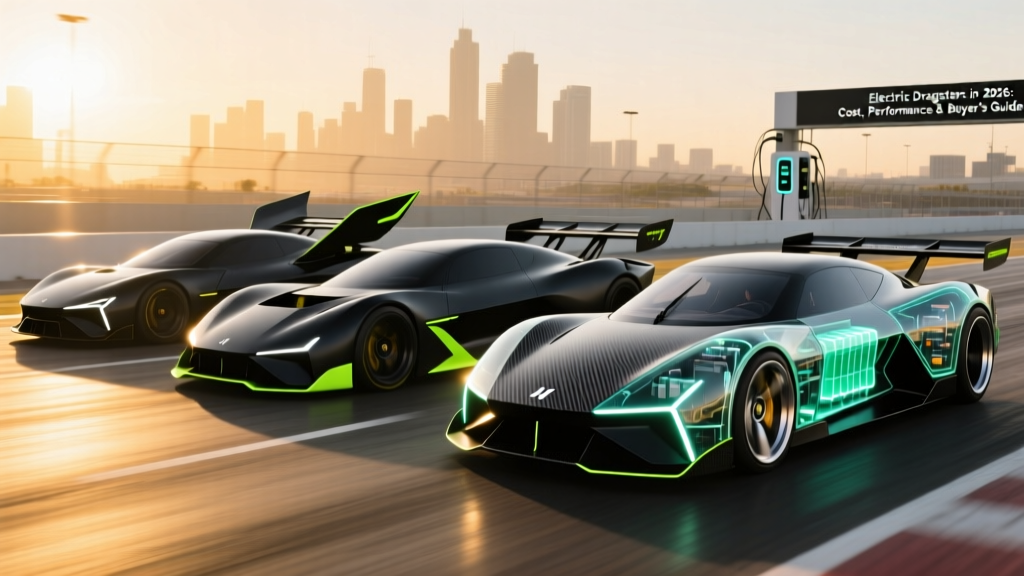
Electric dragsters span a wide spectrum — from tube-chassis rail cars running 800V battery packs to production-based sedans like the Tesla Model S Plaid and Lucid Air Sapphire modified for strip use. Unlike gasoline or nitromethane dragsters, EV dragsters use one or more electric motors (often AC induction or permanent-magnet synchronous units from Cascadia Motion, Yasa, or repurposed OEM drivetrains) paired with high-discharge lithium-ion or LFP battery banks capable of sustaining 2,000–4,000+ amps for the duration of a pass.
The NHRA officially introduced EV competition categories in recent years, and organizations like the NHRA and independent race series now offer classes where electric dragsters compete head-to-head against ICE cars. The key appeal: electric motors deliver peak torque at 0 RPM, eliminating the need for power-band management, torque converters tuned to specific RPM ranges, or multi-stage nitrous systems.
Common electric dragster categories in 2026 include:
- Street/Bracket EV: Modified production cars (Tesla, Porsche Taycan, Ford Mustang Mach-E GT) running 9–11 second quarter-miles. Budget: $80,000–$160,000 total.
- Super Street / Pro Mod EV: Tube-chassis or heavily modified body cars, 1,500–3,000 HP, 7–8 second range. Budget: $200,000–$400,000.
- Top Fuel / Rail EV (experimental): Purpose-built dragsters, 4,000–10,000+ HP, targeting sub-5-second ETs. Budget: $500,000+. Still largely developmental.
Electric Dragster vs. Gas Dragster: Performance and Cost Data
The decision between an electric dragster and a traditional gasoline or nitro-fed car comes down to your class, budget, and how many passes you plan to make per season. Below is a data-driven comparison for a mid-tier bracket-racing build:
| Metric | Electric Dragster (EV) | Gas Dragster (Carbureted V8) |
|---|---|---|
| Build cost (competitive bracket car) | $75,000–$130,000 | $55,000–$95,000 |
| Peak horsepower | 1,200–2,500 HP | 800–1,500 HP |
| Quarter-mile ET (typical) | 8.5–10.5 sec | 8.5–10.5 sec |
| 60-foot time advantage | 0.05–0.15 sec faster (instant torque) | Baseline |
| Cost per pass (energy/fuel) | $2–$8 (grid or generator charging) | $40–$120 (race fuel, 3–8 gal/pass) |
| Drivetrain maintenance per season | $500–$1,500 (coolant, contactor inspection) | $3,000–$8,000 (rebuilds, valve jobs, gaskets) |
| Turnaround time between rounds | 15–45 min (battery recharge/cooldown) | 10–20 min (refuel, cool-down) |
| Noise at the track | 80–95 dB (whine, tire noise) | 120–140 dB (requires hearing protection) |
The EV's 60-foot advantage is the single biggest performance differentiator. Because electric motors don't need to spool up or wait for converter flash, electric dragsters consistently leave the line harder — a critical edge in bracket racing and heads-up eliminations. However, gas dragsters still hold top-end speed advantages in the highest classes (Top Fuel, Funny Car) due to energy-density limitations of current battery chemistry.
Cost Breakdown: Building and Running an Electric Dragster
Understanding total cost of ownership is essential before committing to an electric dragster project. Here's a realistic 2026 breakdown for a competitive Super Street–class EV dragster:
| Category | Estimated Cost | Notes |
|---|---|---|
| Chassis (tube-frame, certified) | $25,000–$45,000 | SFI 25.1 cert required for ETs below 7.50 sec |
| Electric motor(s) + controller | $18,000–$40,000 | Cascadia Motion PM250 or dual Yasa P400R common |
| Battery pack (high-discharge NMC or LFP) | $20,000–$55,000 | 40–80 kWh usable; 4C–8C discharge rated cells |
| BMS + wiring + safety disconnects | $4,000–$8,000 | Must meet NHRA/IHRA electrical safety standards |
| Drivetrain (gearbox, axle, diff) | $5,000–$12,000 | Most EV dragsters use a 2-speed or direct-drive reduction |
| Data acquisition + telemetry | $3,000–$6,000 | Racepak, MoTeC, or Holley systems |
| Safety gear (suit, helmet, parachute) | $2,500–$5,000 | SFI-rated; required for ETs below 9.99 sec |
| Charging equipment (Level 2 + DC fast) | $3,000–$10,000 | Portable DC charger for pits; 240V Level 2 for shop |
| Total build cost | $80,500–$181,000 | Varies widely by class and component sourcing |
| Energy cost per race weekend (8–12 passes) | $30–$100 | Grid power at $0.14/kWh; ~3–6 kWh per pass |
| Season maintenance (motor bearings, coolant, contactors) | $1,500–$3,000 | No oil changes, valve jobs, or piston replacements |
| Tires (slicks, 100–200 passes per set) | $1,200–$2,400 | EV instant torque accelerates tire wear vs. gas |
| Insurance (specialty motorsport policy) | $2,500–$5,500/year | Higher premiums for EV builds due to battery risk underwriting |
Key cost insight: Over a 5-season period with 50 passes per season, an electric dragster's energy and maintenance savings can total $15,000–$30,000 compared to a gas equivalent — partially offsetting the higher initial build cost. However, battery replacement (typically needed after 800–1,500 full-discharge cycles depending on chemistry and thermal management) can cost $15,000–$40,000 and must be factored into long-term planning.
Battery Chemistry for Drag Racing: LFP vs. NMC
Battery selection is the single most consequential decision in an electric dragster build. In 2026, two chemistries dominate:
| Factor | LFP (Lithium Iron Phosphate) | NMC (Nickel Manganese Cobalt) |
|---|---|---|
| Energy density (Wh/kg) | 150–180 Wh/kg | 220–280 Wh/kg |
| Peak discharge rate | 5C–10C (sustained) | 3C–6C (sustained; higher with cooling) |
| Cycle life (to 80% capacity) | 2,000–4,000 cycles | 800–1,500 cycles |
| Weight for 60 kWh pack | ~330–400 kg | ~215–275 kg |
| Thermal runaway risk | Very low | Moderate (requires robust BMS + cooling) |
| Cost per kWh (2026) | $95–$130 | $120–$165 |
| Best for | Bracket racers prioritizing longevity, safety, cost | Pro Mod / high-HP builds where weight matters |
For most bracket and Sportsman-class electric dragsters, LFP is the 2026 default choice: it's safer in a crash scenario (NHRA safety inspectors look closely at battery containment), lasts significantly longer under repeated high-discharge cycles, and costs less per kWh. The weight penalty is manageable in a tube-chassis car where ballast placement is adjustable.
NMC remains the choice for weight-sensitive Pro Mod and Top Doorslammer builds where every kilogram counts and the battery pack sits inside a tightly packaged body. Teams running NMC invest heavily in active liquid cooling and multi-redundant battery management systems to mitigate thermal risk.
Charging Infrastructure: Pit Setup and Turnaround Times
One of the most frequently underestimated aspects of electric dragster ownership is charging logistics. Unlike a gas car that refuels in 2 minutes from a jug, an EV dragster needs a charging strategy that fits within round intervals (typically 30–60 minutes between eliminator rounds).
Realistic pit charging options in 2026:
- Portable DC fast charger (20–50 kW): $8,000–$18,000 unit, requires a 480V 3-phase power drop at the track (not all tracks offer this). Recharges a 60 kWh pack from 20% to 80% in roughly 45–75 minutes.
- Level 2 charging (7.2–19.2 kW): Uses standard 240V outlets available at most pit areas. Adds roughly 15–40 miles of range equivalent per hour — adequate for bracket racers making 2–4 passes per day but too slow for all-day heads-up racing.
- Generator-based charging: Diesel or gasoline generator (20–40 kW output) towed to the track. Adds complexity and fuel cost but ensures independence from track electrical infrastructure. Expect $0.35–$0.60/kWh effective cost.
- Swappable battery packs: Some teams run 2–3 pre-charged packs and swap between rounds. Fastest turnaround (5–10 minutes) but requires $40,000–$100,000+ in additional battery inventory and a safe storage/charging setup at the shop.
Before committing to an electric dragster, contact your local track's tech department to confirm available electrical service. Many tracks have 240V/50A outlets in the pits, but 480V 3-phase is rare outside major facilities. This directly determines whether DC fast charging in the pits is viable.
Common Misconceptions About Electric Dragsters
| Myth | Fact |
|---|---|
| "Electric dragsters can't compete with gas cars." | EVs hold 60-foot records in multiple bracket classes and compete in NHRA-sanctioned EV eliminator categories. Production-based Tesla Plaid builds run 9.2–9.8 sec quarter-miles on street tires. |
| "Battery packs explode in a crash." | Modern LFP packs with proper containment and SFI-certified battery boxes have extremely low thermal runaway risk. NHRA mandates electrical safety cutoffs and physical battery shielding for all EV competition vehicles. |
| "You need a Tesla to build an EV dragster." | While Tesla drivetrains are popular for their availability and power, many competitive builds use standalone motors from Cascadia Motion, Yasa, or EMRAX paired with custom battery packs. No OEM donor car is required for a tube-chassis build. |
| "Electric dragsters are silent and boring." | At full launch, an EV dragster produces 85–95 dB of motor whine, gear whine, and tire roar. It's different from a V8, but far from silent — and the G-forces off the line are often more violent due to instant torque delivery. |
| "Charging takes too long for racing." | With proper planning (DC fast charging or battery swaps), turnaround is 15–45 minutes — adequate for most bracket racing formats. Heads-up racers in quick-turnaround classes need to plan more carefully or carry spare packs. |
| "EV dragsters are maintenance-free." | While there are no engine rebuilds, EV dragsters require battery health monitoring, contactor replacement, coolant system service, motor bearing inspection, and high-voltage safety checks. Budget $1,500–$3,000/season. |
Decision Framework: Is an Electric Dragster Right for You?
If-Then: Choosing Your Dragster Powertrain
- Choose an electric dragster if:
- You race in bracket or Sportsman classes where 60-foot consistency wins rounds
- You make 40+ passes per season and want to minimize per-run costs
- Your track has adequate electrical infrastructure (240V+ pit power)
- You value reduced noise (some tracks are implementing noise restrictions)
- You're comfortable with high-voltage systems or have a qualified EV technician on your crew
- Budget allows $80,000+ for a competitive build
- Choose a gas dragster if:
- You compete in Top Fuel, Funny Car, or Alcohol classes where EVs aren't yet competitive or sanctioned
- Your track lacks charging infrastructure and you don't want to invest in portable DC chargers or generators
- You need 10-minute turnarounds between rounds without carrying spare battery packs
- Your total build budget is under $60,000
- You already have deep expertise with carburetion, engine tuning, and ICE drivetrain maintenance
- Consider a hybrid approach (EV swap-in) if:
- You have an existing gas chassis and want to experiment with EV power without a full new build
- You want to run both gas and EV classes across different race weekends
Real-World Ownership: What First-Time EV Dragster Buyers Should Know
Beyond the spec sheet, here are the ownership realities that separate prepared electric dragster teams from those who abandon their builds after one season:
High-voltage safety is non-negotiable. Electric dragster battery packs operate at 400V–800V DC — lethal if mishandled. Every crew member who touches the car between rounds needs HV safety training. Budget $500–$1,500 per person for a certified EV high-voltage safety course. The NHRA requires documented safety protocols for EV entries at national events.
Battery degradation is real but manageable. A drag racing battery pack sees extreme discharge rates (5C–10C) that accelerate degradation compared to street use. Expect 15–25% capacity loss over 800–1,200 passes with an NMC pack, or 10–15% loss over 2,000+ passes with LFP. Monitor cell voltage spread and internal resistance monthly using your BMS data logs. Plan for pack replacement or cell-level refurbishment every 3–5 seasons.
Cold weather reduces performance. Just like street EVs, dragster battery packs lose discharge capability when cold. If you race in spring or fall events with ambient temps below 50°F, you'll need battery preheating (most high-end BMS units include pack heating circuits) to avoid 10–20% power reduction off the line. Budget 20–30 minutes for pack preconditioning before each run in cold conditions.
Insurance is available but costs more. Specialty motorsport insurers (Hagerty Motorsport, Leland-West, K&K Insurance) now underwrite electric dragsters, but premiums run 15–30% higher than equivalent gas builds due to battery replacement cost exposure and limited actuarial data on EV racing incidents. Expect $2,500–$5,500/year for a $120,000 build.
Tech inspection scrutiny is higher. NHRA and IHRA tech inspectors give electric dragsters additional scrutiny — battery box integrity, HV cable routing, emergency disconnect accessibility, and BMS functionality are all checked. Budget extra time at your first event for tech and be prepared to show documentation on your battery system's safety certifications.
Frequently Asked Questions
How fast can an electric dragster go in the quarter-mile?
Production-based EVs like the Tesla Model S Plaid run 9.2–9.8 seconds at 140–155 mph with drag-prep modifications (tires, weight reduction, launch control tuning). Purpose-built tube-chassis electric dragsters in Pro Mod configuration run 6.5–7.5 seconds at 190–210+ mph. Experimental Top Fuel–style EV rail dragsters have targeted sub-5-second passes, though as of 2026, no EV has matched a nitromethane Top Fuel car's 3.7-second / 335 mph record.
Do I need a special license to race an electric dragster?
You need the same NHRA or IHRA competition license required for any car running your target ET. For example, any car running 9.99 seconds or quicker requires a Class 6 or better license. There is no separate "EV license," but some tracks require documented HV safety training for the driver and crew before allowing an electric car on the track.
Can I convert a gas dragster chassis to electric?
Yes, and this is a common entry point. A certified SFI chassis can be re-purposed with an electric motor, controller, and battery pack. Key challenges include fabricating battery boxes that meet SFI/NHRA containment requirements, routing high-voltage cables safely, and ensuring the car meets weight distribution targets. Budget $35,000–$70,000 for a quality conversion depending on motor and battery selection.
What's the biggest risk when buying a used electric dragster?
Battery pack health. Unlike a gas engine where a leakdown test reveals condition, a used EV dragster's battery may appear functional but have significant capacity loss or elevated internal resistance from hundreds of high-discharge cycles. Demand full BMS data logs, individual cell voltage spreads, and a capacity test before purchase. A degraded pack can cost $20,000–$50,000 to replace.
Are electric dragsters eligible for any tax credits or incentives?
No. The federal §30D Clean Vehicle Credit applies only to street-legal, on-road vehicles meeting specific MSRP, income, and battery-sourcing requirements per IRS guidelines. A purpose-built race car does not qualify. However, some states and local utilities offer rebates for Level 2 or DC fast charging equipment installed at your shop or garage — check your utility's EV infrastructure programs.