If you've ever stood in the auto parts aisle staring at a wall of wiper blades, then looked at your Tesla Cybertruck and thought, "None of these are going to fit that thing," you're not alone. The Cybertruck's angular, stainless-steel exoskeleton isn't just a styling statement — it dictates a completely unconventional wiper architecture that leaves many new owners searching for answers. In this guide, we'll break down exactly how the Cybertruck wiper blade system works, where to get replacements, and what it costs. Then we'll deliver a full profile of the truck itself: range, charging, pricing, and whether it still makes sense in 2026.
Why the Cybertruck Wiper Blade Is Unlike Any Other Truck
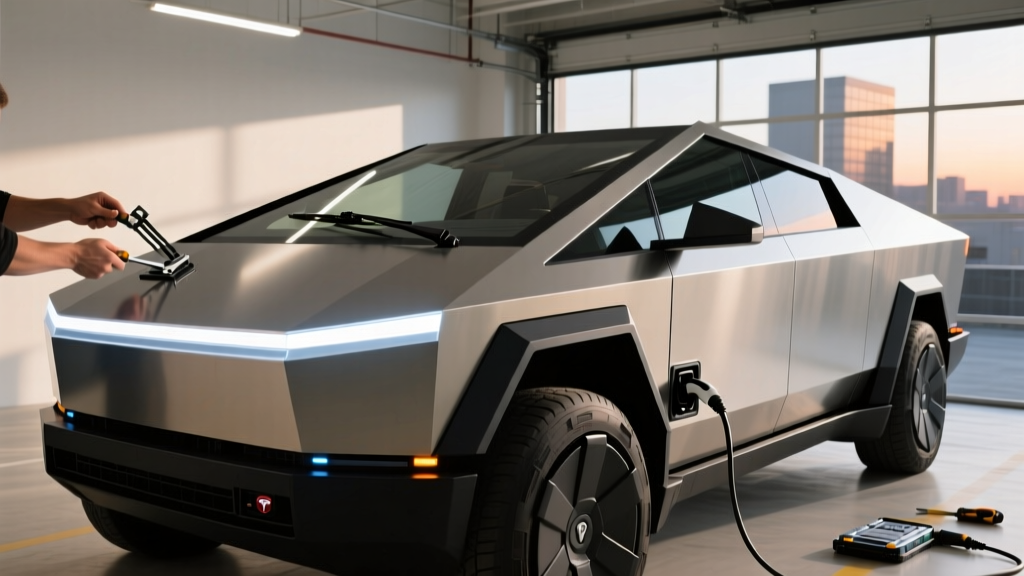
The Cybertruck uses a single, massive wiper blade on the driver's side that sweeps across an enormous windshield. Tesla designed a custom blade with a proprietary mounting interface that doesn't conform to the standard J-hook, bayonet, or side-pin attachments found on conventional trucks. The passenger side uses a smaller secondary blade, also custom-fit.
This matters for three practical reasons:
- Availability: You won't find Cybertruck-specific wiper blades at most auto parts chains. Tesla sells OEM replacements directly through its online store and service centers.
- Cost: Expect to pay roughly $45–$65 for a single OEM driver-side blade, significantly more than a $20 conventional blade for an F-150 or Silverado.
- Installation quirk: The wiper arm requires a specific release procedure detailed in the owner's manual. Forcing it can damage the arm's tension mechanism or the windshield trim.
Pro tip: Before removing the old Cybertruck wiper blade, place a thick towel over the windshield glass directly beneath the wiper arm. If the arm snaps back during removal, it can chip or crack the glass — a costly repair on a windshield this large.
How to Replace the Cybertruck Wiper Blade: Step by Step
- Enter Service Mode: On the touchscreen, navigate to Controls > Service > Wiper Service Position. This moves the wiper arms to an upright, accessible position.
- Release the locking tab: Locate the small release tab where the blade meets the wiper arm. Press and hold it while sliding the blade downward (toward the base of the arm).
- Remove the old blade: Gently pull the blade assembly away from the arm hook.
- Attach the new blade: Align the new OEM Cybertruck wiper blade with the arm hook and slide upward until the locking tab clicks into place.
- Exit Service Mode: Return the wipers to their parked position via the touchscreen.
The entire process takes about five minutes per side. Tesla recommends replacing wiper blades every 6–12 months depending on climate and usage. UV exposure in hot, sunny states degrades the rubber element faster, and the Cybertruck's large windshield area means a worn blade is immediately noticeable as streaking.
Tesla Cybertruck Full Spec Sheet: 2026 Model Year
The wiper blade is a minor ownership detail, but the Cybertruck's core specs are anything but. Here's the complete rundown for the current 2026 lineup, which now includes the long-awaited Rear-Wheel Drive base model alongside the AWD and Cyberbeast trims.
| Spec | RWD (Base) | AWD | Cyberbeast |
|---|---|---|---|
| EPA Range | 250 mi (est.) | 340 mi | 320 mi |
| Battery (usable) | ~100 kWh (NMC) | ~123 kWh (NMC, 4680 cells) | ~123 kWh (NMC, 4680 cells) |
| Drivetrain | Rear-Wheel Drive | Dual-Motor AWD | Tri-Motor AWD |
| Horsepower | ~315 hp | 600 hp | 845 hp |
| 0–60 mph | ~6.5 sec | 4.1 sec | 2.6 sec |
| Max DC Fast Charge | ~250 kW | ~350 kW | ~350 kW |
| 10–80% DC Time | ~28 min | ~18 min | ~18 min |
| Level 2 Home Charge | 11.5 kW (~34 mi/hr) | 11.5 kW (~34 mi/hr) | 11.5 kW (~34 mi/hr) |
| Towing Capacity | 7,500 lbs | 11,000 lbs | 11,000 lbs |
| MPGe (combined) | TBD (est. ~68) | 67 MPGe | 64 MPGe |
| kWh/100 mi | ~50 (est.) | 50 kWh/100mi | 52 kWh/100mi |
| Base MSRP | $60,990 | $79,990 | $99,990 |
Sources: EPA fueleconomy.gov, Tesla Cybertruck specs.
Real-World Range: What the EPA Sticker Doesn't Tell You
EPA Sticker (AWD): 340 miles
Real-World Highway (70 mph, moderate temps): ~270–290 miles
Real-World Cold Weather (below 32°F): ~220–250 miles
Towing at Max Capacity: ~150–180 miles
The Cybertruck's aerodynamics are its biggest efficiency liability. That brutalist angular design looks commanding, but it produces a higher drag coefficient than a rounded-body truck like the Rivian R1T or the Ford F-150 Lightning. At highway speeds above 70 mph, aerodynamic drag dominates energy consumption, and the Cybertruck's boxy profile costs real miles.
In cold weather, expect a 25–35% range reduction. The 4680 NMC cells perform well thermally thanks to Tesla's heat pump and active thermal management, but physics is physics — lithium-ion chemistry slows in the cold, and cabin heating draws significant power. Preconditioning the battery while plugged in (via the Tesla app's scheduled departure feature) mitigates some of this loss by warming the pack before you drive.
If you tow regularly, plan your charging stops accordingly. Pulling an 8,000-pound trailer at highway speed can cut range nearly in half. This isn't unique to the Cybertruck — every electric truck experiences severe range loss under load — but it's a planning reality for road trips.
Charging Speed: DC Fast, Level 2, and the 4680 Advantage
The AWD and Cyberbeast trims leverage Tesla's 4680 structural battery pack, which supports peak DC fast-charging rates around 350 kW at V4 Supercharger stations. In practice, you'll see the Cybertruck sustain above 250 kW through roughly 40% State of Charge before the charge curve tapers. The 10–80% fill takes approximately 18 minutes under ideal conditions (battery preconditioned, ambient temperature 60–85°F).
| Charging Level | Power (kW) | Miles Added Per Hour | Best For |
|---|---|---|---|
| Level 1 (120V outlet) | 1.4 kW | ~4 mi/hr | Emergency trickle only |
| Level 2 (240V, 48A) | 11.5 kW | ~34 mi/hr | Overnight home charging |
| DC Fast (V3 Supercharger) | 250 kW peak | ~750 mi/hr (peak) | Road trips, quick top-ups |
| DC Fast (V4 Supercharger) | 350 kW peak | ~1,000 mi/hr (peak) | Fastest available Cybertruck charging |
At home on a Level 2 Wall Connector, a full overnight session (10 hours) adds roughly 340 miles — enough to refill the AWD battery from near-empty. Most owners who charge nightly at home rarely use more than 30–40% of the battery per day, meaning a 3–4 hour session is typically sufficient.
The charge curve matters more than peak kW. A truck that peaks at 350 kW but tapers aggressively after 50% SoC may not save much time over a truck that sustains 250 kW longer. Tesla's 4680 cells handle sustained high-rate charging better than older 2170 packs, which is a tangible advantage for road-trippers.
Pricing, Trims, and Federal Tax Credit Eligibility
The Cybertruck lineup has expanded for 2026 with the addition of the RWD base model, finally bringing the starting price below the IRS §30D MSRP cap for trucks. Here's the pricing breakdown and tax credit landscape:
| Trim | Base MSRP | §30D Credit Eligible? | Effective Price (with credit) |
|---|---|---|---|
| RWD (Base) | $60,990 | Yes — under $80K truck cap | As low as $53,490 |
| AWD | $79,990 | Yes — at the $80K truck cap limit | As low as $72,490 |
| Cyberbeast | $99,990 | No — exceeds $80K truck MSRP cap | $99,990 |
Critical §30D caveats (per IRS guidelines):
- MSRP cap: Trucks, SUVs, and vans must have an MSRP at or below $80,000 to qualify. The Cyberbeast at $99,990 is excluded. The AWD at $79,990 squeaks in.
- Income cap: Modified adjusted gross income must not exceed $150,000 (single), $225,000 (head of household), or $300,000 (joint filers).
- Battery sourcing: The vehicle must meet critical-mineral and battery-component sourcing requirements that tighten annually. Tesla's North American assembly helps, but verify current-year compliance on the IRS qualified vehicles list before purchase.
- Point-of-sale transfer: As of 2024, buyers can transfer the credit to the dealer at purchase, reducing the out-of-pocket price immediately rather than waiting for a tax refund.
Always confirm eligibility with a tax professional and the latest IRS qualified vehicle list before finalizing your purchase. Rules can shift, and manufacturer sourcing compliance is updated periodically.
Cargo, Interior Space, and Daily Practicality
The Cybertruck's 6-foot bed with a power-retractable tonneau cover offers 67 cubic feet of cargo volume. The bed is stainless steel, matching the exoskeleton, which means no bed liner is needed but cargo can slide more easily than in a composite-bed truck. The front trunk (frunk) adds approximately 7 cubic feet of lockable, weatherproof storage — useful for charging cables, groceries, or a tool kit.
Interior space is adequate but not class-leading:
- Front legroom: ~41.5 inches
- Rear legroom: ~38.0 inches (tighter than an F-150 Lightning's rear seat)
- Seating: 5 passengers across two rows; the rear bench is flat and firm, better suited for shorter trips
- Infotainment: 18.5-inch center touchscreen running Tesla's latest software, with a secondary 9.4-inch rear touchscreen for passengers
The steer-by-wire system (no mechanical connection between the yoke and the wheels) remains the Cybertruck's most polarizing feature. It takes roughly 20–30 minutes of driving to build muscle memory, after which most drivers report it feels natural. The variable steering ratio means minimal hand movement at low speeds and stable, car-like response at highway speed. However, there is no round steering wheel option, and the yoke can feel awkward during low-speed parking maneuvers or three-point turns.
Driver Assistance: Autopilot and FSD (Supervised)
SAE Automation Level: Level 2 (partial driving automation)
The driver must remain fully engaged, hands on the yoke, eyes on the road at all times. Tesla's Autopilot and Full Self-Driving (Supervised) are NOT autonomous driving systems. They are advanced driver-assist features that require constant supervision.
The Cybertruck ships with Tesla's basic Autopilot (Traffic-Aware Cruise Control + Autosteer). FSD (Supervised) is a $8,000 add-on (or $99/month subscription as of 2026) that enables automated lane changes, navigation-guided on/off-ramp handling, and city-street traffic-light and stop-sign recognition. Tesla's HW4 (AI4) computer powers the system, using a camera-only vision approach with no lidar or radar.
In real-world use, FSD handles highway driving competently but still requires intervention in construction zones, complex intersections, and adverse weather. City-street performance has improved substantially over prior versions but remains imperfect. Expect to intervene several times per trip in urban environments.
Warranty Coverage and Battery Longevity
- Basic Vehicle Warranty: 4 years / 50,000 miles
- Battery & Drive Unit Warranty: 8 years / 120,000 miles (AWD & Cyberbeast); 8 years / 100,000 miles (RWD)
- Battery capacity retention threshold: Tesla warrants that the battery will retain at least 70% of its original capacity during the warranty period
The 4680 NMC cells in the AWD and Cyberbeast are Tesla's latest-generation chemistry, offering improved energy density and thermal stability. Long-term degradation data is still accumulating (the Cybertruck launched in late 2023), but Tesla's prior NMC packs in the Model 3 and Model Y have demonstrated roughly 10–12% degradation over 100,000 miles, suggesting the Cybertruck should perform similarly or better.
Replacement cost for the structural battery pack is not publicly listed by Tesla and would likely exceed $20,000 out of warranty. However, catastrophic pack failure is rare; most degradation is gradual and linear.
Who Should Buy the Cybertruck (And Who Shouldn't)
Buy the Cybertruck if:
- You want a head-turning electric truck with tri-motor performance (Cyberbeast's 2.6-second 0–60 is supercar territory)
- You value the Tesla Supercharger network's reliability for road trips
- You need 11,000 lbs of towing capacity (AWD/Cyberbeast) with electric instant torque
- You're comfortable with steer-by-wire and the yoke steering interface
Look elsewhere if:
- Rear-seat passenger comfort is a priority (the Rivian R1T and F-150 Lightning offer more rear legroom)
- You want a conventional steering wheel option
- Maximum highway efficiency matters — the Cybertruck's aerodynamics cost 10–15% range vs. sleeker trucks
- You prefer a traditional truck bed with tie-downs, bed rails, and aftermarket accessory compatibility
Pros and Cons
Pros
- Tri-motor Cyberbeast delivers 845 hp and 2.6-sec 0–60 — fastest production truck ever sold
- Tesla Supercharger network: 20,000+ stalls in North America with NACS connector dominance
- Stainless-steel exoskeleton is dent- and corrosion-resistant; no paint to scratch
- 4680 battery enables ~350 kW peak DC charging (10–80% in ~18 min)
- Frunk + vault bed + onboard power (120V/240V outlets) offer strong utility
- OTA software updates continuously add features and improve performance
Cons
- Boxy aerodynamics reduce real-world highway range to ~270–290 mi (vs. 340 EPA)
- Steer-by-wire yoke is polarizing; no round wheel option
- Rear seat legroom (38 in) is tight for a full-size truck
- Cyberbeast at $99,990 is ineligible for the $7,500 federal tax credit
- Proprietary wiper blades, panel gaps, and build-quality inconsistencies reported by early owners
- Towing range drops to ~150–180 mi at max load — requires careful trip planning
Frequently Asked Questions
Where can I buy a replacement Cybertruck wiper blade?
OEM Cybertruck wiper blades are sold through the Tesla online store and at Tesla Service Centers. Third-party options are limited as of 2026, though some aftermarket suppliers are beginning to offer compatible blades. Expect to pay $45–$65 for an OEM driver-side blade.
What is the real-world range of the Tesla Cybertruck?
The AWD trim carries a 340-mile EPA estimate, but real-world highway driving at 70 mph typically yields 270–290 miles. In cold weather (below 32°F), expect 220–250 miles. Towing at or near the 11,000-lb max reduces range to roughly 150–180 miles.
How fast does the Cybertruck charge at home and on the road?
At home on a Level 2 Tesla Wall Connector (11.5 kW), the Cybertruck adds about 34 miles of range per hour — a full overnight charge refills the battery. On DC fast chargers, the AWD and Cyberbeast peak at ~350 kW on V4 Superchargers, achieving a 10–80% charge in approximately 18 minutes.
Does the Cybertruck qualify for the $7,500 federal EV tax credit?
The RWD ($60,990) and AWD ($79,990) trims fall under the $80,000 MSRP cap for trucks and are potentially eligible for the full $7,500 §30D credit, subject to buyer income limits and battery-sourcing requirements. The Cyberbeast ($99,990) exceeds the cap and does not qualify. Always verify current eligibility on the IRS qualified vehicles page.
Is the Cybertruck worth buying vs. the F-150 Lightning or Rivian R1T?
The Cybertruck wins on raw performance (Cyberbeast's 845 hp), Supercharger network access, and head-turning design. The F-150 Lightning offers a more conventional truck experience with a larger rear seat and better aftermarket support. The Rivian R1T excels in off-road capability and interior refinement. Your choice depends on whether you prioritize performance and Tesla's ecosystem (Cybertruck), traditional utility (Lightning), or adventure refinement (R1T).
Is Tesla's Full Self-Driving actually self-driving?
No. FSD (Supervised) is an SAE Level 2 driver-assistance system. It can manage highway lane-keeping, navigate on/off-ramps, and recognize traffic signals, but the driver must remain fully attentive with hands on the yoke at all times. It is not autonomous driving. Only Level 4 services like Waymo operate without a driver.