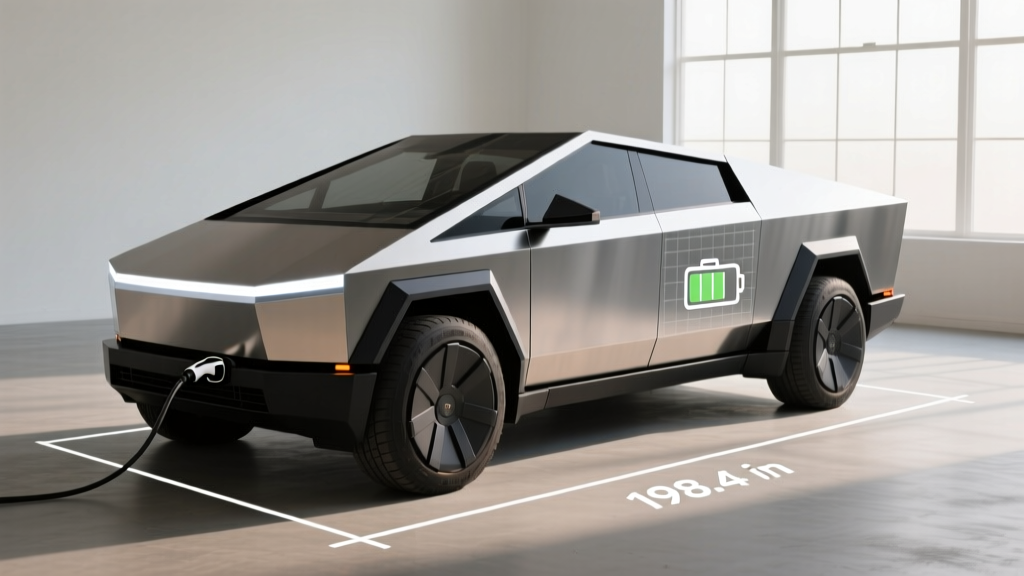
The Tesla Cybertruck turns heads everywhere it goes, and not just because of its stainless-steel exoskeleton. Its sheer physical footprint catches buyers off guard — especially when they try to park it, pull into a narrow garage, or navigate a tight drive-through. If you've been searching for exactly how wide is a Cybertruck, the short answer is 95.0 inches with the mirrors folded and a full 100.2 inches mirror-to-mirror. But the implications of that number ripple through every aspect of ownership, from garage fit to lane positioning on the highway.
This 2026 profile goes well beyond the tape measure. We'll walk through the Cybertruck's EPA range, real-world efficiency, DC fast-charging behavior, pricing across all three trims, federal tax credit eligibility under IRS §30D rules, and how it stacks up against the Ford F-150 Lightning and Rivian R1T in the electric truck segment.
Cybertruck Dimensions: Width, Length, and What They Mean for Your Garage
Let's address the core question head-on. The 2026 Tesla Cybertruck measures 95.0 inches wide at the body (mirrors folded) and stretches to 100.2 inches with mirrors extended. For context, that body width is roughly 6 inches wider than a Ford F-150 Lightning (88.3 inches) and about 9 inches wider than a Rivian R1T (81.8 inches). The Cybertruck is, by a significant margin, the widest pickup in its class.
| Dimension | Tesla Cybertruck | Ford F-150 Lightning | Rivian R1T |
|---|---|---|---|
| Width (body, mirrors folded) | 95.0 in | 88.3 in | 81.8 in |
| Width (mirrors extended) | 100.2 in | 96.0 in | 87.1 in |
| Length (overall) | 223.6 in | 232.7 in | 217.1 in |
| Height | 70.5 in | 79.3 in | 73.0 in |
| Wheelbase | 141.7 in | 145.5 in | 135.9 in |
| Curb Weight | ~6,600–6,850 lbs | ~6,171–6,500 lbs | ~7,148 lbs |
Garage and Parking Realities
A standard US single-car garage door is 8 to 9 feet wide (96–108 inches). The Cybertruck at 95 inches body-width technically fits through a 9-foot door — with roughly 5 inches of clearance on each side. However, a standard 8-foot (96-inch) door leaves less than half an inch per side, which is impractical for daily use. You'll want a minimum 9-foot-wide garage opening, and ideally 10 feet for comfortable entry and exit. A standard two-car garage (16 feet / 192 inches wide) can accommodate one Cybertruck with room to open doors, but fitting two Cybertrucks side-by-side is a tight squeeze at best.
For street parking, the 95-inch width means the Cybertruck will push close to or slightly over the lines in many standard parking spaces, which are typically 8.5 feet (102 inches) wide. Expect to take up some buffer on either side in tighter lots.
Range, Efficiency, and Real-World Driving
The 2026 Cybertruck is offered in three configurations: the Long Range AWD (dual-motor), the Cyberbeast (tri-motor AWD), and the base Rear-Wheel Drive model (slated for later availability). Range varies significantly by trim.
Cyberbeast (tri-motor AWD): EPA-estimated 320 miles. Real-world highway driving at 70–75 mph typically yields 260–285 miles. In cold weather (below 32°F), expect 220–250 miles due to battery chemistry limitations and cabin heating demands.
Long Range AWD (dual-motor): EPA-estimated 340 miles. Real-world highway: 280–305 miles. Cold weather: 240–270 miles.
RWD (base): EPA-estimated 250 miles (preliminary). Real-world highway: ~210–230 miles.
The Cybertruck's angular, flat-panel design creates a higher drag coefficient (~0.34 Cd) than a streamlined sedan, and its 6,600+ lb curb weight demands more energy per mile. At highway speeds, aerodynamic drag dominates — plan for roughly 15–20% range reduction versus the EPA sticker on sustained interstate driving.
Efficiency Numbers
According to fueleconomy.gov, the Cyberbeast achieves approximately 76 MPGe combined (74 city / 79 highway), translating to roughly 44–46 kWh per 100 miles. The Long Range AWD is slightly more efficient at approximately 79 MPGe combined (~42–44 kWh/100 mi). These figures place the Cybertruck on the thirstier end of the EV spectrum — comparable to the GMC Hummer EV but less efficient than the Rivian R1T Dual-Motor (~84 MPGe) or the Ford F-150 Lightning Extended Range (~70 MPGe for the heavier 320-mile pack, though with more usable range).
Battery, Charging Speeds, and Infrastructure
The Cybertruck uses a structural battery pack integrated into the vehicle's stainless-steel exoskeleton. The pack capacity is approximately 123 kWh usable (roughly 135 kWh gross), utilizing NMC (nickel manganese cobalt) chemistry in the AWD and Cyberbeast trims. The pack operates on an 800-volt architecture, enabling faster DC charging than 400V systems.
| Charging Level | Rate | Time / Miles Added |
|---|---|---|
| Level 1 (120V household) | ~1.4 kW | ~3–4 miles per hour of charging |
| Level 2 (240V home, 48A) | 11.5 kW | ~29 miles per hour; full charge in ~11 hours |
| DC Fast Charge (peak) | ~350 kW (at V4 Supercharger) | 10–80% in approximately 18–22 minutes |
| DC Fast Charge (sustained avg) | ~180–220 kW | Expect taper above 60% SoC; 80–100% adds significant time |
Understanding the Charge Curve
Tesla advertises a peak DC fast-charging rate of up to 350 kW at V4 Supercharger stalls, but peak kW is not sustained kW. The Cybertruck's charge curve holds near peak rate between roughly 10% and 35% State of Charge, then progressively tapers. From 60% to 80%, you'll see rates closer to 100–140 kW. The 10–80% time of 18–22 minutes assumes a preconditioned battery (the truck does this automatically when you navigate to a Supercharger). Without preconditioning — say, arriving at a third-party DC fast charger cold — that time can stretch to 28–35 minutes.
The Cybertruck uses the NACS (North American Charging Standard) connector natively, giving it direct access to Tesla's Supercharger network — currently the most reliable and expansive DC fast-charging network in the US. For Electrify America, EVgo, or other CCS networks, you'll need a NACS-to-CCS adapter (sold separately, ~$200–250).
Home Charging Setup
Tesla's Wall Connector (Gen 3) delivers up to 11.5 kW on a 60-amp circuit (48A continuous), adding roughly 29 miles of range per hour. For most owners driving 30–50 miles daily, overnight Level 2 charging more than replenishes daily use. Installation costs for a 240V/60A circuit typically run $800–$2,500 depending on panel proximity and whether a service upgrade (100A to 200A panel) is needed, which can add $1,500–$3,500. Always have a licensed electrician evaluate your panel before committing.
Performance: 0-60, Towing, and Drivetrain
| Spec | RWD (Base) | Long Range AWD | Cyberbeast (Tri-Motor) |
|---|---|---|---|
| Drivetrain | Rear-Wheel Drive | Dual-Motor AWD | Tri-Motor AWD (torque vectoring) |
| Horsepower | ~600 hp (est.) | ~600 hp | 845 hp |
| 0–60 mph | ~6.5 sec (est.) | ~3.9 sec | 2.6 sec |
| Top Speed | 112 mph | 130 mph | 130 mph |
| Max Towing | 7,500 lbs (est.) | 11,000 lbs | 11,000 lbs |
| Payload | ~2,500 lbs | ~2,500 lbs | ~2,500 lbs |
The Cyberbeast's 2.6-second 0–60 time makes it one of the quickest production vehicles on the road, period — truck or otherwise. The tri-motor setup provides torque vectoring across the rear axle, improving cornering agility despite the truck's 6,850-pound curb weight. The Long Range AWD's 3.9-second sprint is hardly slow, and for most buyers, it offers the best balance of range, performance, and price.
Towing at the 11,000-pound maximum will cut range dramatically — expect roughly 50% range reduction when towing near capacity at highway speeds. This is common to all EV trucks; the F-150 Lightning and R1T show similar towing-range penalties.
Interior, Cargo, and Technology
Cabin and Cargo Dimensions
Despite its massive exterior, the Cybertruck seats five (not six — no front bench option). Interior space is adequate but not class-leading:
- Front headroom: ~40.2 inches
- Front legroom: ~41.0 inches
- Rear headroom: ~38.0 inches
- Rear legroom: ~38.5 inches
- Bed length: 6 feet (72 inches), 4 feet wide between wheel wells
- Bed volume: ~67 cu ft (with tonneau closed)
- Front trunk (frunk): ~7.1 cu ft
- Under-bed storage: Lockable compartment behind rear axle
The powered stainless-steel tonneau cover (called the "sail" cover) is standard and retracts automatically, but it reduces vertical clearance for tall items. The bed's 4-foot width between the wheel wells means standard 4×8 sheets of plywood will not lie flat — they'll need to rest on top of the wheel wells or ride at an angle. This is a notable practical limitation versus conventional pickups.
Infotainment and Driver Assistance
The Cybertruck runs Tesla's latest vehicle software on an 18.5-inch front touchscreen (with a 9.4-inch rear screen for passengers). Notable features include:
- Steer-by-wire system (no mechanical connection between yoke and wheels) — a first for a production Tesla
- Rear-wheel steering for a tighter turning radius despite the long wheelbase
- Adaptive air suspension with up to 17 inches of ground clearance in Extract Mode
- Tesla Autopilot (Level 2 driver assistance) standard; Full Self-Driving (Supervised) available as a $8,000 add-on or $99/month subscription
- Integrated 120V and 240V bed outlets for powering tools or camping gear (up to 11.5 kW output via Powershare)
- Bioweapon Defense Mode HEPA air filtration
Tesla Autopilot and FSD (Supervised) are SAE Level 2 driver-assistance systems. The driver must remain fully engaged, hands-on (or eyes-on for FSD), and ready to take over at all times. These are not self-driving systems. Only Level 4 services like Waymo operate without a human driver in geofenced areas.
Notable Drawbacks
The Cybertruck's yoke-style steering wheel and steer-by-wire system require a meaningful adjustment period, particularly for low-speed maneuvering and parking. Visibility rearward is limited by the bed sail and angular design — the truck relies heavily on its camera system. Build quality has improved since the 2024 launch, but panel-gap consistency and stainless-steel fingerprint/smudge maintenance remain common owner complaints. Insurance premiums also run 20–40% higher than comparable F-150 Lightning policies due to repair costs for the stainless-steel body.
Pricing, Trims, and Federal Tax Credit Eligibility
| Trim | Base MSRP | Est. After §30D Credit | §30D Eligible? |
|---|---|---|---|
| RWD (Base) | ~$60,990 | ~$53,490 (if eligible) | Subject to MSRP cap — trucks capped at $80,000; likely qualifies pending sourcing rules |
| Long Range AWD | ~$79,990 | ~$72,490 (if eligible) | Under $80K truck cap; sourcing-dependent |
| Cyberbeast | ~$99,990 | $99,990 (not eligible) | Exceeds $80,000 MSRP cap for trucks — does NOT qualify |
§30D Federal Tax Credit Rules (2026)
The IRS §30D Clean Vehicle Credit offers up to $7,500 for qualifying new EVs, but eligibility is far from automatic. Key requirements for the Cybertruck:
- MSRP Cap: Pickup trucks must have an MSRP at or below $80,000. This means the Long Range AWD (~$79,990) squeaks under, but the Cyberbeast (~$99,990) is excluded.
- Buyer Income Limits: Modified adjusted gross income must not exceed $300,000 (joint filers), $225,000 (head of household), or $150,000 (individual).
- Battery Sourcing: A percentage of critical minerals and battery components must be sourced from the US or free-trade-agreement countries. Tesla's supply chain has been shifting, and eligibility can change by production batch. Always verify current eligibility on fueleconomy.gov before purchasing.
- Point-of-Sale Transfer: As of 2024, eligible buyers can transfer the credit to the dealer at purchase, reducing the upfront price rather than waiting for a tax refund.
Always consult a tax professional to confirm your personal eligibility. Rules and sourcing requirements are updated periodically by the IRS and Treasury Department.
Cybertruck vs. F-150 Lightning vs. Rivian R1T
| Attribute | Tesla Cybertruck LR AWD | Ford F-150 Lightning Ext. Range | Rivian R1T Dual-Motor Max |
|---|---|---|---|
| EPA Range | 340 mi | 320 mi | 410 mi |
| Width (body) | 95.0 in | 88.3 in | 81.8 in |
| 0–60 mph | 3.9 sec | ~4.0 sec | ~3.5 sec |
| Max DC Charge | ~350 kW | ~150 kW | ~220 kW |
| 10–80% DC Time | ~20 min | ~41 min | ~30 min |
| Towing Capacity | 11,000 lbs | 10,000 lbs | 11,000 lbs |
| Base MSRP | ~$79,990 | ~$71,990 | ~$87,000 |
| §30D Eligible? | Likely (under cap) | Yes (under cap) | No (over $80K cap) |
| Connector | NACS (native) | CCS (NACS adapter avail.) | NACS (2025+ models) |
Choose the Cybertruck If…
- You prioritize DC fast-charging speed (best in class at ~350 kW peak)
- You want native Tesla Supercharger access without adapters
- Acceleration and performance are top priorities
- You have a wide enough garage (9+ foot door)
- Stainless-steel durability and the Cybertruck aesthetic appeal to you
Choose a Competitor If…
- Maximum range is critical → Rivian R1T Max Pack (410 mi EPA)
- You need a conventional truck layout with a 5.5- or 6.5-foot bed and standard width → F-150 Lightning
- You need a front bench seat for 6 passengers → F-150 Lightning
- Garage width is limited to a standard 8-foot door → R1T or Lightning
- You prefer a traditional steering wheel over a yoke with steer-by-wire
Battery Warranty and Long-Term Ownership
Tesla covers the Cybertruck's battery and drive unit with an 8-year / 120,000-mile warranty (whichever comes first), guaranteeing a minimum of 70% battery capacity retention over that period. The vehicle's basic limited warranty is 4 years / 50,000 miles.
The NMC chemistry in the AWD and Cyberbeast trims offers higher energy density than LFP (lithium iron phosphate), giving more range per pound, but NMC cells are generally more sensitive to sustained high-State-of-Charge storage. Best practice for longevity: charge to 80% for daily use and only charge to 100% when you need the full range for a trip. Tesla's onboard battery management system (BMS) handles most of this automatically, but following the in-app charge-limit recommendations will help preserve long-term State of Health (SoH).
Based on Tesla Model 3/Y fleet data, NMC packs typically lose 5–8% capacity over the first 100,000 miles, then degrade more slowly. A full battery replacement out of warranty would likely cost $15,000–$22,000 based on current Tesla pack pricing, though this figure is expected to decline as battery costs continue to fall.
Frequently Asked Questions
What is the real-world range of the Cybertruck?
The EPA rates the Long Range AWD at 340 miles and the Cyberbeast at 320 miles. In real-world highway driving at 70–75 mph, expect 280–305 miles from the Long Range and 260–285 from the Cyberbeast. Cold weather (below freezing) can reduce those figures by an additional 15–20%, putting the Cyberbeast closer to 220–250 miles on a winter road trip.
How fast does the Cybertruck charge at home and on the road?
At home on a Level 2 (240V, 48A) Tesla Wall Connector, the Cybertruck charges at 11.5 kW, adding about 29 miles of range per hour — a full charge takes roughly 11 hours. On DC fast chargers, it peaks at ~350 kW at Tesla V4 Superchargers and can go from 10–80% in approximately 18–22 minutes with a preconditioned battery. Third-party CCS chargers (with adapter) typically deliver 50–150 kW, extending that time significantly.
How much does the Cybertruck cost after tax credits?
The Long Range AWD at ~$79,990 MSRP falls just under the IRS §30D $80,000 MSRP cap for trucks, potentially qualifying for the $7,500 credit — bringing the effective price to ~$72,490 — if you meet income limits and the specific vehicle's battery sourcing qualifies. The Cyberbeast at ~$99,990 exceeds the cap and does not qualify. Always verify eligibility on fueleconomy.gov and consult a tax professional before relying on the credit.
Is the Cybertruck worth buying over the F-150 Lightning or Rivian R1T?
It depends on your priorities. The Cybertruck leads the class in DC fast-charging speed and native Supercharger access, and its acceleration is unmatched. However, the F-150 Lightning offers a more conventional truck experience (standard width, bench seat option, 5.5' or 6.5' bed) at a lower starting price, while the Rivian R1T Max Pack delivers the longest EPA range (410 miles) and a more refined interior. If garage width, traditional truck utility, or 6-passenger seating matter, the Lightning is the pragmatic pick. If you want the fastest-charging, most attention-grabbing EV truck and have the garage space for it, the Cybertruck delivers.
What are the biggest pros and cons of the Cybertruck?
Pros
- Class-leading DC fast charging (~350 kW peak)
- Native NACS / Supercharger access
- Blistering acceleration (2.6 sec 0–60 Cyberbeast)
- Stainless-steel exoskeleton — dent and corrosion resistant
- 11,000-lb towing, onboard 120V/240V power output
- Air suspension with up to 17" ground clearance
- Rear-wheel steering for tighter turns
Cons
- 95-inch width — requires a 9+ foot garage door
- Bed only 4 ft wide between wheel wells — no flat 4×8 plywood
- Yoke steer-by-wire has a steep learning curve
- Higher insurance premiums (20–40% above Lightning)
- Cyberbeast ineligible for §30D tax credit (over MSRP cap)
- Stainless-steel shows fingerprints and smudges constantly
- Rear visibility is poor — heavy reliance on cameras
- Efficiency is below average (~44 kWh/100 mi) for an EV
Does the Cybertruck qualify for the federal EV tax credit?
Partially. The Long Range AWD (~$79,990) is under the $80,000 MSRP cap for pickup trucks and may qualify for up to $7,500 under IRS §30D, provided the buyer meets income limits and the specific vehicle's battery critical-mineral and component sourcing satisfies current-year requirements. The base RWD (~$60,990) should also qualify when it becomes available. The Cyberbeast (~$99,990) exceeds the MSRP cap and is not eligible. Check fueleconomy.gov's tax credit tool for the latest per-vehicle eligibility before purchasing.