The Tesla Model X has been the benchmark for three-row electric SUVs since its launch, and the 2024 model year brought meaningful powertrain and interior refinements. If you've been searching for a 2024 black Model X—whether new-old-stock at a dealer or a certified pre-owned example—you're likely weighing its 348-mile EPA range, Supercharger network access, and falcon-wing drama against a starting price that now exceeds $77,000. This review breaks down every number that matters: real-world range at highway speeds, DC fast-charging curves, battery chemistry, cargo dimensions, and whether this SUV still qualifies for federal tax credits under current IRS §30D rules.
Quick Verdict: Who Should Buy the 2024 Model X?
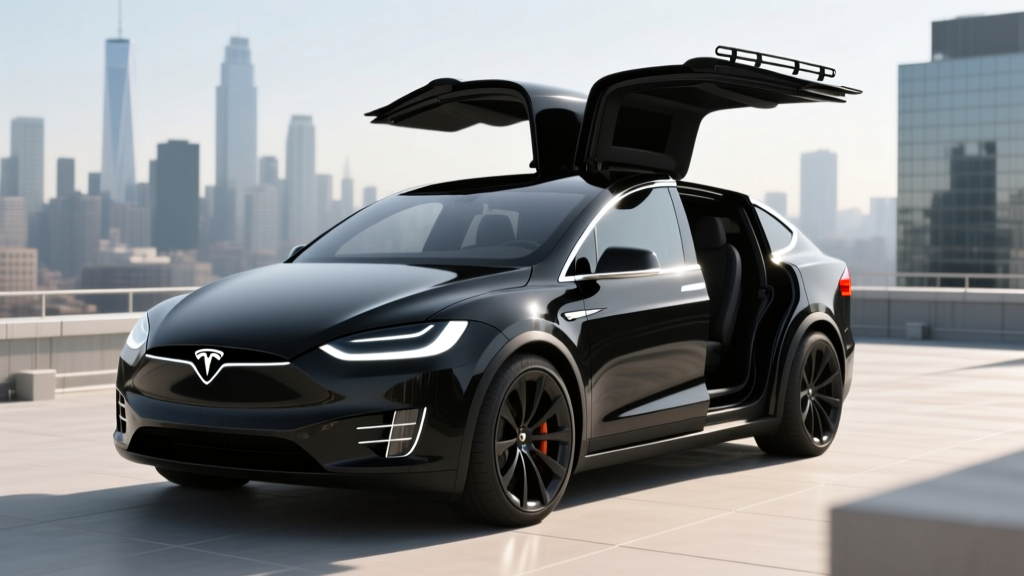
The 2024 Model X is built for families who need three rows, tow occasionally, and want the lowest-friction road-trip charging experience available. It's not the most affordable three-row EV—that title goes to the Kia EV9—but it remains the fastest-charging and longest-range option in the segment. The all-black exterior (Solid Black or Midnight Silver Metallic with black accents) is Tesla's most popular configuration and holds resale value well, though it shows swirl marks readily and demands regular washing.
Choose the 2024 Model X if: You need 300+ miles of EPA range, three usable rows, and frequent access to Tesla's Supercharger network for road trips.
Look elsewhere if: Budget is under $60,000, you prefer physical controls over a touchscreen-only cabin, or you only need two rows (the Model Y or Rivian R1S may serve you better).
Range, Efficiency, and Real-World Expectations
The 2024 Model X Long Range carries an EPA-estimated 348 miles of range on its dual-motor all-wheel-drive powertrain. The Plaid variant, with its tri-motor setup, drops to 326 miles EPA. Efficiency for the Long Range is rated at 100 MPGe combined (34 kWh/100 mi), per fueleconomy.gov.
EPA Range: 348 mi (Long Range) / 326 mi (Plaid)
Real-World Expectation: Expect 280–310 miles on a mixed highway trip at 70–75 mph in moderate temperatures. In freezing conditions (below 32°F), plan for 230–260 miles due to battery heating demands and cabin HVAC load. City driving with regenerative braking can push closer to the EPA sticker.
The Model X uses a 100 kWh battery pack (approximately 95 kWh usable) with NMC (nickel manganese cobalt) chemistry. Unlike the LFP packs in the Model 3 RWD, NMC offers higher energy density but benefits from daily charge limits around 80–90% for longevity. Tesla recommends charging to 100% only for trips.
Charging Speed: DC Fast, Level 2, and the Supercharger Advantage
Charging speed is where the Model X continues to justify its premium. The 2024 model supports up to 250 kW peak DC fast charging on V3 Superchargers and compatible CCS stations (via Tesla's Magic Dock or included adapter).
| Charging Level | Power / Rate | Speed |
|---|---|---|
| DC Fast Charge (V3 Supercharger) | Up to 250 kW peak | 10–80% in ~30 minutes; ~175 miles in 15 min |
| DC Fast Charge (V4 Supercharger) | Up to 250 kW (cable-limited for Model X) | Similar to V3; future OTA may unlock higher rates |
| Level 2 (Tesla Wall Connector, 48A) | 11.5 kW | ~34 miles per hour of charging |
| Level 2 (Generic J1772, 32A) | 7.7 kW | ~23 miles per hour |
| Level 1 (120V household) | ~1.4 kW | ~3–4 miles per hour |
The charge curve on the Model X peaks near 250 kW from roughly 10–30% SoC, then tapers progressively. From 50–80%, expect sustained rates around 80–120 kW. This means the advertised "175 miles in 15 minutes" holds true only when arriving at a low state of charge. For road-trip planning, budget 25–30 minutes per stop from 10–80%.
At home on a 48-amp Tesla Wall Connector (hardwired, requires a 60-amp breaker), the Model X recovers roughly 34 miles of range per hour. An overnight charge from 20–80% takes about 6–7 hours. Installation costs for a Wall Connector typically run $800–$2,000 depending on panel proximity and local permitting.
Performance: 0–60, Horsepower, and Drivetrain
| Spec | Long Range | Plaid |
|---|---|---|
| 0–60 mph | 3.8 seconds | 2.5 seconds |
| Horsepower | 670 hp | 1,020 hp |
| Drivetrain | Dual-Motor AWD | Tri-Motor AWD |
| Top Speed | 155 mph | 163 mph |
| Towing Capacity | 5,000 lbs | 5,000 lbs |
Even the "base" Long Range Model X hits 60 mph in 3.8 seconds—supercar territory a decade ago, now standard in a 5,100-pound family SUV. The Plaid's 2.5-second run is astonishing but costs an additional $15,000+ and sacrifices 22 miles of range. For most buyers, the Long Range delivers more than enough performance while maximizing efficiency.
Interior, Cargo, and Technology
The 2024 Model X seats up to seven in a 2-3-2 configuration, though a six-seat layout with second-row captain's chairs is available. Cargo volume is 88.1 cubic feet with both rear rows folded, 44.1 cu ft behind the second row, and a front trunk (frunk) adding 6.7 cu ft. Second-row legroom measures 41.1 inches; third-row legroom is a tighter 32.7 inches—fine for children but cramped for adults on long trips.
The 17-inch center touchscreen runs Tesla's latest software, including a yoke-style or round steering wheel option. Standout tech features include:
- Autopilot (standard): Adaptive cruise, lane centering, auto emergency braking—SAE Level 2 driver assist, requiring hands-on engagement at all times
- Full Self-Driving (Supervised) ($8,000 option or $99/month): Adds automatic lane changes, traffic light recognition, and navigate-on-Autopilot. Still Level 2; not autonomous
- Falcon Wing rear doors: Articulate upward for easy child-seat access in tight parking spots, though they can be slow in rain and require overhead clearance
- HEPA air filtration: Bioweapon Defense Mode with hospital-grade cabin filtration
- Rear-seat entertainment: 8-inch touchscreen for second-row passengers
Notable drawbacks include the absence of physical buttons for climate and mirror adjustment (everything routes through the touchscreen), panel-gap inconsistency on some build batches, and road noise at highway speeds that exceeds competitors like the BMW iX or Rivian R1S.
Pricing, Trims, and Federal Tax Credit Eligibility
As of the 2024 model year, Tesla priced the Model X as follows:
| Trim | Base MSRP | Federal §30D Credit | Effective Price |
|---|---|---|---|
| Long Range | $77,990 | Not eligible (MSRP cap: $80,000 for SUVs, but battery sourcing rules apply) | ~$77,990 |
| Plaid | $92,990 | Not eligible (exceeds $80,000 SUV MSRP cap) | ~$92,990 |
Under current IRS §30D rules, the Model X Long Range sits just under the $80,000 MSRP cap for SUVs. However, eligibility for the full $7,500 credit depends on battery component and critical-mineral sourcing requirements that have tightened annually. As of 2024–2025, many Tesla vehicles assembled in Fremont have qualified for partial or full credits depending on the production quarter. Buyers should verify current eligibility on the IRS clean vehicle credit page and confirm with their tax professional before purchase. The credit can be transferred at the point of sale as a down-payment reduction, per the latest IRS guidance.
Income caps also apply: modified adjusted gross income must not exceed $300,000 (joint filers), $225,000 (head of household), or $150,000 (single).
Warranty and Ownership Costs
Tesla covers the 2024 Model X with:
- Basic Vehicle Limited Warranty: 4 years / 50,000 miles
- Battery & Drive Unit Warranty: 8 years / 150,000 miles (Long Range), with a minimum 70% capacity retention threshold
- Plaid Battery & Drive Unit: 8 years / 150,000 miles, same 70% retention
The 150,000-mile battery warranty is competitive with Rivian (8/100,000) and exceeds BMW's 8/80,000-mile coverage. Real-world degradation data from Tesla's fleet suggests NMC packs retain approximately 88–92% capacity at 100,000 miles under normal charging habits (avoiding sustained 100% SoC storage).
Insurance premiums for the Model X are notably high—averaging $3,200–$4,500 annually depending on state, driving record, and coverage level—due to repair costs and performance classification. Tesla Insurance is available in many states and can sometimes undercut third-party quotes.
Pros and Cons
Pros
- 348-mile EPA range (Long Range) is class-leading for three-row EVs
- 250 kW DC fast charging with access to 20,000+ Superchargers
- Supercar-level acceleration even in base trim
- Falcon Wing doors are genuinely useful for child-seat installation
- Over-the-air updates continuously add features
- 5,000-lb towing capacity with integrated trailer brake controller
Cons
- Base price near $78,000; options push past $90,000
- Third row is tight for adults (32.7" legroom)
- Touchscreen-only controls frustrate some drivers
- Falcon Wing doors slow to operate and need overhead clearance
- High insurance premiums relative to segment
- Panel gaps and interior rattles reported on some builds
Frequently Asked Questions
What is the real-world range of the 2024 Tesla Model X?
The EPA rates the Long Range at 348 miles and the Plaid at 326 miles. In real-world highway driving at 70–75 mph, expect 280–310 miles. Cold weather (below freezing) can reduce range to 230–260 miles due to battery preconditioning and cabin heating demands.
How fast does the 2024 Model X charge?
On a V3 Supercharger, the Model X peaks at 250 kW and charges from 10–80% in approximately 30 minutes. At home on a 48-amp Level 2 Wall Connector, it adds about 34 miles of range per hour (~11.5 kW).
Does the 2024 Model X qualify for the federal EV tax credit?
The Long Range trim is priced under the $80,000 SUV MSRP cap, but full §30D credit eligibility depends on battery sourcing requirements that change quarterly. Check IRS.gov for the latest sourcing rules and confirm with a tax professional. Income caps of $150K–$300K (by filing status) also apply.
Is the 2024 Model X worth buying vs. the Rivian R1S or Kia EV9?
The Model X wins on range (348 vs. R1S's ~321 mi and EV9's ~279 mi) and charging speed. The Rivian R1S offers a more rugged design, better third-row space, and competitive performance at a lower starting price. The Kia EV9 is the budget pick at ~$55,000 but sacrifices 70+ miles of range and charges slower. If Supercharger access and maximum range are priorities, the Model X remains the segment leader.
What are the biggest drawbacks of the Model X?
High purchase price, touchscreen-only controls, firm third-row seating, falcon-wing door quirks in tight garages, and elevated insurance costs are the most commonly cited complaints.
Does the Model X have Autopilot or self-driving capability?
All Model X vehicles come with Autopilot (adaptive cruise + lane centering), which is an SAE Level 2 driver-assist system. Full Self-Driving (Supervised) is available as a $8,000 option but remains Level 2—the driver must remain attentive and keep hands ready to take over at all times. Tesla's system is not autonomous.