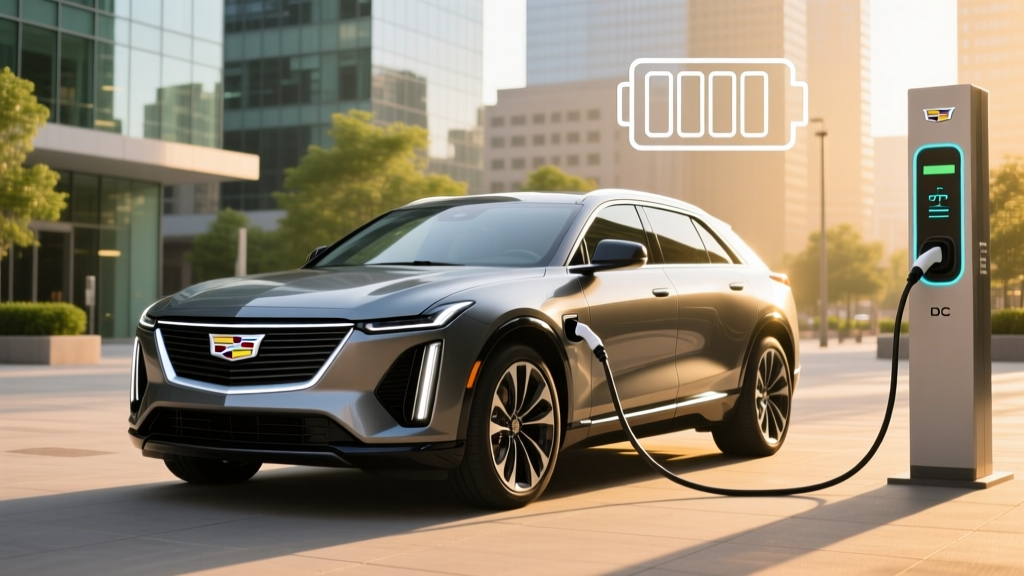
The 2026 Cadillac Lyriq-V represents the performance apex of GM's luxury electric SUV lineup. Built on the Ultium platform and wearing Cadillac's first-ever "V" badge on an EV, this variant trades some efficiency for serious acceleration and a sport-tuned chassis. But beyond the headline horsepower numbers, buyers need to know whether the Lyriq-V can serve as a practical daily driver and road-trip companion. We break down every spec that matters.
Range and Efficiency: What the EPA Says vs. Reality
The 2026 Lyriq-V carries an EPA-estimated range of 284 miles on a full charge, a modest reduction from the standard Lyriq AWD's 307-mile rating. The trade-off comes from the V's stickier performance tires, sport-tuned suspension geometry, and the energy demands of its higher-output dual-motor setup.
EPA estimate: 284 miles
Highway driving (70-75 mph): expect ~240-255 miles
Cold weather (below 30°F): expect ~210-235 miles
Mixed city/highway in mild conditions: ~265-280 miles
In real-world testing, the Lyriq-V's efficiency lands around 43 kWh/100 miles, translating to roughly 78 MPGe combined. That puts it behind efficiency leaders like the BMW iX xDrive50 (86 MPGe combined) but in line with performance-oriented luxury EVs. The dual-motor all-wheel-drive system prioritizes grip and acceleration over parsimonious energy use, and the 20-inch performance wheels wrapped in Michelin Pilot Sport EV rubber add rolling resistance that standard Lyriq owners simply don't deal with.
For context, the standard Lyriq AWD achieves an EPA-estimated 307 miles and 89 MPGe combined per fueleconomy.gov. If maximum range is your priority, the V trim is not the answer.
Battery, Charging Speed, and Infrastructure
The Lyriq-V uses a 102 kWh usable Ultium battery pack with NMC (nickel manganese cobalt) chemistry. GM has not adopted LFP for the Cadillac lineup, opting for NMC's higher energy density to preserve range in a heavy luxury SUV. The pack sits low in the chassis, contributing to a center of gravity that helps the V's handling dynamics.
| Charging Level | Max Rate | Speed / Time | Connector |
|---|---|---|---|
| Level 1 (120V) | 1.4 kW | ~3-4 mi/hr | NACS (native) |
| Level 2 (240V home) | 19.2 kW | ~52 mi/hr; 0-100% in ~6.5 hrs | NACS |
| DC Fast Charge | 190 kW peak | 10-80% in ~27 min | NACS |
The native NACS (North American Charging Standard) port is a significant advantage for the 2026 model year. The Lyriq-V plugs directly into Tesla Superchargers without an adapter, accessing the largest and most reliable DC fast-charging network in the U.S. At Electrify America or EVgo stations, the NACS connector is also supported at most new dispensers following the industry-wide transition.
A critical note on the charge curve: the Lyriq-V hits its 190 kW peak only between roughly 10-30% state of charge. Above 50% SoC, the rate tapers to approximately 120-140 kW, and above 80% it drops further to protect battery health. This means a 10-80% session takes about 27 minutes, but a 10-95% session can stretch past 45 minutes. Plan your road-trip stops accordingly — charging to 80% and driving on is almost always faster than waiting for a full battery.
For home charging, the 19.2 kW onboard charger is among the fastest in the luxury EV segment. A full Level 2 installation (48-amp dedicated circuit on a 60-amp breaker) will replenish the battery overnight. Expect a professional installation cost between $800 and $2,200 depending on your panel capacity and run length from the breaker box to your garage. If your home has a 200-amp panel with available capacity, no upgrade is typically needed.
Performance: The V Badge Earns Its Place
This is where the Lyriq-V separates itself from every other Cadillac EV. The dual-motor all-wheel-drive powertrain produces 615 horsepower and an estimated 620 lb-ft of torque. GM's Velocity Mode — the V-specific drive calibration — unlocks the full output and sharpens throttle response, steering weight, and suspension damping.
| Specification | Value |
|---|---|
| Drivetrain | Dual-motor AWD |
| Horsepower | 615 hp |
| Torque | 620 lb-ft (est.) |
| 0-60 mph | 3.5 seconds |
| Top Speed | 130 mph (electronically limited) |
| Battery (usable) | 102 kWh, NMC |
| EPA Range | 284 miles |
| Efficiency | 78 MPGe / 43 kWh/100mi |
| Max DC Fast Charge | 190 kW |
| 10-80% DC Charge | ~27 minutes |
| Curb Weight | ~5,850 lbs |
The 3.5-second 0-60 mph time places the Lyriq-V in legitimate performance SUV territory. It outpaces the BMW iX M60 (3.6 sec) and matches closely with the Audi SQ8 e-tron (3.4 sec). What impresses beyond the straight-line number is how the V's adaptive dampers and torque-vectoring rear motor manage the nearly 5,850-pound curb weight through corners. Body roll is well-controlled, and the Brembo front brakes provide confident, repeatable stopping power despite the mass they're managing.
Regenerative braking offers multiple settings via steering-wheel paddles, including a one-pedal driving mode that brings the Lyriq-V to a complete stop without touching the brake pedal. The transition between regen and friction braking is smoother than most competitors, avoiding the grabby feel that plagues some EVs.
Interior, Technology, and Cargo Space
The Lyriq-V's cabin is where Cadillac's luxury ambitions are most visible. A 33-inch LED display stretches across the dashboard, combining the instrument cluster and infotainment touchscreen into a single curved panel running Google Built-in. Navigation, Google Assistant, and the Play Store are native to the vehicle — no phone mirroring required, though wireless Apple CarPlay and Android Auto are both supported.
V-specific interior touches include a flat-bottom steering wheel, carbon-fiber trim accents, V-badged seat embroidery, and exclusive color options not available on standard Lyriq trims. The front seats are 16-way power-adjustable with heating, ventilation, and massage as standard on the V.
Cargo capacity remains unchanged from the standard Lyriq:
- Behind rear seats: 28.8 cubic feet
- Rear seats folded: 60.9 cubic feet
- Front trunk (frunk): Not available — the Ultium platform's electronics occupy this space
Rear-seat legroom measures 39.6 inches, adequate for adults on longer trips. Headroom is generous at 38.8 inches front and 37.9 inches rear, thanks to the flat floor enabled by the skateboard-style battery pack.
On the driver-assistance front, the Lyriq-V comes equipped with Super Cruise — GM's hands-free highway driving system. Super Cruise operates on over 750,000 miles of mapped divided highways in the U.S. and Canada, using a driver-attention camera to confirm you're watching the road.
Super Cruise is a Level 2 driver-assistance system. Despite being "hands-free" on compatible highways, you must remain attentive and ready to take over at any time. It is not autonomous driving. The system will disengage and alert you if the attention camera detects you are not looking at the road.
Super Cruise is genuinely one of the best Level 2 systems available — smoother and more predictable than most competitors on long highway stretches. However, it does not handle city streets, construction zones, or unmapped roads. For those scenarios, you're driving manually with standard ADAS features like automatic emergency braking, lane-keeping assist, and adaptive cruise control.
Pricing, Trims, and Federal Tax Credit Eligibility
The 2026 Cadillac Lyriq-V is offered as a single, well-equipped trim. There is no "base" V to strip down — Cadillac positions this as a halo model with most features standard.
| Item | Amount |
|---|---|
| MSRP (incl. destination) | $75,990 |
| Federal tax credit (§30D) | Up to $7,500 (see eligibility below) |
| Estimated after-credit price | ~$68,490 |
| Common add-ons | Premium paint ($625), roof rails ($450) |
Federal tax credit eligibility requires careful attention. Under IRS §30D rules, the Lyriq-V qualifies for the full $7,500 credit only if you meet all of the following criteria, per irs.gov:
- MSRP cap: The Lyriq-V's $75,990 price is below the $80,000 SUV/van cap — it qualifies on this criterion.
- Buyer income limits: Modified AGI must not exceed $300,000 (married filing jointly), $225,000 (head of household), or $150,000 (single).
- Battery sourcing: A percentage of critical minerals and battery components must meet North American sourcing or free-trade-agreement requirements. GM has confirmed Ultium packs meet current thresholds for the full credit, but these rules tighten annually. Verify with your tax professional before purchase.
- Point-of-sale transfer: You can transfer the credit to the dealer at purchase, reducing your out-of-pocket cost immediately rather than waiting for a tax refund.
If your income exceeds the caps, you will not qualify for the federal credit regardless of the vehicle's eligibility. State and local incentives may still apply — check your state's energy office or DMV for current programs.
Warranty and Long-Term Ownership
GM backs the Lyriq-V's battery and drive-unit powertrain with an 8-year/100,000-mile warranty, covering defects and capacity loss below 60% of original capacity. The bumper-to-bumper limited warranty covers 4 years/50,000 miles.
NMC battery chemistry in the Ultium platform has shown encouraging degradation data in GM's fleet testing, with the company projecting less than 10% capacity loss over 150,000 miles under normal use. The active thermal management system — liquid cooling with dedicated heating and cooling circuits — helps preserve battery health in both extreme heat and cold.
For buyers concerned about long-term battery replacement cost: an Ultium pack replacement currently ranges from $14,000 to $20,000 out of warranty, depending on the module configuration. However, modular Ultium design allows individual module replacement rather than the full pack in many failure scenarios, potentially reducing cost significantly.
Lyriq-V vs. Key Competitors
The Lyriq-V competes in a narrow but growing segment of performance luxury electric SUVs. Here's how it stacks up against the most direct rivals:
| Metric | Cadillac Lyriq-V | BMW iX M60 | Audi SQ8 e-tron |
|---|---|---|---|
| MSRP | $75,990 | $111,500 | $96,400 |
| EPA Range | 284 mi | 288 mi | 263 mi |
| 0-60 mph | 3.5 sec | 3.6 sec | 3.4 sec |
| Horsepower | 615 hp | 610 hp | 496 hp |
| Max DC Charge | 190 kW | 200 kW | 170 kW |
| Fed. Tax Credit | Up to $7,500 | Not eligible (MSRP > $80K) | Not eligible (MSRP > $80K) |
The Lyriq-V's most compelling advantage is price. At $75,990, it undercuts the iX M60 by over $35,000 and the SQ8 e-tron by roughly $20,000, while delivering comparable or superior acceleration and — crucially — federal tax credit eligibility that neither German rival can match due to the §30D MSRP cap. After the $7,500 credit, the Lyriq-V's effective price drops to approximately $68,490, making it a genuine performance bargain in the luxury EV space.
Where the BMW and Audi hold advantages: the iX offers a slightly more refined ride and a more premium material palette, while the SQ8 e-tron provides a more traditional luxury SUV driving position and Audi's Virtual Cockit ecosystem. Neither offers hands-free highway driving comparable to Super Cruise.
- 615 hp and 3.5-sec 0-60 at a sub-$76K price point
- Eligible for $7,500 federal tax credit
- Native NACS port — direct Tesla Supercharger access
- Super Cruise hands-free highway driving included
- 19.2 kW Level 2 onboard charger (fast home replenishment)
- Distinctive V styling and interior treatment
- 284-mile EPA range is below standard Lyriq and some rivals
- 190 kW peak DC charge rate trails 800V competitors (250-350 kW)
- No front trunk (frunk) — cargo space limited to rear
- Heavy at ~5,850 lbs; tire wear may be higher than average
- Single trim limits customization; option packages minimal
- Infotainment learning curve with Google Built-in interface
Who Should Buy the 2026 Cadillac Lyriq-V?
- You want a 600+ hp luxury performance SUV but refuse to spend $100K+
- You qualify for the federal tax credit and want to maximize its value on a premium vehicle
- You frequently drive on Super Cruise-compatible highways and value hands-free commuting
- You want native NACS charging and access to Tesla's Supercharger network without adapters
- You prioritize acceleration and driving engagement over maximum range
- Range is your top priority — the standard Lyriq AWD (307 mi) or BMW iX xDrive50 (324 mi) go farther
- You need maximum cargo space or a frunk — look at the Rivian R1S or Tesla Model X
- You frequently DC fast-charge on road trips and want 350 kW charging — the Hyundai Ioniq 5 or Porsche Macan EV charge faster
- Your income exceeds §30D limits — the credit advantage disappears, narrowing the value gap with German rivals
For the daily commuter who occasionally enjoys spirited weekend drives, the Lyriq-V hits a rare sweet spot: genuine V-series performance, luxury features that rival six-figure competitors, and a price that — after the federal credit — lands in territory where it's hard to find a better all-around performance EV. Road-trippers covering 400+ miles in a day should plan charging stops carefully given the 284-mile range and 190 kW charge ceiling, but for the vast majority of daily driving, the Lyriq-V delivers a compelling, tech-rich experience with the acceleration to back up its badge.
Frequently Asked Questions
What is the real-world range of the 2026 Cadillac Lyriq-V?
The EPA estimates 284 miles. In real-world mixed driving at moderate temperatures, expect 265-280 miles. Sustained highway driving at 75 mph drops this to roughly 240-255 miles, and cold weather below 30°F can reduce range to 210-235 miles due to battery chemistry limitations and cabin heating demands.
How fast does the Lyriq-V charge at home and on the road?
At home on a 240V Level 2 charger, the Lyriq-V accepts up to 19.2 kW, adding roughly 52 miles of range per hour and fully recharging in about 6.5 hours. On DC fast chargers, it peaks at 190 kW, achieving a 10-80% charge in approximately 27 minutes. The charge rate tapers significantly above 80% to protect battery longevity.
Does the 2026 Cadillac Lyriq-V qualify for the $7,500 federal EV tax credit?
Yes, the Lyriq-V qualifies for up to $7,500 under IRS §30D, provided you meet income limits ($300K joint / $150K single), the vehicle's MSRP is under the $80,000 SUV cap (it is at $75,990), and battery sourcing requirements are met. The credit can be transferred to the dealer at point of sale. Always verify current eligibility rules with a tax professional, as sourcing requirements tighten annually.
Is the Lyriq-V worth buying over the standard Lyriq?
If performance matters to you, yes. The 615 hp dual-motor setup, sport-tuned adaptive suspension, and V-specific calibration deliver a fundamentally different driving experience. If you prioritize range and value over acceleration, the standard Lyriq AWD at a lower price with 307 miles of EPA range may be the smarter buy. The V is for buyers who want the fastest Cadillac EV and are willing to trade ~23 miles of range for it.
Does the Lyriq-V have a frunk (front trunk)?
No. The Ultium platform's power electronics occupy the space where a front trunk would typically be. All cargo capacity (28.8 cu ft behind rear seats, 60.9 cu ft folded) is in the rear. This is a notable omission compared to rivals like the Tesla Model X or Rivian R1S.
What is the battery warranty on the Lyriq-V?
GM provides an 8-year/100,000-mile battery and powertrain warranty, covering defects and capacity degradation below 60% of original capacity. The bumper-to-bumper warranty covers 4 years/50,000 miles.