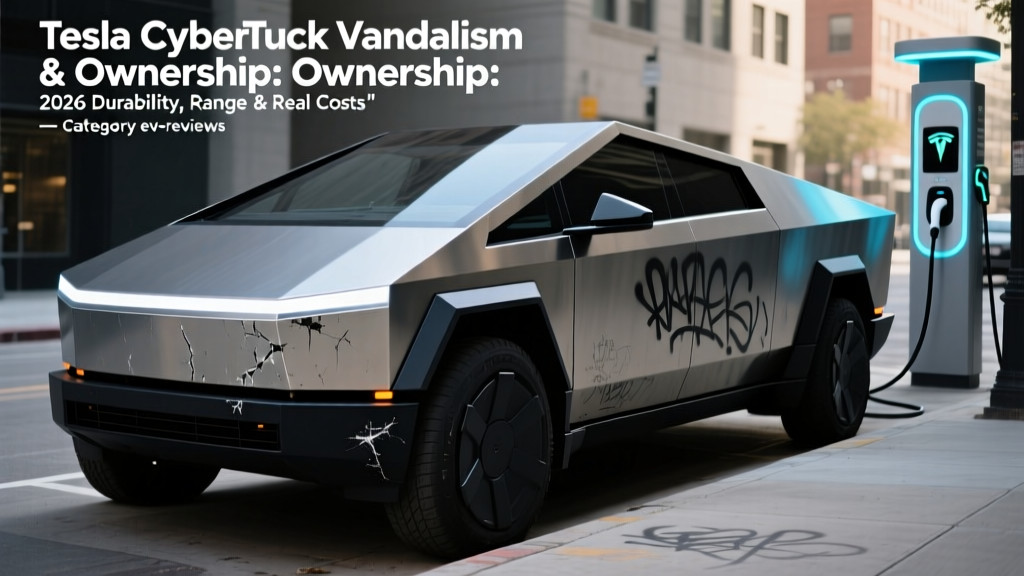
The Tesla Cybertruck's angular stainless-steel exoskeleton was designed to shrug off bullets, baseballs, and — by extension — the scratches and dents that plague conventional trucks. But viral videos of keyed panels, shattered windows, and dented beds have sparked a specific search query among prospective buyers: Cybertruck vandalism. Is the truck actually more resistant to malicious damage than a Ford F-150 Lightning or Rivian R1T, or does its unconventional skin invite more trouble than it solves?
This review goes beyond the internet drama to evaluate the Cybertruck as a complete electric pickup — its real-world range, charging speed, pricing after tax credits, and whether its stainless-steel body genuinely protects your investment. If you're weighing a 2026 Cybertruck purchase, here's every number you need.
Cybertruck Vandalism: Does Stainless Steel Actually Deter Damage?
The Cybertruck's 30X cold-rolled stainless-steel body panels are harder than conventional automotive steel and aluminum. Tesla claims the material resists dents from minor impacts and won't rust or require traditional paint. In practice, this means:
- Key scratches: The unpainted brushed finish makes shallow key marks less visible than on a glossy painted surface. Deeper gouges into the steel are possible but require significant force.
- Dents: The ultra-hard 30X alloy resists door-ding dents far better than aluminum or mild steel panels. However, it cannot be conventionally repaired — a significant dent typically requires full panel replacement.
- Window vulnerability: The "armor glass" famously cracked during Tesla's 2019 demo. Production trucks use improved laminated glass, but it remains a target for determined vandals, as does any vehicle glass.
- Bed and tonneau: The composite bed liner and stainless tonneau resist scratches well, though the tonneau mechanism has been a reliability concern for early owners.
The reality is nuanced. The Cybertruck's appearance deters casual vandalism because vandals assume it's harder to damage. But its high-profile, polarizing design also makes it a target for ideologically motivated attacks. Insurance data from 2025 suggests Cybertruck comprehensive claims trend slightly higher than the F-150 Lightning, driven more by glass replacement and panel-replacement costs than frequency of incidents.
| Spec | AWD | Cyberbeast |
|---|---|---|
| EPA Range | 340 miles | 320 miles |
| Battery (usable) | ~123 kWh (NMC) | ~123 kWh (NMC) |
| Peak DC Fast Charge | 250+ kW (800V architecture) | 250+ kW (800V architecture) |
| 10–80% Charge Time | ~18 minutes | ~18 minutes |
| Level 2 Home Charging | 11.5 kW (~44 mi/hr) | 11.5 kW (~44 mi/hr) |
| 0–60 mph | 3.9 seconds | 2.6 seconds |
| Horsepower | 600 hp | 845 hp |
| Drivetrain | Dual-Motor AWD | Tri-Motor AWD |
| MPGe (combined) | 67 MPGe | 64 MPGe |
| Efficiency | 48 kWh/100mi | 52 kWh/100mi |
| Towing Capacity | 11,000 lbs | 11,000 lbs |
| Bed Length | 6 ft (72 in) | 6 ft (72 in) |
| Cargo Volume (bed + frunk) | ~67 cu ft bed + 7 cu ft frunk | ~67 cu ft bed + 7 cu ft frunk |
| Base MSRP | $79,990 | $99,990 |
| Battery/Drive Unit Warranty | 8 years / 120,000 miles | 8 years / 120,000 miles |
Range, Battery & Efficiency: The Real-World Picture
The AWD Cybertruck carries an EPA-estimated 340 miles of range; the tri-motor Cyberbeast is rated at 320 miles. However, the truck's massive frontal area and ~6,800-lb curb weight hit efficiency hard at highway speeds. Expect 260–290 miles of real-world range at 70–75 mph in moderate temperatures. In cold weather (below 30°F), range can drop an additional 15–25%, bringing effective highway range to roughly 210–240 miles on a full charge. City driving with regenerative braking recovers more energy, yielding closer to EPA figures.
The Cybertruck uses a large ~123 kWh usable NMC (nickel-manganese-cobalt) battery pack operating on an 800-volt architecture. Tesla has not offered an LFP (lithium iron phosphate) variant, which makes sense given the energy density required to move this vehicle's mass. The NMC chemistry provides excellent energy density but follows standard degradation best practices: avoid sitting at 100% SoC for extended periods, and try to keep daily charging between 20–80%.
Efficiency figures from fueleconomy.gov show the AWD at roughly 67 MPGe combined (48 kWh/100mi) and the Cyberbeast at 64 MPGe (52 kWh/100mi). For context, that's significantly less efficient than a Model Y (~120 MPGe) but competitive with the Rivian R1T and slightly better than the GMC Hummer EV Pickup.
Charging Speed: 800V Architecture in Practice
The Cybertruck's 800V electrical architecture enables faster charging than most 400V competitors. Here's what owners actually experience:
| Charge Type | Max Power | Speed | Notes |
|---|---|---|---|
| Level 1 (120V) | ~1.4 kW | ~3–4 mi/hr | Emergency/trickle only |
| Level 2 (240V, 48A) | 11.5 kW | ~44 mi/hr | Full charge in ~10–11 hours |
| DC Fast Charge (V4 Supercharger) | 250+ kW | ~1,000+ mi/hr peak | 10–80% in ~18 min |
| DC Fast Charge (350 kW CCS station w/ adapter) | ~200 kW sustained | ~700+ mi/hr peak | Charge curve tapers above 80% |
Charge curve reality: Like all large-battery EVs, the Cybertruck doesn't sustain its peak charge rate for the entire session. You'll see peak rates between roughly 10–40% SoC, after which the curve progressively tapers. Charging from 10–80% takes approximately 18 minutes at a V3 or V4 Supercharger, but 80–100% can add another 20+ minutes. For road trips, plan stops around the 10–80% window to minimize time at the charger.
The Cybertruck ships with a NACS (North American Charging Standard) connector, giving it native access to Tesla's Supercharger network — the most reliable DC fast-charging network in North America. Tesla also provides access to its expanding V4 Supercharger stalls, which support higher power delivery.
Performance & Capability: Tri-Motor Muscle
The Cybertruck's performance numbers are genuinely supercar-rivaling in the Cyberbeast trim. The tri-motor configuration produces 845 horsepower and achieves a 2.6-second 0–60 mph time — making it one of the quickest production pickups ever built. The dual-motor AWD trim is hardly slow at 3.9 seconds to 60 mph with 600 hp.
Capability specs include:
- Towing: 11,000 lbs rated capacity (both trims). Note that towing at max capacity will reduce range by 40–60% depending on trailer profile and terrain.
- Payload: ~2,500 lbs in the bed.
- Off-road: Adaptive air suspension provides up to 16 inches of ground clearance in Extract mode, with approach/departure angles competitive with mid-size off-road trucks.
- Bed: 6-foot composite bed with a powered stainless-steel tonneau cover. The vault-style design is lockable and weather-sealed.
- Frunk: ~7 cu ft front trunk, useful for groceries or charging cables.
- Steer-by-wire: The Cybertruck uses a fully electronic steer-by-wire system with a yoke-style steering wheel. This provides a variable steering ratio (fewer turns lock-to-lock at low speeds) but has drawn polarizing reviews from drivers accustomed to traditional mechanical steering.
Pricing, Tax Credits & Total Cost
The 2026 Cybertruck lineup has simplified into two main trims after Tesla discontinued the base RWD model's initial reservation timeline:
| Trim | Base MSRP | §30D Credit Eligible? | Effective Price (w/ credit) |
|---|---|---|---|
| AWD (Dual Motor) | $79,990 | No — exceeds $80,000 truck MSRP cap* | $79,990 |
| Cyberbeast (Tri Motor) | $99,990 | No — exceeds MSRP cap | $99,990 |
*Under IRS §30D rules, trucks (including pickups) have an $80,000 MSRP cap for the new clean vehicle credit. The AWD trim at $79,990 sits at the threshold, but destination fees, mandatory options, or dealer-installed accessories can push the final MSRP above the cap. Verify the exact vehicle MSRP on the window sticker before purchase. Buyer income limits also apply ($300,000 MFJ / $150,000 single). Battery component and critical-mineral sourcing requirements must also be met. See IRS §30D guidance for current-year rules. A point-of-sale transfer is available if all requirements are satisfied.
In practice, most Cybertruck buyers will not qualify for the full $7,500 federal tax credit due to the MSRP cap and battery-sourcing requirements. Some buyers may qualify for a partial credit depending on the specific vehicle's battery mineral sourcing and their adjusted gross income. Always consult a tax professional and verify the specific VIN's eligibility before counting on the credit in your purchase budget.
Insurance costs for the Cybertruck run significantly higher than average for the truck segment. Expect annual premiums of $3,000–$4,500+ depending on your profile and location, driven by the vehicle's high repair costs (stainless panel replacement, armor glass, sensor recalibration) and performance capability.
Tech, Interior & Driver Assistance
The Cybertruck's interior is minimalist even by Tesla standards — a single 18.5-inch front touchscreen handles nearly all vehicle functions, with a secondary 9.4-inch rear touchscreen for passengers. Notable tech features include:
- Autopilot: Standard adaptive cruise control and lane-keeping (SAE Level 2 driver assistance — driver must remain engaged at all times).
- Full Self-Driving (Supervised): Optional $8,000 add-on (or $99/month subscription). Despite the name, FSD remains an SAE Level 2 system requiring continuous driver supervision. It handles highway lane changes, city intersections, and parking maneuvers but is not autonomous.
- Steer-by-wire: Fully electronic steering with no mechanical linkage. Enables variable ratio and 4-wheel steering for a tighter turning radius.
- Powershare: Vehicle-to-load (V2L) capability with 120V and 240V outlets in the bed, capable of powering tools or providing emergency home backup (up to 11.5 kW continuous).
- Bioweapon Defense Mode: HEPA filtration system for cabin air quality.
Notable drawbacks: Rear visibility is poor due to the sloping bed design and lack of a rear window (a camera-based digital rearview mirror compensates). The yoke steering and steer-by-wire system require a meaningful adjustment period. Build quality on early production units drew criticism for panel gaps and tonneau-cover issues, though 2025–2026 production has improved. The angular design also makes the truck too wide for some older parking structures and tight urban streets.
Who Should Buy the Cybertruck — And Who Shouldn't
Pros
- Stainless-steel body resists dents, scratches, and corrosion better than painted trucks
- Tri-motor Cyberbeast offers supercar acceleration (2.6s 0–60)
- Native NACS connector with Tesla Supercharger network access
- 11,000-lb towing and robust V2L powershare capability
- Air suspension with up to 16 in. ground clearance for off-road use
- 8-year/120,000-mile battery and drive unit warranty
Cons
- Real-world highway range falls well short of EPA sticker (~260–290 mi)
- Likely ineligible for the $7,500 federal EV tax credit due to MSRP cap
- High insurance premiums ($3,000–$4,500+/year)
- Stainless panels require full replacement if significantly damaged — costly repairs
- Yoke steering and steer-by-wire polarize drivers
- Poor rear visibility; reliance on camera-based mirrors
- Polarizing design attracts attention — including unwanted attention from vandals
Choose the Rivian R1T instead if: You prioritize a more conventional driving experience, a quad-motor option with independent wheel control, or a more refined interior. The R1T offers competitive range and a more practical gear tunnel.
Choose the Ford F-150 Lightning if: You need proven fleet/truck usability, a lower starting price, a traditional steering wheel, and broader dealer-service support. The Lightning's range is lower, but its familiarity and Pro Power Onboard are strong work-truck assets.
Cybertruck Ownership Costs vs. Competitors
Beyond the sticker price, Cybertruck ownership involves several cost considerations that differentiate it from rivals:
- Charging cost: At an average residential rate of $0.16/kWh, fully charging the ~123 kWh battery costs roughly $19.70 at home. Public DC fast charging at $0.35–$0.50/kWh brings a 10–80% session to approximately $25–$35.
- Tire replacement: The Cybertruck uses custom 35-inch all-terrain tires. Replacement sets run $1,600–$2,400 and may need replacement every 20,000–30,000 miles given the vehicle's weight and torque.
- Maintenance: Minimal compared to ICE trucks — no oil changes, no transmission fluid. Expect cabin air filter replacements, wiper fluid, brake fluid checks, and occasional washer nozzle service. Tesla's mobile service handles most items.
- Depreciation: Early Cybertruck resale values have been volatile. Some early Foundation Series units sold above MSRP on the secondary market, but standard production models are settling. Expect depreciation in line with other premium EVs — roughly 40–50% over 5 years, though this remains uncertain given the model's novelty.
Frequently Asked Questions
Is the Cybertruck bulletproof against vandalism?
No. The stainless-steel body resists dents and shallow scratches far better than painted steel or aluminum, but it is not impervious. Determined vandals can damage glass, deep-gouge steel with hardened tools, or target the tonneau mechanism. The truck's high-visibility design can also make it a more frequent target. Insurance comprehensive coverage is strongly recommended.
What is the real-world range of the Cybertruck?
The EPA rates the AWD at 340 miles and the Cyberbeast at 320 miles. In real-world highway driving at 70–75 mph, expect 260–290 miles. Cold weather (below 30°F) can reduce this further to 210–240 miles. City driving with regenerative braking gets closer to EPA estimates.
How fast does the Cybertruck charge at home and on the road?
At home on a 240V Level 2 charger (11.5 kW), the Cybertruck adds approximately 44 miles of range per hour, with a full charge taking 10–11 hours. On a Tesla V3/V4 Supercharger, it peaks above 250 kW and charges from 10–80% in approximately 18 minutes.
Does the Cybertruck qualify for the $7,500 federal EV tax credit?
Most likely not. The IRS §30D credit imposes an $80,000 MSRP cap for trucks. The AWD trim at $79,990 sits at the limit, but destination fees and options can push it over. The Cyberbeast at $99,990 is well above the cap. Buyer income limits and battery-sourcing requirements add further restrictions. Consult IRS guidance and a tax professional.
How does the Cybertruck's warranty compare to competitors?
Tesla covers the Cybertruck's battery and drive units for 8 years or 120,000 miles (whichever comes first), with a minimum 70% capacity retention threshold. The basic vehicle limited warranty is 4 years / 50,000 miles. This is competitive with the Rivian R1T (8 years/175,000 miles for battery) and Ford F-150 Lightning (8 years/100,000 miles for battery).
Is the Cybertruck worth buying over the Rivian R1T or F-150 Lightning?
It depends on your priorities. The Cybertruck wins on raw acceleration, Supercharger network access, and stainless-steel durability. The R1T offers a more refined interior, a gear tunnel, and available quad-motor torque vectoring. The F-150 Lightning provides the most traditional truck experience with the widest service network. Test-drive all three and weigh range, charging access, and daily usability for your specific needs.