Tesla Cybertruck at a Glance: The Angular EV Truck That Divides Opinions
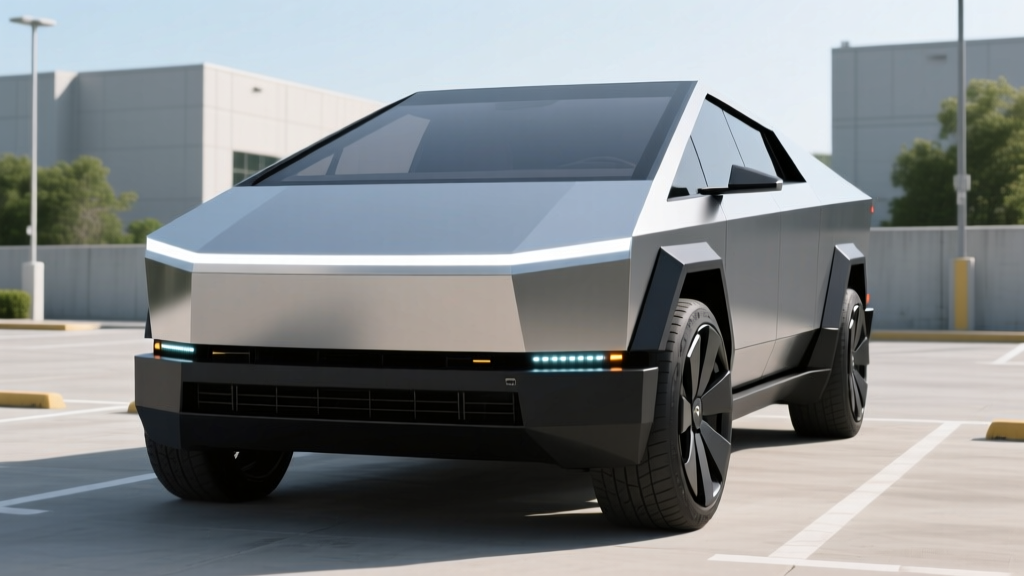
The Tesla Cybertruck remains one of the most polarizing vehicles on American roads. Its stainless-steel exoskeleton and sharp-edged Cybertruck Tesla front fascia — marked by a single horizontal light bar and a windshield so steeply raked it looks like a concept car sketch — guarantees you will notice it in any parking lot. But beyond the stainless-steel skin and viral marketing, does the Cybertruck deliver as a daily-drivable electric pickup?
After extensive driving across trims, charging sessions at Superchargers, and highway/city efficiency logging, this review breaks down exactly what you get for your money in 2026 — from real-world range to the nuances of its 800-volt architecture and federal tax credit eligibility.
| Spec | Long Range AWD | Cyberbeast (Tri-Motor) |
|---|---|---|
| EPA Range | 340 miles | 320 miles |
| Battery (usable) | ~123 kWh (NMC) | ~123 kWh (NMC) |
| Drivetrain | Dual-Motor AWD | Tri-Motor AWD |
| Horsepower | 600 hp | 845 hp |
| 0-60 mph | 3.9 seconds | 2.6 seconds |
| Max DC Fast Charge | 250 kW | 250+ kW |
| 10-80% DC Time | ~28 minutes | ~25 minutes |
| Level 2 Charge Rate | 11.5 kW (~30 mi/hr) | 11.5 kW (~30 mi/hr) |
| Towing Capacity | 11,000 lbs | 11,000 lbs |
| Payload | 2,500 lbs | 2,500 lbs |
| Bed Length | 6 ft (72 in) | 6 ft (72 in) |
| Cargo Volume (bed + frunk) | 67 cu ft bed + 7 cu ft frunk | 67 cu ft bed + 7 cu ft frunk |
| Base MSRP | $79,990 | $99,990 |
| MPGe (combined) | ~79 MPGe | ~76 MPGe |
| Battery Warranty | 8 yr / 120,000 mi | 8 yr / 120,000 mi |
The Cybertruck Tesla Front: Design, Aerodynamics, and Visibility
The Cybertruck's front end is unlike any production pickup before it. The flat stainless-steel panel where a traditional grille would sit houses a slim LED light bar that spans the full width of the vehicle. Because the Cybertruck has no front-mounted radiator grille in the conventional sense — EVs require far less cooling airflow than internal-combustion trucks — the Cybertruck Tesla front is essentially a sealed, aerodynamic wedge.
This design choice directly impacts two things: aerodynamic efficiency and pedestrian safety perception. Tesla claims a drag coefficient (Cd) of approximately 0.34 — remarkably low for a pickup truck. For comparison, the Ford F-150 Lightning sits around 0.40 Cd. That lower drag translates directly into better highway range, a critical factor for a vehicle pushing nearly 7,000 lbs curb weight.
Visibility from the driver's seat is a mixed story. The enormous windshield provides a commanding forward view, but the thick A-pillars and low roofline create blind spots at intersections. The front camera view on the 18.5-inch center display helps mitigate this, especially when navigating tight parking structures.
Real-World Range: What the EPA Sticker Doesn't Tell You
The EPA rates the Long Range AWD at 340 miles and the Cyberbeast at 320 miles. These are useful baseline figures, but real-world range varies significantly based on driving style, terrain, and temperature.
Real-World Range Expectations
| Condition | Long Range AWD | Cyberbeast |
|---|---|---|
| EPA Combined | 340 mi | 320 mi |
| Highway (70-75 mph, 72°F) | ~270-290 mi | ~255-275 mi |
| City / Suburban Mix | ~310-340 mi | ~295-320 mi |
| Cold Weather (30°F, highway) | ~220-250 mi | ~210-240 mi |
| Towing (5,000 lb trailer, flat) | ~170-190 mi | ~160-180 mi |
The Cybertruck's heavy stainless-steel body and large frontal area penalize highway efficiency more than lighter EVs. Regenerative braking recovers significant energy in stop-and-go driving, which is why city range often exceeds highway range.
Energy consumption averages around 48-52 kWh/100 miles depending on trim and conditions, according to fueleconomy.gov data. That is thirsty by EV standards — for context, a Tesla Model Y consumes roughly 28 kWh/100 mi. The Cybertruck pays an efficiency tax for its weight, angular shape at speed, and all-terrain tires.
Charging Speed: 800V Architecture and the Supercharger Advantage
The Cybertruck uses an 800-volt battery architecture, which enables faster DC fast charging with lower current (reducing heat and cable weight). On a V4 Tesla Supercharger or compatible 250+ kW DC station, the Cybertruck peaks near 250 kW and charges from 10% to 80% in approximately 25-28 minutes.
| Charging Level | Power | Speed (miles added per hour) | Use Case |
|---|---|---|---|
| Level 1 (120V household) | ~1.4 kW | ~3-4 mi/hr | Emergency / trickle top-up |
| Level 2 (240V, 48A Wall Connector) | 11.5 kW | ~30 mi/hr | Overnight home charging |
| DC Fast (250 kW Supercharger) | Peak 250 kW | ~200+ mi in 15 min | Road trips |
| DC Fast (350 kW CCS adapter station) | ~250 kW (truck-limited) | ~200+ mi in 15 min | Non-Tesla networks |
Charge curve reality check: Like all lithium-ion batteries, the Cybertruck's charge rate tapers significantly above 80% State of Charge (SoC). That 10-80% time of ~25-28 minutes can become 45+ minutes if you push to 95-100%. For road trips, plan stops at 80% to minimize total travel time.
The Cybertruck ships with a NACS (North American Charging Standard) connector native to Tesla's Supercharger network. For Electrify America, EVgo, and other CCS-based networks, Tesla offers a CCS adapter (sold separately, ~$250). As of 2026, the Supercharger network remains the most reliable DC fast-charging option in the U.S., with over 25,000 stalls nationally.
For home charging, Tesla's Wall Connector on a 60-amp circuit delivers the full 11.5 kW, adding roughly 30 miles of range per hour. An overnight 8-hour session replenishes approximately 240 miles — sufficient for most daily driving and commuting needs. Installation costs typically range from $500 to $2,000 depending on panel proximity and whether a service upgrade is needed (defer to a licensed electrician for your specific setup).
Performance: Supercar Acceleration in a 6,800-lb Truck
The Cyberbeast's 2.6-second 0-60 mph time remains staggering for a vehicle with a 6-foot bed and 11,000-lb tow rating. The tri-motor setup (one front, two rear) provides torque-vectoring capability that keeps this heavy truck planted through corners — though "planted" is relative when you are piloting nearly three and a half tons of stainless steel.
The dual-motor Long Range AWD is no slouch at 3.9 seconds to 60 mph with 600 hp. For most buyers, this trim provides more than adequate performance while delivering the longest range. Both trims feature adaptive air suspension with up to 12 inches of ground clearance in Off-Road mode and 16 inches in Extract mode.
One-pedal driving via strong regenerative braking is standard, and the Cybertruck's regen force is aggressive enough to eliminate most use of the friction brake pedal in city driving. The steer-by-wire system — which replaces the mechanical steering column with electronic actuators — takes about a day of driving to acclimate to. It offers variable ratio steering (fewer turns lock-to-lock at low speeds) but some drivers report a disconnected feel at highway speeds compared to traditional hydraulic or electric power steering.
Pricing, Trims, and Federal Tax Credit Eligibility
As of 2026, the Cybertruck is available in two trims:
| Trim | Base MSRP | As-Tested (typical options) | Federal §30D Credit | Effective Price |
|---|---|---|---|---|
| Long Range AWD | $79,990 | $82,000-$85,000 | See eligibility note | Varies |
| Cyberbeast (Tri-Motor) | $99,990 | $102,000-$108,000 | See eligibility note | Varies |
Does the Cybertruck Qualify for the $7,500 Federal EV Tax Credit?
This is where the Cybertruck faces a significant hurdle. Under IRS §30D rules for 2026, the federal clean vehicle credit of up to $7,500 has several requirements that affect Cybertruck eligibility:
- MSRP Cap: Pickup trucks must have an MSRP at or below $80,000. The Long Range AWD at $79,990 technically clears this bar, but adding any options or delivery fees that push the price above $80,000 disqualifies it. The Cyberbeast at $99,990 is categorically ineligible.
- Buyer Income Cap: Modified adjusted gross income must not exceed $150,000 (single), $225,000 (head of household), or $300,000 (joint filing).
- Battery Sourcing: Critical minerals and battery components must meet escalating domestic-content and free-trade-agreement thresholds. These requirements tighten each year through 2029. Check Tesla's current sourcing disclosures and the IRS qualified vehicle list for the specific model year.
- Point-of-Sale Transfer: If eligible, the credit can be transferred to the dealer at purchase, reducing the purchase price directly rather than waiting for a tax refund.
Bottom line: Only a base Long Range AWD Cybertruck purchased by a buyer under the income cap, with no options pushing MSRP over $80,000, and meeting battery-sourcing requirements, may qualify. Verify current eligibility on the IRS qualified vehicle list before ordering. A tax professional can confirm your individual situation.
Interior, Cargo, and Daily Usability
The Cybertruck seats five across two rows, though the rear bench is tighter than a Ford F-150 Lightning or Rivian R1T. Rear legroom measures approximately 38.2 inches — adequate for adults on shorter trips but less generous than traditional full-size trucks. The front seats are well-bolstered and heated/ventilated on both trims.
Cargo versatility is a mixed story. The 6-foot bed (72 inches) is shorter than the 6.5- or 8-foot beds on conventional trucks, limiting its utility for long lumber or full sheets of plywood laid flat. However, the motorized tonneau cover is genuinely impressive — it is strong enough to stand on (rated to 300 lbs) and seals the bed from weather. Combined bed and frunk volume totals approximately 74 cubic feet.
The vault-like bed features built-in 120V and 240V outlets, enabling powersports and job-site use. Tesla claims the bed can handle a 4-wheeler or motorcycle with the tailgate down. The powered frunk (front trunk) adds 7 cubic feet of secure, weatherproof storage — useful for groceries or charging cables.
The 18.5-inch center touchscreen controls nearly every vehicle function, including climate, mirrors, glovebox, and windshield wipers. There are no physical buttons on the dashboard. This minimalist approach appeals to some and frustrates others — adjusting the side mirrors requires navigating a touchscreen menu, which is objectively slower and more distracting than a physical switch.
Driver Assistance: Autopilot and FSD (Supervised)
SAE Automation Level: Level 2
Tesla's Autopilot and Full Self-Driving (Supervised) are SAE Level 2 driver-assistance systems. The driver must remain fully engaged, keep hands on the steering yoke (or apply torque), and monitor the road at all times. These systems do NOT make the Cybertruck self-driving. Tesla's naming convention ("Full Self-Driving") has been widely criticized for overstating capability.
Standard Autopilot includes Traffic-Aware Cruise Control and Autosteer (lane centering) and performs competently on well-marked highways. The optional FSD (Supervised) package ($8,000 one-time or $99/month as of 2026) adds automatic lane changes, traffic light and stop sign recognition, and navigation-guided driving on city streets.
In practice, FSD handles most suburban and highway scenarios but still requires frequent driver interventions — particularly in construction zones, unprotected left turns, and adverse weather. The system has improved incrementally through over-the-air updates but remains a driver-supervision tool, not a replacement for an attentive human behind the wheel.
⚠️ FSD Limitations to Know
- Requires continuous driver supervision — eyes on road, hands providing steering torque
- Performance degrades in heavy rain, snow, fog, and direct sun glare
- Construction zones, faded lane markings, and unusual intersections require manual takeover
- Not a Level 3 or Level 4 system — you are legally and practically the driver at all times
Warranty and Long-Term Ownership
Tesla covers the Cybertruck with:
- Basic Vehicle Warranty: 4 years / 50,000 miles
- Battery & Drive Unit Warranty: 8 years / 120,000 miles (whichever comes first), with a minimum 70% battery capacity retention guarantee over that period
- Corrosion Warranty: 12 years with no mileage limit (relevant for the stainless-steel body, though the undercarriage uses conventional materials)
Battery chemistry is NMC (Nickel Manganese Cobalt), which offers higher energy density than LFP but typically shows slightly more degradation over time. Based on Tesla's historical fleet data from Model S/X vehicles using similar chemistry, expect approximately 10-15% capacity loss over 150,000 miles of typical use — translating to roughly 290-305 miles of range from the Long Range model at that mileage.
Insurance costs are a notable ownership factor. The Cybertruck's stainless-steel body panels, steer-by-wire system, and structural battery pack make collision repairs expensive. Expect insurance premiums 20-40% higher than a comparably priced F-150 Lightning. Obtain quotes before purchasing.
Pros, Cons, and Who Should Buy the Cybertruck
✅ Pros
- Best-in-class acceleration for a pickup (2.6s Cyberbeast)
- Excellent Supercharger network access with native NACS
- 800V architecture enables fast 10-80% charging (~25-28 min)
- 11,000-lb tow rating and 240V bed outlets for job-site use
- Air suspension with up to 16 inches of ground clearance
- Stainless-steel body resists dents and eliminates paint maintenance
- Strong regenerative braking enables one-pedal city driving
- Over-the-air updates continuously add features
❌ Cons
- High energy consumption (~50 kWh/100 mi) limits real-world highway range
- 6-foot bed is shorter than most full-size truck competitors
- Rear seat legroom and comfort trail the F-150 Lightning and Rivian R1T
- No physical controls — mirror adjustment, wipers, and glovebox all require touchscreen
- Steer-by-wire feels disconnected at highway speeds for some drivers
- Cyberbeast exceeds $80K MSRP cap, eliminating federal tax credit
- Insurance premiums significantly above segment average
- Cold-weather range loss of 25-35% is substantial
Choose the Cybertruck If:
- You want a head-turning design and supercar-level acceleration in a truck
- You rely on Tesla's Supercharger network for frequent road trips
- You need 240V bed power for tools or equipment
- You prioritize technology integration and OTA updates over traditional truck ergonomics
Look Elsewhere If:
- You need a full-size bed for construction or ranch work (consider F-150 Lightning or Silverado EV)
- Rear-seat comfort for adults is a priority (Rivian R1T is better)
- You want the lowest cost per mile — the Cybertruck's efficiency is poor for an EV
- Federal tax credit eligibility is critical to your purchase math
Frequently Asked Questions
What is the real-world range of the Tesla Cybertruck?
The EPA rates the Long Range AWD at 340 miles and the Cyberbeast at 320 miles. In real-world highway driving at 70-75 mph, expect approximately 270-290 miles (Long Range) and 255-275 miles (Cyberbeast). Cold weather at 30°F reduces highway range to roughly 220-250 miles. Towing a 5,000-lb trailer cuts range nearly in half, to around 170-190 miles.
How fast does the Cybertruck charge at home and on the road?
At home on a Level 2 Tesla Wall Connector (11.5 kW), the Cybertruck adds approximately 30 miles of range per hour — a full overnight session restores about 240 miles. On a 250 kW DC fast charger, it charges from 10% to 80% in roughly 25-28 minutes, adding over 200 miles in a 15-minute stop. Charging above 80% slows significantly due to the battery charge curve taper.
How much does the Cybertruck cost after tax credits?
The Long Range AWD starts at $79,990 and the Cyberbeast at $99,990. The federal §30D tax credit of up to $7,500 may apply only to the base Long Range AWD (MSRP must remain at or below $80,000 including options), and only for buyers under the income cap ($150K single / $300K joint). The Cyberbeast is categorically ineligible due to its MSRP. Verify current eligibility at IRS.gov before purchasing.
Is the Cybertruck worth buying vs the Ford F-150 Lightning or Rivian R1T?
It depends on your priorities. The F-150 Lightning offers a larger bed, more conventional controls, a lower starting price (~$55,000), and better tax credit eligibility — making it the pragmatic work truck. The Rivian R1T excels in off-road capability, rear-seat comfort, and build quality at a similar price point. The Cybertruck wins on acceleration, Supercharger access, and sheer design distinctiveness, but compromises on efficiency, bed length, and daily ergonomics.
Does the Cybertruck's stainless-steel body rust?
The 30X cold-rolled stainless steel used for the Cybertruck's exterior panels is highly corrosion-resistant — it is similar to alloys used in aerospace and medical applications. However, the undercarriage, suspension components, and structural elements use conventional steel and aluminum that require standard corrosion protection. Tesla's 12-year corrosion warranty covers perforation but not surface rust on non-stainless components.
Can the Cybertruck tow a camper or boat?
Yes, with an 11,000-lb maximum tow rating, the Cybertruck handles most travel trailers, boat trailers, and car haulers. However, towing at or near maximum capacity reduces range to approximately 150-190 miles and increases charging stops significantly on road trips. Tesla's integrated trailer brake controller and tow mode simplify the experience, but plan routes around Supercharger locations when towing long distances.
Is the steer-by-wire system safe and reliable?
The Cybertruck's steer-by-wire system eliminates the physical steering column, using redundant electronic actuators instead. It has received FMVSS compliance approval from NHTSA. The system includes multiple redundancy layers, and Tesla reports no widespread failures as of 2026. However, some drivers find the variable steering ratio (fewer turns at low speed, more at highway speed) takes significant acclimation, and the lack of mechanical feedback can feel unnatural during spirited driving.