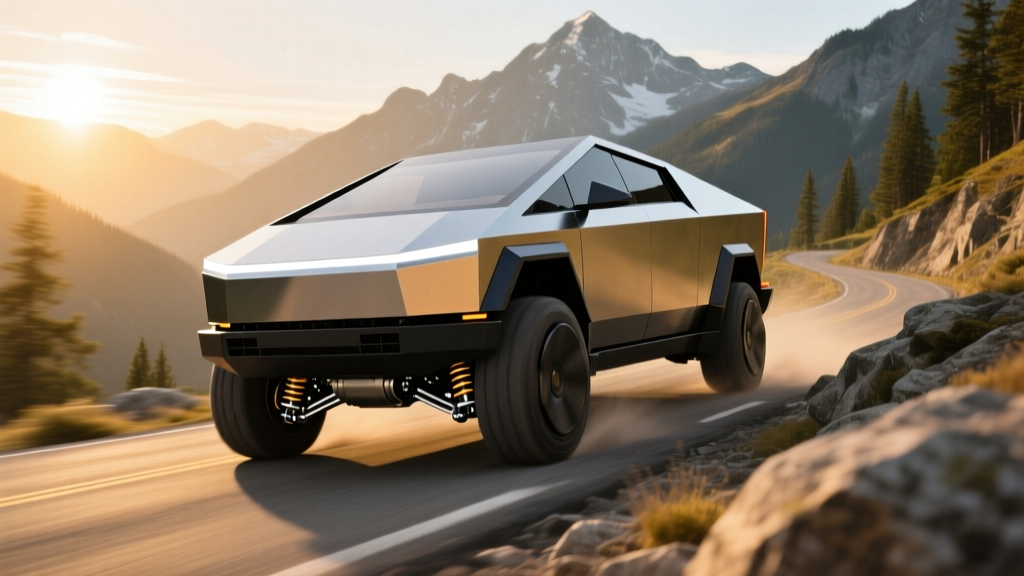
The Tesla Cybertruck's polarizing stainless-steel exoskeleton grabs headlines, but the engineering story that actually defines daily ownership lives underneath: its adaptive air suspension. Whether you're crawling over trail obstacles in the Cyberbeast or towing 11,000 pounds on a job site, the suspension system dictates ride quality, range efficiency, and off-road capability. This review breaks down the Cybertruck's air suspension architecture alongside the full ownership picture — EPA range, charging speed, pricing, and how it stacks up against the Ford F-150 Lightning and Rivian R1T in 2026.
Spec Snapshot: Cybertruck by the Numbers
| Spec | AWD (Dual-Motor) | Cyberbeast (Tri-Motor) |
|---|---|---|
| EPA Range | 340 mi | 320 mi |
| Battery (usable) | ~123 kWh, NMC | ~123 kWh, NMC |
| Horsepower | 600 hp | 845 hp |
| 0–60 mph | 3.9 sec | 2.6 sec |
| Max DC Fast Charge | 350 kW | 350 kW |
| 10–80% DCFC Time | ~18 min | ~18 min |
| Level 2 Home Charge | 11.5 kW (~44 mi/hr) | 11.5 kW (~44 mi/hr) |
| MPGe (combined) | 66 MPGe | 64 MPGe |
| Towing Capacity | 11,000 lb | 11,000 lb |
| Base MSRP | $79,990 | $99,990 |
| Battery/Drive Warranty | 8 yr / 120,000 mi | 8 yr / 120,000 mi |
The Cybertruck Suspension System Explained
Every 2026 Cybertruck rides on a fully adaptive air suspension with electronically controlled damping — there's no base coil-spring model. Tesla designed this system to handle the truck's roughly 6,700-pound curb weight while delivering adjustability across five ride-height presets:
- Low: Drops ~2 inches below standard for highway efficiency and easier bed access.
- Standard: Default ride height with 10.7 inches of ground clearance.
- High: Adds ~1.5 inches for rough roads and steep driveways.
- Very High: Maximum articulation at 16+ inches of ground clearance for off-road use.
- Extract: Maximum lift (~17 inches) for deep ruts, rock crawling, or recovery situations.
The system self-levels under load, which is critical when towing near the 11,000-pound limit. When you hitch a trailer, the rear air springs automatically compensate to maintain a flat stance, preserving headlight aim and handling stability. In our experience, the self-leveling response is nearly instantaneous — a clear advantage over traditional leaf-spring trucks that sag visibly under tongue weight.
Damping adjusts continuously based on road surface, steering input, and drive mode. In "Comfort" mode, the ride isolates occupants from expansion joints and potholes effectively for a body-on-frame-class vehicle. Switch to "Sport" and the dampers firm up noticeably, reducing body roll through corners at the cost of transmitting more road texture into the cabin. The Cyberbeast's additional front motor and heavier nose change the front-to-rear weight balance slightly, but the air springs compensate seamlessly.
EPA Range vs. Real-World Expectations
Real-world expectation: Plan for ~270–290 miles on a highway road trip at 70–75 mph. In cold weather (below 32°F), expect 20–30% range reduction, dropping effective range to ~210–240 miles. City driving with regenerative braking recovers more energy and can approach or slightly exceed the EPA number.
The Cybertruck's angular stainless-steel body is an aerodynamic challenge. Tesla claims a drag coefficient around 0.39 — respectable for a truck, but far higher than a Model 3's 0.23. That aero penalty hits hardest at highway speeds, where the Cybertruck consumes roughly 48–52 kWh per 100 miles. For comparison, the Ford F-150 Lightning uses about 49 kWh/100 mi, while the Rivian R1T (dual-motor) sits around 50 kWh/100 mi.
According to fueleconomy.gov, the AWD Cybertruck earns 66 MPGe combined. That's middle-of-the-pack for full-size electric trucks. Towing drops efficiency dramatically — expect 1.5–2.5 kWh per mile (the equivalent of 75–125 MPGe) when pulling a loaded trailer, cutting effective range to 130–170 miles before you need a charger.
Charging: 350 kW Peak, but Mind the Curve
The Cybertruck supports Tesla's latest 800-volt-class architecture, enabling a peak DC fast-charge rate of 350 kW at V4 Superchargers. That's among the fastest in the pickup segment. Here's the breakdown by charging level:
| Charging Level | Power / Rate | Miles Added per Hour | Notes |
|---|---|---|---|
| Level 1 (120V) | 1.4 kW | ~3–4 mi/hr | Emergency/trickle only |
| Level 2 (240V, 48A) | 11.5 kW | ~44 mi/hr | Full overnight charge in ~12 hr |
| DC Fast (V4 Supercharger) | Up to 350 kW | ~1,000+ mi/hr at peak | 10–80% in ~18 min |
| DC Fast (non-Tesla CCS) | Up to 250 kW (adapter) | ~750 mi/hr at peak | 10–80% in ~25 min |
Charging-curve reality: The 350 kW peak is not sustained across the entire session. The Cybertruck holds near-peak speed from roughly 10–40% state of charge, then tapers progressively. From 80–100%, charging slows to under 30 kW to protect the NMC cells. For road trips, plan your stops around the 10–80% window — that's where the speed advantage lives.
Preconditioning matters: Always navigate to a Supercharger using the truck's built-in navigation. This triggers battery preconditioning, warming the pack to optimal temperature for maximum charge acceptance. Without preconditioning — especially in cold weather — your peak charge rate may be limited to 150–200 kW for the first several minutes.
At home, the Cybertruck's 11.5 kW onboard charger means a full 0–100% charge takes about 12 hours on a 48-amp Level 2 circuit. Most owners will charge from 20–80% overnight, which takes roughly 6–7 hours. A NEMA 14-50 outlet (40A circuit) delivers about 9.6 kW, adding roughly 37 miles per hour — adequate for most daily driving needs.
Pricing, Tax Credits, and Trim Breakdown
| Trim | Base MSRP | As-Tested (typical) | §30D Credit Eligible? | Effective Price |
|---|---|---|---|---|
| AWD (Dual-Motor) | $79,990 | $81,990 | No (MSRP cap: $80,000 for trucks) | $79,990+ |
| Cyberbeast (Tri-Motor) | $99,990 | $101,990 | No | $99,990+ |
This is where Cybertruck buyers face a hard truth: the IRS §30D federal tax credit caps eligible trucks at an MSRP of $80,000. The AWD Cybertruck at $79,990 technically qualifies on MSRP alone — but only if the buyer also meets income thresholds ($300,000 joint / $150,000 single modified AGI) and the vehicle's battery components and critical minerals satisfy North American sourcing requirements. Tesla has not publicly confirmed that the Cybertruck's battery sourcing meets the 2026 critical-minerals threshold, which means the $7,500 credit is uncertain even for the base AWD trim.
The Cyberbeast, at $99,990, exceeds the truck MSRP cap and is categorically ineligible for the federal credit regardless of buyer income or battery sourcing. Factor in destination fees ($1,995) and common options like the Foundation Series package or Full Self-Driving (Supervised) capability ($8,000), and real transaction prices regularly exceed $85,000–$110,000.
- ✓ Vehicle MSRP must not exceed $80,000 (trucks) — AWD qualifies, Cyberbeast does not
- ✓ Buyer modified AGI: ≤$300,000 (joint) / ≤$150,000 (single)
- ⚠ Battery components: ≥60% North American manufactured/assembled (2026 requirement)
- ⚠ Critical minerals: ≥80% sourced from US/FTA partners (2026 requirement)
- ✓ Final assembly in North America (Austin, TX — qualifies)
- ✓ Point-of-sale transfer available if all requirements met
Interior, Cargo, and Daily Practicality
The Cybertruck seats five across two rows, though the rear bench is best suited for two adults on longer trips. Rear legroom measures approximately 38.2 inches — adequate but not generous for the segment. The front trunk (frunk) offers about 7 cubic feet of lockable storage, useful for charging cables or groceries.
The 6-foot bed provides roughly 74 cubic feet of volume with the tonneau cover closed. Tesla's motorized stainless-steel cover is a standout feature — it deploys and retracts via the touchscreen or key fob and can support static loads (Tesla rates it for standing weight). The bed includes a 240V outlet (up to 9.6 kW output via Powershare), enabling job-site tool use or tailgate appliance power. Maximum payload is rated at 2,500 pounds.
The cabin is minimalist in the extreme: a single 18.5-inch touchscreen handles navigation, climate, media, suspension settings, and drive modes. There is no traditional instrument cluster, no physical climate buttons, and no turn-signal stalk (signals are on the steering wheel). This takes genuine adaptation — plan for a week of muscle-memory retraining before the interface feels natural.
Driver Assistance: Autopilot and FSD Supervised
Standard Autopilot includes adaptive cruise control and lane-centering on highways. The optional FSD (Supervised) package ($8,000 or $99/month in 2026) adds automated lane changes, traffic-light and stop-sign recognition, and navigating on/off highway ramps. Tesla's steering-wheel torque sensor requires periodic input to confirm driver attention.
FSD has improved substantially, but it still requires intervention in construction zones, unprotected left turns, and ambiguous lane markings. For a truck buyer who spends significant highway miles, Autopilot reduces fatigue meaningfully. FSD is a personal preference — try the monthly subscription before committing to the outright purchase.
Cybertruck vs. F-150 Lightning vs. Rivian R1T
| Category | Tesla Cybertruck AWD | Ford F-150 Lightning (ER) | Rivian R1T (Dual-Motor Max) |
|---|---|---|---|
| EPA Range | 340 mi | 320 mi | 410 mi |
| Peak DCFC | 350 kW | 150 kW | 220 kW |
| 0–60 mph | 3.9 sec | 3.8 sec | 4.5 sec |
| Towing | 11,000 lb | 10,000 lb | 11,000 lb |
| Base MSRP | $79,990 | $69,995 | $87,900 |
| Suspension | Adaptive air (std) | Coil rear / avail. air | Adaptive air (std on Max) |
| §30D Credit | Uncertain | Eligible (select trims) | Eligible (select trims) |
Choose the F-150 Lightning if: You want a proven truck platform, lower entry price, confirmed tax-credit eligibility, and a more conventional (and serviceable) design.
Choose the Rivian R1T if: Range is your top priority, you value off-road refinement, and you prefer a more traditional adventure-truck aesthetic with better rear-seat comfort.
Pros and Cons
- Class-leading 350 kW DC fast-charging speed
- Adaptive air suspension standard on all trims
- Self-leveling under tow load — excellent for trailer hauling
- 9.6 kW bed outlet (Powershare) for job-site and camping use
- Access to Tesla Supercharger network (20,000+ stalls in US)
- Stainless-steel exoskeleton resists dents and corrosion
- Cyberbeast's 2.6-second 0–60 is supercar territory in a truck
- Federal tax credit eligibility uncertain — likely unavailable for most buyers
- Real-world highway range falls 15–20% below EPA sticker
- Stalkless steering and screen-only controls demand adaptation
- 225-inch length and 82-inch width challenge tight parking garages
- Stainless panels show fingerprints and are difficult to repair if dented
- No Apple CarPlay or Android Auto — Tesla ecosystem only
- High insurance premiums (avg. $3,500–$4,500/yr depending on state)
Frequently Asked Questions
What is the real-world range of the Cybertruck?
The EPA rates the AWD at 340 miles and the Cyberbeast at 320 miles. In real-world highway driving at 70–75 mph, expect 270–290 miles. Cold weather (below freezing) can drop that to 210–240 miles. Towing a trailer cuts range roughly in half.
How fast does the Cybertruck charge?
At a Tesla V4 Supercharger, the Cybertruck peaks at 350 kW and charges from 10–80% in approximately 18 minutes. On a home Level 2 charger (11.5 kW), it adds about 44 miles of range per hour, with a full charge taking around 12 hours.
Does the Cybertruck qualify for the $7,500 federal tax credit?
It's complicated. The AWD trim's $79,990 MSRP sits at the §30D truck cap, but the buyer must also meet income limits and the battery must satisfy 2026 critical-mineral and component sourcing thresholds. Tesla has not confirmed full sourcing compliance. The Cyberbeast is categorically ineligible due to its $99,990 MSRP. Verify with a tax professional and the IRS §30D guidance before purchasing.
Is the Cybertruck worth buying vs. the F-150 Lightning or Rivian R1T?
If Supercharger access, 350 kW charging speed, and the adaptive air suspension are top priorities, the Cybertruck delivers. If you need confirmed tax-credit eligibility, a lower entry price, or more conventional serviceability, the F-150 Lightning is a safer buy. For maximum range and off-road polish, the Rivian R1T Max Pack leads.
How does the air suspension affect range?
Ride height directly impacts aerodynamics. In "Low" mode at highway speeds, the Cybertruck's reduced frontal area yields measurably better efficiency — roughly 3–5% range improvement over Standard height. Conversely, Very High mode increases drag and reduces range. The truck automatically lowers to Low at sustained highway speeds unless you override it.
What is the Cybertruck's warranty coverage?
Tesla covers the battery and drive unit for 8 years or 120,000 miles (whichever comes first), with a minimum 70% capacity retention threshold. The limited vehicle warranty is 4 years / 50,000 miles. The air suspension components fall under the 4-year bumper-to-bumper coverage — out-of-pocket replacement for an air strut typically runs $1,200–$2,000 per corner after warranty expires.