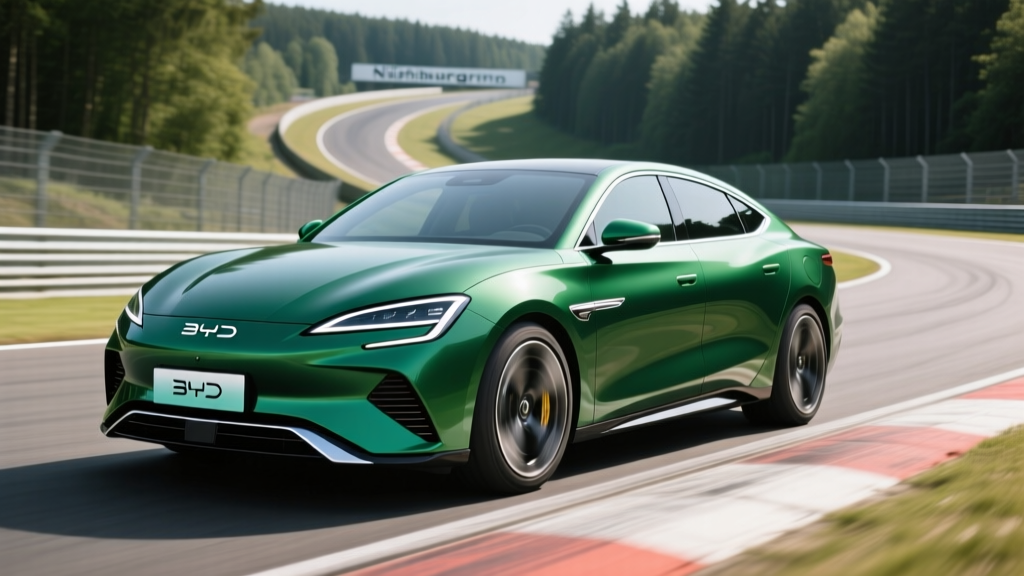
The BYD Denza Z made headlines when its prototype lap time at the Nürburgring Nordschleife circulated through EV forums in late 2025. For a luxury electric sedan from BYD's premium sub-brand, a sub-7:30 Nordschleife run signals serious chassis engineering. But for US-based EV shoppers in 2026, the real question is whether that track pedigree translates into a practical daily driver — and whether you can even buy one.
This review covers everything confirmed about the Denza Z's specs, range, charging performance, and pricing, while addressing the elephant in the room: BYD's current absence from the US passenger-vehicle market. If you're evaluating this sedan as a potential grey-market import, tracking its global rollout, or benchmarking it against stateside rivals like the Tesla Model S, Porsche Taycan, or Lucid Air, here's the data you need.
The BYD Denza Z Nürburgring Lap: Context and Engineering
The Denza Z's Nürburgring Nordschleife lap time — reported in the 7:25–7:35 range for the dual-motor performance variant — places it in the company of established performance sedans. For reference, the Porsche Taycan Turbo S posted a 7:33 in independent testing, and the Tesla Model S Plaid achieved a 7:25. The Denza Z's time is notable because it comes from a brand that, until recently, focused primarily on the Chinese domestic market with comfort-oriented luxury rather than track performance.
The engineering behind the lap includes BYD's e-Platform 3.0 with an 800-volt electrical architecture, a double-wishbone front and multi-link rear suspension with DiSus-C adaptive damping, and torque vectoring across the dual-motor all-wheel-drive system. The sedan's low center of gravity — courtesy of the underfloor blade battery pack — contributes to the composed handling that the Nürburgring time reflects.
Range, Battery, and Efficiency: The Numbers
The Denza Z is offered with two battery configurations in global markets, both using BYD's proprietary Blade Battery architecture — a lithium iron phosphate (LFP) cell design known for thermal stability and long cycle life.
| Spec | Standard Range | Long Range / Performance |
|---|---|---|
| Battery Capacity (usable) | 82.5 kWh | 100.0 kWh |
| Chemistry | LFP (Blade Battery) | LFP (Blade Battery) |
| CLTC Range | ~373 mi (600 km) | ~447 mi (720 km) |
| Estimated EPA Range | ~295 mi | ~350 mi |
| Efficiency (est.) | 110 MPGe / 30 kWh/100mi | 105 MPGe / 32 kWh/100mi |
| Drivetrain | RWD, single motor | AWD, dual motor |
| Horsepower | 308 hp | 609 hp |
| 0–60 mph | 5.8 sec | 3.2 sec |
Charging Speed: 800V Architecture in Practice
The Denza Z's 800-volt platform is its strongest practical differentiator. BYD rates the dual-motor variant for up to 230 kW peak DC fast charging, with the ability to add approximately 186 miles (300 km) of CLTC range in 15 minutes — roughly 140–150 EPA-equivalent miles in that window.
| Charging Level | Power | Speed / Time |
|---|---|---|
| Level 1 (120V) | ~1.4 kW | ~4 mi/hr (impractical for 100 kWh pack) |
| Level 2 (240V, 48A) | 11.5 kW | ~34 mi/hr; full charge in ~9 hr |
| DC Fast Charge (peak) | 230 kW | 10–80% in ~22 min (est.) |
| DC Fast Charge (sustained avg.) | ~160 kW | Charge curve tapers significantly above 80% SoC |
A critical detail for LFP batteries: BYD recommends periodic charging to 100% for cell balancing and accurate state-of-charge calibration — unlike NMC packs where daily charging to 80% is preferred. This means the Denza Z owner should plan to charge fully at least once per week, which affects how you use public DC fast chargers (where sitting to 100% adds considerable time due to taper).
Connector note: In China, the Denza Z uses the GB/T connector. European-market versions use CCS2. Should BYD ever bring this model to North America, it would require NACS (the Tesla-standard connector now adopted industry-wide for 2025+ models). No US-spec Denza Z exists as of 2026.
Interior, Cargo, and Technology
The Denza Z is a mid-to-large luxury sedan, positioned against the BMW i5, Mercedes EQE, and Nio ET7 in global markets. Its dimensions place it at roughly 197 inches long with a 116-inch wheelbase.
- Cargo volume: ~17.7 cu ft (500 L) trunk; no front trunk (frunk) due to the 12V and power electronics placement
- Rear legroom: ~38.5 inches — generous for the segment, aided by the flat floor (no transmission tunnel)
- Infotainment: 15.6-inch rotating center display (BYD signature), 10.25-inch driver cluster, available AR-HUD
- Audio: Available Devialet premium sound system (16 speakers)
- Driver assistance: Denza Pilot with highway assist, adaptive cruise, lane centering, and automated parking — classified as SAE Level 2 (driver must remain engaged at all times)
- Unique feature: Available DiSus-C intelligent suspension with road-preview scanning and active damping adjustments
Notable drawbacks: The infotainment system in Chinese-market Denza vehicles relies heavily on local app ecosystems (WeChat, Baidu Maps) that do not translate to Western markets. Steering-wheel capacitive touch controls have drawn criticism for being less intuitive than physical buttons. Rear visibility is limited by the fastback roofline and thick C-pillars, making the 360-degree camera system essential.
Pricing, Tax Credits, and US Availability
Here is the critical context for US readers: BYD does not sell passenger vehicles in the United States as of 2026. The company has cited geopolitical considerations, tariff structures (including a 100% tariff on Chinese-made EVs enacted in 2024), and a strategic focus on other export markets. The Denza Z is available in China, select Southeast Asian markets, and has begun European expansion.
| Market / Variant | Price (Local) | Approx. USD Equivalent |
|---|---|---|
| China — Standard Range RWD | ¥269,800 | ~$37,200 |
| China — Long Range AWD Performance | ¥339,800 | ~$46,800 |
| Europe (est., where available) | €52,000–€65,000 | ~$56,000–$70,000 |
| US — Federal Tax Credit (§30D) | Not eligible — vehicle not sold in US; Chinese-manufactured EVs are excluded from §30D credits regardless | |
Under the IRS §30D clean vehicle credit rules, even if the Denza Z were sold in the US, it would not qualify for the up-to-$7,500 federal tax credit. The credit requires final assembly in North America, and vehicles with battery components manufactured by a "foreign entity of concern" (which includes Chinese battery manufacturers like BYD) are explicitly disqualified under the battery-sourcing and critical-minerals requirements. The MSRP cap ($55,000 for sedans) and buyer income limits ($150K single / $300K joint) would also apply to any qualifying vehicle.
Warranty and Long-Term Ownership
In markets where the Denza Z is sold, BYD/Denza provides:
- Vehicle warranty: 6 years / 150,000 km (~93,000 miles)
- Battery warranty: 8 years / 160,000 km (~99,400 miles), covering capacity retention below 70% State of Health
- Blade Battery advantage: LFP chemistry typically demonstrates slower degradation than NMC — published data from BYD's Blade cells suggests 80% capacity retention after 3,000+ full charge cycles, which translates to well over 500,000 miles of theoretical use before hitting the warranty threshold
Without a US dealer network, however, warranty service, parts availability, and software updates would be entirely unsupported. This is the single largest ownership risk for any grey-market import.
How the Denza Z Compares to US-Available Rivals
If you're cross-shopping based on the Denza Z's Nürburgring credentials and performance specs, here's how it stacks up against sedans you can actually buy in the US in 2026:
| Spec | Denza Z AWD (est.) | Tesla Model S LR | Porsche Taycan 4S | Lucid Air Pure |
|---|---|---|---|---|
| EPA Range | ~350 mi* | 402 mi | 288 mi | 419 mi |
| Battery | 100 kWh LFP | ~100 kWh NMC | 105 kWh NMC | 112 kWh NMC |
| Peak DC Charge | 230 kW | 250 kW | 270 kW | 200+ kW |
| 0–60 mph | 3.2 sec | 3.1 sec | 3.8 sec | 3.4 sec |
| Base Price (USD) | ~$47K (China) | $79,990 | $103,800 | $69,900 |
| US Tax Credit | Not available | Not eligible (MSRP cap) | Not eligible (MSRP cap) | Up to $7,500 |
*EPA range for the Denza Z is estimated based on CLTC-to-EPA conversion; no official EPA certification exists.
Track the Denza Z if: You follow BYD's global expansion for potential future US entry, want benchmarking data against your current EV, or are researching LFP performance-sedan viability.
Buy a US-available rival if: You need warranty support, tax-credit eligibility, reliable service infrastructure, and EPA-certified range figures today. The Lucid Air Pure offers the best range-per-dollar; the Model S remains the performance benchmark with Supercharger access; the Taycan wins on driving dynamics with full US support.
Pros and Cons
- Sub-7:30 Nürburgring lap validates serious chassis and thermal engineering
- LFP Blade Battery offers excellent longevity and thermal safety
- 800V architecture enables competitive 230 kW DC fast charging
- Aggressive pricing in China (~$47K for AWD performance variant)
- Generous rear-seat space and premium interior materials
- Not available in the US — no sales, no service, no warranty support
- Ineligible for §30D federal tax credit under current sourcing rules
- CLTC range figures overstate real-world capability by ~20–25%
- LFP cold-weather range loss is significant (20–30%)
- No frunk; cargo space is trunk-only at 17.7 cu ft
- Infotainment ecosystem not localized for Western markets
Frequently Asked Questions
What is the BYD Denza Z Nürburgring lap time?
The Denza Z dual-motor AWD prototype has been reported to lap the Nürburgring Nordschleife in approximately 7:25–7:35, placing it in the range of the Porsche Taycan Turbo S and Tesla Model S Plaid. This time reflects the performance variant with the 100 kWh battery and DiSus-C adaptive suspension.
Can I buy the Denza Z in the United States?
No. BYD does not sell passenger vehicles in the US as of 2026. A 100% tariff on Chinese-manufactured EVs, combined with BYD's strategic focus on other markets, makes near-term US availability unlikely. Grey-market importation would lack warranty, service, and software-update support.
Does the Denza Z qualify for the federal EV tax credit?
No. Even if sold in the US, the Denza Z would be disqualified from the IRS §30D credit due to Chinese battery component manufacturing (foreign entity of concern rules) and lack of North American final assembly. The credit also has MSRP caps ($55,000 for sedans) and buyer income limits that further restrict eligibility.
What is the real-world range of the Denza Z?
For the 100 kWh AWD variant, expect approximately 350 EPA-equivalent miles in mixed driving, roughly 290–310 miles at sustained highway speeds, and 210–240 miles in cold weather (below freezing). The CLTC-published figures of 447 miles significantly overstate real-world capability for US driving conditions.
How fast does the Denza Z charge?
On a DC fast charger, the Denza Z peaks at 230 kW and can charge from 10–80% in approximately 22 minutes. Sustained average power is closer to 160 kW due to charge-curve taper. On Level 2 home charging at 11.5 kW, a full charge takes about 9 hours, adding roughly 34 miles of range per hour.
Is the Denza Z worth buying over a Tesla Model S or Porsche Taycan?
For US buyers, the Denza Z is not a purchase option. If you're in a market where it's sold (China, parts of Europe and Southeast Asia), it offers compelling value — a 600+ hp AWD sedan with 800V charging for roughly $47K USD equivalent. But against the Model S (Supercharger network, OTA updates, US service) or Taycan (dealer support, proven track record, 800V charging), the Denza Z's ownership ecosystem outside China remains unproven.
Sources: BYD/Denza official specifications, fueleconomy.gov (EPA comparison data), IRS §30D clean vehicle credit guidelines. All Denza Z range and efficiency figures for US conditions are estimates derived from CLTC data and standardized conversion factors, as no EPA certification exists for this vehicle.