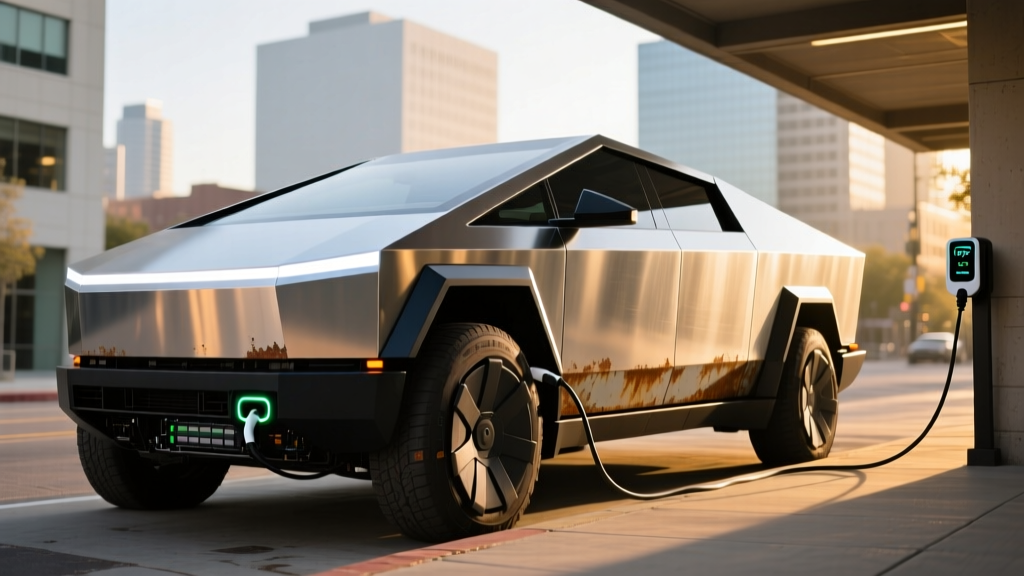
The Tesla Cybertruck's polarizing angular design turns heads, but for many prospective buyers, the bigger question isn't about looks — it's about longevity. Search forums and social media and you'll find hundreds of posts about Cybertruck rusting: surface spots appearing within weeks of delivery, orange streaking after rain, and owners scrambling for cleaning solutions. Is the stainless steel exoskeleton actually corroding, or is something else happening?
This review tackles the rust question head-on, then delivers the full ownership picture: real-world range, charging speed, pricing after tax credits, and whether the Cybertruck earns a spot in your garage versus a Rivian R1T, Ford F-150 Lightning, or Chevrolet Silverado EV.
The Cybertruck Rust Question: Surface Contamination vs. True Corrosion
The Cybertruck's body panels are made from ultra-hard 300-series stainless steel — the same alloy family used in kitchen sinks, surgical instruments, and architectural cladding. Unlike conventional truck bodies stamped from mild steel and coated with paint and clearcoat, the Cybertruck wears no paint on its exterior panels. That bare-metal finish is central to the rust conversation.
Here's what's actually happening when owners report "rust":
- Iron particle contamination: The most common culprit. Tiny iron particles from brake dust, rail transport, industrial fallout, or even the manufacturing process itself embed in the stainless surface. These particles rust — not the panel underneath. The result is orange spotting that looks alarming but is superficial.
- Surface oxidation (tea staining): Stainless steel develops a thin, protective chromium oxide layer. In certain environments — coastal salt air, road salt exposure, industrial pollution — the surface can develop a uniform dull patina or light discoloration. This is cosmetic, not structural.
- Galvanic corrosion at joints: Where stainless steel contacts dissimilar metals (aluminum trim, carbon steel fasteners), galvanic corrosion is theoretically possible if moisture bridges the gap. Tesla has addressed most junctions with isolators and sealants, but early-production units showed some weeping at panel seams.
Range, Battery, and Real-World Efficiency
The 2026 Cybertruck lineup offers three configurations with distinct range profiles. Tesla's EPA estimates tell part of the story, but this 6,600+ pound stainless steel wedge doesn't achieve its sticker numbers in every condition.
| Specification | RWD (Standard) | AWD Long Range | Cyberbeast (Tri-Motor) |
|---|---|---|---|
| EPA Range | 250 mi | 340 mi | 320 mi |
| Battery Capacity (usable) | ~100 kWh (NMC) | ~123 kWh (NMC) | ~123 kWh (NMC) |
| Battery Chemistry | NMC (Nickel Manganese Cobalt) | NMC | NMC |
| Drivetrain | Rear-Wheel Drive | Dual-Motor AWD | Tri-Motor AWD |
| Horsepower | ~315 hp | ~600 hp | ~845 hp |
| 0-60 mph | 6.5 sec | 4.1 sec | 2.6 sec |
| EPA Efficiency | ~2.0 kWh/mi (50 MPGe) | ~2.1 kWh/mi (48 MPGe) | ~2.3 kWh/mi (44 MPGe) |
| Max Towing | 7,500 lb | 11,000 lb | 11,000 lb |
| Base MSRP | $60,990 | $79,990 | $99,990 |
The Cybertruck uses NMC (nickel manganese cobalt) lithium-ion cells in a structural battery pack that contributes to the vehicle's rigidity. NMC offers higher energy density than LFP (lithium iron phosphate), which is necessary given the truck's mass and range targets. The trade-off: NMC degrades slightly faster over time and is more sensitive to sustained 100% state of charge. Tesla recommends daily charging to 80-90% for longevity, reserving 100% for long trips.
Efficiency is the Cybertruck's weakest EV metric. At roughly 2.0-2.3 kWh per mile, it consumes significantly more energy per mile than a Model Y (~1.5 kWh/mi) or even the F-150 Lightning (~2.0 kWh/mi). The angular, un-aerodynamic shape and heavy stainless steel body are the primary causes. This matters for charging cost: at the national average of $0.16/kWh for home electricity, a full charge costs approximately $19-25 depending on trim.
Charging Speed: DC Fast Charging and Home Level 2
Charging speed is where the Cybertruck's 800-volt architecture pays dividends — when you can find a compatible charger. Here's the full breakdown:
| Charging Level | Power / Rate | Speed (Miles Added) | Notes |
|---|---|---|---|
| Level 1 (120V household) | ~1.4 kW | ~3-4 mi/hr | Emergency/trickle only; full charge takes days |
| Level 2 (240V home, 48A) | 11.5 kW | ~30-34 mi/hr | Full overnight charge in ~10-12 hours; recommended home setup |
| Level 2 (240V, 80A Wall Connector) | 19.2 kW | ~50-55 mi/hr | Requires 100A circuit; fastest home option |
| DC Fast Charge (V4 Supercharger) | Peak 250-350 kW | ~200+ mi in 15 min | 10-80% in ~20-25 min; tapers significantly above 80% |
| DC Fast Charge (CCS adapter, 3rd-party) | Up to 250 kW | Varies by station | Requires Tesla CCS adapter (included); Electrify America, EVgo compatible |
The Cybertruck's charge curve is worth understanding before you plan road trips. Peak charging rate of 250-350 kW (depending on Supercharger generation) is achievable between roughly 10-40% state of charge. Above 50%, the rate tapers to ~150 kW, and above 80% it drops sharply to under 50 kW to protect the NMC cells. A realistic 10-80% session at a V4 Supercharger takes approximately 20-25 minutes. At a third-party 150 kW CCS station, plan for 35-45 minutes for the same session.
For home charging, Tesla's Wall Connector at 48 amps (11.5 kW) adds roughly 30-34 miles per hour of charging. Most owners who drive 40-60 miles daily will fully replenish overnight on a standard NEMA 14-50 outlet (240V, 40A, ~9.6 kW) — no panel upgrade required in most homes. If you want the fastest home charging at 80A (19.2 kW), budget $1,500-$3,000 for electrical work including a 100-amp dedicated circuit, per Tesla's home charging guide.
Pricing, Trims, and Federal Tax Credit Eligibility
The Cybertruck's pricing has shifted since its 2023 reveal, and the federal tax credit picture requires careful attention to current IRS rules under §30D.
| Trim | Base MSRP | As-Tested (Typical Options) | §30D Credit Eligible? | Effective Price (with credit) |
|---|---|---|---|---|
| RWD Standard | $60,990 | $62,500 | Up to $7,500* | ~$53,490-$55,000 |
| AWD Long Range | $79,990 | $83,500 | Up to $7,500* | ~$72,490-$76,000 |
| Cyberbeast Tri-Motor | $99,990 | $104,000 | Up to $7,500* | ~$92,490-$96,500 |
*Federal tax credit caveats (2026 rules): The §30D Clean Vehicle Credit provides up to $7,500, but eligibility hinges on three requirements that change periodically. Per the IRS §30D guidelines:
- MSRP cap: Pickup trucks must have an MSRP at or below $80,000. The RWD ($60,990) and AWD Long Range ($79,990) qualify. The Cyberbeast ($99,990) exceeds the cap and does NOT qualify for the federal credit.
- Buyer income limits: Modified adjusted gross income must not exceed $150,000 (single), $225,000 (head of household), or $300,000 (joint filing).
- Battery sourcing requirements: A percentage of critical minerals and battery components must be sourced from the U.S. or free-trade-agreement countries. These thresholds tighten annually. Tesla's North American battery production generally meets current requirements, but verify at fueleconomy.gov before purchasing, as sourcing compliance can change by model year and production batch.
- Point-of-sale transfer: As of 2024, buyers can transfer the credit to the dealer at purchase, reducing the out-of-pocket cost immediately rather than waiting for a tax refund.
Performance, Cargo, and Daily Usability
The Cybertruck delivers sports-car acceleration in a truck body — particularly the Cyberbeast, which hits 60 mph in 2.6 seconds. But raw speed isn't the whole story for truck buyers.
Cargo and dimensions:
- Bed length: 6 feet (72 inches) with the tonneau cover closed; the bed is enclosed and lockable, a significant security advantage over open-bed trucks
- Bed volume: ~67 cu ft with tailgate up
- Front trunk (frunk): ~7 cu ft — useful for charging cables, groceries, or a small bag
- Passenger capacity: 5 passengers (bench front seat); rear legroom is ~38 inches, adequate but not generous for a full-size truck
- Towing: 7,500 lb (RWD) or 11,000 lb (AWD/Cyberbeast) — competitive with mid-size trucks but below heavy-duty ICE pickups
- Payload: ~2,500 lb
Standout tech features:
- 18.5-inch center touchscreen running Tesla's latest infotainment (no Apple CarPlay/Android Auto — Tesla-native only)
- Rear 9.4-inch touchscreen for rear passengers
- Autopilot standard; Full Self-Driving (Supervised) available as a $8,000 option or $99/month subscription — this is SAE Level 2 driver assistance, not autonomous driving; the driver must remain engaged at all times
- Steer-by-wire with 4-wheel steering — the Cybertruck has no mechanical connection between steering wheel and wheels, enabling a remarkably tight 34-foot turning circle
- Adaptive air suspension with up to 16 inches of ground clearance in Extract mode
- 120V and 240V bed outlets (Powershare) for job-site tool use or camping
- Bioweapon Defense Mode (HEPA cabin filtration)
Warranty, Battery Longevity, and Ownership Costs
Tesla's warranty coverage for the Cybertruck aligns with its broader EV lineup:
- Basic vehicle warranty: 4 years / 50,000 miles
- Battery and drive unit warranty: 8 years / 120,000 miles (whichever comes first), with a minimum 70% capacity retention guarantee over that period
- Stainless steel body: Covered under the basic 4-year warranty for manufacturing defects; cosmetic surface contamination (the "rust spots" discussed above) is considered a maintenance issue and is NOT covered
Battery replacement cost, should it be needed out of warranty, is estimated at $15,000-$22,000 for the structural pack based on current Tesla service pricing for similar-capacity packs. However, NMC packs in Tesla vehicles historically show degradation of roughly 10-12% over 150,000 miles based on fleet data — well within the warranty threshold.
5-year estimated cost of ownership (AWD Long Range, 15,000 mi/yr, national averages):
- Electricity (home charging at $0.16/kWh): ~$5,200
- Maintenance (no oil changes; tire rotation, cabin filter, wiper fluid): ~$2,800
- Insurance (national EV truck average): ~$12,500-$15,000 (Cybertruck insurance runs 20-40% higher than comparable trucks due to repair costs and stainless steel panel replacement)
- Tires (heavy vehicle, high torque — expect 25,000-35,000 mi per set): ~$4,800
- Estimated 5-year depreciation: ~$28,000-$35,000 (EV truck depreciation remains elevated; monitor resale trends)
Cybertruck vs. R1T, F-150 Lightning, and Silverado EV
The electric truck segment is competitive. Here's how the Cybertruck AWD stacks up against key rivals:
| Attribute | Cybertruck AWD | Rivian R1T (Dual-Motor Max) | Ford F-150 Lightning (Ext. Range) | Chevy Silverado EV (4WT) |
|---|---|---|---|---|
| EPA Range | 340 mi | ~352 mi | ~320 mi | ~390 mi |
| Starting MSRP | $79,990 | ~$87,000 | ~$72,000 | ~$78,000 |
| 0-60 mph | 4.1 sec | ~3.5 sec | ~3.8 sec | ~4.5 sec |
| Max Towing | 11,000 lb | 11,000 lb | 10,000 lb | 10,000 lb |
| Bed Length | 6 ft (enclosed) | 4.5 ft + Gear Tunnel | 5.5 ft (open) | 5 ft 11 in (open) |
| DC Fast Charge Peak | 250-350 kW | ~200 kW | ~150 kW | ~200 kW |
| Body Material | Stainless steel (unpainted) | Painted aluminum/steel | Painted aluminum/steel | Painted steel/aluminum |
Choose the Rivian R1T if: You prioritize off-road capability, want a more conventional driving feel, value the Gear Tunnel for gear storage, and prefer Rivian's adventure-oriented brand ethos. Expect higher pricing and slightly slower charging.
Choose the F-150 Lightning if: You want the most traditional truck experience, need a full-size open bed, prefer Ford dealer service infrastructure, and want a lower starting price. Charging is slower, but the Pro Power Onboard system is excellent for job-site use.
Choose the Silverado EV if: Maximum range is your top priority (the 4WT trim leads the segment at ~390 mi EPA) and you prefer GM's Ultium platform. Availability and dealer allocation remain limiting factors.
Pros, Cons, and Final Verdict
Pros
- Class-leading DC fast charging (250-350 kW peak, 10-80% in ~20-25 min)
- Enclosed, lockable bed with 120V/240V outlets — unmatched security and utility
- Steer-by-wire with 4-wheel steering gives a compact-car turning radius
- Tri-motor Cyberbeast delivers supercar acceleration (2.6 sec 0-60)
- Tesla Supercharger network remains the most reliable DC charging infrastructure
- Stainless steel body will not rust through — only surface contamination requires maintenance
- Over-the-air updates continuously add features
Cons
- Stainless steel surface demands regular cleaning to prevent iron contamination spots
- Poor efficiency (~2.0-2.3 kWh/mi) means higher charging costs than competitors
- Cyberbeast trim ($99,990) does not qualify for the $7,500 federal tax credit (exceeds $80K MSRP cap)
- No Apple CarPlay or Android Auto
- Steer-by-wire feel draws mixed reviews; learning curve for traditional truck drivers
- Insurance premiums 20-40% higher than comparable trucks
- Real-world highway and cold-weather range drops significantly (expect ~240-280 mi in adverse conditions for AWD trim)
- Limited rear-seat legroom for a full-size truck
Frequently Asked Questions
Is the Cybertruck actually rusting, or is it surface contamination?
The stainless steel body panels are not rusting through. The orange spots owners report are overwhelmingly iron particle contamination — brake dust, rail dust, or industrial fallout that settles on the surface and oxidizes. It's removable with stainless steel-specific cleaners like Bar Keepers Friend or CitriSurf. However, the maintenance requirement is real: expect to clean the exterior every 2-4 weeks in areas with road salt, coastal air, or heavy brake dust to prevent particles from etching the surface over time.
What is the real-world range of the Cybertruck?
The AWD Long Range carries an EPA estimate of 340 miles, but real-world mixed driving returns approximately 280-300 miles. Highway driving at 75+ mph drops this to ~260-280 miles due to the Cybertruck's poor aerodynamics. In cold weather (below 32°F), expect 240-260 miles as the battery works harder and cabin heating draws additional power. The RWD Standard trim's 250-mile EPA estimate translates to roughly 200-220 miles in real-world highway use.
How fast does the Cybertruck charge at home and on the road?
On a home Level 2 charger at 48 amps (11.5 kW), the Cybertruck adds roughly 30-34 miles per hour — a full overnight charge takes 10-12 hours. At a Tesla V4 Supercharger, the peak rate reaches 250-350 kW, delivering a 10-80% charge in approximately 20-25 minutes. At third-party CCS stations (with the included adapter), expect 150-250 kW peak rates and 10-80% sessions of 25-45 minutes depending on station output. Charging tapers significantly above 80% state of charge.
Does the Cybertruck qualify for the $7,500 federal EV tax credit?
It depends on the trim. The RWD Standard ($60,990) and AWD Long Range ($79,990) fall under the $80,000 MSRP cap for pickup trucks and are potentially eligible for up to $7,500 under IRS §30D — provided the buyer meets income limits ($150K single / $300K joint) and the vehicle's battery sourcing meets current critical-mineral and component requirements. The Cyberbeast ($99,990) exceeds the MSRP cap and does not qualify. Always verify current eligibility at fueleconomy.gov and consult a tax professional before purchasing, as sourcing rules tighten annually.
Is the Cybertruck worth buying over the Rivian R1T or F-150 Lightning?
The Cybertruck excels at DC fast charging speed, bed security (fully enclosed and lockable), and urban maneuverability thanks to steer-by-wire. The Rivian R1T offers superior off-road capability and a more conventional driving feel at a higher price. The F-150 Lightning provides the most traditional truck experience with an open bed and lower starting price but slower charging. Your choice depends on priorities: charging speed and security favor the Cybertruck; off-road and adventure favor the R1T; traditional truck utility and price favor the Lightning.
How much does it cost to maintain the Cybertruck's stainless steel body?
Budget approximately $15-30 per month for cleaning supplies (stainless steel cleaner, microfiber towels, iron-removal spray). In rust-belt states or coastal areas, plan for a professional stainless steel decontamination and passivation treatment once or twice per year at $150-300 per session. This is an ownership cost that painted trucks don't carry — factor it into your decision. Tesla's warranty does not cover cosmetic surface contamination.
What is the Cybertruck's battery warranty?
Tesla covers the Cybertruck's battery and drive unit for 8 years or 120,000 miles (whichever comes first), guaranteeing a minimum of 70% capacity retention over that period. If the battery degrades below 70% within the warranty window, Tesla will repair or replace it at no cost. The basic vehicle warranty covers 4 years / 50,000 miles. Out-of-warranty battery replacement is estimated at $15,000-$22,000, though historical Tesla NMC fleet data suggests 10-12% degradation over 150,000 miles is typical.