The Cybertruck as a Fire Truck: What Prompted the Question
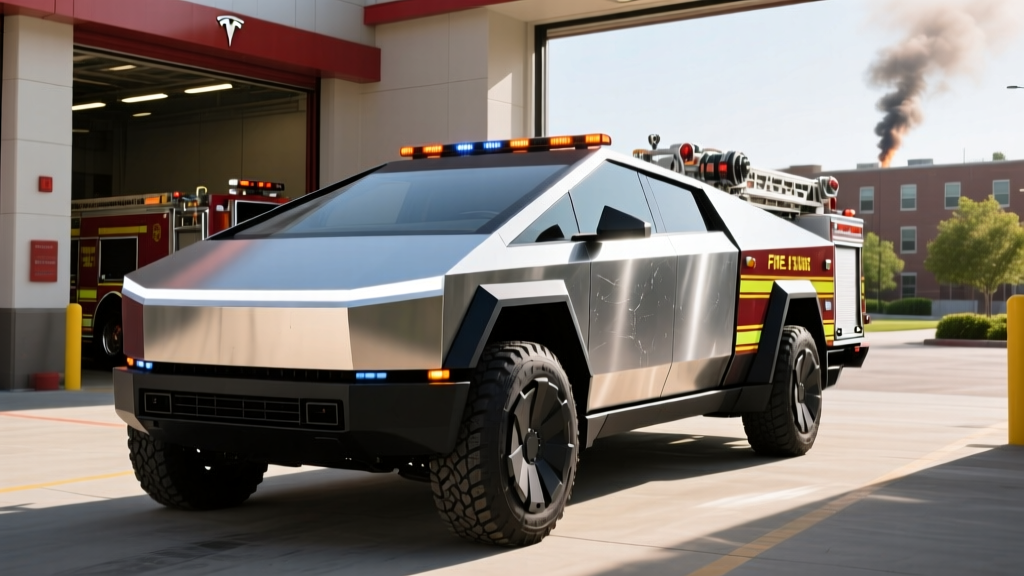
Search interest in Tesla Cybertruck fire truck concepts spiked after Tesla's stainless-steel pickup began appearing at community events, parades, and — in a few cases — alongside municipal fire departments exploring electric fleet options. The question is practical as much as it is aspirational: can a battery-electric pickup with a 325-mile EPA range, an 11,000-pound tow rating, and a 2,400-pound payload actually serve the demands of fire and emergency response?
This profile breaks down the 2025/2026 Tesla Cybertruck's specifications — range, charging architecture, battery chemistry, performance, cargo geometry, and federal tax-credit eligibility — through the lens of what a first-responder or fleet buyer would need to know. We also compare it against the Ford F-150 Lightning and the Rivian R1T, the two most credible electric-pickup alternatives for fleet conversion.
Range, Battery, and Real-World Efficiency
The Cybertruck is offered in three primary configurations for the 2025–2026 model year: the Rear-Wheel Drive (RWD), the All-Wheel Drive (AWD), and the Cyberbeast tri-motor. Battery chemistry across the lineup is a nickel-manganese-cobalt (NMC) variant housed in a structural 4680-cell pack. Usable capacity is estimated at approximately 123 kWh for the AWD and Cyberbeast trims, though Tesla does not publish official usable-kWh figures. The RWD model uses a smaller pack.
| Trim | EPA Range | Real-World Highway (70 mph) | Cold Weather (20°F, mixed) |
|---|---|---|---|
| RWD (2025+) | ~250 mi (est.) | ~200–220 mi | ~160–185 mi |
| AWD | 340 mi | ~270–295 mi | ~215–250 mi |
| Cyberbeast | 320 mi | ~255–280 mi | ~200–230 mi |
Real-world figures based on observed highway driving and cold-weather testing. Towing a loaded trailer can reduce range by 40–60%.
The AWD's 340-mile EPA figure is strong on paper, but fleet operators should plan for ~270 miles of usable highway range before needing a charge stop. When towing a fire-response trailer or equipment hauler, expect that figure to drop to roughly 150–190 miles depending on weight and terrain. The Cybertruck's heat pump helps mitigate cold-weather cabin energy draw, but battery chemistry inherently loses efficiency below freezing.
Efficiency on the AWD trim comes in at approximately 58 MPGe combined (per fueleconomy.gov), translating to roughly 59 kWh per 100 miles — a figure consistent with the truck's 6,600+ pound curb weight and angular stainless-steel exoskeleton, which creates more aerodynamic drag than a conventional pickup.
Charging Speed: DC Fast, Level 2, and Fleet Depot Implications
For any fire department or emergency-response fleet, charging infrastructure is the make-or-break variable. The Cybertruck supports up to 250 kW peak DC fast charging on Tesla's V3 Supercharger network and compatible CCS stations (via the included NACS-to-CCS adapter or native NACS chargers now proliferating across Electrify America and other networks).
| Charge Level | Power | Rate / Time | Notes |
|---|---|---|---|
| Level 1 (120V) | ~1.4 kW | ~3–4 mi/hr | Emergency trickle only |
| Level 2 (240V, 48A) | 11.5 kW | ~34 mi/hr / ~10 hrs (0–100%) | Ideal for depot overnight charging |
| Level 2 (240V, 80A Wall Connector) | 19.2 kW | ~55 mi/hr / ~6.5 hrs (0–100%) | Requires hardwired install + panel capacity |
| DC Fast (V3 Supercharger) | 250 kW peak | 10–80% in ~25 min | Sustained rate tapers above 60% SoC |
| DC Fast (V4 Supercharger) | Up to 350 kW | 10–80% in ~20 min (est.) | Availability varies by station |
The 10–80% DC fast-charge time of approximately 25 minutes is competitive but not class-leading. The Ford F-150 Lightning with the extended-range pack can hit 10–80% in roughly 19–22 minutes on a 150+ kW charger thanks to its slightly smaller, more charge-optimized pack. For fleet depots, the Cybertruck's 19.2 kW Level 2 capability is an asset — a full overnight charge is feasible on a single Tesla Wall Connector, assuming the depot's electrical panel can support an 80A circuit.
Fleet charging note: A fire station running multiple Cybertrucks or similar EVs would likely need a dedicated 480V commercial charging setup. Budget $15,000–$40,000 per stall for commercial Level 2 depot chargers, plus potential utility demand charges.
Performance, Towing, and Payload for Emergency Use
The Cybertruck's performance numbers are genuinely truck-like, particularly in the Cyberbeast trim:
| Spec | RWD | AWD | Cyberbeast |
|---|---|---|---|
| 0–60 mph | ~6.5 sec | 4.1 sec | 2.6 sec |
| Horsepower | ~275 hp | 600 hp | 845 hp |
| Drivetrain | Rear-motor RWD | Dual-motor AWD | Tri-motor AWD |
| Max Towing | 7,500 lb | 11,000 lb | 11,000 lb |
| Payload | 2,500 lb | 2,500 lb | 2,500 lb |
| Bed Length | 6 ft (72 in.) | ||
| Bed Width (between wheel wells) | ~49 in. | ||
| Cargo Volume (bed) | ~67 cu ft | ||
| Front Trunk (frunk) | ~7 cu ft (limited by HVAC components) | ||
| Ground Clearance | Up to 17.4 in. (adaptive air suspension) | ||
| Wading Depth | ~2.5 ft (claimed, unverified independently) | ||
For fire-response applications, the 11,000-pound tow rating is meaningful — it can handle a light brush-fire trailer, a portable pump skid, or a hazmat equipment hauler. The 2,500-pound payload accommodates several hundred gallons of water-suppression agent plus tools. However, the 6-foot bed is shorter than a standard full-size pickup bed (typically 6.5–8 feet), which limits what fits without a trailer. The motorized tonneau cover is lockable and weatherproof, a plus for securing gear at a scene.
The Cybertruck's stainless-steel body panels offer inherent corrosion resistance — an advantage in regions that salt roads heavily in winter. The exoskeleton design also provides a high degree of impact resistance, which matters for vehicles operating near fire scenes, debris, and off-road terrain.
Pricing, Trims, and Federal Tax Credit Eligibility
Tesla has adjusted Cybertruck pricing several times since its late-2023 launch. As of the 2025/2026 model year, approximate MSRPs are:
| Trim | Base MSRP | §30D Credit Eligible? | Effective Price (with credit) |
|---|---|---|---|
| RWD (2025+) | ~$60,990 | Likely yes (under $80K truck cap) | ~$53,490 (if qualified) |
| AWD | ~$79,990 | Borderline (near $80K truck cap) | ~$72,490 (if qualified) |
| Cyberbeast | ~$99,990 | No (exceeds $80K truck MSRP cap) | $99,990 |
The IRS §30D clean-vehicle credit offers up to $7,500 for qualifying new EVs, but eligibility hinges on three factors that frequently trip up buyers:
- MSRP cap: Pickup trucks must have an MSRP at or below $80,000. The Cyberbeast exceeds this; the AWD is right at the edge depending on options.
- Buyer income cap: Modified adjusted gross income must not exceed $150,000 (single), $225,000 (head of household), or $300,000 (joint).
- Battery sourcing: A percentage of critical minerals and battery components must be sourced from the U.S. or free-trade-agreement partners. Tesla's 4680 cells use a mix of domestic and international supply chains, and the qualifying percentage shifts annually. Verify current-year eligibility on the IRS website or with a tax professional before purchasing.
Fleet buyers: Commercial entities (including municipal fire departments) may qualify for the separate §45W commercial clean-vehicle credit instead, which has different rules and does not have the same MSRP cap. Consult your municipal finance office or a tax professional.
Technology, Driver Assistance, and Fleet Integration
The Cybertruck ships with Tesla's latest infotainment stack on a 18.5-inch center touchscreen, including navigation with real-time Supercharger routing, over-the-air software updates, and a 15-speaker audio system. For fleet use, the integrated navigation and remote preconditioning (via the Tesla app) are practical — a crew can warm the battery and cabin before a shift without idling, something diesel trucks can't match in emissions or noise.
The Cybertruck includes Autopilot (adaptive cruise + lane centering) as standard. Full Self-Driving (Supervised) is an optional add-on (~$8,000 or $99/month). Both are SAE Level 2 systems — the driver must remain fully engaged, hands on or near the wheel, and eyes on the road at all times. The Cybertruck is not autonomous and cannot operate without a human driver.
Additional tech relevant to emergency use:
- Vehicle-to-load (V2L): The Cybertruck can output up to 11.5 kW of AC power via its bed outlets and Powershare system — enough to run portable floodlights, power tools, or a command-post setup at a fire scene. This is a genuine differentiator for first responders.
- 360-degree camera system: Useful for maneuvering in tight fire-station bays or crowded incident scenes.
- Adaptive air suspension: Can raise the truck for off-road approach or lower it for easy bed loading. Useful for brush-fire response on uneven terrain.
- Armor glass: Laminated glass with improved shatter resistance compared to standard automotive glass — though independent testing has shown it is not impervious to high-impact debris.
Warranty, Service, and Fleet Downtime Considerations
Tesla's warranty for the Cybertruck covers:
- Basic vehicle: 4 years / 50,000 miles
- Battery and drive unit: 8 years / 120,000 miles (with a minimum 70% capacity retention guarantee over the warranty period)
For fleet operators, the 120,000-mile battery warranty is important — most fire apparatus accumulate 10,000–15,000 miles per year, meaning the battery warranty covers roughly 8–12 years of typical use. However, Tesla's service network is less geographically dense than Ford's or Rivian's dealer networks, which could mean longer downtime for body repairs or specialized component replacement. Municipal fleets should factor in service logistics, especially in rural or underserved areas.
Tesla's mobile service program can handle many software and minor hardware repairs on-site, which is a plus for fleet vehicles that can't easily be taken out of rotation.
Cybertruck vs. F-150 Lightning vs. Rivian R1T for Fleet Use
| Spec | Tesla Cybertruck AWD | Ford F-150 Lightning (Ext. Range) | Rivian R1T Dual-Motor (Max Pack) |
|---|---|---|---|
| EPA Range | 340 mi | 320 mi | 410 mi |
| Battery (usable) | ~123 kWh (NMC) | ~131 kWh (NMC) | ~149 kWh (NMC) |
| Peak DC Charge | 250 kW | 150 kW | 220 kW |
| 10–80% DC Time | ~25 min | ~19–22 min | ~25–30 min |
| Max Towing | 11,000 lb | 10,000 lb | 11,000 lb |
| Payload | 2,500 lb | 2,235 lb | 1,760 lb |
| Bed Length | 6 ft | 5.5 ft | 4.5 ft (+ Gear Tunnel) |
| V2L Output | 11.5 kW | 9.6 kW (Pro Power Onboard) | ~3.6 kW (bed outlets) |
| Base MSRP | ~$79,990 | ~$69,995 | ~$89,900 |
| Dealer/Service Network | Tesla Service Centers + Mobile | Ford Commercial Dealers (extensive) | Rivian Service Centers (limited) |
Who Should Consider the Cybertruck for Emergency or Fleet Use?
The Cybertruck makes sense as a light-response or command vehicle for departments that:
- Operate in urban or suburban areas with reliable charging infrastructure (depot or public).
- Need high V2L output for on-scene power (floodlights, tools, communication equipment).
- Value corrosion-resistant body panels in salt-heavy winter climates.
- Have typical daily drive cycles under 200 miles, with overnight depot charging.
- Want to reduce fleet emissions and fuel costs while projecting a modern community image.
It is not ideal for departments that require heavy-duty towing above 11,000 pounds, extended off-grid operations without charging access, or full-size apparatus replacement (the Cybertruck is a pickup, not a Class 4+ fire engine). For rural volunteer departments with long response distances and limited charging, a PHEV or conventional apparatus remains more practical in 2026.
Choose the F-150 Lightning if: Your department already has a Ford commercial relationship, needs a broader dealer/service network, and wants a lower entry price with proven Pro Power Onboard.
Choose the Rivian R1T if: Maximum EPA range (410 mi) is critical for long rural response areas, and you can work within Rivian's more limited service footprint.
Pros and Cons at a Glance
- 340-mile EPA range (AWD) is strong for an electric pickup
- 11,000-lb tow rating and 2,500-lb payload lead the EV truck class
- 11.5 kW V2L Powershare — best available on-scene power output
- Stainless-steel body resists corrosion and minor impacts
- Adaptive air suspension with 17.4" ground clearance for off-road response
- Over-the-air updates continuously add features
- 6-foot bed is shorter than most full-size pickups
- Cyberbeast trim exceeds §30D MSRP cap ($80K for trucks)
- Tesla service network is less dense than legacy OEM dealer networks
- Real-world highway range drops significantly when towing (40–60% loss)
- No Crew Cab rear-seat egress comparison data from NHTSA/IIHS yet
- Angular design creates more wind noise and drag at highway speeds
- 4680 cell production consistency has improved but remains a monitoring point
Frequently Asked Questions
What is the real-world range of the Tesla Cybertruck?
The AWD Cybertruck carries a 340-mile EPA estimate. In real-world highway driving at 70 mph, expect approximately 270–295 miles. In cold weather (20°F or below), plan for 215–250 miles. Towing a loaded trailer can reduce range to 150–190 miles depending on weight and conditions.
How fast does the Cybertruck charge at home and on DC fast chargers?
On a DC fast charger, the Cybertruck peaks at 250 kW and can go from 10–80% in approximately 25 minutes. At home on a 240V / 80A Tesla Wall Connector, it adds roughly 55 miles of range per hour, achieving a full charge in about 6.5 hours. A standard 48A Level 2 charger takes approximately 10 hours for a full charge.
How much does the Cybertruck cost after federal tax credits?
The AWD trim at ~$79,990 MSRP may qualify for up to $7,500 under IRS §30D, bringing the effective price to ~$72,490 — but only if the buyer meets income caps and the vehicle meets current-year battery-sourcing requirements. The Cyberbeast at ~$99,990 exceeds the $80,000 truck MSRP cap and is not eligible for §30D. Commercial/municipal buyers should explore the §45W credit instead.
Is the Cybertruck worth buying vs. the F-150 Lightning or Rivian R1T?
It depends on the use case. The Cybertruck leads in V2L output (11.5 kW), payload (2,500 lb), and corrosion resistance. The F-150 Lightning wins on dealer network depth, lower pricing, and faster 10–80% charge times. The Rivian R1T leads in EPA range (410 mi with the Max Pack) but costs more and has a shorter bed. For fleet buyers, the F-150 Lightning often makes the most logistical sense due to Ford's commercial infrastructure.
Does the Cybertruck qualify for the federal EV tax credit?
It depends on the trim, buyer income, and current-year battery-sourcing rules. The RWD and AWD trims fall at or below the $80,000 MSRP cap for pickup trucks under §30D, making them potentially eligible. The Cyberbeast does not qualify due to its MSRP. All buyers must also meet income thresholds. Verify on IRS.gov before purchasing, as sourcing rules change annually.
Can a fire department actually use a Cybertruck as a fire truck?
As a full fire engine replacement, no — the Cybertruck is a light-duty pickup, not a Class 4+ apparatus. As a light-response vehicle, command post, brush-fire unit, or equipment hauler, yes — particularly in urban/suburban departments with depot charging. The 11.5 kW V2L capability is genuinely useful for powering on-scene equipment, and the 11,000-lb tow rating handles most light-response trailers.
What is the Cybertruck's battery warranty?
Tesla covers the Cybertruck's battery and drive unit for 8 years or 120,000 miles, whichever comes first, with a guaranteed minimum of 70% capacity retention over that period. The basic vehicle warranty is 4 years / 50,000 miles.