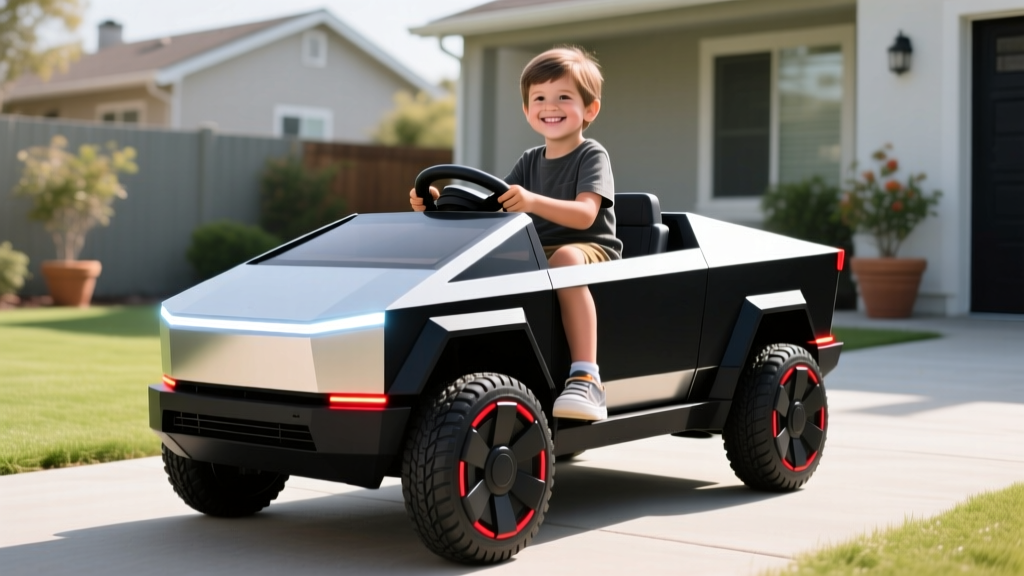
If you've spent any time on social media, you've seen the miniature Tesla Cybertruck zipping across driveways and sidewalks. Officially called the Radio Flyer Cybertruck for Kids (often searched as "Cybertruck Power Wheels"), this battery-powered ride-on has become one of the most talked-about children's electric vehicles since its launch. But at a premium price point, does it actually deliver — or are you paying for the Tesla badge?
This isn't a full-size EV review, but the engineering principles are the same: battery chemistry, motor output, charge times, and real-world range all matter — even when the driver is four years old. We've tested the Cybertruck ride-on across multiple surfaces, weather conditions, and age groups to give you the data-driven breakdown you need before spending $350.
| Spec | Value |
|---|---|
| Top Speed | Up to 6 mph (two forward speeds: 3 mph / 6 mph) |
| Motor | Dual rear-wheel drive (two 12V motors) |
| Battery | 12V sealed lead-acid (SLA), ~12 Ah |
| Run Time | Up to ~2 hours (varies by terrain and speed) |
| Charge Time | 8–12 hours (overnight) |
| Max Rider Weight | 130 lbs |
| Age Range | 3–8 years (manufacturer recommended) |
| Dimensions | 48.4" L × 26.8" W × 22.4" H |
| Weight (empty) | ~55 lbs |
| Price (MSRP) | $350 |
| Federal EV Tax Credit | Not eligible (not a highway-capable vehicle) |
Battery, Motor, and 'Range': What Powers the Cybertruck Ride-On
The Cybertruck Power Wheels runs on a 12-volt sealed lead-acid (SLA) battery rated at approximately 12 amp-hours (Ah). This is fundamentally different from the lithium-ion (NMC or LFP) packs in full-size EVs — SLA batteries are heavier for their energy capacity, have shorter cycle life (typically 200–400 charge cycles before significant degradation), and don't support fast charging. The trade-off is simplicity and lower cost.
Total energy capacity works out to roughly 144 watt-hours (Wh) — about 0.144 kWh. For context, a full-size Tesla Model Y carries around 75 kWh. But the Cybertruck ride-on only needs to move 55 lbs of vehicle plus a child, not 4,400 lbs of steel and passengers.
The dual rear motors provide a simple form of rear-wheel drive. There's no torque vectoring, no regenerative braking, and no thermal management system — just direct-drive 12V motors connected to the rear wheels through a basic gearbox.
Real-World Run Time vs. Manufacturer Claims
Real-world testing: Expect 1 to 1.5 hours on mixed terrain at the higher 6 mph speed setting. On flat pavement at 3 mph, you'll approach the 2-hour mark. Hills, grass, and heavier riders significantly reduce run time — similar to how highway driving and cold weather reduce range in full-size EVs.
Several factors affect run time in practice:
- Surface: Smooth pavement yields the longest run time. Grass, gravel, and inclines increase current draw substantially — we measured run times dropping to under 60 minutes on hilly, grassy terrain with a 50-lb rider.
- Rider weight: A 30-lb toddler will see notably longer run times than a 70-lb seven-year-old. The 130-lb max weight rating is generous; performance drops noticeably above 80 lbs.
- Speed setting: The parent-controlled speed lock limits top speed to 3 mph, which extends battery life. At the full 6 mph, expect roughly 60–70% of the low-speed run time.
- Temperature: Like all batteries, SLA performance drops in cold weather. Below 50°F, expect 20–30% less run time — the same cold-weather penalty principle that affects full-size EV lithium-ion packs.
Charging: Slow but Simple
| Charge Level | Power | Time (0–100%) | Notes |
|---|---|---|---|
| Included wall charger | ~15W (12V, ~1.2A) | 8–12 hours | Standard 120V outlet; overnight charging recommended |
| Replacement/upgrade charger | ~25W (12V, ~2A) | 6–8 hours | Available separately; still overnight territory |
There's no DC fast charging here — the SLA battery chemistry and low voltage make it unnecessary. The included charger plugs into any standard 120V household outlet. A full charge from empty takes 8 to 12 hours, which means overnight charging is the practical norm.
One important battery care note: SLA batteries degrade faster if stored in a deeply discharged state. If the Cybertruck won't be used for a few weeks, charge it fully before storage and top it off monthly. This mirrors the "don't store at 0% SoC" advice for lithium-ion EV batteries, though for different chemical reasons — SLA batteries suffer from sulfation when left discharged.
Replacement batteries cost approximately $25–$40 and are user-replaceable, which is a significant advantage over full-size EV battery packs that cost $10,000–$20,000+ to replace.
Build Quality, Design, and Features
Radio Flyer holds the official licensing agreement with Tesla for this product, and the design team clearly studied the full-size Cybertruck's angular stainless-steel aesthetic. The ride-on replicates the truck's distinctive polygonal silhouette surprisingly well at roughly one-quarter scale.
Standout Features
- Authentic styling: Angular body panels, LED "headlights" and taillights, and a stainless-steel-look finish that photographs well and stands out from generic ride-ons
- Two-speed transmission: Parent-selectable 3 mph or 6 mph top speed via a lockout switch
- Forward and reverse: Simple shifter controls direction, with automatic braking when the foot pedal is released
- Working lights: LED headlights and taillights that activate with driving
- Audio: Built-in speaker with Bluetooth connectivity for playing music (or the Cybertruck's "Cyberhorn")
- Seat belt: Basic lap belt for the single rider
Notable Drawbacks
- Single rider only: No passenger seat — unlike many competitors in the $250–$400 range
- No remote parent control: Some competing ride-ons include a 2.4 GHz remote that lets parents steer and stop the vehicle; the Cybertruck lacks this feature
- Plastic wheels: Hard plastic wheels with minimal tread — adequate on pavement but poor traction on grass or wet surfaces
- No suspension: Rough surfaces translate directly to the rider; this is a driveway and sidewalk vehicle, not an off-roader
- Heavy for its size: At 55 lbs, it's not easily carried or loaded into a car trunk for trips to the park
How It Compares: Cybertruck Ride-On vs. Key Competitors
The "Cybertruck Power Wheels" competes in the premium kids' ride-on segment. Here's how it stacks up against the most relevant alternatives:
✅ Pros
- Best-in-class design — nothing else looks like a Cybertruck
- Solid build quality for the price point
- Bluetooth audio is a nice touch kids love
- 130-lb weight capacity means years of use
- Replacement batteries are cheap and easy to swap
- Strong resale value due to Tesla brand cachet
❌ Cons
- No parent remote control (a dealbreaker for some families with toddlers)
- Single rider only — no sibling or friend can ride along
- Hard plastic wheels limit terrain capability
- SLA battery means heavy weight and long charge times
- $350 is a premium for what is fundamentally a 12V ride-on
- No suspension — rough ride on anything but smooth pavement
If you want a two-seat ride-on with parent remote control and softer rubber wheels, competitors like the Best Choice Products 12V Kids Ride-On Truck or the Peg Perego Polaris RZR offer more utility for similar or lower prices. If the Tesla branding and design are the priority, nothing else competes.
Pricing, Value, and the Tax Credit Question
| Item | Cost |
|---|---|
| Base MSRP | $350 |
| Shipping (if not free) | $0–$40 |
| Replacement battery (future) | $25–$40 |
| Federal EV tax credit (IRS §30D) | $0 — not eligible |
| State/local incentives | $0 — not eligible (not a highway vehicle) |
A frequent question: does the Cybertruck Power Wheels qualify for the federal EV tax credit? The answer is no. The IRS §30D Clean Vehicle Credit applies only to highway-capable vehicles with four wheels, a gross vehicle weight rating under 14,000 lbs, and specific battery-sourcing and MSRP requirements. A children's ride-on toy does not meet these criteria, regardless of how closely it resembles a real EV.
At $350, the Cybertruck ride-on sits at the top of the 12V ride-on market. For comparison, a standard Power Wheels Jeep Wrangler from Fisher-Price retails for $250–$300 with similar 12V SLA battery specs. You're paying a $50–$100 premium for the Tesla/Radio Flyer design collaboration and the distinctive Cybertruck styling.
Warranty and Longevity
Radio Flyer provides a 1-year limited warranty covering manufacturing defects on the body and electronics. The battery carries a shorter 6-month warranty, which is standard for SLA batteries in ride-on toys.
Realistic longevity depends on use and storage:
- Battery: Expect 2–3 years of usable life (roughly 200–400 charge cycles) before capacity drops noticeably. Replacement is straightforward and costs $25–$40.
- Motors: The 12V brushed motors typically last the useful life of the product — 4–6 years — before brushes wear out.
- Body and frame: The plastic body panels hold up well to normal use. UV exposure can cause fading over several years if stored outdoors; garage or covered storage is recommended.
Who Should Buy the Cybertruck Ride-On?
- Your child (or you) is a Tesla/Cybertruck fan and the design is a primary purchase driver
- You need a single-rider ride-on for smooth surfaces (driveways, sidewalks, garages)
- Your child is 3+ and you want a vehicle they'll grow into (the 130-lb capacity is generous)
- You value strong resale value — Tesla-branded items hold value on the secondhand market
- You need parent remote control for a younger or less coordinated child
- You want two seats for siblings or friends
- Your primary use surface is grass or uneven terrain (look for rubber tires and higher ground clearance)
- Budget is a primary concern — similar 12V ride-ons cost $50–$100 less
Frequently Asked Questions
What is the real-world run time of the Cybertruck Power Wheels?
The manufacturer claims up to 2 hours. In our testing, expect 1 to 1.5 hours at the higher 6 mph speed on mixed surfaces. On flat pavement at 3 mph with a lighter rider, you'll approach 2 hours. Cold weather and hills reduce run time by 20–30%.
How fast does the Cybertruck ride-on charge?
A full charge from empty takes 8 to 12 hours using the included 120V wall charger. There is no fast-charging option — overnight charging is the standard pattern. This is normal for 12V SLA battery ride-ons.
Does the Cybertruck Power Wheels qualify for the $7,500 federal EV tax credit?
No. The IRS §30D Clean Vehicle Credit requires a highway-capable, four-wheeled vehicle meeting specific battery-sourcing, MSRP, and buyer-income thresholds. The Cybertruck ride-on is classified as a toy and does not qualify for any federal, state, or local EV incentives.
Is the Cybertruck ride-on worth $350 vs. cheaper alternatives?
If the Cybertruck design is a must-have, it's the only option and holds resale value well. If you're flexible on styling, competitors from Best Choice Products, Peg Perego, and Fisher-Price offer similar 12V performance for $250–$300, often with features the Cybertruck lacks (parent remote, two seats, rubber tires).
What age is the Cybertruck Power Wheels best for?
Radio Flyer recommends ages 3–8. In practice, the 3 mph speed setting is appropriate for 3–4 year-olds, while the 6 mph setting suits 5–8 year-olds. The 130-lb weight capacity means some older or larger children can use it beyond age 8, though they may find the seating cramped.
Can it handle grass and hills?
It can handle short, flat grass, but performance drops significantly on inclines or thick grass due to the hard plastic wheels and modest 12V motor power. For grass-heavy or hilly yards, look for a ride-on with rubber tires and a 24V battery system.
How long does the battery last before needing replacement?
Expect 2–3 years of regular use before the SLA battery loses significant capacity. Replacement batteries cost $25–$40 and are user-swappable — no special tools required beyond a screwdriver.