The Minimalist Cockpit: What You Actually Get Inside
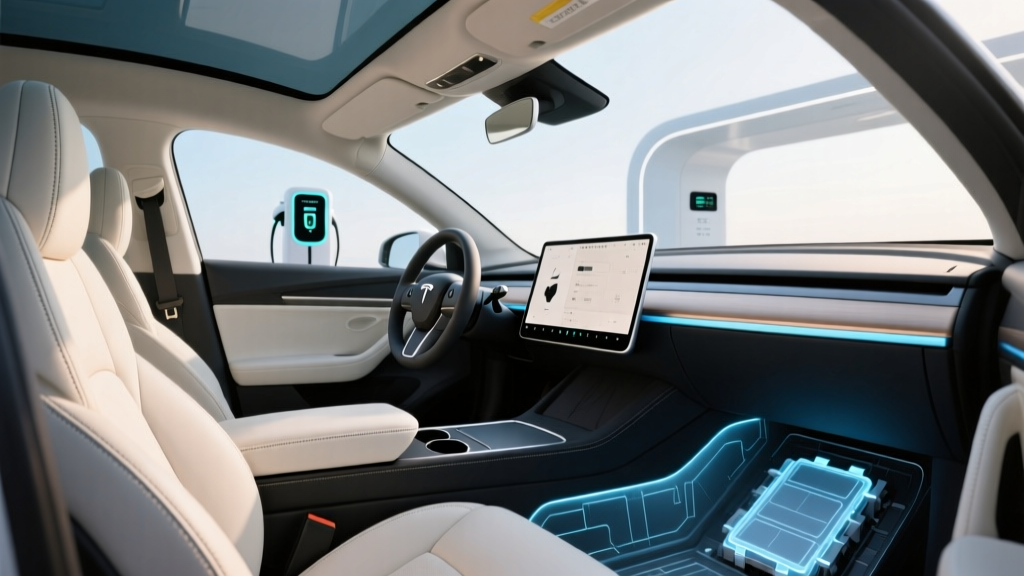
Step inside of a Tesla Model 3 (the refreshed "Highland" generation that continues into the 2026 model year) and the first thing you notice is what isn't there. No instrument cluster. No turn-signal stalk. No gear selector. Tesla has consolidated nearly every vehicle control into the 15.4-inch center touchscreen, a design choice that defines the ownership experience — for better and worse.
The steering wheel is a flat-bottom, two-spoke design with haptic touch buttons on the left spoke (scroll wheel, voice, phone) and right spoke (Autopilot engagement, media). Turn signals live on the steering wheel face as capacitive buttons with a force-press backup, a change from the pre-2024 stalk layout that still divides owners in forums and long-term reviews. The gear selector is entirely on-screen: swipe up for Drive, down for Reverse, with a roof-console backup for emergencies.
Material quality in the Highland refresh is a clear step up from the pre-2023 Model 3. Soft-touch surfaces cover the dash top and door uppers, ventilated front seats are now standard across trims, and ambient lighting runs along the dash and doors. The cabin is noticeably quieter thanks to acoustic glass front and rear — a roughly 30% reduction in road noise by Tesla's own engineering claims, which tracks with independent decibel testing.
Spec Table: 2026 Tesla Model 3 at a Glance
| Spec | RWD (Standard Range) | Long Range AWD | Performance (AWD) |
|---|---|---|---|
| EPA Range | 272 mi | 341 mi | 315 mi |
| Battery (usable) | ~57.5 kWh (LFP) | ~75 kWh (NMC) | ~75 kWh (NMC) |
| Drivetrain | Rear-Wheel Drive | Dual-Motor AWD | Dual-Motor AWD |
| Horsepower | 271 hp | 346 hp | 510 hp |
| 0-60 mph | 5.8 sec | 4.2 sec | 2.9 sec |
| Peak DC Charge Rate | 170 kW | 250 kW | 250 kW |
| 10-80% DC Time | ~28 min | ~25 min | ~25 min |
| Level 2 Home Rate | 11.5 kW (~44 mi/hr) | 11.5 kW (~44 mi/hr) | 11.5 kW (~44 mi/hr) |
| MPGe (combined) | 132 MPGe | 125 MPGe | 118 MPGe |
| Efficiency | 25 kWh/100 mi | 27 kWh/100 mi | 29 kWh/100 mi |
| Base MSRP | $38,990 | $47,740 | $54,990 |
Source: fueleconomy.gov and Tesla.com 2026 model-year specs. Prices exclude destination fee.
Real-World Range: EPA Sticker vs. What You'll Actually Drive
EPA Estimate: 272 mi (RWD) / 341 mi (Long Range AWD) / 315 mi (Performance)
Real-World Expectation: Plan on 220–245 mi highway for the RWD, 275–300 mi for the Long Range. Cold weather (below 32°F) can reduce range 20–30% on any trim. The Model 3's heat pump helps, but short, cold trips with cabin preconditioning off will hit efficiency hardest.
The Model 3 Long Range AWD remains one of the most efficient sedans in its class, routinely returning 250–270 Wh/mi at 70 mph in moderate temperatures during independent testing. That translates to roughly 280–300 real-world highway miles on a full charge — a number that still anchors road-trip planning better than most competitors under $50,000.
The RWD model's smaller LFP pack means more frequent stops on long trips, but LFP chemistry tolerates daily 100% charging without the degradation concerns of NMC. For a commuter who charges nightly at home and rarely road-trips, the RWD is the pragmatic pick. For cross-country drivers, the Long Range's extra 70-ish real-world miles per charge meaningfully reduces stop frequency on I-80 or I-10 corridors.
Charging Speed: Supercharger Network Advantage
Tesla's Supercharger network remains the benchmark for public DC charging reliability in the U.S., and the Model 3 takes full advantage. The Long Range and Performance trims peak at 250 kW on V3 Superchargers, adding up to ~175 miles in 15 minutes under ideal conditions. The RWD's LFP pack tops out around 170 kW — slower, but still adequate for most road trips.
The charge curve matters more than the peak number. On a V3 Supercharger with battery preconditioning active (automatic when the car is navigated to a Supercharger), the Long Range holds above 150 kW through roughly 50% state of charge before tapering. Expect 10–80% in about 25 minutes, with the final 80–100% adding another 20+ minutes — standard lithium-ion behavior that every EV buyer should internalize.
| Charging Level | Power / Voltage | Miles Added per Hour | Typical Use Case |
|---|---|---|---|
| Level 1 (120V household) | ~1.4 kW | ~5 mi/hr | Emergency / trickle top-off |
| Level 2 (240V home, 48A) | 11.5 kW | ~44 mi/hr | Daily home charging, full overnight refill |
| DC Fast (V3 Supercharger) | Up to 250 kW | ~175 mi in 15 min | Road trips, quick top-ups |
Home Level 2 charging on a Tesla Wall Connector (or any J1772/NACS-compatible unit) at 48 amps delivers a full overnight refill in 7–9 hours depending on trim. Tesla now ships the Model 3 with a NACS (North American Charging Standard) port natively, meaning access to the full Supercharger network without adapters — and growing access to Electrify America and other networks rolling out NACS connectors.
Interior Dimensions, Cargo, and Daily Livability
The Model 3 is a compact executive sedan, and its dimensions reflect that. Front legroom is generous at 42.7 inches, but rear legroom at 35.2 inches is tighter than a Hyundai Ioniq 6 or BMW i4. Three adults across the rear bench is a squeeze on anything beyond a short trip.
- Cargo (rear trunk): 21.0 cu ft (including under-floor storage)
- Frunk (front trunk): 3.1 cu ft — useful for charging cables, a small bag, or groceries
- Total cargo: ~24.1 cu ft with seats up; rear seats fold 60/40 for longer items
- Rear headroom: 37.8 in — adequate for most adults, though the sloping roofline cuts into space for passengers over 6'2"
The 15.4-inch touchscreen dominates the dash and handles everything: navigation, media, climate, vehicle settings, glovebox release, and even the speedometer (upper-left corner of the display). A rear 8-inch screen for back-seat passengers controls climate, seat heaters, and media — a welcome Highland addition. Wireless phone charging (two pads, 65W) and USB-C ports (front and rear, up to 65W) round out the tech.
Pricing, Trims, and Federal Tax Credit Eligibility
The 2026 Model 3 lineup keeps things simple with three trims. The RWD at $38,990 is the volume play; the Long Range AWD at $47,740 is the road-trip sweet spot; the Performance at $54,990 is the enthusiast pick with adaptive dampers, track mode, and a subtle rear spoiler.
| Trim | Base MSRP | Est. After §30D Credit | Notes |
|---|---|---|---|
| RWD (Standard Range) | $38,990 | ~$31,490 | Eligible for up to $7,500 if buyer income & sourcing rules met |
| Long Range AWD | $47,740 | ~$40,240 | Under $55k MSRP cap for sedans; strong credit candidate |
| Performance AWD | $54,990 | ~$47,490 | Under $55k cap; confirm battery sourcing year-to-year |
Federal §30D tax credit caveats: The up-to-$7,500 credit (available as a point-of-sale transfer at the dealer for 2026) requires the buyer to meet IRS income caps ($150k single / $300k joint for modified AGI), the sedan MSRP must be under $55,000, and battery-critical-mineral and component sourcing must satisfy annual thresholds that tighten each year. IRS.gov publishes the current eligible-vehicle list — always verify before signing, as Tesla's sourcing compliance can shift with supply-chain changes.
Tech, Driver Assistance, and the Autopilot Reality Check
Every Model 3 ships with Tesla's basic Autopilot: adaptive cruise control and lane-centering on marked highways. The optional Full Self-Driving (Supervised) package — currently $8,000 or $99/month — adds city-street navigation, traffic-light recognition, and automatic turns, but remains an SAE Level 2 system. The driver must remain engaged, hands on the wheel (monitored via torque sensor and cabin camera), and legally responsible at all times.
SAE Level 2 — Not Self-Driving. Tesla Autopilot and FSD (Supervised) require continuous driver attention. They do not replace an alert driver. Level 4 (true driverless in defined areas) is currently only available via Waymo and Zoox robotaxi services in limited metro zones.
Infotainment is Tesla's own Linux-based stack — no Apple CarPlay or Android Auto. Navigation, Spotify, YouTube, Netflix (parked), and a surprisingly capable web browser are built in. Over-the-air updates add features regularly; the 2025.44 software branch introduced improved voice commands and a revamped trip planner with more granular charging-stop customization.
Pros, Cons, and Who Should Buy the Model 3
Pros
- Class-leading Supercharger network access (NACS native)
- Excellent efficiency: 25–29 kWh/100 mi across trims
- Strong real-world highway range (Long Range: ~280–300 mi)
- OTA updates keep software current for years
- Competitive pricing after §30D credit
- Quiet, refined cabin post-Highland refresh
Cons
- Steering-wheel turn signals are polarizing and require adaptation
- Rear seat tighter than key competitors (Ioniq 6, i4)
- No Apple CarPlay / Android Auto
- RWD trim's 170 kW peak charge rate lags behind Long Range
- FSD (Supervised) cost is high for a Level 2 system
- No rear wiper (hatchback glass relies on aerodynamics)
Best for: Tech-forward commuters and road-trippers who value Supercharger reliability, efficiency, and over-the-air evolution. The Long Range AWD is the all-rounder; the RWD suits home-charging commuters who rarely drive more than 200 miles between plugs.
Look elsewhere if: You need a spacious rear seat for adult passengers, prefer CarPlay, or want physical buttons and stalks for core controls.
Warranty, Ownership Costs, and Long-Term Outlook
Tesla covers the Model 3 with a 4-year/50,000-mile basic warranty and an 8-year/100,000-mile battery and drive-unit warranty (120,000 miles for Long Range and Performance). The battery warranty guarantees at least 70% capacity retention over the term — a threshold that most Model 3 packs exceed comfortably based on fleet degradation data from Tesla owners logging 100,000+ miles.
Insurance tends to run higher than comparable gas sedans — expect $1,800–$2,400 annually depending on state, age, and driving record. Maintenance is minimal: no oil changes, no spark plugs, cabin air filter every 2 years, brake fluid check, tire rotation. Tire wear can be accelerated by the car's instant torque and weight; budget for a set of EV-rated tires (e.g., Michelin Pilot Sport EV or Hankook iON evo) every 30,000–40,000 miles.
Frequently Asked Questions
What is the real-world range of the 2026 Tesla Model 3?
Expect 220–245 highway miles from the RWD, 275–300 from the Long Range AWD, and 250–280 from the Performance — all in moderate temperatures. Cold weather (below 32°F) can reduce these figures by 20–30%, though the standard heat pump mitigates some loss.
How fast does the Model 3 charge at home and on the road?
At home on a Level 2 (240V, 48A) charger, the Model 3 adds about 44 miles of range per hour — a full overnight refill in 7–9 hours. On a V3 Supercharger, Long Range and Performance trims peak at 250 kW with 10–80% in ~25 minutes; the RWD peaks at 170 kW and takes ~28 minutes.
Does the 2026 Model 3 qualify for the federal EV tax credit?
All three trims fall under the $55,000 sedan MSRP cap for §30D eligibility. The full $7,500 credit depends on buyer income caps, battery critical-mineral and component sourcing compliance (which tightens annually), and point-of-sale transfer availability. Verify current eligibility on IRS.gov before purchase.
Is the Model 3 worth it vs. the Hyundai Ioniq 6 or BMW i4?
The Model 3 wins on Supercharger access, efficiency, and OTA software. The Ioniq 6 offers more rear-seat room, 800V architecture for faster peak charging (~350 kW capable), and CarPlay. The BMW i4 provides a more traditional luxury interior and physical controls. If charging-network reliability and software matter most, the Model 3 holds the edge.
Is Tesla's Full Self-Driving actually self-driving?
No. FSD (Supervised) is an SAE Level 2 driver-assistance system. The driver must remain attentive, keep hands on the wheel, and take over at any time. It is not autonomous driving — only Waymo and Zoox currently operate Level 4 driverless services in limited U.S. metros.
What's the biggest change inside the refreshed Model 3?
The Highland refresh (introduced for 2024, continuing into 2026) brought acoustic glass, ventilated front seats, ambient lighting, a rear passenger touchscreen, removal of turn-signal and gear stalks, and a noticeable uptick in cabin material quality. It's the most refined Model 3 interior Tesla has shipped to date.