Quick Verdict: The Lifted Cybertruck Trade-Off
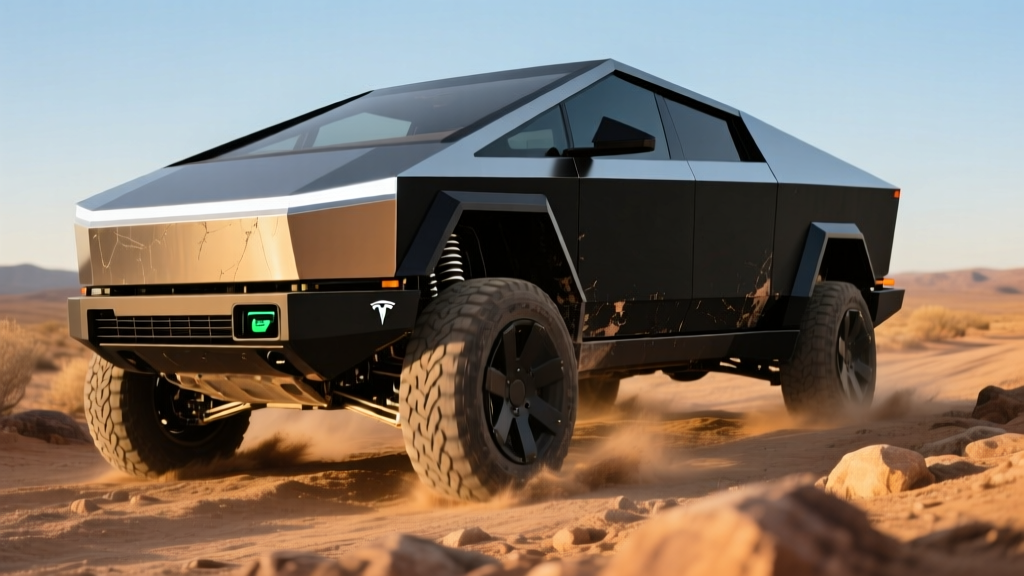
The Tesla Cybertruck is already one of the most polarizing EVs on the road. Lifting it amplifies that divide. A lifted Cybertruck gains serious off-road credibility — more ground clearance, better approach and departure angles, room for 35-inch all-terrain tires — but it surrenders measurable efficiency, range, and on-road refinement in the process. If you're researching a cybertruck lifted build, this guide breaks down exactly what happens to range, charging, warranty, and daily drivability when you raise Tesla's stainless-steel truck.
Stock Cybertruck Dual Motor AWD: EPA 340 miles (123 kWh usable battery).
Lifted with 35" A/T tires: expect 260–290 miles real-world (15–25% range loss).
Cold weather (below 30°F) + highway speeds: as low as 220–240 miles.
Full Spec Sheet: Stock vs. Lifted Cybertruck
| Specification | Stock Dual Motor AWD | Lifted Build (Typical) |
|---|---|---|
| EPA Range | 340 miles | N/A (modified — see real-world below) |
| Battery Capacity | ~123 kWh usable (NMC) | Unchanged |
| Drivetrain | Dual Motor AWD | Unchanged |
| Horsepower | 600 hp | Unchanged |
| 0–60 mph | 4.1 seconds | ~4.5–5.0 sec (added weight/drag) |
| Ground Clearance | 16.0 in (max, adaptive air) | 18–20+ in (with lift kit) |
| Tire Size (stock) | 285/65R20 | 35x12.5R18 or 35x12.5R20 common |
| Max DC Fast Charge | 250 kW | Unchanged (charging curve below) |
| 10–80% DCFC Time | ~20 minutes | ~20 minutes |
| Level 2 Home Charge | 11.5 kW (~30 mi/hr) | Unchanged |
| MPGe (combined, stock) | 79 MPGe | ~60–68 MPGe (est.) |
| Efficiency (stock) | 48 kWh/100 mi | ~58–68 kWh/100 mi (est.) |
| Tow Rating | 11,000 lbs | Reduced; consult lift-kit mfr. |
| Cargo Bed Volume | 67 cu ft | Unchanged |
| Frunk Volume | 7 cu ft | Unchanged |
| Rear Legroom | 40.9 in | Unchanged |
| Battery Warranty | 8 yr / 120,000 mi | Potentially voided (see below) |
| Base MSRP (Dual Motor) | $79,990 | +$3,500–$8,000 lift/tire/wheel |
How Lifting Changes Real-World Range and Efficiency
The stock Cybertruck Dual Motor AWD carries an EPA-rated 340 miles of range from its approximately 123 kWh usable NMC battery pack. The Cyberbeast variant is rated at 320 miles. These figures assume stock wheels, stock tires, and factory ride height.
Once you install a suspension lift (typically 2–4 inches from brands like Unplugged Performance, Delta Vehicle Systems, or Rough Country) and mount heavier, knobbier 35-inch all-terrain or mud-terrain tires, three physics penalties compound:
- Increased rolling resistance: A/T tires have deeper tread blocks and softer compounds than the stock Michelin or Goodyear highway rubber. This alone can cost 8–12% efficiency.
- Added unsprung weight: Larger wheels and tires add rotational mass. Each 35-inch A/T tire and wheel assembly can weigh 15–25 lbs more than stock, forcing the motors to work harder on every acceleration event.
- Aerodynamic disruption: The Cybertruck's angular shape is already aerodynamically challenged (~0.38 Cd). Lifting the body increases the frontal gap between the tires and fenders, disrupting underbody airflow. At highway speeds (70–80 mph), aero drag dominates energy consumption.
Combined, owners in EV forums and build threads report real-world efficiency in the 58–68 kWh/100 mi range (versus the stock 48 kWh/100 mi). That translates to roughly 260–290 miles on a full charge in moderate weather with mixed driving. Push 80 mph on the interstate in winter, and you may see 220–240 miles before needing to plug in.
For context, the EPA's official Cybertruck data on fueleconomy.gov lists the stock Dual Motor at 79 MPGe combined and 48 kWh/100 mi. No lifted variant will appear on that page — aftermarket modifications are not EPA-certified.
Charging Speed: DC Fast Charging and Home Level 2
Lifting the Cybertruck does not alter its charging hardware. The truck's 800-volt-class architecture and battery management system remain stock. However, your larger battery consumption means each mile of range takes slightly more energy to replenish — effectively making your "miles added per hour" numbers less impressive, even though the kW rate is unchanged.
| Charging Level | Power | Stock mi/hr Added | Lifted mi/hr Added (est.) |
|---|---|---|---|
| Level 1 (120V, 12A) | ~1.4 kW | ~3 mi/hr | ~2–2.5 mi/hr |
| Level 2 (240V, 48A) | 11.5 kW | ~30 mi/hr | ~22–26 mi/hr |
| DC Fast Charge (peak) | 250 kW | ~140–170 mi in 15 min | ~110–140 mi in 15 min |
DC fast charging reality: The Cybertruck peaks at 250 kW on V3 Superchargers and compatible CCS/NACS DC fast chargers. Tesla claims a 10–80% charge in roughly 20 minutes. The charge curve is aggressive early — you'll see 200+ kW up to about 40% state of charge — then it tapers progressively. Above 80%, charging slows dramatically to protect the NMC cells, dropping below 50 kW. This taper behavior is unchanged on a lifted build, but because your lifted truck burns more kWh per mile, those electrons don't carry you as far.
Home charging: On a 48-amp Level 2 circuit (requiring a 60-amp breaker), the Cybertruck pulls 11.5 kW, adding roughly 30 miles of range per hour stock. A lifted build, with its higher consumption, effectively gains closer to 22–26 miles per hour of Level 2 charging. Overnight charging (8–10 hours) still fully replenishes the pack for most daily needs.
Performance: Does a Lift Ruin the Cybertruck's Speed?
The stock Cybertruck Dual Motor AWD produces 600 horsepower and hits 0–60 mph in 4.1 seconds. The tri-motor Cyberbeast pushes 845 hp and a claimed 2.6-second 0–60. These are supercar-rivaling numbers in a 6,800-lb stainless-steel wedge.
A typical lift kit adds 100–200 lbs of hardware (control arms, spacers, heavier wheels/tires). The 35-inch tires also change the effective final-drive ratio, slightly reducing acceleration force at the contact patch. In practice, owners report 0–60 times slipping to roughly 4.5–5.0 seconds on the Dual Motor — still quick by any truck standard, but measurably off the stock benchmark.
Handling changes are more noticeable. The higher center of gravity increases body roll in corners, and the heavier steering feel from larger tires is perceptible at parking-lot speeds. The adaptive air suspension still functions, but its tuning was calibrated for stock geometry — it may not compensate fully for the altered suspension angles.
Pricing, Build Cost, and Federal Tax Credit Eligibility
The 2026 Cybertruck Dual Motor AWD starts at $79,990 MSRP. The Cyberbeast starts at $99,990. The rear-wheel-drive base model ($60,990) has been discontinued, simplifying the lineup.
| Item | Cost |
|---|---|
| Cybertruck Dual Motor AWD (base MSRP) | $79,990 |
| Destination fee | $1,995 |
| Lift kit (2–4" suspension) | $2,000–$4,500 |
| 35" A/T tires (set of 4) | $1,200–$2,000 |
| Aftermarket wheels (18" or 20", set of 4) | $1,200–$2,400 |
| Alignment + installation labor | $500–$1,200 |
| Estimated total (Dual Motor, lifted) | $87,000–$94,000 |
Federal tax credit (§30D): The Cybertruck's eligibility for the $7,500 federal EV tax credit depends on several IRS rules that change frequently. Key constraints for 2026:
- MSRP cap: Trucks, SUVs, and vans must have an MSRP at or below $80,000. The Dual Motor AWD at $79,990 squeaks under; the Cyberbeast at $99,990 does not qualify.
- Buyer income cap: Modified adjusted gross income must not exceed $150,000 (single), $225,000 (head of household), or $300,000 (joint filers).
- Battery sourcing: Critical minerals and battery components must meet phased-in domestic-content and free-trade-agreement thresholds. Tesla's supply chain has been volatile on this front — check current eligibility at the point of sale.
- Point-of-sale transfer: If eligible, you can transfer the credit to the dealer at purchase, reducing your out-of-pocket cost immediately.
Critical caveat: The tax credit applies to the vehicle purchase, not to aftermarket modifications. Your lift kit, wheels, and tires are not credit-eligible. Also, if modifications affect the vehicle's classification or if the IRS or manufacturer updates sourcing compliance mid-year, eligibility can shift. Always verify current rules at IRS.gov's clean vehicle credits page and confirm with your tax professional before purchasing.
Warranty Impact: What Lifting Does to Your Coverage
Tesla's new-vehicle limited warranty covers 4 years / 50,000 miles. The battery and drive unit warranty extends to 8 years / 120,000 miles (with a minimum 70% capacity retention threshold). These are strong terms for an EV truck.
However, the Magnuson-Moss Warranty Act protects you only partially. Tesla can deny warranty claims on components that were demonstrably affected by aftermarket modifications. In practice:
- Likely still covered: Battery pack degradation, drive motor failures, infotainment — components unrelated to suspension geometry.
- At risk of denial: Air suspension compressor or air spring failures, steering rack wear, CV joint or half-shaft issues, wheel bearing wear — all plausibly accelerated by increased ride height, larger tires, and altered suspension angles.
- Almost certainly voided: Any claim on the specific lift-kit hardware or aftermarket wheels/tires themselves (those fall to the aftermarket manufacturer's warranty).
Before lifting, document your truck's condition, save all receipts, and consider whether the off-road capability justifies the potential warranty friction. Some owners opt for reversible spacer lifts rather than full control-arm replacement kits to preserve the option of returning to stock.
Tech, Interior, and Daily Livability
The Cybertruck's interior and technology carry over unchanged in a lifted build:
- 18.5-inch front touchscreen with Tesla's latest UI, navigation, and media — no Apple CarPlay or Android Auto (Tesla's ecosystem only).
- 9.4-inch rear touchscreen for rear-seat climate and entertainment.
- Autopilot (standard): adaptive cruise control, lane-keeping assist. This is an SAE Level 2 driver-assist system — you must remain engaged with hands on the wheel and eyes on the road at all times.
- Full Self-Driving (Supervised): Optional upgrade (~$8,000 or $99/month). Despite the name, this is still SAE Level 2 — not autonomous. The driver is responsible for all driving decisions.
- Armor glass: Laminated "ultra-hard" glass. Durable but not indestructible — replacement costs remain high.
- Bioweapon Defense Mode: HEPA filtration system, a genuine differentiator for dusty off-road environments.
- 67 cu ft bed (vault) with powered tonneau cover and integrated ramp. The 120V and 240V bed outlets (up to 9.6 kW V2L) are ideal for powering tools or camp equipment at a trailhead.
Drawbacks of the lifted setup in daily use: Increased wind noise at highway speeds from the tire tread pattern, a rougher ride over sharp pavement imperfections (stiffer sidewall on 35-inch tires), and potential difficulty fitting into low-clearance parking structures (at max air suspension height plus lift, you may exceed 7-foot clearance limits).
Who Should Build a Lifted Cybertruck?
Build it if: You regularly drive unpaved roads, forest service roads, or moderate off-road trails; you value ground clearance and tire sidewall for rock gardens and ruts; you accept a 15–25% range penalty as a fair trade; you have reliable home Level 2 charging to offset daily range loss.
Keep it stock if: Your use case is primarily highway commuting, road trips on paved interstates, or towing (where range is already compressed); you rely on public DC fast charging and want maximum miles-per-charge; you want zero warranty friction with Tesla Service.
Lifted Cybertruck Pros and Cons
- 18–20+ inches of ground clearance for serious off-road capability
- Accommodates 35" A/T or M/T tires for traction and sidewall protection
- Aggressive, custom appearance — stands out even among Cybertrucks
- Retains 600 hp dual-motor AWD performance (still quick)
- V2L (9.6 kW) bed power is ideal for overlanding and campsite use
- Air suspension still functional for on-road comfort adjustment
- 15–25% range loss (260–290 real-world miles vs. 340 EPA)
- Higher energy cost per mile (~58–68 kWh/100 mi vs. 48 stock)
- Potential warranty disputes on suspension/steering/driveline components
- Increased wind and road noise at highway speeds
- 0–60 time degrades to ~4.5–5.0 seconds
- May not fit standard parking structures at full ride height
- Aftermarket build cost adds $3,500–$8,000+ on top of MSRP
Frequently Asked Questions
What is the real-world range of a lifted Cybertruck?
With a 2–4 inch lift and 35-inch all-terrain tires, expect 260–290 miles in moderate weather with mixed driving. Highway-only driving at 75+ mph or cold-weather driving below 30°F can drop this to 220–240 miles. The stock EPA rating of 340 miles no longer applies once you modify wheels, tires, and ride height.
How fast does a lifted Cybertruck charge?
Charging hardware is unchanged: 250 kW peak DC fast charging with a 10–80% time of about 20 minutes on a V3 Supercharger. Level 2 home charging at 11.5 kW adds roughly 22–26 miles per hour (fewer than stock because each mile costs more energy). The charging curve tapers significantly above 80% state of charge — plan your road-trip stops around the 10–80% sweet spot.
How much does a lifted Cybertruck cost after tax credits?
A Dual Motor AWD Cybertruck starts at $79,990 MSRP. A typical lift/tire/wheel build adds $3,500–$8,000. If you qualify for the full $7,500 §30D federal tax credit (meeting income, MSRP, and battery-sourcing requirements), your effective vehicle cost drops to ~$72,490 — but the aftermarket modifications are not credit-eligible. Total out-of-pocket for a lifted build: roughly $79,000–$87,000 after credit, depending on your parts choices.
Is a lifted Cybertruck worth it versus a stock Cybertruck or a Rivian R1T?
If off-road capability is a primary use case, a lifted Cybertruck offers more raw ground clearance and a more aggressive approach/departure angle than stock. However, the Rivian R1T (with its available quad-motor setup and factory-available all-terrain packages) may offer more refined off-road capability without warranty risk or range penalties as severe. The Cybertruck's advantage is its V2L power output, stainless-steel durability, and lower starting price. The choice depends on whether you value factory-integrated off-road engineering (Rivian) or aftermarket customization freedom (Cybertruck).
Does the Cybertruck qualify for the federal EV tax credit?
The Dual Motor AWD at $79,990 MSRP falls under the $80,000 truck MSRP cap and is potentially eligible for the full $7,500 credit, provided you meet income thresholds ($150K single / $300K joint) and the vehicle's battery sourcing meets current-year critical-mineral and component requirements. The Cyberbeast at $99,990 exceeds the MSRP cap and does not qualify. Rules change — always verify at IRS.gov before purchasing. The credit applies to the vehicle, not aftermarket lift modifications.
Will lifting my Cybertruck void the battery warranty?
Not automatically. Tesla's 8-year/120,000-mile battery warranty covers the pack itself, and a suspension lift doesn't directly affect battery chemistry or degradation. However, if a driveline vibration caused by altered suspension geometry leads to a drive-unit issue, Tesla may deny that specific claim under the Magnuson-Moss framework. Document everything, use quality components, and consider keeping stock parts for reversibility.