Quick Verdict: The Original Efficiency King
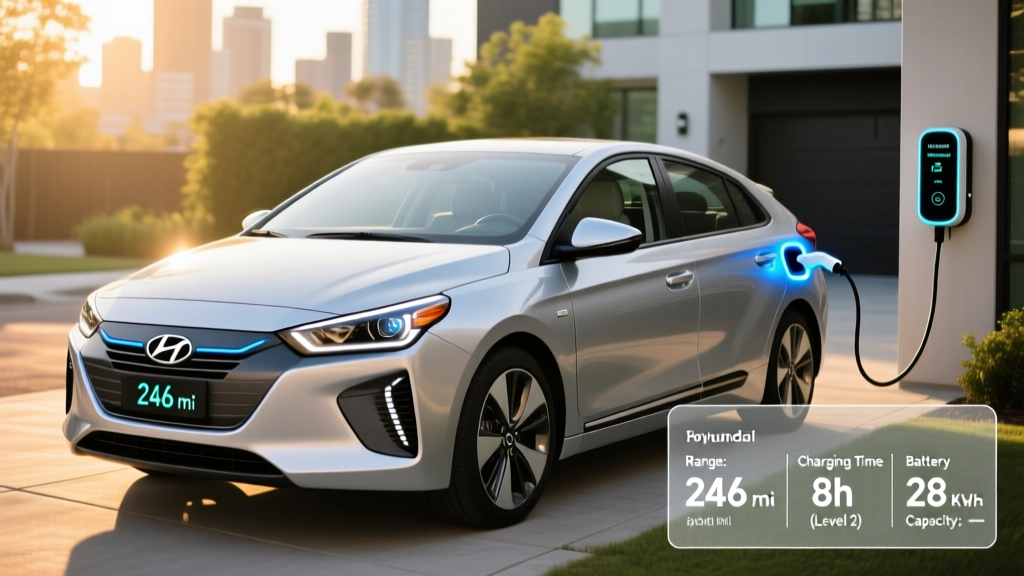
Before the Ioniq 5 grabbed headlines with its 800-volt architecture and retro-futuristic styling, Hyundai built a quieter pioneer: the 2017 Ioniq Electric. This compact liftback was engineered for one mission — squeeze every possible mile out of every kilowatt-hour. With an EPA-estimated 124 miles of range from a modest 28 kWh battery, it posted a then-class-leading 136 MPGe combined, a figure that still embarrasses many 2026 EVs carrying batteries twice its size.
If you're shopping the used EV market today and your commute is predictable, your budget is tight, and you can charge at home, the 2017 Ioniq Electric remains one of the smartest value plays available. But its short range, slow DC fast charging, and discontinued status mean it's not for everyone. Here's exactly what you need to know before buying one in 2026.
EPA Range vs. Real-World Driving
Real-World Expectation: 95–115 miles highway (70 mph); 110–130 miles city/mixed; 75–95 miles in freezing weather with cabin heat
Usable Battery: ~25.6 kWh of 28 kWh total (buffer protects longevity)
The 2017 Ioniq Electric's 124-mile EPA rating was the gold standard among affordable EVs at launch, beating the 2017 Nissan Leaf's 107 miles and the BMW i3's 114 miles. That efficiency came from a combination of factors: a drag coefficient of just 0.24, a relatively light 3,230-pound curb weight, and a heat pump (standard on all trims) that dramatically reduced cabin-heating energy draw in cold weather.
In real-world highway testing at sustained 70 mph speeds, expect roughly 100–110 miles before the low-battery warning forces you to find a charger. The Ioniq Electric's thermal management is passive (air-cooled), meaning battery temperature can limit performance during repeated fast-charge sessions or in extreme heat. In winter conditions below 20°F, range drops of 25–35% are typical — plan for 80–95 miles if you're running the heater and seat warmers on a January commute.
For context, the EPA rated the Ioniq Electric at 136 MPGe combined (145 city / 127 highway), translating to roughly 25 kWh per 100 miles — a number that still ranks among the most efficient EVs ever sold in the US, per fueleconomy.gov.
Battery, Charging Speeds, and Connector Reality
The 2017 Ioniq Electric carries a 28 kWh lithium-ion polymer battery pack using NMC (nickel manganese cobalt) chemistry. Hyundai engineered a conservative buffer — roughly 2.4 kWh is reserved and inaccessible — to slow degradation over the pack's life. This is a common strategy, and real-world data from high-mileage Ioniq owners suggests State of Health (SoH) retention of 90–95% after 80,000 miles is achievable when DC fast charging is used sparingly.
| Charging Level | Power / Rate | Time / Speed | Connector |
|---|---|---|---|
| Level 1 (120V household) | ~1.4 kW | ~3–4 miles per hour; ~24 hrs (0–100%) | J1772 |
| Level 2 (240V home/public) | 6.6 kW (onboard charger max) | ~4 hours (0–100%); ~22 miles per hour | J1772 |
| DC Fast Charge | Peak ~50 kW (CCS) | 10–80% in ~33 minutes; tapers sharply above 80% | CCS1 (Combo) |
The Ioniq Electric's DC fast-charging capability is its most significant limitation by 2026 standards. At a peak of roughly 50 kW, it can add about 80 miles of range in 30 minutes under ideal conditions. However, because the pack is air-cooled, consecutive fast-charge sessions (common on road trips) will cause the battery to heat up, and the car will throttle charge speeds to protect the cells — sometimes dropping to 25–30 kW. This makes the Ioniq Electric a poor choice for frequent long-distance travel.
For daily use, the 6.6 kW Level 2 onboard charger is perfectly adequate. A home Level 2 station (like a ChargePoint Home Flex or Emporia Vue) will fully replenish the battery overnight in about four hours. At an average electricity rate of $0.14/kWh, a full charge costs roughly $3.50 — about $0.03 per mile.
Note: The 2017 model uses the CCS1 connector for DC fast charging and J1772 for Level 1/2. It does not have NACS (Tesla) compatibility, though CCS-to-NACS adapters are expected to become more widely available. Tesla Supercharger access requires an adapter and depends on Hyundai's integration agreements, which did not exist for this model year.
Performance, Drivetrain, and Driving Impressions
| Metric | Specification |
|---|---|
| Motor | Single permanent-magnet synchronous (front axle) |
| Horsepower | 110 hp (81 kW) |
| Torque | 218 lb-ft |
| Drivetrain | Front-wheel drive (FWD) |
| 0–60 mph | ~9.7 seconds |
| Top Speed | ~103 mph (electronically limited) |
| Regenerative Braking | 3 levels via steering-wheel paddles (no true one-pedal mode) |
The Ioniq Electric was never meant to be quick. Its 9.7-second 0–60 time puts it firmly in economy-car territory, and highway merging requires planning. But around town, the 218 lb-ft of instant electric torque makes it feel surprisingly responsive off the line. The steering is light and precise, the ride is compliant, and the low center of gravity (battery under the rear seats) keeps body roll controlled in corners.
Three regenerative braking levels — adjustable via paddles behind the steering wheel — let you tailor deceleration. Level 3 provides strong regen that approaches one-pedal driving in city traffic, but it won't bring the car to a complete hold without touching the brake pedal, unlike systems in the Chevrolet Bolt or later Hyundai EVs.
Interior, Cargo, and Technology
The 2017 Ioniq Electric seats five, though the rear middle position is best suited for a child. Rear legroom measures 35.7 inches — adequate for adults on shorter trips — while front headroom is generous at 39.9 inches. The sloping liftback roofline cuts into rear headroom for taller passengers.
Cargo volume behind the rear seats is 23.8 cubic feet, expanding to roughly 55 cubic feet with the 60/40 split rear seats folded. That's competitive with a Honda Civic hatchback and significantly more than the BMW i3 (15.1 cu ft). There is no front trunk (frunk).
Infotainment and tech: The Limited trim (the only trim available in most US markets for the Electric variant) includes a 7-inch touchscreen with Apple CarPlay and Android Auto, navigation, a premium Infinity audio system, wireless phone charging, and a 4.2-inch color TFT instrument cluster. It feels dated by 2026 standards — no over-the-air updates, no phone-as-a-key — but CarPlay/Android Auto integration keeps it functional for daily use.
Driver-assistance features: The 2017 Ioniq Electric includes Hyundai's SmartSense suite: automatic emergency braking with pedestrian detection, lane departure warning with lane-keep assist, blind-spot detection, and rear cross-traffic alert. Adaptive cruise control is standard on the Limited trim. This is an SAE Level 1 system — the driver must remain fully engaged at all times. There is no hands-free or automated lane-change capability.
Used Pricing and Federal Tax Credit Eligibility
The 2017 Ioniq Electric originally started at $29,500 (Limited trim was ~$33,000) before incentives. By 2026, used examples with 50,000–80,000 miles typically sell for $10,000–$14,500 depending on condition, battery health, and region. Low-mileage examples under 30,000 miles occasionally appear above $16,000.
| Scenario | Estimated Cost |
|---|---|
| Used market price (avg, 60k miles) | $12,000–$14,000 |
| IRS §25E Used EV Credit (if eligible) | Up to $4,000 (30% of sale price, max $4,000) |
| Effective price after credit | $8,000–$10,000 |
Critical tax credit note: The 2017 Ioniq Electric is no longer eligible for the new-vehicle §30D credit (the car is discontinued). However, buyers may qualify for the §25E Previously Owned Clean Vehicle Credit — up to $4,000 or 30% of the sale price, whichever is lower. Per IRS guidelines, eligibility requires:
- Sale price of $25,000 or less (the Ioniq qualifies easily)
- Buyer adjusted gross income: ≤$75,000 single / ≤$112,500 head of household / ≤$150,000 joint
- Purchase from a licensed dealer (private-party sales do not qualify)
- Vehicle must be at least two model years old (the 2017 qualifies)
- You must not have claimed the used-EV credit in the prior three years
This credit can be transferred to the dealer at point of sale as an immediate price reduction. Always confirm eligibility with a tax professional before relying on the credit.
Warranty and Battery Longevity
Hyundai originally backed the 2017 Ioniq Electric with a strong warranty package:
- Battery: 8 years / 100,000 miles (10 years / 100,000 miles in California and CARB-adopting states)
- Powertrain: 10 years / 100,000 miles
- New vehicle: 5 years / 60,000 miles
By 2026, most 2017 examples are at or past the 8-year battery warranty mark unless they were sold new in CARB states (California, Oregon, Washington, New York, and others that adopted California's ZEV mandate). Hyundai's battery warranty covers capacity loss below 70% of original capacity — a reasonable threshold. Replacement battery packs, when available through Hyundai, typically cost $5,000–$8,000 including labor, though supply for the original Ioniq Electric can be limited given the model's discontinuation.
When evaluating a used 2017 Ioniq Electric, ask the seller for a battery State of Health (SoH) reading. Some Hyundai dealerships can pull this via the OBD-II diagnostic tool, and third-party apps like Car Scanner (with an OBD dongle) can read the BMS data directly. An SoH above 90% at 60,000–80,000 miles is a positive sign.
Pros and Cons
Pros
- Class-leading efficiency — 136 MPGe combined still beats most 2026 EVs
- Standard heat pump preserves range in cold weather better than competitors
- Liftback cargo versatility (23.8 cu ft) in a compact footprint
- Low used pricing ($10–14k) and potential $4,000 used-EV credit
- Apple CarPlay / Android Auto keep infotainment usable
- Comprehensive driver-assist suite for the model year
Cons
- 124-mile EPA range is limiting — even for commuting, range anxiety is real
- 50 kW DC fast charging is painfully slow by 2026 standards
- Air-cooled battery limits repeated fast-charge performance
- No one-pedal driving mode; regen is adequate but not exceptional
- Discontinued — parts and battery replacements may be harder to source
- Back seat and cargo area smaller than Bolt EV or Leaf
- Most battery warranties have expired or are expiring
Who Should Buy the 2017 Ioniq Electric?
Best for: Budget-conscious commuters with home charging, predictable sub-80-mile round trips, and a second car for longer drives. The Ioniq Electric's efficiency means your cost per mile is among the lowest of any EV ever sold — roughly 3–4 cents per mile on average residential electricity rates.
Skip it if: You need a single-vehicle solution for road trips, live in an apartment without charging access, regularly drive in extreme cold (range drops below 80 miles), or want modern fast-charging capability for spontaneous long drives. Consider a used Chevrolet Bolt EV (238-mile range, similar pricing) or a used Hyundai Kona Electric (258-mile range, 2020+ models) instead.
Frequently Asked Questions
What is the real-world range of the 2017 Hyundai Ioniq Electric?
The EPA rates it at 124 miles, but real-world highway driving at 70 mph yields roughly 100–110 miles. City driving with regenerative braking can stretch it to 125–130 miles. In freezing temperatures with cabin heat, expect 80–95 miles. The standard heat pump helps, but the small 28 kWh battery is the limiting factor.
How fast does the 2017 Ioniq Electric charge?
On a Level 2 (240V) home charger at its 6.6 kW maximum, it gains about 22 miles of range per hour and charges fully in roughly 4 hours. On a DC fast charger, it peaks at approximately 50 kW, reaching 10–80% in about 33 minutes under ideal conditions. However, the air-cooled battery means speeds drop significantly during consecutive fast-charge sessions or in hot weather.
Does the 2017 Hyundai Ioniq Electric qualify for any federal tax credit?
It does not qualify for the new-vehicle §30D credit (the model is discontinued). However, it may qualify for the §25E Used Clean Vehicle Credit — up to $4,000 — if you buy from a licensed dealer for $25,000 or less and your income falls within IRS limits ($75k single / $150k joint). Confirm eligibility at irs.gov or with a tax professional.
Is the 2017 Ioniq Electric worth buying vs. a used Chevy Bolt or Nissan Leaf?
It depends on your priorities. The Ioniq Electric is the most efficient (lowest cost per mile) but has the shortest range. The 2017 Chevrolet Bolt EV offers 238 miles of EPA range at similar used pricing and charges faster (55 kW peak, with a liquid-cooled battery). The 2017 Nissan Leaf (107 miles) has a CHAdeMO connector that's increasingly unsupported at new DC stations. If range is your top concern, the Bolt wins. If cost-per-mile efficiency and a heat pump matter most, the Ioniq is the pick.
What is the battery replacement cost for the 2017 Ioniq Electric?
A replacement 28 kWh battery pack through Hyundai typically costs $5,000–$8,000 including labor, though availability may be limited for this discontinued model. Third-party EV battery repair shops can sometimes replace individual modules for $1,500–$3,000 if only a few cells have degraded. Always check the battery's State of Health before purchasing.
Can I use a Tesla Supercharger with the 2017 Ioniq Electric?
Not natively. The 2017 Ioniq Electric uses a CCS1 connector. Hyundai's newer models (2025+) are adopting the NACS standard and gaining Supercharger access, but this does not retroactively apply to the 2017 Ioniq Electric. Third-party CCS-to-NACS adapters may become available, but compatibility and safety certification vary. Plan to use Electrify America, EVgo, or ChargePoint DC stations instead.
Sources: EPA fueleconomy.gov, IRS §25E Used Clean Vehicle Credit, Hyundai Motor America press archives. Specifications reflect the 2017 model year as originally sold in the United States.