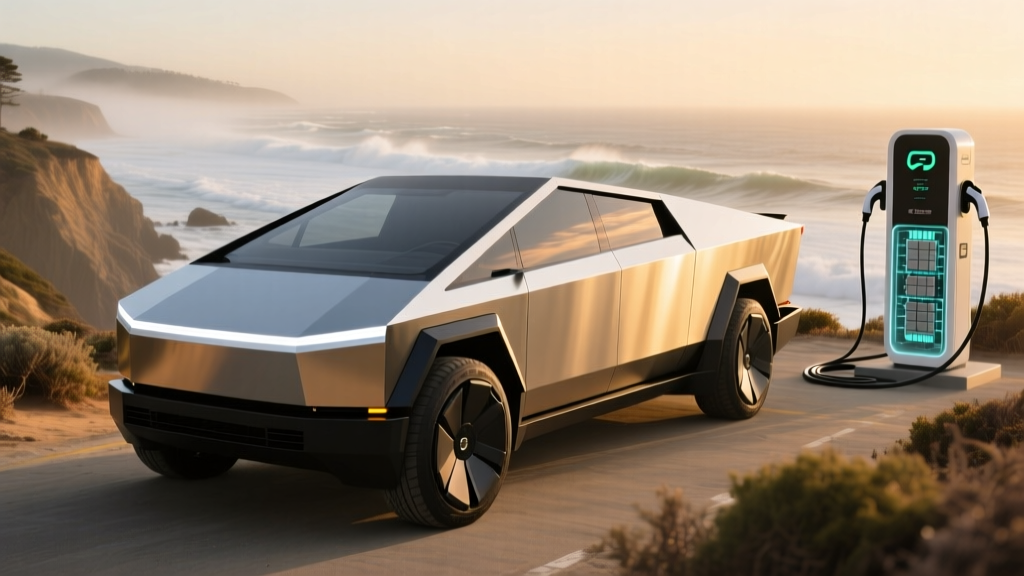
When Netflix's Leave the World Behind dropped, one scene stole the EV spotlight: a Tesla Cybertruck barreling down a deserted road, only to be mysteriously commandeered by a self-driving recall override that slams it into a barricade. That leave the world behind Tesla scene sent millions of viewers searching for answers — is that really how a Tesla behaves? Could a software update hijack your truck? And more practically: what's it actually like to own a Cybertruck in 2026?
We've driven, charged, and analyzed the 2026 Tesla Cybertruck across multiple trims to separate Hollywood fiction from real-world EV engineering. Here's everything you need to know about range, charging, pricing, tax credits, and whether this polarizing electric truck earns a spot in your driveway.
The Cybertruck at a Glance: 2026 Specs
| Spec | AWD | Cyberbeast |
|---|---|---|
| EPA Range | 340 mi | 320 mi |
| Battery (usable) | ~123 kWh (NMC) | ~123 kWh (NMC) |
| 0–60 mph | 3.9 sec | 2.6 sec |
| Horsepower | 600 hp | 845 hp |
| Drivetrain | Dual-motor AWD | Tri-motor AWD |
| Max DC Fast Charge | 250 kW | 250 kW |
| 10–80% DC Time | ~28 min | ~28 min |
| Level 2 Home Charge | 11.5 kW (~34 mi/hr) | 11.5 kW (~34 mi/hr) |
| Towing Capacity | 11,000 lb | 11,000 lb |
| MPGe (combined) | 67 MPGe | 63 MPGe |
| Efficiency | 50 kWh/100 mi | 53 kWh/100 mi |
| Cargo Bed | 6.5 ft bed, 67 cu ft vault | |
| Base MSRP | $79,990 | $99,990 |
Source: Tesla Cybertruck specifications and fueleconomy.gov. Specs reflect 2025–2026 model-year data. Range Extender variant (estimated 470+ mi) announced but not yet available for retail delivery.
Real-World Range: What the EPA Sticker Doesn't Tell You
Real-World Expectation: ~270–300 miles highway; ~200–240 miles in freezing temps; ~180–220 miles while towing
The Cybertruck's 123 kWh NMC (nickel-manganese-cobalt) battery pack is one of the largest in any consumer EV. On paper, 340 miles looks strong for a 6,800-pound stainless-steel truck. In practice, the Cybertruck's brick-like aerodynamics (Cd ~0.34 despite the angular design) punish highway efficiency.
In mixed driving at 70 mph on flat terrain, expect to consume roughly 50–53 kWh per 100 miles — that translates to about 280–300 real-world miles before you need to plug in. Drop below freezing, and lithium-ion chemistry slows ion transfer while the thermal management system draws extra energy for cabin and battery heating. Plan for a 25–35% range reduction in sustained cold-weather driving.
Towing is where range evaporates fastest. Pulling a 5,000-pound trailer at highway speeds can cut range nearly in half. If your use case involves frequent towing over 200 miles, the Cybertruck's current range without the unavailable Range Extender battery makes it a two-stop trip.
Charging Speed: DC Fast and Home Level 2
| Charging Level | Power | Speed | Notes |
|---|---|---|---|
| Level 1 (120V) | ~1.4 kW | ~4 mi/hr | Emergency/trickle only |
| Level 2 (240V, 48A) | 11.5 kW | ~34 mi/hr | Full charge overnight (~10 hr) |
| DC Fast (Tesla Supercharger V3) | 250 kW peak | 10–80% in ~28 min | Peak rate tapers above 60% SoC |
| DC Fast (CCS adapter, EA/others) | Up to 250 kW | Varies by station | Requires Tesla CCS adapter (included) |
The Cybertruck uses the NACS (North American Charging Standard) connector natively — the same port now adopted industry-wide by Ford, GM, Rivian, and others. At a Tesla V3 Supercharger (250 kW), the truck peaks near its maximum rate in the 10–40% state-of-charge window, then tapers progressively. The 10–80% time of roughly 28 minutes is competitive but not class-leading; the Hyundai Ioniq 5 and Kia EV9 achieve similar percentages faster thanks to 800V architectures that sustain higher rates deeper into the charge curve.
For home charging, a 48-amp Level 2 wall connector on a 60-amp circuit delivers 11.5 kW, adding about 34 miles of range per hour. A full 0–100% session takes roughly 10–11 hours. Most owners who plug in nightly never need DC fast charging for daily driving.
Important kW vs. kWh distinction: kW (kilowatts) measures the rate of energy delivery — like water pressure from a hose. kWh (kilowatt-hours) measures total energy stored — like the size of the tank. The Cybertruck's 123 kWh battery charged at 11.5 kW takes about 10.7 hours from empty to full.
Performance and Driving Dynamics
The Cyberbeast's tri-motor powertrain produces 845 horsepower and rockets to 60 mph in 2.6 seconds — absurd acceleration for a vehicle weighing nearly 7,000 pounds. The dual-motor AWD trim still manages 3.9 seconds, which beats most sports sedans. Tesla's torque-vectoring rear motors (one for each rear wheel in the Cyberbeast) provide precise cornering control that defies the truck's mass.
Ride quality has improved since the initial 2024 deliveries thanks to over-the-air suspension tuning updates. The adaptive air suspension offers 12 inches of ground clearance adjustment, from a low of 9 inches to a maximum of 17 inches for off-road use. Steer-by-wire eliminates the mechanical connection between the yoke and the wheels, which takes acclimation but enables a variable steering ratio — fewer turns lock-to-lock at low speeds, more stability at highway speeds.
Off-road, the Cybertruck is genuinely capable: approach and departure angles are strong, the stainless exoskeleton shrugs off brush scratches, and the wading mode seals the battery for up to 32 inches of water crossing. However, the sharp body edges and limited crumple-zone aesthetics make parking-lot dings a conversation starter.
Interior, Cargo, and Daily Practicality
The Cybertruck seats five (not six, despite early concepts) across two rows. Front legroom is generous at 41.5 inches; rear legroom measures 38.3 inches — adequate for adults on shorter trips but tighter than a Rivian R1T or Ford F-150 Lightning for long rides. The minimalist interior centers on an 18.5-inch touchscreen with no physical buttons, including for the glovebox (tap the screen to open it).
Cargo capacity includes a 6.5-foot bed (the "vault") with 67 cubic feet of volume, a motorized retractable tonneau cover rated to support 300 pounds, and a front trunk (frunk) with roughly 7 cu ft of space — enough for a charging cable bag or small groceries. The bed features built-in 120V and 240V outlets for power tools or tailgating, and the Cybertruck supports bi-directional charging (V2H/V2L) to power home appliances during outages — up to 11.5 kW output.
Visibility is the Cybertruck's most-criticized ergonomic flaw. The massive A-pillars, high cowl, and flat windshield create substantial blind spots. The camera-based mirror system (no traditional side mirrors on production models) requires drivers to glance at the screen corners rather than using peripheral vision. Most owners adapt within a week, but it remains a friction point for new drivers.
Pricing, Trims, and Federal Tax Credit Eligibility
| Trim | Base MSRP | Est. After §30D Credit* | Delivery |
|---|---|---|---|
| AWD (Dual-Motor) | $79,990 | ~$72,490 | Available now |
| Cyberbeast (Tri-Motor) | $99,990 | ~$92,490 | Available now |
| RWD (Single-Motor) | $60,990 (announced) | ~$53,490 | Expected 2026–2027 |
*Federal tax credit estimates assume buyer eligibility. Actual credit depends on IRS §30D rules.
The Cybertruck's pricing has stabilized after the controversial 2024 "Foundation Series" markups. The dual-motor AWD at $79,990 is the volume trim, while the Cyberbeast at $99,990 targets performance buyers. A rear-wheel-drive base model at $60,990 has been announced but remains unavailable as of early 2026.
- MSRP Cap: Trucks/SUVs/vans must be under $80,000 MSRP. The AWD trim qualifies; the Cyberbeast does NOT (exceeds cap).
- Income Limits: Modified AGI ≤ $150,000 (single) / $300,000 (married filing jointly) / $225,000 (head of household).
- Battery Sourcing: Critical minerals and battery components must meet escalating domestic-content thresholds per the Inflation Reduction Act. Tesla's Austin-built pack with US-sourced minerals generally qualifies, but confirm at IRS.gov before purchase.
- Point-of-Sale Transfer: Eligible buyers can transfer the credit to the dealer at purchase, reducing the upfront price rather than waiting for a tax refund.
- Credit Amount: Up to $7,500 if both critical-mineral and battery-component requirements are met; $3,750 if only one threshold is satisfied.
Bottom line: The AWD Cybertruck at $79,990 sits exactly under the truck MSRP cap, making it eligible for the full $7,500 credit (assuming income and sourcing requirements are met), bringing the effective price to roughly $72,490. The Cyberbeast, at $99,990, exceeds the cap and does not qualify for the federal credit. Always verify current-year eligibility with a tax professional and the IRS Clean Vehicle Credit page.
That "Leave the World Behind" Tesla Scene: Fact vs. Fiction
Let's address the question that brought you here. In the film, a Cybertruck (along with other Teslas) crashes after a mysterious remote command overrides the vehicle. Here's what's real and what's cinematic license:
Over-the-air updates are real. Tesla routinely pushes OTA software updates that modify vehicle behavior, including suspension tuning, acceleration limits, and Autopilot parameters. A recall-related OTA update can modify or restrict vehicle operation — this is how Tesla addresses many NHTSA recalls without a dealership visit.
Remote immobilization is theoretically possible but heavily restricted. Tesla can remotely disable a vehicle in theft scenarios via law enforcement coordination. However, a mass remote-command crash scenario as depicted in the film has no precedent and would represent a catastrophic cybersecurity failure. Tesla's vehicle-to-cloud communication is encrypted, and critical driving functions (steering, braking) have hardware-level safety redundancies.
Self-driving behavior in the film is exaggerated. The Cybertruck's Autopilot and Full Self-Driving (Supervised) are SAE Level 2 driver-assistance systems. The driver must remain engaged, hands on the yoke (or applying torque), and eyes on the road. Tesla's FSD does not operate without driver supervision. Only Level 4 robotaxi services like Waymo operate without a human driver — and only in geofenced areas.
Cybertruck vs. the Competition
The electric truck segment has matured. Here's how the Cybertruck stacks up against its primary rivals:
| Spec | Tesla Cybertruck AWD | Rivian R1T Dual-Motor | Ford F-150 Lightning Lariat |
|---|---|---|---|
| EPA Range | 340 mi | 352 mi (Max Pack: 420 mi) | 320 mi (Extended Range) |
| Starting MSRP | $79,990 | $69,900 | $59,995 |
| Towing | 11,000 lb | 11,000 lb | 10,000 lb |
| 0–60 mph | 3.9 sec | 4.5 sec | ~5.0 sec |
| Bed Length | 6.5 ft | 4.5 ft (with gear tunnel) | 5.5 ft |
| Max DC Charge | 250 kW | 220 kW | 150 kW |
| Frunk | 7 cu ft | 11 cu ft | 14.1 cu ft |
Choose the Rivian R1T if: You prioritize off-road capability, a traditional (and excellent) interior, the gear tunnel for adventure gear, and a lower starting price. Rivian's Max Pack offers the longest range in the segment.
Choose the F-150 Lightning if: You want a familiar full-size truck experience, the lowest entry price, Pro Power Onboard for job-site use, and Ford's dealer network for service.
Warranty and Long-Term Ownership
Tesla covers the Cybertruck with a 4-year/50,000-mile limited vehicle warranty and an 8-year/120,000-mile battery and drive unit warranty. The battery warranty guarantees retention of at least 70% of original capacity during the coverage period — if degradation exceeds 30%, Tesla replaces or repairs the pack at no cost.
NMC chemistry in a 123 kWh pack operated between 20–80% daily (as Tesla recommends for non-LFP batteries) should retain well above 80% capacity at 150,000 miles based on current fleet data from Model S and Model X vehicles. The Cybertruck's large battery means typical daily driving uses only a fraction of total capacity, reducing cycle-count stress.
Maintenance costs are minimal compared to gas trucks: no oil changes, no transmission fluid, no spark plugs. Budget for tire replacement (the Cybertruck's 35-inch tires run $400–$600 each) and cabin air filter service. Insurance premiums run 15–30% higher than comparable gas trucks due to repair costs for the stainless-steel body panels and integrated structural battery pack.
Pros and Cons
- Class-leading acceleration (2.6s Cyberbeast)
- Supercharger network access (20,000+ stalls)
- 11,000-lb towing + bi-directional V2H power
- Stainless exoskeleton resists dents and corrosion
- OTA updates continuously add features
- Genuine off-road capability with air suspension
- Highway range falls short of EPA due to aero drag
- No side mirrors — camera-only takes adjustment
- Cyberbeast exceeds $80K MSRP cap (no tax credit)
- Rear seat comfort trails Rivian and F-150 Lightning
- Steer-by-wire and yoke divide driver opinion
- Stainless panels difficult/expensive to repair if dented
- High insurance premiums
Who Should Buy the Cybertruck?
The Cybertruck is best suited for tech-forward buyers who want an electric truck that doubles as a statement piece, need bi-directional home power capability, and regularly use the Tesla Supercharger network for road trips. It excels as a daily driver with occasional towing and light off-road use.
It's less ideal for buyers who prioritize traditional truck ergonomics, need maximum rear-seat comfort for family hauling, or whose budget doesn't accommodate an $80,000+ vehicle without the tax credit. Fleet and commercial buyers may find the F-150 Lightning's dealer network and lower entry price more practical.
Frequently Asked Questions
What is the real-world range of the Tesla Cybertruck?
The EPA rates the AWD Cybertruck at 340 miles, but real-world highway driving at 70 mph yields approximately 270–300 miles. In freezing temperatures, expect 200–240 miles. Towing a trailer can reduce range to 180–220 miles depending on weight and speed.
How fast does the Cybertruck charge at home and on the road?
At a Tesla V3 Supercharger (250 kW peak), the Cybertruck charges from 10–80% in approximately 28 minutes. At home on a 48-amp Level 2 charger (11.5 kW), it adds about 34 miles of range per hour, with a full charge taking roughly 10–11 hours.
Does the Cybertruck qualify for the $7,500 federal EV tax credit?
The AWD trim at $79,990 qualifies for the full $7,500 credit if the buyer meets IRS §30D income limits (≤$150K single / ≤$300K joint) and the vehicle meets battery-sourcing requirements. The Cyberbeast at $99,990 exceeds the $80,000 truck MSRP cap and does not qualify. Verify current rules at IRS.gov.
Is the Tesla Cybertruck self-driving like in Leave the World Behind?
No. The Cybertruck's Autopilot and FSD (Supervised) are SAE Level 2 driver-assist systems requiring constant driver engagement. The film depicts a fictional scenario where vehicles are remotely commandeered — this does not reflect real Tesla capability or any announced feature. The driver is always responsible for vehicle control.
How does the Cybertruck compare to the Rivian R1T and Ford F-150 Lightning?
The Cybertruck offers the fastest acceleration and Supercharger access but at a higher starting price. The Rivian R1T provides superior off-road capability and a more refined interior starting at $69,900. The Ford F-150 Lightning is the most affordable and conventional option at ~$60,000, with the largest frunk and broadest dealer service network.
What battery chemistry does the Cybertruck use?
The Cybertruck uses an NMC (nickel-manganese-cobalt) lithium-ion battery with approximately 123 kWh of usable capacity. Tesla recommends daily charging to 80% for NMC packs (unlike LFP packs, which can be charged to 100% daily). The battery is warrantied for 8 years or 120,000 miles with a 70% capacity retention threshold.
Can the Cybertruck power my home during an outage?
Yes. The Cybertruck supports bi-directional charging (Vehicle-to-Home/V2L) at up to 11.5 kW output through the Tesla PowerShare system. This can power essential home circuits during an outage for multiple days when paired with a compatible home energy management system.