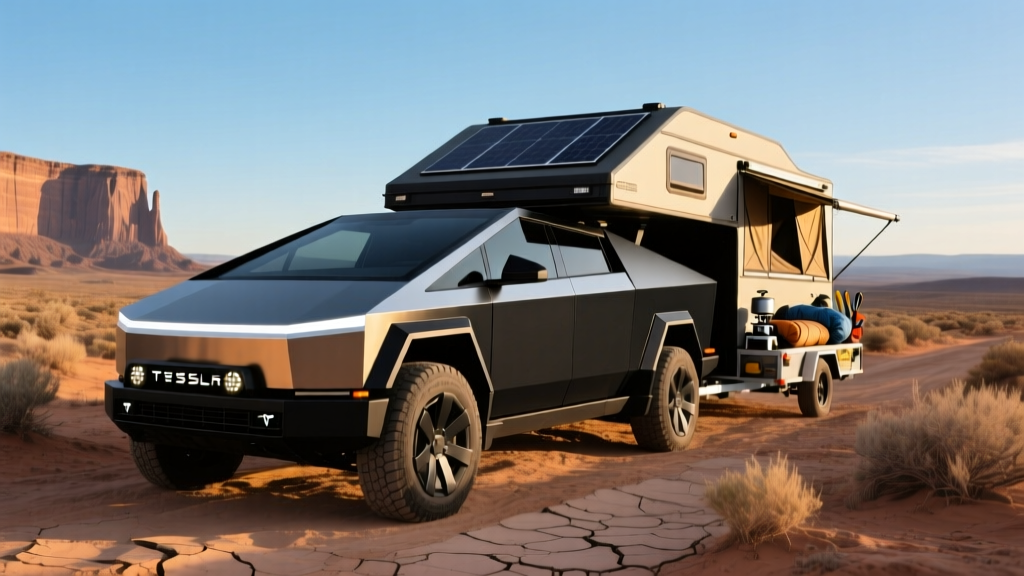
The Tesla Cybertruck was engineered as an angular, stainless-steel workhorse — but the overlanding community saw something else: a platform purpose-built for a camper shell. With its vault-like 6.5-foot bed, integrated 240V outlet, and available air suspension, pairing a Cybertruck with camper shell has become one of the most talked-about EV overlanding setups on the market. But bolting a topper onto a 6,800-pound electric truck changes the physics in ways the EPA sticker doesn't capture. This review breaks down exactly what happens to range, charging, payload, and livability when you turn a Cybertruck into a camper.
Cybertruck Core Specs at a Glance
| Specification | AWD (Dual-Motor) | Cyberbeast (Tri-Motor) |
|---|---|---|
| EPA Range (no shell) | 340 miles | 320 miles |
| Battery Capacity | ~123 kWh usable (NMC) | ~123 kWh usable (NMC) |
| Max DC Fast Charge | 250 kW (800V architecture) | 250 kW (800V architecture) |
| 10–80% DC Charge Time | ~28 minutes | ~28 minutes |
| Level 2 Home Charging | 11.5 kW (~37 mi/hr) | 11.5 kW (~37 mi/hr) |
| 0–60 mph | 4.1 seconds | 2.6 seconds |
| Horsepower | 600 hp | 845 hp |
| Drivetrain | Dual-Motor AWD | Tri-Motor AWD |
| Max Towing | 11,000 lbs | 11,000 lbs |
| Payload Capacity | 2,500 lbs | 2,500 lbs |
| Bed Length | 6.5 ft (vault) | 6.5 ft (vault) |
| MPGe (combined) | 67 MPGe | 64 MPGe |
| Efficiency | 50 kWh/100 mi | 52 kWh/100 mi |
| Base MSRP (2026) | $79,990 | $99,990 |
| Battery/Drive Unit Warranty | 8 yr / 120,000 mi | 8 yr / 120,000 mi |
Source: EPA / fueleconomy.gov and Tesla specifications.
Real-World Range: What a Camper Shell Actually Costs You
With Camper Shell (real-world): Expect 250–280 miles in fair conditions. The shell adds 250–500 lbs of weight and disrupts the Cybertruck's already-boxy aerodynamics, increasing drag at highway speeds. At 75 mph on a flat interstate, plan for roughly 260 miles before hitting a 10% state of charge.
Cold Weather Penalty: Below 32°F, the NMC battery loses efficiency and cabin/battery heating draws additional power. With a shell installed in winter conditions, realistic range drops to 190–220 miles. The Cybertruck's heat pump helps mitigate this compared to resistive heating, but physics still wins.
The Cybertruck's efficiency sits at roughly 50 kWh per 100 miles stock — already high for an EV due to the truck's 6,800-pound curb weight and flat-panel aero profile. A camper shell pushes that to an estimated 58–65 kWh/100 mi depending on shell weight, roof rack loading, and driving speed. For overlanders accustomed to planning fuel stops in remote areas, this means DC fast chargers become critical waypoints, not just conveniences.
Tesla's built-in range estimation accounts for recent driving behavior and elevation changes, which partially offsets the shell penalty by giving you a realistic projection. But it does not know you've added 400 lbs of fiberglass and a rooftop tent — so treat the displayed range as optimistic once a shell is installed.
Charging Speed: 800V Architecture Meets the Campground
| Charging Level | Power (kW) | Speed (miles/hr added) | Use Case |
|---|---|---|---|
| Level 1 (120V standard outlet) | ~1.4 kW | ~3–4 mi/hr | Emergency/trickle; overnight at campsite |
| Level 2 (240V / 48A) | 11.5 kW | ~37 mi/hr | Home garage; full charge in ~10 hours |
| DC Fast Charge (V4 Supercharger) | 250 kW peak | ~12 mi/min at peak | Road trips; 10–80% in ~28 min |
| CCS Adapter (non-Tesla DC) | Up to 150–250 kW | Varies by station | Electrify America, EVgo, etc. |
The Cybertruck uses Tesla's 800-voltage architecture, which allows it to accept high charge rates while keeping current (amps) manageable — reducing heat and cable thickness. At a V4 Supercharger, the truck peaks near 250 kW, though the charge curve tapers significantly above 60% state of charge. The 10–80% sprint takes roughly 28 minutes in ideal conditions (battery preconditioned, warm ambient temperature). In practice, a 15–85% session at a remote Supercharger with a camper shell loaded will take closer to 32–35 minutes because the battery management system works harder to cool a pack under higher sustained loads.
One critical detail for campers: the Cybertruck's bed includes a 240V NEMA 14-50 outlet (via the Powershare system) capable of delivering up to 9.6 kW of continuous power. This means you can run a portable induction cooktop, electric heater, or power tools directly from the truck's 123 kWh battery — essentially turning the Cybertruck into a 123 kWh portable power station. At a conservative 1 kW continuous draw for lighting, a laptop, and a small fridge, you could power a campsite for days without depleting the battery meaningfully.
Camper Shell Options and Payload Math
The Cybertruck's bed measures approximately 6.5 feet long, 4.1 feet wide between wheel wells, with a powered retractable tonneau cover that most camper shells are designed to replace or integrate with. Major shell manufacturers offering Cybertruck-specific models include:
- Basecamp Vehicles — integrated slide-in camper with pop-top, ~450 lbs, sleeps 2, includes galley module
- SpaceCamp — lightweight hard-shell topper, ~280 lbs, compatible with rooftop tents
- AT Overland (Summit) — pop-up camper, ~350 lbs, integrated awning and lighting
- DIY/Custom aluminum shells — weight varies widely, 200–600 lbs depending on build
The Cybertruck's 2,500-pound payload capacity is generous, but it must cover everything: shell weight, rooftop tent (~130 lbs), water tanks, gear, passengers, and any aftermarket suspension components. A fully loaded overlanding build with a 450-lb camper shell, 200 lbs of gear, and two passengers lands around 1,000–1,200 lbs of payload — well within limits. However, if you add a rooftop tent on top of a heavy shell, you approach the roof-load limit and raise the center of gravity, which matters on forest service roads.
Driving and Towing with a Camper Shell
The dual-motor AWD Cybertruck produces 600 horsepower and can hit 60 mph in 4.1 seconds — figures that feel absurd in a truck this size. With a camper shell and 1,000 lbs of payload, 0–60 drops to roughly 5.0 seconds, which is still quicker than most gas trucks without a load. The adaptive air suspension adjusts ride height by several inches, offering a "High" mode for rough trails and an "Extract" mode that provides maximum ground clearance for obstacle clearance.
Towing with a shell installed introduces a compounding range penalty. The Cybertruck's 11,000-lb max tow rating is best-in-class for EVs, but towing a 5,000-lb trailer with a shell on the truck can push real-world range down to 140–170 miles at highway speeds. Tesla's tow-mode route planning factors in elevation and trailer weight, but the combined drag of shell plus trailer is brutal on electrons.
On the ADAS front, the Cybertruck ships with Tesla's Enhanced Autopilot — a SAE Level 2 driver-assistance system that handles adaptive cruise control and lane centering. It is not autonomous driving; the driver must maintain steering-wheel contact and situational awareness at all times. For long highway stretches to remote trailheads, it meaningfully reduces fatigue.
Pricing, Tax Credits, and Total Build Cost
| Cost Item | AWD Trim | Cyberbeast Trim |
|---|---|---|
| Base MSRP (2026) | $79,990 | $99,990 |
| Camper Shell (aftermarket) | $3,500–$15,000 | $3,500–$15,000 |
| Rooftop Tent (optional) | $1,500–$3,500 | $1,500–$3,500 |
| Federal §30D Tax Credit | Up to $7,500* | $0 (MSRP cap exceeded*) |
| Estimated Total Build | $85,000–$98,500 | $105,000–$118,500 |
* Federal EV tax credit under IRS §30D rules: The credit is up to $7,500 but requires the vehicle MSRP to be at or below $80,000 for trucks/vans. The AWD Cybertruck at $79,990 technically qualifies on MSRP, but buyer income caps ($300K joint / $150K single MAGI), critical-mineral sourcing, and battery-component requirements must all be met. The Cyberbeast at $99,990 exceeds the truck MSRP cap and does not qualify. Eligibility is complex — consult a tax professional and check current IRS guidance before purchasing. Point-of-sale transfer is available at participating dealers.
A realistic overlanding Cybertruck build with a mid-range camper shell, rooftop tent, and recovery gear lands in the $90,000–$100,000 range for the AWD trim. That positions it against fully built-out overland rigs like the Rivian R1T with a Camp Kitchen and shell, or a Toyota Tacoma with a Four Wheel Camper — though the Cybertruck offers vastly more battery capacity for off-grid power.
Who Should Build a Cybertruck Camper?
- You want a 123 kWh off-grid power source for extended boondocking (V2L/Vehicle Powershare)
- You have reliable access to Superchargers along your overlanding routes
- You value rapid DC charging (250 kW) over remote range
- You want truck-class towing (11,000 lbs) for a trailer behind the camper build
- You already own or plan to buy a Cybertruck and want to add overlanding capability
- You regularly overland in areas with no DC charging infrastructure (range limits are real)
- You need a full slide-in camper with a bathroom or standing room (the 6.5-ft bed is compact)
- Your budget is under $80,000 for the entire vehicle-and-camper build
- You prioritize maximum interior sleeping space over tech and power features
Pros and Cons
- 123 kWh battery doubles as a massive campsite power station (9.6 kW 240V output)
- 250 kW DC fast charging minimizes downtime on road-trip legs
- Air suspension adapts to loaded/unloaded states and rough terrain
- Stainless exoskeleton resists trail pinstriping and dents
- 2,500-lb payload handles most camper shells with room for gear
- 11,000-lb tow rating lets you add a trailer for extended trips
- Camper shell drops real-world range to ~250–280 mi (as low as 190 in cold)
- 6.5-ft bed limits camper shell size — no full walk-in or standing-room builds
- Cyberbeast trim exceeds $80K MSRP cap, losing §30D tax credit eligibility
- Charging infrastructure in remote overlanding areas remains sparse
- High starting price: realistic builds cost $90K–$100K+
- Tesla service center availability is limited in rural/remote regions
Frequently Asked Questions
What is the real-world range of the Cybertruck with a camper shell?
Without a shell, the AWD Cybertruck delivers roughly 300–320 real-world highway miles. With a 300–500 lb camper shell installed, expect 250–280 miles in moderate temperatures at highway speeds, and as low as 190–220 miles in sub-freezing conditions. City and low-speed driving recovers some range thanks to regenerative braking.
How fast does the Cybertruck charge with a camper shell on?
The shell doesn't affect charging speed — the battery and thermal management are unchanged. At a V4 Supercharger, expect 250 kW peak and a 10–80% charge in about 28–35 minutes. At home on a Level 2 wall connector (11.5 kW), a full charge takes roughly 10 hours.
Does the Cybertruck qualify for the $7,500 federal EV tax credit?
The AWD trim at $79,990 MSRP falls just under the $80,000 truck cap and may qualify, but only if the buyer meets IRS §30D income limits ($300K joint / $150K single), and the battery meets critical-mineral and component-sourcing requirements. The Cyberbeast at $99,990 does not qualify. Always verify current rules with a tax professional.
Can I run appliances from the Cybertruck at a campsite?
Yes. The Cybertruck's Powershare system provides a 240V NEMA 14-50 outlet in the bed, delivering up to 9.6 kW continuous. This can run an induction cooktop, electric heater, microwave, or power tools. At a modest 1 kW draw, the 123 kWh battery can power a campsite for multiple days.
Is the Cybertruck camper setup worth it vs. a Rivian R1T or gas truck?
It depends on your priorities. The Cybertruck offers the largest battery (123 kWh) and highest V2L output of any EV truck, making it the best off-grid power platform. The Rivian R1T has a longer bed and more refined overlanding accessories but a smaller battery (~149 kWh usable on Max Pack, but higher efficiency needs). A gas Tacoma or 4Runner offers unlimited range with jerry cans but no silent, emission-free campsite power. For tech-forward overlanders who plan routes around Superchargers, the Cybertruck is compelling. For deep-backcountry travel with zero charging infrastructure, a gas or diesel rig remains more practical.
What camper shell brands fit the Cybertruck?
As of 2026, Cybertruck-specific shells are available from Basecamp Vehicles, SpaceCamp, AT Overland, and several custom aluminum fabricators. Because the Cybertruck's bed geometry is unique (angular, with a powered retractable tonneau), universal shells generally do not fit — you need a model designed specifically for the truck.
How does towing affect range with a camper shell installed?
Towing a 5,000-lb trailer with a camper shell on the Cybertruck can reduce range to approximately 140–170 miles at highway speeds. This is the worst-case scenario for the platform and requires careful route planning around DC fast chargers. Lighter trailers (2,000–3,000 lbs) are more manageable, yielding roughly 200–230 miles.