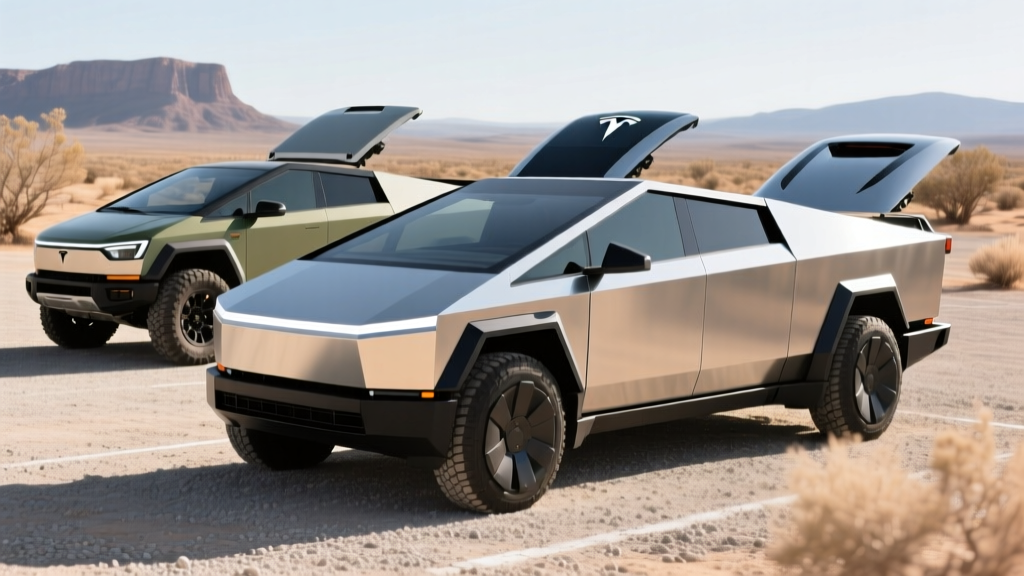
The Tesla Cybertruck entered delivery in late 2023 and quickly polarized the truck market with its stainless-steel exoskeleton, steer-by-wire steering, and 48-volt electrical architecture. For 2025-2026, Tesla offers three variants — the Long Range AWD, the Cyberbeast tri-motor, and the recently introduced Rear-Wheel Drive — each with distinct range, performance, and pricing profiles. But beyond the powertrain, one of the most-searched accessories among owners and prospective buyers is the Cybertruck bed cap (also called a tonneau cover or bed topper), which Tesla sells directly and third-party manufacturers have begun offering in hard-shell and camper configurations.
This review covers the full Cybertruck lineup with real-world range data, charging speeds, pricing after federal tax credits, bed cap options and their impact on utility, and whether this angular electric pickup earns a spot in your driveway versus the Ford F-150 Lightning, Rivian R1T, or Chevrolet Silverado EV.
Cybertruck Specs at a Glance: Range, Battery, and Performance
| Spec | RWD (2025) | Long Range AWD | Cyberbeast (AWD) |
|---|---|---|---|
| EPA Range | ~250 mi (est.) | 340 mi | 320 mi |
| Battery Capacity (usable) | ~100 kWh (est.) | ~123 kWh | ~123 kWh |
| Battery Chemistry | NMC (est.) | NMC | NMC |
| Drivetrain | Rear-Wheel Drive | Dual-Motor AWD | Tri-Motor AWD |
| Horsepower | ~340 hp (est.) | 600 hp | 845 hp |
| 0–60 mph | ~5.8 sec (est.) | 3.9 sec | 2.6 sec |
| Towing Capacity | 7,500 lb (est.) | 11,000 lb | 11,000 lb |
| Payload Capacity | ~2,500 lb | 2,500 lb | 2,500 lb |
| Bed Length | 6 ft | 6 ft | 6 ft |
| Base MSRP | $60,990 | $79,990 | $99,990 |
| Efficiency (MPGe) | TBD | 67 MPGe combined | 65 MPGe combined |
| Efficiency (kWh/100 mi) | TBD | ~50 kWh/100 mi | ~52 kWh/100 mi |
| Battery/Drive Unit Warranty | 8 yr / 120,000 mi | 8 yr / 120,000 mi | 8 yr / 120,000 mi |
Tesla's NMC (nickel-manganese-cobalt) battery pack prioritizes energy density over cycle life — a deliberate choice for a vehicle this heavy (curb weight exceeds 6,600 lb on AWD trims). The 48-volt low-voltage architecture reduces wiring harness weight and enables the steer-by-wire and rear-wheel steering systems that give the Cybertruck a surprisingly tight 37-foot turning circle despite its 223.7-inch overall length.
The Long Range AWD's EPA-estimated 340 miles is achievable in mild city/suburban driving at moderate speeds. Expect 270–290 miles on highway road trips at 70–75 mph, where aerodynamic drag dominates. In cold weather (below 32°F), range drops 20–30% without preconditioning, putting realistic winter highway range at 200–230 miles. The Cyberbeast's tri-motor setup and aggressive tuning reduce its EPA range to 320 miles, with similar proportional real-world losses. Towing cuts range dramatically — expect 130–170 miles at highway speeds with a 7,000+ lb trailer.
Charging Speed: 800V Architecture and Real Charge Curves
The Cybertruck uses an 800-volt battery architecture — the same high-voltage approach found in the Porsche Taycan, Hyundai Ioniq 5, and Kia EV6 — enabling faster DC charging with lower current and less heat generation. At a Tesla V4 Supercharger or compatible 350 kW CCS/NACS station, the Cybertruck peaks at approximately 350 kW.
| Charging Level | Power / Rate | Speed / Notes |
|---|---|---|
| Level 1 (120V outlet) | ~1.4 kW | ~3–4 miles per hour |
| Level 2 (240V, 48A Wall Connector) | 11.5 kW | ~30–34 miles per hour; 0–100% in ~11 hours |
| Level 2 (240V, 80A Wall Connector) | 19.2 kW | ~50+ miles per hour; 0–100% in ~7 hours |
| DC Fast Charge (peak) | 350 kW | 10–80% in ~15–17 minutes (preconditioned) |
| DC Fast Charge (sustained avg.) | ~200–220 kW avg | Charge curve tapers sharply above 60% SoC |
Charge curve reality: Like most large NMC packs, the Cybertruck doesn't sustain peak 350 kW for long. The charge rate peaks between 10–30% state of charge (SoC) and begins tapering by 40–50%. By 80% SoC, you're typically seeing 60–80 kW. This means the advertised 10–80% time of roughly 15–17 minutes is accurate with proper battery preconditioning (navigating to a Supercharger triggers automatic thermal prep), but 10–100% can take 35–45 minutes. Plan road-trip stops around the 10–80% sweet spot for maximum efficiency.
At home, the Tesla Wall Connector at 48 amps on a 60-amp circuit is the most common setup, adding about 30–34 miles of range per hour — enough for a full overnight charge. An 80-amp circuit with the 80A Wall Connector cuts that time nearly in half but requires a 100-amp breaker and heavier-gauge wiring. Most Cybertruck owners report installing a NEMA 14-50 outlet (40A circuit, ~9.6 kW) as a cost-effective baseline, adding roughly 25 miles per hour.
Cybertruck Bed Cap Options: Tesla's Tonneau and Third-Party Alternatives
The Cybertruck's 6-foot composite bed is a core part of its identity, but an open bed exposes cargo to weather and theft. The Cybertruck bed cap market has grown since launch, with options ranging from Tesla's own powered tonneau to camper-shell conversions.
Tesla Powered Tonneau Cover ($2,975): Tesla's official bed cap is a motorized, retractable aluminum cover integrated into the vehicle's electrical system. It opens and closes via the touchscreen or the Tesla app, features a lockable mechanism, and maintains the Cybertruck's angular aesthetic. It supports up to 300 lb of distributed load on top and seals reasonably well against rain. However, it consumes roughly 2 inches of vertical bed space at the front where the canister houses the rolled cover, and its powered mechanism adds a potential failure point long-term.
Third-Party Hard Bed Caps: Companies like Rugged Liner, UnderCover, and newer EV-focused brands are developing hard-shell bed caps (full toppers) for the Cybertruck. These typically cost $2,500–$5,000, weigh 100–200 lb, and offer lockable, weatherproof storage. Some camper-shell designs from companies like Space Camp and AT Overland add a rooftop tent mounting platform and enclosed sleeping area — turning the Cybertruck into an overlanding rig. Expect availability to expand through 2026 as aftermarket tooling matures.
Aerodynamic impact: Any bed cap or tonneau reduces aerodynamic drag slightly at highway speeds, which can recover 1–3% of range on long trips. The effect is modest — don't buy a bed cap for efficiency gains alone — but it's a measurable bonus. The larger consideration is weight: a 200 lb hard cap reduces payload marginally but won't meaningfully affect range or performance.
Interior, Tech, and Daily Livability
The Cybertruck seats five across two rows, with 41.0 inches of front legroom and 38.4 inches of rear legroom — competitive with mid-size trucks but tighter than a full-size F-150 Lightning's cabin. Rear headroom is constrained by the sloping roofline, and the rear bench sits relatively upright, making it more suitable for children or shorter trips for adult passengers.
Cargo space behind the rear seats measures approximately 35 cubic feet, expanding with the rear seats folded. The front trunk (frunk) provides ~7 cubic feet of lockable storage — useful for charging cables, groceries, or a small bag. The 6-foot bed offers ~65 cubic feet of volume with the tailgate closed and a rated payload of 2,500 lb.
Standout tech features:
- Steer-by-wire: No mechanical connection between the yoke and the wheels. Enables variable steering ratios — less than one full turn lock-to-lock at highway speed, eliminating hand-over-hand maneuvers. Takes adaptation but feels intuitive within a few days of driving.
- Rear-wheel steering: Up to 10 degrees of rear-axle articulation at low speeds tightens the turning circle; at highway speeds, it improves lane-change stability.
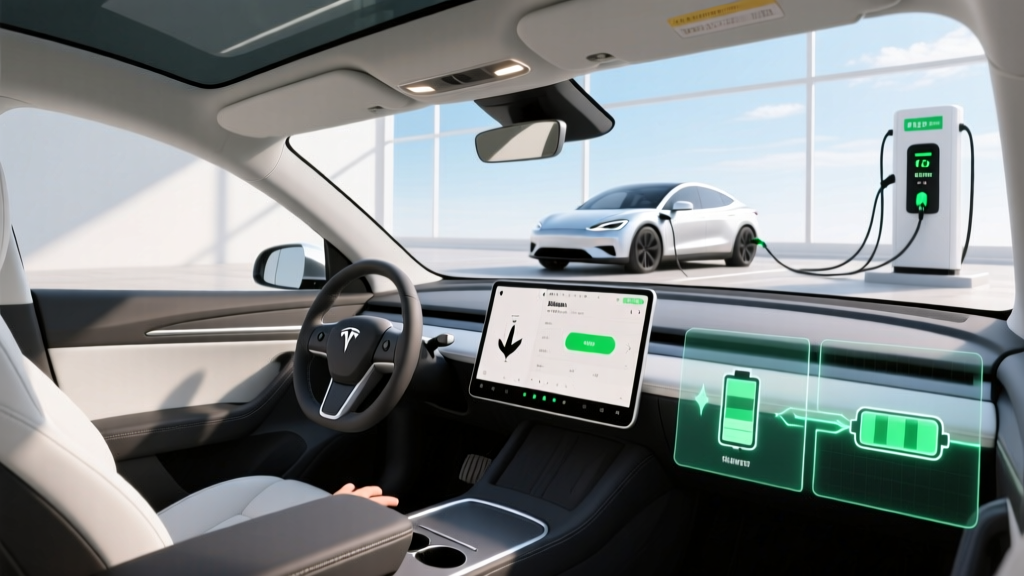
- 18.5-inch central touchscreen: Runs Tesla's latest software with navigation, streaming, gaming, and vehicle controls. No physical buttons — climate, glovebox, and mirror adjustments all live on-screen.
- Autopilot (standard) and FSD Supervised (optional, $8,000): Both are SAE Level 2 driver-assistance systems. The driver must remain engaged, hands on the yoke, eyes on the road. FSD Supervised handles city streets, stoplights, and highway lane changes but is not autonomous driving.
- Armor glass: Tesla's proprietary laminated glass is more resistant to impacts than standard automotive glass, though early reports note it's not impervious to rock chips or extreme impacts.
- Powershare (V2L/V2H): The Cybertruck can output up to 11.5 kW of bidirectional power — enough to run power tools at a job site, power a campsite, or serve as a home backup generator during outages (with appropriate transfer switch installation).
Notable drawbacks: The yoke-style steering wheel is controversial — some owners love it, others find it impractical for low-speed parking maneuvers and three-point turns. Panel gaps and early-build quality issues have been widely documented, though Tesla reports improvements in 2025–2026 production. The stainless-steel body panels resist dents but show fingerprints and scratches readily, and repair costs for collision damage are significantly higher than conventional stamped steel or aluminum bodies. Visibility is compromised by the thick A-pillars, small rear window, and high beltline.
Pricing, Trims, and Federal Tax Credit Eligibility (2026)
| Trim | Base MSRP | Destination | Est. Total | §30D Credit Eligibility |
|---|---|---|---|---|
| RWD | $60,990 | $1,995 | $62,985 | Potentially up to $7,500* |
| Long Range AWD | $79,990 | $1,995 | $81,985 | Eligible (under $80K truck cap)* |
| Cyberbeast AWD | $99,990 | $1,995 | $101,985 | Eligible (under $80K truck cap)* |
Federal tax credit (§30D) — critical caveats: The Cybertruck qualifies as a light truck under IRS rules, which means the MSRP cap is $80,000 (higher than the $55,000 cap for sedans). The RWD and Long Range AWD trims fall under this threshold at base MSRP; the Cyberbeast at $99,990 exceeds it, but Tesla has historically structured pricing or options to maintain eligibility — verify current status before purchasing. Buyer income caps apply: $300,000 joint / $225,000 head of household / $150,000 single (modified adjusted gross income). Battery component and critical mineral sourcing requirements must also be met, and these rules tighten annually. As of 2026, the credit can be transferred to the dealer at point of sale, reducing your purchase price directly rather than waiting for a tax refund. Always verify current eligibility on IRS.gov and consult a tax professional before relying on credit amounts.
As-tested pricing reality: Adding FSD Supervised ($8,000), the Tesla Powered Tonneau ($2,975), and premium interior or wheel options can push a Long Range AWD to $93,000–$95,000 before incentives. After a potential $7,500 credit, expect an effective cost in the mid-$80K range for a well-equipped Long Range.
Cybertruck vs. F-150 Lightning vs. Rivian R1T: Which Electric Truck Wins?
The Cybertruck's strongest competitive advantage is its charging speed — the 800V architecture delivers meaningfully faster DC stops than the Lightning or R1T on comparable road trips. Its weakest points relative to rivals are rear-seat comfort (the R1T and Lightning both offer more usable back-seat space), repairability (stainless-steel body panels are expensive to replace), and dealer/service network density (Tesla's service centers remain concentrated in metro areas compared to Ford's nationwide dealer footprint).
Who Should Buy the Cybertruck (and Who Shouldn't)?
Buy the Cybertruck if:
- You want the fastest-charging electric pickup available and regularly road-trip on the Supercharger network
- You value bidirectional power (Powershare/V2L) for job-site tools, camping, or home backup
- You're drawn to the Cybertruck's design language and steer-by-wire tech and don't mind the learning curve
- Your daily driving is within 250 miles round-trip and you can charge at home overnight
- You need 11,000-lb towing capacity and plan to use it occasionally (not daily)
Look elsewhere if:
- Rear-seat passenger comfort is a priority (Rivian R1T or F-150 Lightning are better)
- You live far from a Tesla Service Center and want conventional dealer support
- You need a full-size 8-foot bed (Silverado EV or Lightning with options)
- You want the longest possible range — the Rivian R1T Max Pack offers 410 miles EPA
- You're uncomfortable with a yoke-style steering wheel and touchscreen-only controls
Pros and Cons: The Honest Cybertruck Verdict
- Class-leading 350 kW DC fast charging (10–80% in ~15 min)
- 11,000-lb towing with integrated trailer brake controller
- Powershare V2L/V2H (11.5 kW output) for job sites and home backup
- Steer-by-wire with rear-wheel steering — remarkably maneuverable for its size
- Stainless-steel body resists dents; armor glass resists impacts
- Access to Tesla Supercharger network (17,000+ stalls in North America)
- Over-the-air software updates continuously add features
- Rear seat is cramped for adults; sloping roofline limits headroom
- Panel gaps and build quality inconsistent on early production units
- Stainless-steel body repair costs are high; limited body shop expertise
- Yoke steering requires adaptation; not ideal for all drivers
- No physical buttons — all controls via touchscreen
- Heavy curb weight (6,600+ lb) reduces efficiency vs. lighter EVs
- Real-world highway range falls 15–20% below EPA sticker
- Cyberbeast trim exceeds $80K MSRP cap for §30D credit
Frequently Asked Questions
What is the real-world range of the Tesla Cybertruck?
The Long Range AWD is EPA-rated at 340 miles, but expect 270–290 miles on sustained highway driving at 70–75 mph. In cold weather (below freezing), range drops to roughly 200–230 miles on the highway without aggressive preconditioning. The Cyberbeast's 320-mile EPA rating yields similar proportional real-world reductions. Towing a large trailer cuts range to 130–170 miles depending on weight, terrain, and speed.
How fast does the Cybertruck charge at home and on the road?
On DC fast chargers, the Cybertruck peaks at 350 kW and charges from 10–80% in approximately 15–17 minutes with battery preconditioning. At home on a Level 2 Tesla Wall Connector (48A, 240V), it adds about 30–34 miles of range per hour, achieving a full charge in roughly 11 hours. A standard NEMA 14-50 outlet (40A) adds about 25 miles per hour.
Does the Cybertruck qualify for the $7,500 federal EV tax credit?
The RWD and Long Range AWD trims fall under the $80,000 MSRP cap for trucks under IRS §30D rules and may qualify for up to $7,500, subject to buyer income limits ($300K joint / $150K single), battery sourcing requirements, and point-of-sale transfer rules. The Cyberbeast at $99,990 MSRP likely exceeds the cap. Always verify current eligibility on IRS.gov before purchasing.
What Cybertruck bed cap options are available?
Tesla sells an official Powered Tonneau Cover for $2,975 — a motorized, retractable aluminum cover controlled via touchscreen or app. Third-party hard bed caps and camper shells from brands like UnderCover, Space Camp, and AT Overland are available or in development, typically costing $2,500–$5,000. A bed cap adds weather protection, security, and a minor aerodynamic efficiency benefit (1–3% range recovery at highway speeds).
Is the Cybertruck worth buying versus the F-150 Lightning or Rivian R1T?
The Cybertruck wins on DC charging speed (350 kW peak), Supercharger network access, and bidirectional power capability. The F-150 Lightning offers a lower starting price, a massive frunk, and Ford's extensive dealer network. The Rivian R1T delivers the longest available range (410 mi with Max Pack), superior off-road capability, and a more conventional interior. Your best choice depends on whether charging speed (Cybertruck), price/practicality (Lightning), or range/adventure (R1T) matters most.
How does the Cybertruck's warranty compare to competitors?
Tesla covers the battery and drive units for 8 years or 120,000 miles (whichever comes first), with a guaranteed minimum 70% battery capacity retention over that period. The basic vehicle limited warranty is 4 years or 50,000 miles. This is comparable to the Rivian R1T (8 yr / 175,000 mi battery) and slightly less generous than Ford's F-150 Lightning battery warranty (8 yr / 100,000 mi). Tesla's warranty does not cover cosmetic stainless-steel panel issues or glass damage from road debris.
Sources: EPA / fueleconomy.gov for efficiency and range data; IRS.gov for §30D tax credit rules; Tesla.com official specifications for MSRP, battery, and charging data. Tax credit eligibility and vehicle specs are subject to change — always verify with official sources at time of purchase.