What the Rivian EDV Actually Is
The Rivian EDV (Electric Delivery Van) is not a consumer vehicle you can order from a dealership. It is a purpose-built, Class 2b commercial electric van designed exclusively for Amazon's last-mile delivery network under a multi-year exclusivity agreement. If you've seen these boxy, white-and-blue vans rolling through neighborhoods and searched for Rivian Amazon truck interior details, you're looking at a vehicle engineered around one mission: maximizing delivery-driver efficiency across 150-mile urban routes.
Rivian builds the EDV at its Normal, Illinois factory alongside the R1T and R1S. Three body variants exist — the EDV-500, EDV-700, and EDV-900 — differentiated primarily by cargo volume and wheelbase. Amazon began deploying them at scale in 2023, and by early 2026, thousands are active across U.S. metro areas. This review examines the cab, cargo area, powertrain specs, and real-world operational data that define this commercial EV.
Cab Layout and Driver Experience
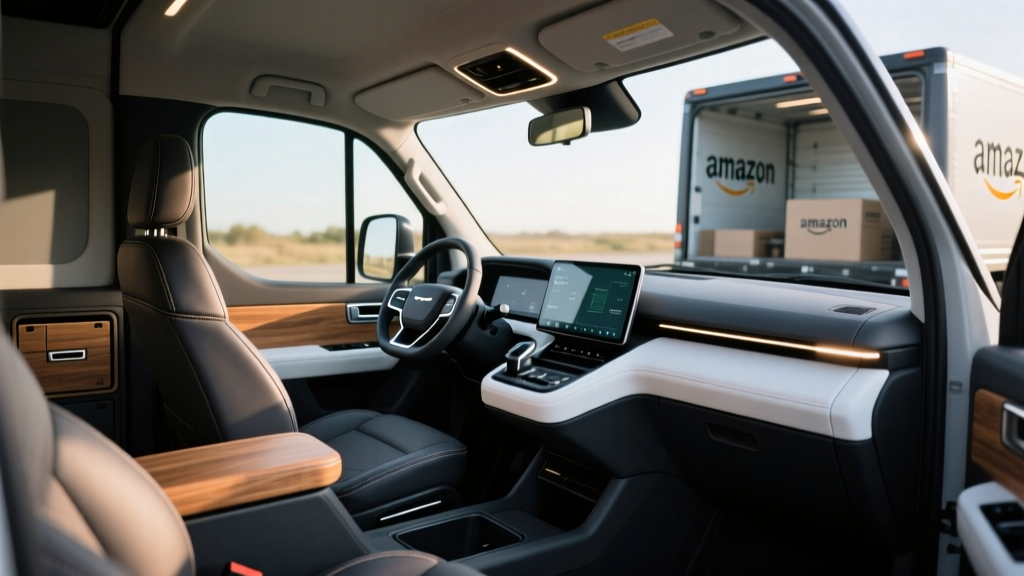
The EDV interior reflects a single design principle: a delivery driver may enter and exit the cab 150+ times per shift. Every surface and control serves that reality.
Entry and Seating
The driver's side features a conventional door, but the curb-side (passenger) entry uses a wide-opening sliding door with an integrated grab handle running the full height of the B-pillar. The floor is flat and low — approximately 18 inches from ground — so drivers step in rather than climb up. The driver's seat is a manually adjustable, heavily bolstered bucket designed for all-day use with a heavy-duty vinyl surface that resists abrasion from tool belts and package scanners.
There is no traditional passenger seat. Instead, the curb-side area is an open pass-through directly into the cargo bay, allowing drivers to walk from the cab to the shelves without going outside. This "walk-through" layout is the single most impactful interior feature for route efficiency.
Controls and Instrumentation
Rivian stripped the dashboard to operational essentials:
- 15.6-inch central touchscreen running a custom Android-based OS with integrated Amazon route navigation, package manifest display, and vehicle telemetry
- Digital instrument cluster (approximately 10 inches) showing speed, state of charge, estimated remaining range, and drive mode
- Column-mounted shifter (PRND) to free up floor space
- Physical HVAC knobs — a deliberate choice, since drivers wearing gloves cannot reliably use touchscreens
- Integrated barcode scanner mount built into the center console
Notably absent: consumer infotainment features. There is no Apple CarPlay, no premium audio system, no ambient lighting. The EDV is a tool, not a lifestyle product.
Visibility and Camera Systems
The windshield is unusually tall and upright, providing a commanding view of intersections. A multi-camera surround-view system (front, rear, curb-side, and blind-spot) feeds the central display, critical for navigating tight suburban driveways. The exterior mirrors are heated and power-adjustable, with integrated puddle lamps for pre-dawn winter routes.
Cargo Bay Configuration and Dimensions
The cargo area is where the EDV earns its keep. Rivian designed the bay in partnership with Amazon's logistics team to accommodate standardized shelving systems.
| Variant | Cargo Volume | Wheelbase | Overall Length | GVWR |
|---|---|---|---|---|
| EDV-500 | ~500 cu ft | ~130 in | ~228 in | ~9,500 lb |
| EDV-700 | ~700 cu ft | ~150 in | ~258 in | ~10,500 lb |
| EDV-900 | ~900 cu ft | ~170 in | ~288 in | ~12,000 lb |
The EDV-700 is the most common variant in Amazon's fleet, balancing cargo capacity with maneuverability in residential neighborhoods. The cargo floor is flat aluminum with integrated tie-down channels. LED strip lighting runs the full length of the ceiling. The rear doors are a 50/50 split barn-door design opening 270 degrees, and the curb-side sliding cargo door provides fast access to mid-bay shelves without walking to the rear.
| Specification | Value |
|---|---|
| EPA Estimated Range | ~150 miles (EDV-700) |
| Battery Capacity (usable) | ~105 kWh (estimated), NMC chemistry |
| Max DC Fast Charge Rate | ~70 kW peak |
| 10–80% DC Charge Time | ~60 minutes |
| Level 2 Charge Rate | ~11.5 kW (depot charging) |
| Motor Configuration | Single rear motor, RWD |
| Horsepower | ~250 hp |
| 0–60 mph (unloaded) | ~8.5 seconds |
| Efficiency | ~2.0–2.4 kWh/mile (route-dependent) |
Range, Battery, and Real-World Efficiency
The EDV's range spec is deliberately calibrated for a specific duty cycle: stop-and-go urban delivery routes averaging 60–100 miles per shift, returning to a depot with reserve capacity for detours, weather, and HVAC load.
Real-World Range Expectations
EPA estimate: ~150 miles (EDV-700, full payload).
Real-world urban delivery route (70°F, moderate stops): 130–145 miles effective range.
Cold-weather impact (below 32°F): Expect 15–25% range reduction due to battery resistance and cabin/cargo heating — bringing effective range to approximately 105–125 miles. Amazon mitigates this by pre-conditioning vans while plugged in at the depot and sizing routes conservatively in northern markets.
Highway driving (sustained 65 mph): Aerodynamic drag on the boxy profile drops efficiency to roughly 2.5+ kWh/mile, reducing effective range to ~110–120 miles.
Rivian uses a liquid-cooled NMC (nickel manganese cobalt) battery pack. NMC was chosen over LFP for its higher energy density — important in a van where battery mass directly reduces payload capacity. The pack sits low in the chassis between the axles, contributing to a stable center of gravity unusual for a delivery van. Regenerative braking is aggressive and effectively enables one-pedal driving, which reduces brake wear on stop-heavy routes — a significant maintenance savings for fleet operators.
Charging Infrastructure and Speeds
The EDV is designed around depot charging, not public fast-charging networks. Amazon has invested heavily in Level 2 depot infrastructure, with most delivery stations equipped with dozens of 11.5 kW Level 2 chargers where vans plug in overnight.
| Charging Level | Power (kW) | Rate | Use Case |
|---|---|---|---|
| Level 1 (120V) | ~1.4 kW | ~3–4 mi/hr | Emergency/trickle only |
| Level 2 (240V, depot) | ~11.5 kW | ~28–32 mi/hr | Primary overnight charging |
| DC Fast Charge | ~70 kW peak | ~150 mi/hr (peak) | Mid-day top-up if needed |
DC fast charging on the EDV is modest by consumer-EV standards. The ~70 kW peak rate means a 10–80% session takes roughly 60 minutes — acceptable for a mid-shift top-up at a depot DC charger but not competitive with consumer vehicles like the Hyundai Ioniq 5 (240 kW peak). This is a deliberate engineering trade-off: fleet vans charge overnight on Level 2, so investing in expensive high-rate DC capability would add cost and battery stress without operational benefit.
The EDV uses a CCS1 connector. It does not support Tesla's NACS connector, as Rivian's commercial fleet infrastructure is built around the CCS/Level 2 depot standard.
Driver Assistance and Safety Technology
The EDV includes a robust ADAS suite branded as Rivian Driver+, but it is critical to understand what this system does and does not do.
SAE Automation Level: Level 2
Rivian Driver+ is an SAE Level 2 driver-assistance system. It provides adaptive cruise control and lane-centering assistance, but the driver must remain fully engaged — hands on the wheel, eyes on the road — at all times. This is not autonomous or self-driving capability. Level 4 driverless systems (like Waymo's robotaxi service) operate without a human driver; the EDV requires one.
Key safety and assistance features include:
- Automatic emergency braking (AEB) with pedestrian and cyclist detection
- Blind-spot monitoring with visual alerts in the side mirrors
- Surround-view camera system with curb-side emphasis for sidewalk awareness
- Rear cross-traffic alert when backing out of driveways
- Lane departure warning and lane-keeping assist
- Driver monitoring camera to detect inattention or drowsiness
These features are particularly valuable in a delivery context, where driver fatigue from repetitive routes and tight schedules increases incident risk. NHTSA has not published a separate safety rating for the EDV as a commercial vehicle, but Rivian's consumer R1T earned a Top Safety Pick+ from the IIHS, suggesting strong underlying crash-structure engineering.
What Driver+ Does NOT Do
Rivian Driver+ will not navigate intersections, make turns, respond to traffic signals, or handle construction zones without driver input. It is a highway and straight-road assist system. The delivery driver is always responsible for vehicle control, and Amazon's internal policies require active driver engagement at all times.
Warranty, Maintenance, and Fleet Economics
As a commercial vehicle sold exclusively to Amazon, the EDV is not subject to consumer warranty structures. However, available information indicates:
- Battery warranty: 8 years / 100,000 miles (consistent with Rivian's consumer warranty and industry standards for commercial EVs)
- Powertrain warranty: 8 years / 175,000 miles (commercial use spec)
- Bumper-to-bumper: 5 years / 60,000 miles
The battery warranty guarantees a minimum of 70% capacity retention over the warranty period. For a 150-mile-range van, 70% retention means ~105 miles of effective range at end-of-warranty — still sufficient for many urban routes, though Amazon likely plans battery refresh cycles for high-mileage units.
Maintenance savings versus a gas-powered Ram ProMaster or Ford Transit are substantial. The EDV eliminates oil changes, transmission fluid, spark plugs, and exhaust system repairs. Regenerative braking extends brake pad life by an estimated 2–3x versus conventional vans. Rivian's mobile service team handles much of the fleet maintenance on-site at Amazon delivery stations.
Tax Credits and Commercial EV Incentives
The EDV is not eligible for the consumer IRS §30D clean vehicle credit — that credit applies only to personal-use vehicles purchased by individual taxpayers. However, Amazon benefits from the Commercial Clean Vehicle Credit (§45W), which provides up to $7,500 for qualified commercial EVs under 14,000 lb GVWR and up to $40,000 for heavier vehicles. The EDV-500 and EDV-700 fall under the $7,500 tier; the EDV-900 may qualify for the higher amount.
Additional incentives available to fleet operators include:
- IRA §179 expensing for accelerated depreciation on commercial EVs
- State and utility fleet-electrification rebates (vary by jurisdiction — check local programs)
- Charging infrastructure tax credits under §30C for depot charger installation
These incentives, combined with lower per-mile energy and maintenance costs, make the EDV economically compelling for Amazon at fleet scale, even though the upfront vehicle cost is higher than a comparable diesel van.
Pros
- Purpose-built walk-through cab eliminates 150+ daily re-entries from the curb side
- Regenerative braking dramatically extends brake pad life on stop-heavy routes
- Surround-view camera and AEB reduce low-speed incident risk in residential areas
- Overnight Level 2 depot charging eliminates fueling time and cost
- Quiet operation enables early-morning deliveries in noise-sensitive neighborhoods
- Low center of gravity from floor-mounted battery improves handling vs. ICE vans
Cons
- ~150-mile range limits use to urban/suburban routes — not viable for rural or long-haul
- ~70 kW DC fast-charge rate is slow; mid-day top-ups take ~60 minutes
- No consumer availability — exclusively sold to Amazon
- Cold-weather range loss (15–25%) requires conservative winter route planning
- Single rear motor / RWD limits traction in deep snow or heavy rain vs. AWD alternatives
- Minimal driver comfort features — this is a work tool, not a pleasant place to sit for long breaks
Is the Rivian EDV Worth It vs. Competitors?
Since you cannot buy an EDV, the "worth it" question applies to fleet operators evaluating commercial EV vans. The EDV's primary competitors are the Ford E-Transit and the BrightDrop Zevo 600 (General Motors).
| Spec | Rivian EDV-700 | Ford E-Transit (High Roof) | BrightDrop Zevo 600 |
|---|---|---|---|
| EPA Range | ~150 mi | ~126 mi | ~250 mi |
| Cargo Volume | ~700 cu ft | ~487 cu ft | ~600 cu ft |
| DC Fast Charge (peak) | ~70 kW | ~115 kW | ~120 kW |
| Walk-Through Cab | Yes | No | No |
| Consumer Availability | No (Amazon exclusive) | Yes | Yes |
The EDV wins on cargo volume and cab efficiency (the walk-through layout is a genuine operational advantage no competitor matches). The BrightDrop Zevo 600 offers superior range and faster charging, making it better suited for longer suburban routes. The Ford E-Transit is the most accessible option for small fleet operators, with widespread dealer support and a lower entry price, though its range and cargo space trail both competitors.
Can I buy a Rivian Amazon delivery van for personal use?
No. The EDV is sold exclusively to Amazon under a commercial agreement. Rivian has not announced plans to offer a consumer variant. If you want a Rivian for personal use, the R1T pickup and R1S SUV are the available options.
What is the real-world range of the Rivian EDV?
On a typical urban delivery route at moderate temperatures, expect 130–145 miles of effective range from the ~150-mile EPA estimate. In sub-freezing weather, plan for 105–125 miles due to battery and heating losses.
How fast does the EDV charge?
At a Level 2 depot charger (11.5 kW), a full charge takes approximately 9–10 hours — designed for overnight turnaround. On a DC fast charger, 10–80% takes roughly 60 minutes at a ~70 kW peak rate.
Does the Rivian EDV qualify for the federal EV tax credit?
Not the consumer §30D credit — that applies to personal-use vehicles only. Amazon claims the Commercial Clean Vehicle Credit (§45W) instead, which provides up to $7,500 per van for qualifying commercial EVs. Eligibility depends on GVWR, battery sourcing, and IRS rules that may change. Consult IRS guidance for current requirements.
What battery chemistry does the EDV use?
The EDV uses NMC (nickel manganese cobalt) lithium-ion cells with liquid cooling. NMC provides higher energy density than LFP, which is critical in a commercial van where battery weight reduces payload capacity.
Is Rivian Driver+ self-driving?
No. Driver+ is an SAE Level 2 driver-assist system offering adaptive cruise and lane-centering. The driver must remain fully engaged at all times. It does not navigate intersections, respond to traffic signals, or operate without human supervision.