The 2025 Tesla Model Y arrived with its long-awaited "Juniper" refresh, bringing a redesigned cabin, ambient lighting, ventilated front seats, and a rear touchscreen that finally gives back-seat passengers some control. But beyond the aesthetic upgrades, the engineering story is about efficiency refinement and a shift to LFP battery chemistry across the standard-range lineup. We spent time with the 2025 Model Y Long Range AWD to evaluate whether the new interior justifies the premium and how the numbers stack up against the Hyundai Ioniq 5, Ford Mustang Mach-E, and Kia EV6.
2025 Model Y Interior: What Changed and Why It Matters
The previous Model Y cabin was famously minimalist — some called it elegant, others called it sparse. The 2025 refresh addresses the most common critiques. Tesla added a wraparound ambient light strip across the dashboard and door panels, replacing the flat-black surfaces that showed every fingerprint. The center console now features ventilated cupholders, a wireless phone charger with active cooling, and softer-touch materials on the armrest and door uppers.
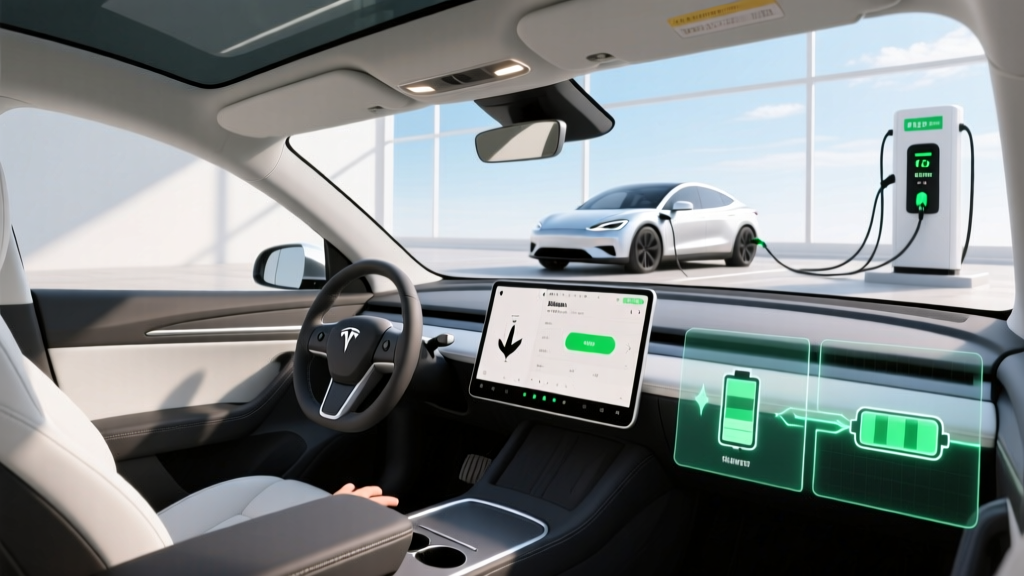
The biggest interior upgrade is the 8-inch rear touchscreen mounted to the back of the center console. Rear passengers can control climate, seat heating, and media independently — a feature that sounds minor until you're on a 400-mile road trip with kids arguing about the temperature. The screen also displays navigation and speed, reducing the "am I there yet?" factor.
Front seats now come with ventilation on Long Range and Performance trims (previously a glaring omission at this price point). The seat foam is denser, providing better long-drive support, though the seat bottom remains slightly shorter than the Ioniq 5's, which matters if you're over 6 feet tall. Rear legroom is unchanged at 41.6 inches — generous for the class — but the sloping roofline still limits headroom for taller passengers compared to the boxier Hyundai.
Cargo volume holds at 30.2 cubic feet behind the second row and 72.1 cu ft with seats folded. The front trunk (frunk) adds another 4.1 cu ft — useful for charging cables and groceries but not as deep as the Mach-E's 4.7 cu ft frunk. The power liftgate now opens and closes noticeably faster, and the load floor is lower, making it easier to slide in a stroller or luggage.
Range, Battery, and Real-World Efficiency
The 2025 Model Y Long Range AWD carries a 78.1 kWh usable battery (NMC chemistry) and earns an EPA-estimated 320 miles of range. The base Rear-Wheel-Drive model uses a 60 kWh LFP (lithium iron phosphate) battery with an EPA rating of 267 miles.
EPA 320 mi (Long Range AWD) — expect 270–290 mi on sustained highway driving at 70+ mph, and 240–260 mi in sub-30°F winter conditions with cabin heat running. The Model Y's heat pump helps mitigate cold-weather loss compared to resistive-heating EVs, but physics is physics: cold batteries and dense air reduce range 15–25%. The LFP-equipped RWD model is more resilient to daily 100% charging but delivers roughly 225–240 real-world highway miles in mild weather.
Efficiency on the Long Range AWD rates at 119 MPGe combined (28 kWh/100 mi) per fueleconomy.gov. That's excellent for a 4,400-lb crossover and slightly better than the pre-refresh model, thanks to revised aerodynamics and a more efficient inverter. The RWD model achieves 124 MPGe combined.
| Attribute | RWD (Base) | Long Range AWD | Performance |
|---|---|---|---|
| EPA Range | 267 mi | 320 mi | 293 mi |
| Battery (usable) | 60 kWh (LFP) | 78.1 kWh (NMC) | 78.1 kWh (NMC) |
| 0–60 mph | 6.6 sec | 4.8 sec | 3.5 sec |
| Horsepower | 315 hp | 384 hp | 456 hp |
| Drivetrain | RWD | Dual-Motor AWD | Dual-Motor AWD |
| MPGe (combined) | 124 | 119 | 111 |
| Base MSRP | $44,990 | $48,990 | $53,990 |
Charging Speed: DC Fast and Home Level 2
The 2025 Model Y Long Range supports a peak DC fast-charge rate of 250 kW on V3 Superchargers, adding up to 200 miles in approximately 15 minutes under ideal conditions. In practice, the 10–80% charge takes about 25 minutes, as the charge curve tapers meaningfully above 60%. Tesla's preconditioning system automatically warms the battery when you navigate to a Supercharger, which is critical — arrive without preconditioning and peak rates can drop to 120–150 kW until the pack reaches optimal temperature.
The RWD model with the LFP battery peaks at 170 kW DC, with 10–80% in roughly 30 minutes. LFP chemistry tolerates regular 100% charging without the degradation concerns of NMC, so daily top-offs are fine — a practical advantage for commuters with predictable routines.
| Charging Level | Power / Rate | Miles Added per Hour | Notes |
|---|---|---|---|
| Level 1 (120V outlet) | 1.4 kW | ~4 mi/hr | Emergency/trickle only |
| Level 2 (240V, 48A) | 11.5 kW | ~37 mi/hr | Full charge in ~7 hrs (LR) |
| DC Fast (V3 Supercharger) | 250 kW peak (LR) | ~1,000 mi/hr (peak) | 10–80% in ~25 min |
| DC Fast (RWD/LFP) | 170 kW peak | ~680 mi/hr (peak) | 10–80% in ~30 min |
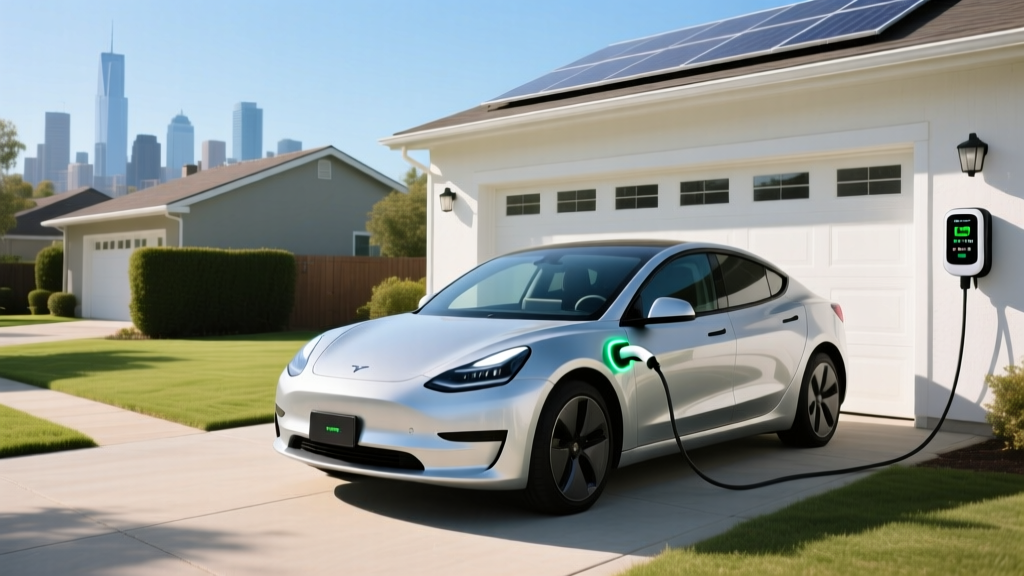
For home charging, the Model Y accepts up to 11.5 kW on a 48-amp Level 2 circuit (requires a 60-amp breaker). A full overnight charge from 20% to 100% takes roughly 7 hours on the Long Range. Tesla's Wall Connector costs around $420; professional installation with a dedicated 60A circuit typically runs $600–$1,800 depending on panel proximity and local permit requirements. If your home has a 200-amp electrical panel with spare capacity, you're usually fine — older 100-amp panels may need a $2,000–$4,000 upgrade.
Performance and Driving Impressions
The Long Range AWD delivers 384 horsepower and a 4.8-second 0–60 mph time — quick enough to merge onto any highway with authority, though the Performance trim's 3.5-second sprint is the one that rearranges your internal organs. The dual-motor AWD system provides confident all-weather traction, and the low center of gravity keeps body roll well-controlled through corners.
Ride quality improved with the Juniper update: Tesla retuned the dampers and added acoustic laminated glass to the front windows, noticeably reducing wind and road noise at highway speeds. The steering remains precise but heavily assisted — there's little road feel, which some drivers love and enthusiasts find numb. Regenerative braking is aggressive enough for one-pedal driving in most scenarios, though Tesla removed the adjustable regen setting that earlier owners appreciated.
The Model Y does not offer adaptive air suspension (that's reserved for Model S/X), so pothole impacts are more noticeable than in the Ioniq 5 or EV6, which have slightly more compliant setups. Ground clearance is 6.6 inches — adequate for light snow but not for rough unpaved roads.
Pricing, Trims, and Federal Tax Credit Eligibility
The 2025 Model Y lineup starts at $44,990 for the Rear-Wheel-Drive trim and climbs to $53,990 for the Performance. Destination adds $1,390. Our Long Range AWD tester, equipped with the $2,000 FSD (Supervised) package and $1,500 Ultra Red paint, came to an as-tested price of $53,880.
| Trim | MSRP (incl. dest.) | §30D Credit Eligibility* | Effective Price (est.) |
|---|---|---|---|
| RWD | $46,380 | $0 (see below) | $46,380 |
| Long Range AWD | $50,380 | $0 (see below) | $50,380 |
| Performance | $55,380 | $0 (see below) | $55,380 |
As of the current tax year, no Tesla Model Y trim qualifies for the $7,500 federal EV tax credit. The reason: battery component and critical-mineral sourcing requirements under the Inflation Reduction Act. Tesla's battery supply chain does not currently meet the percentage thresholds mandated by the IRS for vehicles assembled in North America with qualifying mineral content. Buyers should verify current eligibility at irs.gov before purchase, as sourcing rules and Tesla's supply chain evolve. State-level incentives (California, Colorado, New York, and others) may still apply — check your local DMV or energy office.
Income caps for §30D: $150,000 single / $300,000 joint AGI. MSRP cap for SUVs: $80,000. The Model Y clears both thresholds; the barrier is sourcing compliance.
Technology, Autopilot, and Driver Assistance
Every 2025 Model Y comes with Tesla's Basic Autopilot — adaptive cruise control, lane centering, and automatic emergency braking. This is a SAE Level 2 driver-assistance system, meaning you must keep your hands on the wheel and eyes on the road at all times. The system works well on divided highways but can phantom-brake in certain conditions (a documented issue that Tesla has addressed incrementally through software updates).
Autopilot and the optional FSD (Supervised) package are SAE Level 2 systems. The driver is always responsible. FSD adds automatic lane changes, traffic light/stop sign recognition, and city-street navigation assistance, but still requires full driver supervision. Only Level 4 services like Waymo operate without a human driver in defined geofenced areas.
The infotainment system remains a 15-inch center touchscreen running Tesla's proprietary OS. It's fast, responsive, and includes Netflix/YouTube streaming while parked, a built-in web browser, and over-the-air updates that regularly add features. The 2025 refresh improved the UI with a cleaner navigation display and better voice recognition. There is no Apple CarPlay or Android Auto — Tesla's ecosystem is closed, which frustrates some buyers who prefer their phone's interface.
Notable tech drawbacks: no heads-up display, no traditional instrument cluster, and all climate/seat controls are buried in the touchscreen (though the new rear screen helps passengers). The turn-signal stalk was removed in favor of steering-wheel-mounted buttons in some markets — a controversial choice that US buyers should test-drive before committing.
Warranty, Ownership Costs, and Reliability
Tesla covers the Model Y with a 4-year/50,000-mile basic warranty and an 8-year/120,000-mile battery and drive unit warranty (Long Range/Performance). The RWD model's battery warranty is 8 years/100,000 miles. The warranty guarantees at least 70% battery capacity retention over the coverage period.
Insurance costs are a real factor: the Model Y consistently ranks among the more expensive EVs to insure, with national averages around $2,400–$3,200/year depending on your state, age, and driving record. Tesla's own insurance product (available in select states) uses real-time driving data and can be 10–20% cheaper for clean drivers, but availability varies.
Maintenance is minimal — no oil changes, no spark plugs, cabin air filter replacement every 2 years (~$75), tire rotation every 6,250 miles, and brake fluid checks. Regenerative braking dramatically extends pad life; many owners report original brake pads at 80,000+ miles.
Pros, Cons, and Who Should Buy
- Best-in-class Supercharger network access (17,000+ US stations)
- Refreshed 2025 interior with ambient lighting, ventilated seats, rear screen
- 320-mile EPA range (Long Range) with strong real-world efficiency
- 250 kW DC fast charging with reliable preconditioning
- OTA updates continuously improve the vehicle post-purchase
- Spacious cargo area (72.1 cu ft) with practical frunk
- No federal §30D tax credit due to battery sourcing rules
- No Apple CarPlay or Android Auto
- Insurance premiums above average for the segment
- Ride firmness on rough roads; no air suspension option
- All climate/seat controls touchscreen-dependent
- FSD (Supervised) costs $2,000+ and remains Level 2
- Choose the Model Y Long Range if you road-trip frequently (Supercharger network is unmatched), want a refreshed premium interior without stepping to luxury-brand pricing, and need a practical family crossover with strong cargo space.
- Choose the RWD if you commute under 40 miles daily, can charge at home, and want the lowest entry price with LFP battery longevity.
- Look at the Ioniq 5 or EV6 instead if the federal tax credit is essential to your budget, you prefer CarPlay, or you want a softer ride and more rear headroom.
- Consider the Mach-E if you want a more traditional driving feel, a larger frunk, and Ford dealer service proximity.
Frequently Asked Questions
What is the real-world range of the 2025 Model Y?
The Long Range AWD is EPA-rated at 320 miles, but expect 270–290 miles on sustained highway trips at 70+ mph and 240–260 miles in cold weather (below 30°F). The RWD with LFP battery rates at 267 EPA miles with roughly 225–240 real-world highway miles in mild conditions.
How fast does the 2025 Model Y charge?
On a V3 Supercharger, the Long Range peaks at 250 kW and charges 10–80% in about 25 minutes. The RWD/LFP peaks at 170 kW with 10–80% in roughly 30 minutes. At home on a 48A Level 2 charger, expect about 37 miles of range per hour of charging.
Does the 2025 Model Y qualify for the federal EV tax credit?
Currently, no. The Model Y does not meet the IRS §30D battery-sourcing and critical-mineral requirements as of the 2025 tax year. The MSRP and buyer income thresholds are satisfied, but the supply-chain rules disqualify it. Verify at irs.gov before purchasing, as rules and sourcing can change.
Is the 2025 Model Y interior a significant improvement?
Yes. The Juniper refresh adds ambient lighting, ventilated front seats, a rear passenger touchscreen, improved sound insulation, and softer materials. It addresses the most common complaints about the pre-2025 cabin and brings the Model Y closer to the premium feel of the BMW iX3 or Audi Q4 e-tron, though at a lower price point.
Is the Model Y worth buying over the Ioniq 5 or EV6?
If Supercharger access and over-the-air updates are priorities, the Model Y remains the default choice. If the $7,500 federal credit matters to your budget (both the Ioniq 5 and EV6 may qualify depending on trim and sourcing), or you prefer CarPlay and a softer ride, the Korean alternatives are compelling. Test-drive both before deciding.
What is the battery warranty on the 2025 Model Y?
Tesla provides 8 years/120,000 miles on the Long Range and Performance battery and drive unit, and 8 years/100,000 miles on the RWD. The warranty guarantees a minimum of 70% capacity retention during the coverage period.