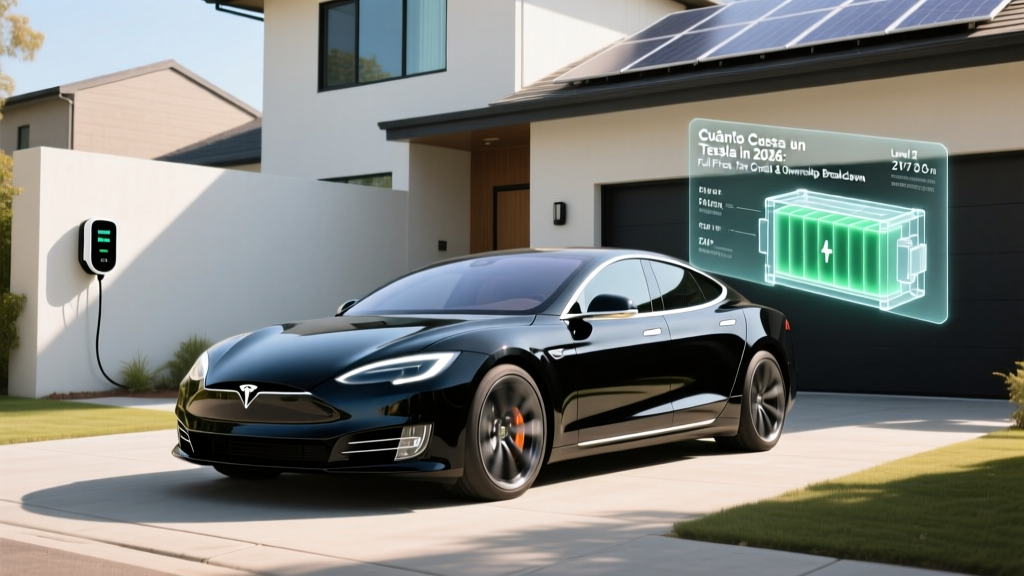
If you've been searching cuánto cuesta un Tesla, the answer in 2026 depends on which model you choose, which incentives you qualify for, and how you plan to charge. Tesla's lineup has matured past the early-adopter phase, and pricing now overlaps with mainstream EVs from Hyundai, Ford, and Chevrolet — but the Supercharger network, software ecosystem, and efficiency figures keep Tesla in a category of its own. Below, we dissect every current Tesla model with the exact numbers buyers need: EPA range, battery chemistry, charging curves, real-world efficiency, §30D tax-credit eligibility, and five-year ownership math.
2026 Tesla Lineup at a Glance: MSRP, Range, and Tax-Credit Eligibility
Tesla sells four core models in the U.S. for 2026: Model 3, Model Y, Model S, and Model X, plus the Cybertruck. Each has shifted in price multiple times over the past two years, but the table below reflects current MSRPs as of early 2026, before destination fees and before any federal or state incentives. The IRS §30D federal EV tax credit remains a moving target — eligibility hinges on MSRP caps, buyer income limits, and battery-mineral sourcing requirements that Tesla has been actively reworking to satisfy.
| Model / Trim | Base MSRP | EPA Range | Battery (kWh, Chem) | 0-60 mph | §30D Credit Eligible? |
|---|---|---|---|---|---|
| Model 3 RWD | $38,990 | 272 mi | ~60 kWh, LFP | 5.8 s | Yes — $7,500 (if sourcing rules met) |
| Model 3 Long Range AWD | $45,490 | 341 mi | ~82 kWh, NMC | 4.2 s | Yes — $7,500 (if sourcing rules met) |
| Model Y RWD | $44,990 | 303 mi | ~60 kWh, LFP | 6.6 s | Yes — $7,500 (if sourcing rules met) |
| Model Y Long Range AWD | $48,990 | 320 mi | ~82 kWh, NMC | 4.8 s | Yes — $7,500 (if sourcing rules met) |
| Model S Long Range | $79,990 | 402 mi | ~100 kWh, NMC | 3.1 s | No — exceeds $55K sedan MSRP cap |
| Model X Long Range | $84,990 | 335 mi | ~100 kWh, NMC | 3.8 s | No — exceeds $80K SUV cap in most configs |
| Cybertruck AWD | $79,990 | 340 mi | ~123 kWh, NMC | 3.9 s | Yes — $7,500 (SUV/pickup $80K cap) |
Source: fueleconomy.gov and Tesla's official 2026 configurator. Tax-credit eligibility per IRS §30D rules — always confirm with a tax professional before purchase, as critical-mineral and battery-component sourcing thresholds tighten annually.
The Real Question: Cuánto Cuesta un Tesla After Tax Credits and Incentives?
The sticker price is only the opening bid. Here's how the math actually works for the most popular configuration — the Model Y Long Range AWD — which remains Tesla's volume leader in 2026.
| Cost Factor | Model Y LR AWD | Model 3 LR AWD |
|---|---|---|
| Base MSRP | $48,990 | $45,490 |
| Destination Fee | +$1,390 | +$1,390 |
| Federal §30D Credit (if eligible) | −$7,500 | −$7,500 |
| Typical State Rebate (varies) | −$1,000 to −$5,000 | −$1,000 to −$5,000 |
| Estimated Out-of-Pocket (pre-tax, no trade) | ~$37,880 – $42,880 | ~$34,380 – $39,380 |
§30D eligibility requirements for 2026:
- MSRP cap: ≤$55,000 for sedans (Model 3 qualifies); ≤$80,000 for SUVs/pickups (Model Y and Cybertruck qualify)
- Buyner income cap: AGI ≤$150K single / ≤$225K head-of-household / ≤$300K joint
- Battery sourcing: Increasing percentages of critical minerals and battery components must be sourced from the U.S. or FTA-partner nations — Tesla's LFP cells (largely CATL-sourced) face tighter scrutiny than NMC packs
- Point-of-sale transfer: You can apply the $7,500 credit as a down-payment reduction at purchase, rather than waiting for tax filing
Important caveat: LFP-equipped RWD trims using CATL cells may face partial or full credit disqualification depending on how the sourcing percentages land for the specific build month. Always check the VIN-specific eligibility on the IRS portal before signing.
Real-World Range: What the EPA Sticker Doesn't Tell You
EPA vs. Reality — Model Y Long Range AWD:
EPA sticker: 320 miles. Real-world highway (75 mph, 70°F): ~270–285 miles. Cold-weather highway (30°F): ~220–245 miles. City/regenerative driving: can exceed 320 miles.
Tesla's efficiency remains best-in-class among crossover SUVs. The Model Y LR achieves roughly 28 kWh/100 mi on the EPA combined cycle — that translates to about 3.5 miles per kWh. But physics is physics: sustained highway speeds above 70 mph increase aero drag quadratically, and cold temperatures reduce battery chemical efficiency while demanding cabin-heating energy.
The LFP chemistry in RWD trims has a different discharge curve than NMC — it holds voltage more linearly, which means the range estimate on the dash is actually more accurate day-to-day, but the total usable capacity is slightly lower. In our experience, LFP Model 3 owners report 240–250 real highway miles from a full charge versus the 272 EPA figure.
Charging Speed: DC Fast Charging, Home Level 2, and the Supercharger Advantage
Charging speed is where Tesla still holds a tangible edge, not because of peak kW numbers (many competitors now match or exceed them), but because of the integrated Supercharger network reliability and the vehicle's thermal preconditioning system.
| Charging Level | Model 3/Y (NMC LR) | Model 3/Y (LFP RWD) | Model S/X |
|---|---|---|---|
| Level 1 (120V, 12A) | ~3 mi/hr | ~3 mi/hr | ~3 mi/hr |
| Level 2 (240V, 48A) | 11.5 kW / ~44 mi/hr | 11.5 kW / ~44 mi/hr | 11.5 kW / ~36 mi/hr |
| DC Fast Charge (peak) | 250 kW (V3 Supercharger) | 170 kW | 250 kW |
| 10–80% DCFC time | ~25–28 min | ~30–35 min | ~30–35 min |
Charge-curve reality check: The 250 kW peak on NMC Long Range models only sustains between roughly 10–30% State of Charge (SoC). Above 50%, the curve tapers to ~120 kW, and above 80% it drops below 50 kW. That 10–80% time of ~25 minutes is honest, but if you're the type to charge to 100% at a Supercharger, add another 20–30 minutes for that final 20%. This is why Tesla (and every EV maker) recommends 80% for road-trip stops.
The LFP RWD models accept a lower peak charge rate (~170 kW), but LFP chemistry tolerates regular 100% charging without accelerated degradation — a genuine ownership advantage for commuters who want to charge fully every night at home.
Performance, Efficiency, and What It's Like to Drive
Tesla's dual-motor AWD system delivers torque with zero lag. The Model 3 Long Range hits 0–60 in 4.2 seconds — quicker than a BMW 340i — while returning 132 MPGe combined. The Model Y, despite weighing ~4,400 lbs, manages 122 MPGe combined and a 4.8-second sprint. These numbers are repeatable because Tesla's thermal management keeps the battery in its optimal performance window.
Regenerative braking in Tesla's one-pedal mode is aggressive but predictable. On hilly commutes, owners routinely recapture 15–25% of energy consumed on the outbound leg. The heat pump (standard on all 2026 models) significantly reduces winter range loss compared to older resistive-heater EVs — expect roughly 15–20% range reduction in 30°F weather, versus 30%+ on older competitors without heat pumps.
Pros
- Supercharger network: 6,000+ U.S. stalls, highest reliability of any public DC network
- Class-leading efficiency (kWh/100mi) means lower charging costs
- Over-the-air updates continuously add features
- LFP option allows daily 100% charging without degradation worry
- Strong resale value relative to most EVs
Cons
- No Apple CarPlay / Android Auto — Tesla's screen is the only interface
- Build-quality inconsistency still surfaces (panel gaps, trim rattle)
- FSD (Supervised) is SAE Level 2 — not self-driving, requires full attention
- Insurance premiums run 15–30% higher than equivalent ICE vehicles
- Lack of physical controls for climate, mirrors, glovebox frustrates some drivers
Interior Space, Cargo, and Tech That Defines the Tesla Experience
The Model Y offers 30.2 cu ft of cargo space behind the second row and 76.2 cu ft with seats folded — competitive with a Toyota RAV4. Front legroom is 41.8 inches; rear legroom is 38.4 inches. The optional third row (best suited for small children) reduces cargo to 12.8 cu ft.
The Model 3 provides 23 cu ft of trunk space (including a small frunk), with 42.2 inches of front legroom and 35.3 inches rear. It's tighter than the Model Y but adequate for two-adult commuting.
Tech highlights include a 15.4-inch center touchscreen (all models), over-the-air software updates, a built-in dashcam and Sentry Mode surveillance system, and Tesla's app-based preconditioning and charge monitoring. Autopilot (basic lane-keep and adaptive cruise) is standard; Enhanced Autopilot ($6,000) and Full Self-Driving Supervised ($8,000 or $99/mo) remain optional — but these are SAE Level 2 systems requiring continuous driver supervision. Tesla has not achieved Level 4 autonomy in consumer vehicles.
Battery Longevity, Warranty, and Replacement Costs
Tesla warranties the battery and drive unit for 8 years / 100,000 miles on RWD trims and 8 years / 120,000 miles on Long Range and Performance models. The warranty guarantees at least 70% capacity retention over that period. In practice, NMC packs in Long Range Teslas typically show 8–12% degradation at 100,000 miles based on fleet data, while LFP packs show even less — often under 5% — thanks to the chemistry's superior cycle life.
Out-of-warranty battery replacement costs remain a concern: approximately $12,000–$16,000 for a Model 3/Y pack and $18,000–$22,000 for Model S/X. However, failure rates before 150,000 miles are low — under 2% based on Tesla's impact report data.
Who Should Buy a Tesla in 2026 — And Who Shouldn't?
Choose Tesla if:
- You road-trip frequently and want the most reliable DC fast-charging network
- You value software updates, remote preconditioning, and app integration
- Efficiency (lowest cost per mile) is a top priority
- You can charge at home with a Level 2 wall connector (the ownership experience depends on this)
Look elsewhere if:
- You need Apple CarPlay or physical knobs for climate/audio
- Build-quality consistency is non-negotiable (consider Hyundai Ioniq 5 or BMW iX)
- You need a truck bed for work (Rivian R1T or Ford F-150 Lightning may suit better)
- You cannot install home charging and your area lacks reliable public infrastructure
Frequently Asked Questions
Cuánto cuesta un Tesla Model Y en 2026 después del crédito fiscal?
The Model Y Long Range AWD starts at $48,990 + $1,390 destination. With the full $7,500 §30D federal credit (if your VIN qualifies under sourcing rules and your income is under the cap), the effective price drops to ~$42,880 before any state incentives. The RWD trim at $44,990 can land near $38,880 after credits.
Does the Tesla Model 3 qualify for the full $7,500 federal tax credit?
It can, but eligibility depends on the specific build month and battery sourcing. NMC Long Range AWD models have higher qualification rates. LFP RWD models using CATL cells face tighter critical-mineral thresholds. Always verify your specific VIN on the IRS portal or via the point-of-sale transfer tool before finalizing your purchase. Income caps apply: ≤$150K single, ≤$300K joint filers.
What is the real-world highway range of a Tesla Model 3 Long Range?
The EPA rates it at 341 miles. In real-world highway driving at 70–75 mph in moderate temperatures, expect 280–300 miles. In cold weather (below freezing), that drops to 240–265 miles. City driving with regenerative braking can match or slightly exceed the EPA figure.
How fast does a Tesla charge at home?
With a Tesla Wall Connector on a 60A circuit (48A continuous), all Model 3 and Model Y variants charge at up to 11.5 kW, adding roughly 44 miles of range per hour. A full charge from 10% to 100% takes approximately 7–8 hours. Installation typically costs $800–$2,000 depending on your electrical panel capacity and distance from the panel to the garage.
Is Tesla's Full Self-Driving actually self-driving?
No. FSD (Supervised) is an SAE Level 2 driver-assistance system. It can navigate highways, change lanes, and handle some city streets, but the driver must remain fully attentive with hands ready to take over at any moment. Only Level 4 services like Waymo operate without a human driver, and those are limited to specific geofenced areas in a handful of cities.
Is it worth buying a Tesla vs. a Hyundai Ioniq 5 or Ford Mustang Mach-E?
Tesla wins on efficiency, charging-network reliability, and software. The Ioniq 5 offers faster peak DC charging (350 kW on 800V architecture), Apple CarPlay, and a more conventional interior. The Mach-E provides a more traditional driving feel and Ford dealer service. If Supercharger access and app-based ownership matter most, Tesla still leads. If you prioritize interior quality and physical controls, the competitors close the gap.