2026 Tesla Model Y: Safety First, Specs Second
If you've been searching for crash test Tesla results, you're likely zeroing in on the Model Y — the best-selling EV in the U.S. and a default pick for safety-conscious families. The refreshed "Juniper" Model Y (introduced for the 2025 model year and carried into 2026) brought structural tweaks, updated restraint systems, and revised ADAS hardware that directly impact crashworthiness. Below, we walk through every major safety rating, then cover the specs that matter just as much for daily ownership: real-world range, charging curves, tax credit math, and where it falls short against the Hyundai Ioniq 5 and Ford Mustang Mach-E.
NHTSA & IIHS Crash Test Tesla Model Y Results
The National Highway Traffic Safety Administration (NHTSA) has historically awarded the Model Y its top 5-Star Overall Safety Rating, with 5 stars in frontal crash, side crash, and rollover resistance. The refreshed Juniper platform retains the same low-center-of-gravity skateboard architecture that gives it one of the lowest rollover risks in the SUV segment.
The Insurance Institute for Highway Safety (IIHS) evaluates the Model Y across its updated, more stringent protocol (small-overlap passenger-side, updated side-impact barrier). The 2026 Model Y earns a Top Safety Pick designation when equipped with the standard LED reflector headlights. Key sub-scores:
| Test | Rating |
|---|---|
| Driver-side small overlap front | Good |
| Passenger-side small overlap front | Good |
| Moderate overlap front (updated test) | Good |
| Side impact (updated barrier) | Good |
| Roof strength | Good |
| Head restraints & seats | Good |
| Front crash prevention (vehicle-to-vehicle) | Superior |
| Headlights | Acceptable (LED reflector) |
| LATCH ease of use | Acceptable |
Notable: the IIHS updated side-impact barrier simulates a 4,200-lb vehicle at 37 mph — substantially more punishing than the old test. The Juniper's reinforced B-pillars and revised side-curtain airbag timing helped it maintain a "Good" score where several rivals dropped to "Marginal."
Range, Battery Chemistry, and Real-World Expectations
The 2026 Model Y is offered in three trims, each with different battery chemistry and range profiles. Long Range and Rear-Wheel Drive models use a lithium iron phosphate (LFP) pack for the base RWD and NMC (nickel manganese cobalt) for Long Range and Performance AWD variants.
| Spec | Rear-Wheel Drive | Long Range AWD | Performance AWD |
|---|---|---|---|
| EPA Range | 290 mi | 320 mi | 295 mi |
| Battery (usable) | ~60 kWh (LFP) | ~75 kWh (NMC) | ~75 kWh (NMC) |
| MPGe (combined) | 123 MPGe | 122 MPGe | 111 MPGe |
| kWh / 100 mi | 27 | 28 | 30 |
| 0-60 mph | 5.8 sec | 4.1 sec | 3.5 sec |
| Horsepower | 315 hp | 384 hp | 456 hp |
| Drivetrain | RWD (single motor) | AWD (dual motor) | AWD (dual motor) |
| Base MSRP | $44,990 | $48,990 | $53,990 |
Charging Speed: DC Fast, Level 2, and the Curve Reality
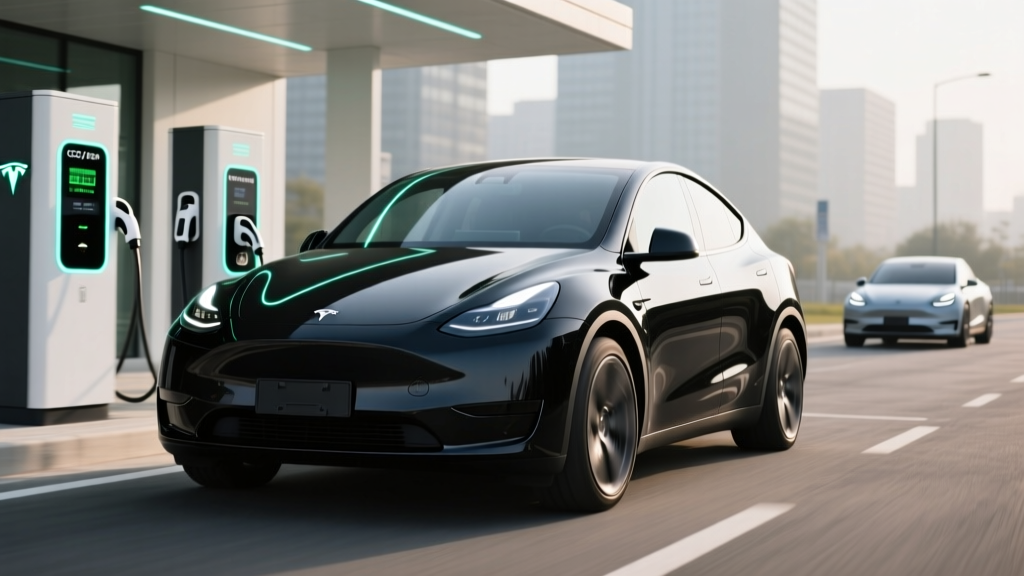
Tesla's Supercharger network remains the gold standard for reliability, but peak kW is only part of the story. The Long Range AWD peaks at ~250 kW on a V3 Supercharger, but the charge curve tapers noticeably past 55% SoC. Expect a 10-80% time of roughly 22 minutes under ideal conditions (preconditioned pack, warm ambient temp). Sustained average is closer to 150-170 kW across the whole session.
| Level | Power / Voltage | Miles Added per Hour | Notes |
|---|---|---|---|
| Level 1 (120V) | 1.4 kW | ~4-5 mi/hr | Emergency / trickle only |
| Level 2 (240V, 48A) | 11.5 kW | ~38-42 mi/hr | Home wall connector; full charge overnight |
| DC Fast (V3 Supercharger) | Peak 250 kW | ~200 mi in 15 min | 10-80% in ~22 min; tapers above 55% |
| DC Fast (V4 Supercharger) | Peak 250+ kW | Similar to V3 | Improved cable handling, CCS-native plug |
Home charging on a 48A Level 2 circuit will fully replenish the Long Range pack in about 7-8 hours. If your electrical panel is older, budget $500-$1,500 for a sub-panel or service upgrade — a common hidden cost.
Tax Credit Eligibility and True Out-of-Pocket Price
Under current IRS §30D rules, the Model Y qualifies for up to $7,500 in federal tax credits, but only if you meet three criteria:
- MSRP cap: SUVs must be under $80,000. All 2026 Model Y trims clear this easily.
- Buyer income cap: AGI must not exceed $150,000 (single), $225,000 (head of household), or $300,000 (joint).
- Battery sourcing: A percentage of critical minerals and battery components must be sourced from the U.S. or FTA partners. Tesla's domestic cell production (via Panasonic in Nevada and CATL-sourced LFP) generally satisfies current thresholds, but verify at point of sale — rules tighten annually.
| Trim | Base MSRP | After $7,500 Credit | Destination |
|---|---|---|---|
| Rear-Wheel Drive | $44,990 | $37,490* | $1,390 |
| Long Range AWD | $48,990 | $41,490* | $1,390 |
| Performance AWD | $53,990 | $46,490* | $1,390 |
*Assumes full §30D eligibility. State/local incentives vary — check AFDC for your jurisdiction. Tax credit rules subject to change; confirm with a tax professional.
Cargo, Passenger Space, and Daily Practicality
The Model Y's hatchback form factor is its secret weapon for families. Behind the second row, you get 30.2 cu ft of cargo volume; fold the rear seats flat and it expands to 72.1 cu ft. The front trunk (frunk) adds another 4.1 cu ft — ideal for charging cables or groceries you want to isolate from the cabin.
Legroom is generous: 41.8 inches front / 37.3 inches rear. The panoramic glass roof creates an airy feel, though it does eat into headroom for taller passengers — a 6'2" rider in the rear will notice the slope. Rear-seat comfort improved in the Juniper refresh with slightly more recline and ventilated cushions on higher trims.
Standout Tech, Drawbacks, and Ownership Costs
Tesla's 15.4-inch center touchscreen runs the full vehicle interface — no physical buttons, no Apple CarPlay or Android Auto. The new ambient lighting, ventilated front seats, and power-folding second row (Juniper additions) close the gap with luxury competitors. The 16-speaker audio system is a highlight.
Notable drawbacks: The absence of CarPlay/Android Auto remains a dealbreaker for some. The turn-signal stalk was removed in the refresh — signals are now on the steering wheel rim, which takes weeks to build muscle memory. Insurance costs run 15-25% higher than the segment average due to Tesla's proprietary repair network and aluminum body panels.
- Best-in-class Supercharger network access
- Top NHTSA 5-star and IIHS Top Safety Pick
- LFP option for daily 100% SoC charging without degradation worry
- Class-leading cargo volume for a compact SUV
- OTA updates add features post-purchase
- No Apple CarPlay or Android Auto
- Stalkless steering wheel takes adaptation
- Insurance premiums above segment average
- FSD (Supervised) remains Level 2, not autonomous
- Ride firmness noticeable on rough pavement
Battery & Powertrain Warranty
Tesla covers the Model Y battery and drive units for 8 years / 100,000 miles (RWD) or 8 years / 120,000 miles (Long Range and Performance), whichever comes first. The warranty guarantees at least 70% capacity retention over that period. The vehicle limited warranty is 4 years / 50,000 miles — in line with the industry.
Is the 2026 Model Y Worth It vs. the Competition?
Against the Hyundai Ioniq 5 (800V architecture, 10-80% in ~18 min, CarPlay standard), the Model Y wins on Supercharger access and cargo volume but loses on charging speed and interior material quality. The Ford Mustang Mach-E offers a more engaging drive and BlueCruise hands-free on mapped highways (still Level 2), but its public charging network (via BlueOval) is less mature. For a family prioritizing safety ratings, range confidence, and road-trip infrastructure, the Model Y remains the default — just know what you're giving up in infotainment flexibility and ride comfort.
Frequently Asked Questions
What is the real-world range of the 2026 Tesla Model Y?
The Long Range AWD is EPA-rated at 320 miles. Real-world highway driving at 70-75 mph typically yields 270-285 miles. In freezing weather with heat on, expect 220-245 miles.
How fast does the Model Y charge at home and on the road?
On a 48A Level 2 home charger, expect ~40 miles per hour of charging (full charge in 7-8 hours). On a V3 Supercharger, 10-80% takes roughly 22 minutes, with peak draw of 250 kW tapering above 55% SoC.
Does the 2026 Model Y qualify for the federal EV tax credit?
Yes — all trims fall under the $80,000 SUV MSRP cap. Buyer income must be under $150K (single) / $300K (joint), and battery sourcing must meet current §30D thresholds. Verify at point of sale; rules tighten annually.
Is the Model Y the safest EV in its class?
It's among the safest, with NHTSA 5-Star Overall and IIHS Top Safety Pick ratings. The Volvo EX40 and Genesis Electrified GV70 also earn top marks, so safety alone doesn't uniquely differentiate the Model Y — but it doesn't lag, either.
Should I buy the Model Y over the Ioniq 5 or Mach-E?
Choose the Model Y if you prioritize Supercharger reliability, cargo space, and OTA feature updates. Choose the Ioniq 5 if you want faster DC charging (800V) and CarPlay. Choose the Mach-E if you value driving dynamics and hands-free highway assist on mapped routes.