The Bottom Line on Early Electric Vehicles in 2026
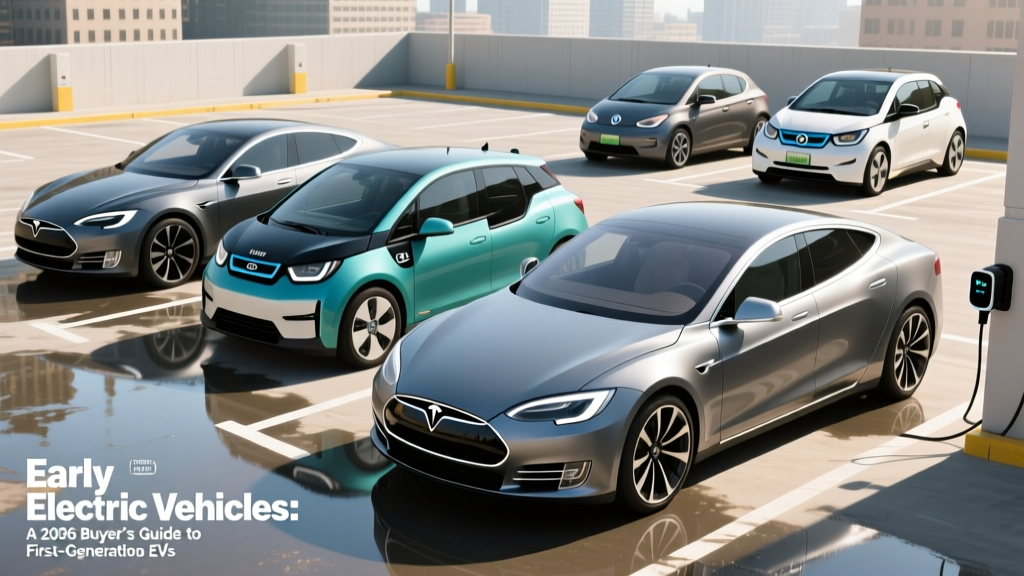
Early electric vehicles — models produced roughly between 2011 and 2018, like the first-generation Nissan Leaf, Chevy Spark EV, BMW i3, Fiat 500e, and original VW e-Golf — are now the most affordable entry point into EV ownership, with used prices often ranging from $4,000 to $14,000. However, most pack batteries between 16 and 30 kWh, delivering 50–100 real-world miles of range after years of degradation. They're excellent second cars, commuter runabouts, or neighborhood vehicles if you can charge at home, but they are not road-trip machines. Budget $500–$2,000 for a battery health check and potential module replacement on higher-mileage examples.
What Counts as an "Early Electric Vehicle" in 2026?
The term early electric vehicles generally refers to the first wave of mass-produced battery-electric cars sold in the U.S. starting around 2011. These vehicles predate the modern era of 200+ mile EPA ranges, DC fast charging above 100 kW, and widespread CCS/NACS standardization. Key models include:
- Nissan Leaf (2011–2017, 1st gen): 24 kWh or 30 kWh battery, EPA range of 73–107 miles when new
- Chevrolet Spark EV (2014–2016): ~19 kWh usable, EPA 82 miles, CCS-compatible on later models
- BMW i3 BEV (2014–2017): 22 kWh usable (60 Ah), EPA 81 miles; 33 kWh (94 Ah) variant rated at 114 miles
- Fiat 500e (2013–2019): 24 kWh, EPA 87 miles
- Volkswagen e-Golf (2015–2017): 24.2 kWh, EPA 83 miles; 2017 SEL got 35.8 kWh and 125 miles
- Kia Soul EV (2015–2019, 1st gen): 27 kWh usable, EPA 93 miles
- Ford Focus Electric (2012–2018): 23 kWh (later 33.5 kWh), EPA 76–115 miles
These vehicles were pioneers. They proved consumer EVs were viable, but their battery technology — mostly early NMC (nickel manganese cobalt) chemistry with passive or limited thermal management — has aged in ways that directly affect what you'll experience as a buyer in 2026.
Real-World Range: What the Sticker Doesn't Tell You
When an early electric vehicle left the showroom with a 24 kWh battery and an EPA rating of 84 miles, that number assumed a brand-new battery under standardized test conditions. In 2026, a 12-year-old Leaf with 90,000 miles has likely lost 20% to 40% of its original capacity, depending on climate, charging habits, and whether it was regularly DC fast-charged or garaged in moderate temperatures.
Here's what that means in practice:
| Model (Year) | Original EPA Range | Battery Capacity (kWh) | Expected 2026 Range (70–85% SoH) | Worst-Case Cold/Highway |
|---|---|---|---|---|
| Nissan Leaf (2013, 24 kWh) | 75 mi | 24 | 52–64 mi | 38–48 mi |
| Nissan Leaf (2016, 30 kWh) | 107 mi | 30 | 75–91 mi | 55–68 mi |
| BMW i3 60 Ah (2015) | 81 mi | 22 (usable) | 57–69 mi | 42–52 mi |
| VW e-Golf (2016) | 83 mi | 24.2 | 58–71 mi | 43–53 mi |
| Fiat 500e (2016) | 87 mi | 24 | 61–74 mi | 45–55 mi |
Cold weather compounds degradation. Lithium-ion batteries lose efficiency below 40°F, and early EVs mostly lacked the sophisticated heat-pump or liquid-cooled thermal management found in modern platforms. If you live in Minneapolis or Chicago, expect to lose another 25–35% on top of age-related degradation during January. A 2013 Leaf that shows 60 miles of range on a mild October day might deliver just 38 miles on a 15°F February morning with the heater running.
Source: fueleconomy.gov EV technology overview
Charging Reality: Slow by Modern Standards
This is where early electric vehicles diverge most sharply from 2026 expectations. Most first-gen EVs were designed around Level 2 AC charging at 3.3 kW to 6.6 kW — meaning a full charge from empty takes 4 to 8 hours on a 240V home circuit. That's perfectly fine for overnight top-ups but useless for mid-day replenishment.
| Charging Level | Typical Power (kW) | Miles Added per Hour | Availability on Early EVs |
|---|---|---|---|
| Level 1 (120V household) | 1.2–1.4 kW | 3–5 mi/hr | All models (standard cord included) |
| Level 2 (240V, 16A–32A) | 3.3–6.6 kW | 12–25 mi/hr | All models; some capped at 3.3 kW onboard |
| DC Fast (CHAdeMO) | 50 kW peak | ~90–120 mi/hr (tapers fast) | Nissan Leaf, Kia Soul EV, Mitsubishi i-MiEV |
| DC Fast (CCS) | 50 kW peak | ~90–120 mi/hr | Chevy Spark EV, BMW i3 (w/ DC option), VW e-Golf, 2015+ Fiat 500e |
CHAdeMO is fading. If you're considering a Nissan Leaf or Kia Soul EV from this era, know that CHAdeMO connectors are being phased out at many public charging networks. Electrify America, for example, has largely standardized on CCS1 and NACS. Some older CHAdeMO stations remain operational, but availability is declining. This is a real ownership consideration, not a theoretical one.
The 50 kW DC fast-charge ceiling matters. Even when new, these vehicles topped out at roughly 50 kW on DC fast charging, and the charge curve tapered aggressively above 80% State of Charge (SoC). A 10–80% charge on a 24 kWh Leaf takes roughly 30–40 minutes at a 50 kW station — if the battery is preconditioned and ambient temperatures are moderate. In cold weather without preconditioning (which the 1st-gen Leaf lacked), that same session could stretch past 50 minutes.
Cost Breakdown: Purchase, Charging, and Ownership
Early electric vehicles are compelling on price but require clear-eyed cost analysis. Here's how the numbers stack up against a comparable used gas car.
| Cost Category | Used Early EV (e.g., 2015 Leaf, $7,500) | Used Gas Car (e.g., 2015 Corolla, $9,000) |
|---|---|---|
| Purchase Price | $6,000–$10,000 | $8,000–$12,000 |
| Fuel / Electricity (annual, 12,000 mi) | $360–$600 (at $0.12–$0.18/kWh home rate) | $1,440–$1,800 (at $3.20–$4.00/gal, 28 MPG avg) |
| Maintenance (annual) | $200–$400 (tires, cabin filter, brake fluid) | $600–$1,000 (oil, filters, brakes, belts) |
| Insurance (annual) | $900–$1,300 | $800–$1,100 |
| Battery Replacement Risk | $3,000–$6,500 if needed (aftermarket/refurb) | N/A (engine/transmission risk: $2,000–$4,000) |
| Estimated 5-Year Total Cost | $12,500–$19,500 | $17,000–$23,500 |
Key takeaway: The fuel savings are real and significant — typically $900–$1,200 per year when charging at home at residential electricity rates. Over five years, that's $4,500–$6,000 in fuel savings alone, plus reduced maintenance from fewer moving parts (no oil changes, no timing belts, regenerative braking extends pad life). However, the battery replacement wildcard can erase those savings if you buy a high-mileage example with degraded cells.
Federal tax credits do not apply to private-party used EV sales from this era in most cases. The IRS §30D used clean vehicle credit (up to $4,000 or 30% of sale price, whichever is lower) requires purchase from a licensed dealer, a sale price under $25,000, buyer income caps ($75,000 single / $150,000 joint), and the vehicle must be at least two model years old. Many early EVs qualify on paper, but the dealer-sale requirement eliminates most Craigslist and Facebook Marketplace deals. Always verify current-year rules on irs.gov before assuming eligibility.
What First-Time EV Buyers Must Know Before Purchasing
If you're considering an early electric vehicle as your first EV, these practical realities will determine whether the experience is liberating or frustrating:
1. Get a Battery Health Report Before You Buy
Unlike a gas car where you check compression and scan for codes, the single most important metric on a used EV is State of Health (SoH) — the percentage of original battery capacity remaining. On a Nissan Leaf, you can read this directly from the dashboard (the "bars" display, where 12 bars = ~100% SoH and 8 bars = ~66%). For other models, an OBD2 scanner with EV-specific software (like LeafSpy for Nissan or BimmerCode for BMW) can pull exact SoH data. Do not buy without this number. A car at 70% SoH or below is a negotiation point or a walk-away.
2. Home Charging Is Non-Negotiable for Convenience
Early EVs with 60 miles of real-world range are manageable only if you can plug in every night. Relying on public Level 2 chargers for daily needs with a 24 kWh battery means spending 3–4 hours at a charging station multiple times per week. If you live in an apartment without charging access, an early EV will be a daily inconvenience. A basic 240V Level 2 home installation typically costs $500–$1,500 if your electrical panel has capacity, or $2,000–$4,000 if a panel upgrade is needed.
3. Plan for Climate Realities
If your commute is 40 miles round-trip and you live in a temperate climate, a 2015 Leaf with 65 miles of degraded range gives you a comfortable buffer. That same car in a Minnesota winter, with the resistive heater drawing 2–4 kW continuously, might deliver only 40–45 miles — cutting your margin to zero. Early EVs used resistive cabin heaters rather than the heat pumps found in modern EVs, which dramatically increases energy consumption in cold weather.
Early EVs vs. Modern EVs vs. Hybrids: A Decision Framework
Not every buyer should buy an early EV. Here's how the decision breaks down with real numbers:
| Factor | Early EV (e.g., 2015 Leaf) | Modern Used EV (e.g., 2022 Bolt EUV) | Used Hybrid (e.g., 2019 Prius) |
|---|---|---|---|
| Purchase Price | $6,000–$10,000 | $16,000–$22,000 | $16,000–$21,000 |
| Real-World Range | 50–75 mi | 220–250 mi | 500+ mi (gas tank) |
| DC Fast Charging | 50 kW (CHAdeMO/CCS) | 55 kW (CCS) | N/A (gas station) |
| Annual Fuel/Energy Cost | $360–$600 | $450–$750 | $900–$1,200 |
| Road-Trip Capable? | No | Yes (with planning) | Yes |
| Battery Risk | Moderate–High | Low (under warranty) | Low (small hybrid battery) |
Choose Based on Your Situation
Choose an early EV if: You need a second car for commuting under 40 miles round-trip, you have home charging (garage or driveway with 240V access), your budget is under $10,000, and you live in a temperate climate or accept reduced winter range.
Choose a modern used EV (2020+) if: This is your only car, you need 200+ miles of range, you want DC fast charging above 100 kW for road trips, or you want remaining battery warranty coverage.
Choose a hybrid if: You lack home charging access, you regularly drive over 200 miles in a day, you live in an extreme-cold climate, or you want zero range compromise at the cost of higher fuel expenses and ongoing engine maintenance.
Common Misconceptions About Early Electric Vehicles
| Myth | Fact |
|---|---|
| "The battery will need replacing and cost $15,000." | While some early EV batteries do need replacement, refurbished packs for a Leaf run $3,000–$5,500 installed at independent EV shops. Many 2013–2017 Leafs still run on original batteries at 70–80% SoH with 80,000+ miles. |
| "Early EVs are unreliable." | Electric powertrains have far fewer moving parts than gas engines. The Nissan Leaf and BMW i3 have proven mechanically robust. Common issues are 12V auxiliary battery failures, OBC (onboard charger) faults, and tire wear from instant torque — not motor or inverter failures. |
| "You can't drive them in winter." | You can, but range drops 25–40% in sub-freezing temperatures. Preheating the cabin while plugged in (using the car's timer or app) mitigates this significantly and preserves range. |
| "Charging takes too long." | At home on Level 2, a 24 kWh battery charges fully in 4–5 hours — overnight while you sleep. The "too slow" complaint applies to road-trip DC fast charging, which is a legitimate limitation of these vehicles. |
| "They're unsafe compared to modern cars." | The 2016+ Leaf earned an IIHS Good rating in moderate overlap front tests. However, early EVs lack modern ADAS features (automatic emergency braking, lane-keeping) that are now standard. Check individual IIHS ratings for specific model years. |
Frequently Asked Questions
Is a 2013 Nissan Leaf still a good buy in 2026?
It can be — at the right price ($4,000–$6,000) and with verified battery health above 70% SoH. It's a practical 50-mile commuter car if you charge at home. Avoid examples with fewer than 9 capacity bars on the dashboard display unless priced accordingly. The 2013 model year specifically had a known onboard charger issue; verify it has been addressed or budget for repair.
How much does it cost to replace a battery in an early EV?
Refurbished or aftermarket battery replacements for common early EVs range from $3,000 to $6,500 installed, depending on the model and shop. Nissan Leaf replacements are the most affordable due to parts availability. BMW i3 battery replacements tend toward the higher end due to the vehicle's unique carbon-fiber construction and specialized labor requirements. OEM new batteries from dealers can exceed $8,000–$10,000, which often exceeds the vehicle's value.
Can I road-trip in an early electric vehicle?
Technically yes, but practically no. A 24 kWh Leaf with 50 kW CHAdeMO charging requires a 35–45 minute stop every 50–65 miles. A 300-mile trip becomes a 7–8 hour ordeal. These vehicles were designed as urban and suburban commuters, not touring cars. If road trips are a regular need, a modern EV with 250+ mile range and 150+ kW charging, or a plug-in hybrid, is a far better choice.
What's the best early electric vehicle to buy used?
The 2017 VW e-Golf SEL (35.8 kWh, 125-mile EPA range, CCS charging, liquid-cooled battery) is widely considered the best of this era due to its superior thermal management, more usable range, and better build quality. The 2016–2017 Nissan Leaf SV/SL with the 30 kWh battery is the best value pick, offering 107 EPA miles new (roughly 75–90 miles in 2026 condition) at lower prices. The BMW i3 REx (range-extended, with a small gas generator) offers a unique compromise: ~70 electric miles plus a gas backup for longer trips.
Do early EVs qualify for any tax credits in 2026?
The federal used clean vehicle credit under IRS §30D allows up to $4,000 (or 30% of sale price, whichever is less) for qualifying used EVs purchased from a licensed dealer. Requirements include a sale price under $25,000, buyer modified adjusted gross income below $75,000 (single) or $150,000 (joint), and the vehicle must be at least two model years old. Early EVs meet the age and price requirements, but you must buy from a dealer — not a private party — and the dealer must report the sale through the IRS Energy Credits Online system. State and local incentives vary; check your state's energy office for additional rebates. Always confirm current rules on irs.gov.