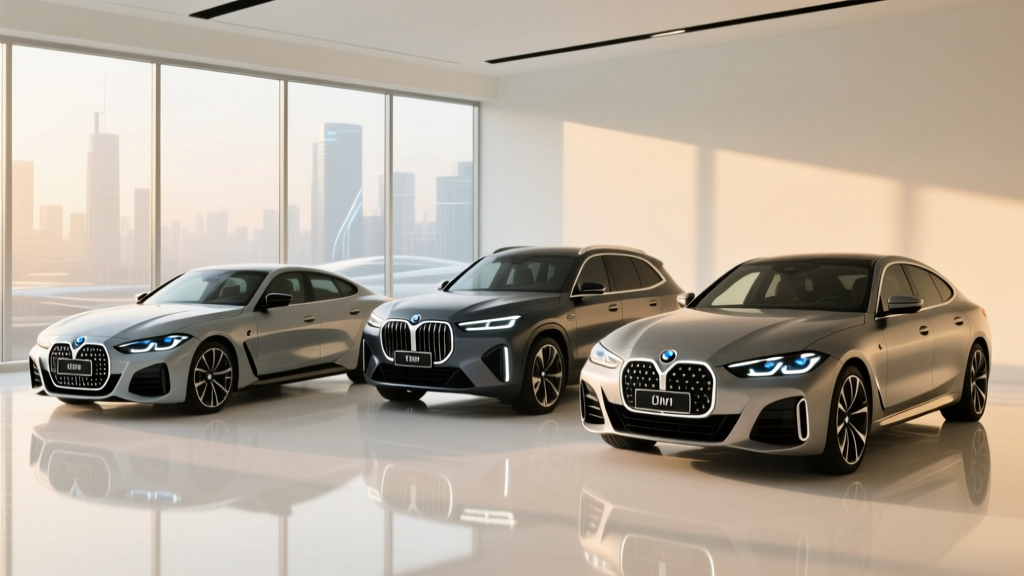
BMW's electric lineup has expanded significantly, but the sticker price only tells part of the story. Whether you're eyeing the sporty i4 Gran Coupe, the flagship iX SUV, or the luxury i7 sedan, understanding the true cost of electric BMW ownership requires looking at charging economics, federal incentive eligibility, insurance premiums, and long-term depreciation. This guide runs the numbers for 2026 so you can budget accurately before signing the lease or purchase agreement.
BMW's 2026 Electric Lineup at a Glance
BMW currently offers several battery-electric vehicles (BEVs) in the U.S. market, all built on the brand's flexible CLAR architecture. Here's how the core models stack up on the specs that matter most to ownership cost:
| Model | Base MSRP | Battery (kWh usable) | EPA Range | Efficiency (MPGe) | Peak DC Charge | 10–80% DCFC | 0–60 mph |
|---|---|---|---|---|---|---|---|
| i4 eDrive40 | $57,900 | 81.5 kWh (NMC) | 307 mi | 97 MPGe | 205 kW | ~31 min | 5.5 s |
| i4 M50 | $69,900 | 81.5 kWh (NMC) | 271 mi | 85 MPGe | 205 kW | ~31 min | 3.7 s |
| iX xDrive50 | $87,250 | 105.2 kWh (NMC) | 324 mi | 86 MPGe | 200 kW | ~35 min | 4.4 s |
| i7 eDrive50 | $105,700 | 101.7 kWh (NMC) | 318 mi | 82 MPGe | 195 kW | ~34 min | 4.5 s |
Federal Tax Credit Eligibility: What BMW Buyers Need to Know
The federal EV tax credit under IRS §30D can reduce your effective purchase price by up to $7,500 — but eligibility for BMW's electric vehicles is far from guaranteed. The rules involve multiple overlapping requirements that have tightened considerably since the Inflation Reduction Act reshaped the credit landscape.
- MSRP Cap: Sedans and coupes (i4, i7) must have an MSRP at or below $55,000. SUVs (iX) qualify up to $80,000. Most BMW EV trims exceed these thresholds.
- Buyer Income Limits: Modified AGI must not exceed $150,000 (single), $225,000 (head of household), or $300,000 (joint filers).
- Battery Component Sourcing: Battery components must be manufactured or assembled in North America (phased percentages increase annually through 2029).
- Critical Minerals: A required percentage of critical minerals must be sourced from the U.S. or FTA partners.
- FEOC Restriction: Vehicles with battery components from a Foreign Entity of Concern (including certain Chinese suppliers) are disqualified entirely.
- Point-of-Sale Transfer: Eligible buyers can transfer the credit to the dealer at purchase, receiving the benefit as an immediate price reduction rather than waiting for a tax refund.
- One Credit Per VIN: The credit applies once per vehicle; a used BMW EV does not re-qualify the new buyer for the new-vehicle credit.
As of early 2026, most new BMW electric vehicles do not qualify for the full $7,500 federal credit due to MSRP caps and battery-sourcing requirements. The i4 eDrive40 starts at $57,900, which exceeds the $55,000 sedan cap before adding any options. The iX, classified as an SUV, clears the $80,000 MSRP cap at base price but faces battery-sourcing scrutiny. Always verify current eligibility on the fueleconomy.gov tax credit lookup tool and consult a tax professional before relying on the credit in your purchase decision. Rules can change with new Treasury guidance, and BMW's supply chain sourcing may shift model-year eligibility.
If you're considering a used BMW EV, the §25E used EV credit offers up to $4,000 (or 30% of the sale price, whichever is less) on vehicles priced at or below $25,000, subject to income limits of $75,000 (single) / $150,000 (joint). This opens the door for pre-owned i4 and iX models that have depreciated below that threshold.
Charging Costs vs. Gasoline: The Per-Mile Math
The single largest ongoing savings in EV ownership comes from fuel. But the actual savings depend heavily on how and where you charge. Let's break down the cost of electric BMW driving versus a comparable gasoline BMW.
| Scenario | Rate / Assumption | Cost per Mile (i4 eDrive40) | Cost per Mile (430i Gran Coupe, 28 MPG combined) |
|---|---|---|---|
| Home charging (Level 2) | $0.14/kWh national avg | $0.040 | — |
| Home charging (off-peak TOU) | $0.08/kWh | $0.023 | — |
| Public DC fast charging | $0.40/kWh avg | $0.114 | — |
| Gasoline (premium 91 octane) | $3.85/gallon | — | $0.138 |
| Annual fuel cost (12,000 mi/yr, 80% home / 20% DCFC) | Blended $0.19/kWh | $651 | $1,656 |
For the larger iX and i7, efficiency drops slightly. The iX xDrive50 averages about 39 kWh/100 mi (86 MPGe), raising home charging costs to approximately $0.055/mile — still well below gasoline equivalents. The i7 eDrive50 sits at roughly 41 kWh/100 mi (82 MPGe).
Maintenance Savings: Where EVs Genuinely Cost Less
BMW's electric vehicles eliminate several routine maintenance items that gasoline BMWs require. The savings are real but should be understood in context — BMWs are premium vehicles, and some service costs (tires, cabin filters, brake fluid) remain regardless of powertrain.
| Service Item | Gasoline BMW (430i / X5) | BMW EV (i4 / iX) | 5-Year Savings |
|---|---|---|---|
| Oil changes (every 10k mi) | 6 × $150 = $900 | $0 | $900 |
| Spark plugs (30k–60k mi) | $400–$600 | $0 | $500 |
| Transmission fluid service | $300–$500 | $0 (single-speed reduction gear) | $400 |
| Brake pad replacement | $600–$900 (front + rear) | $0–$300 (regen extends life to 80k+ mi) | $500 |
| Engine air filter | $80–$120 | $0 | $100 |
| Cabin air filter (both) | $200 | $200 | $0 |
| Tire rotation (both) | $300 | $300 | $0 |
| Tire replacement (heavier EV wear) | $1,200 | $1,400 (EV-specific tires, heavier vehicle) | −$200 |
| Brake fluid flush (both) | $200 | $200 | $0 |
| Total estimated | $4,300 | $2,400 | ~$1,900 |
The regenerative braking system in BMW EVs handles the majority of deceleration, dramatically reducing friction brake wear. Many BMW EV owners report original brake pads at 60,000+ miles. However, EV-specific tires (designed for low rolling resistance and noise reduction with higher load ratings for the heavier vehicle) tend to cost 10–20% more than standard tires, and the added vehicle weight can accelerate tire wear slightly. BMW's standard maintenance plan, BMW Ultimate Care, covers scheduled maintenance for 3 years or 36,000 miles on new vehicles, which offsets some early costs for both EV and gas models.
Insurance Premiums: The Cost Factor Most Buyers Overlook
Insurance is where BMW EV ownership costs more than gasoline equivalents — typically 15–25% higher premiums according to industry data. Several factors drive this:
- Higher repair costs: EV battery packs, power electronics, and specialized sensors require certified technicians and OEM parts. A minor collision involving the battery enclosure can result in a total-loss declaration.
- Vehicle value: Higher MSRP means higher comprehensive and collision coverage costs.
- Limited repair network: Fewer body shops have BMW high-voltage certification, concentrating repair demand and raising labor rates.
- Performance profiles: The i4 M50's 536 hp and 3.7-second 0–60 time place it in a higher-performance insurance tier.
Based on 2026 national averages for a 40-year-old driver with a clean record and 100/300/100 liability limits:
| Model | Est. Annual Premium | vs. Gas Equivalent |
|---|---|---|
| i4 eDrive40 | $2,600–$3,100 | +18% vs. 430i Gran Coupe |
| i4 M50 | $3,000–$3,600 | +22% vs. M440i |
| iX xDrive50 | $2,900–$3,400 | +20% vs. X5 xDrive40i |
| i7 eDrive50 | $3,400–$4,100 | +15% vs. 740i |
Always get a personalized insurance quote before purchasing. BMW's partnership with certain insurers may offer bundled discounts, and some states provide EV insurance incentives. Over 5 years, the insurance premium differential can add $2,000–$4,500 in additional cost versus the gasoline counterpart.
Depreciation and Resale Value Trends
Depreciation remains the largest single cost in vehicle ownership, and BMW EVs have faced steeper depreciation curves than their gasoline counterparts — though the gap is narrowing as the used EV market matures.
Based on current 2026 market data and historical trends:
- BMW i4: Retains approximately 48–53% of MSRP after 5 years / 60,000 miles. The Gran Coupe body style and strong range keep demand steady in the used market.
- BMW iX: Retains approximately 42–48% of MSRP after 5 years. Higher initial price and rapid EV technology advancement create larger absolute depreciation dollars.
- BMW i7: Retains approximately 38–44% of MSRP after 5 years. Luxury sedans historically depreciate steeply, and the i7 follows this pattern with additional EV-specific uncertainty.
For comparison, the gasoline BMW 430i Gran Coupe retains roughly 50–55% after 5 years, and the X5 xDrive40i holds about 48–52%. The EV depreciation premium (additional value loss) translates to roughly $3,000–$8,000 over 5 years depending on model and market conditions.
Factors that may improve BMW EV resale values include expanding NACS charging access (BMW adopted the Tesla connector standard starting with 2025 models), maturing battery health certification programs, and growing consumer comfort with used EV purchases. Factors that may hurt resale include rapid battery technology advancement (solid-state batteries on the horizon), new-model price competition, and potential battery replacement concerns for out-of-warranty vehicles.
5-Year Total Cost of Ownership: The Full Picture
Combining every cost factor gives us the most honest comparison. Below is a 5-year / 60,000-mile TCO estimate for the BMW i4 eDrive40 versus the gasoline BMW 430i Gran Coupe, assuming 12,000 miles driven annually, 80% home / 20% public charging, and no federal tax credit (due to MSRP cap exceedance).
| Cost Category | i4 eDrive40 (EV) | 430i Gran Coupe (Gas) |
|---|---|---|
| Purchase price (MSRP) | $57,900 | $49,900 |
| Federal tax credit (§30D) | $0 (exceeds sedan MSRP cap) | $0 |
| Fuel / energy (60,000 mi) | $3,250 | $8,280 |
| Maintenance | $2,400 | $4,300 |
| Insurance (5 years) | $14,250 | $12,100 |
| Estimated depreciation | $29,000 (50%) | $24,000 (48%) |
| Total 5-Year TCO | $106,800 | $98,580 |
| Cost per mile | $1.78/mi | $1.64/mi |
State, Local, and Utility Incentives
Beyond the federal credit, additional incentives can meaningfully reduce the cost of electric BMW ownership. These vary significantly by location and are subject to change:
- State rebates: States like California (CVRP, up to $2,000 for income-qualified buyers), Colorado (up to $5,000 tax credit), and Massachusetts (MOR-EV, up to $3,500) offer direct purchase incentives. Many have income and MSRP caps similar to federal rules.
- Utility rebates: Electric utilities frequently offer $500–$1,500 rebates for EV purchases and an additional $300–$1,000 for home Level 2 charger installation. Check with your local utility — programs from PG&E, Con Edison, Xcel Energy, and others rotate annually.
- HOV lane access: Many states grant solo carpool lane access to EVs regardless of occupant count, a significant time savings in metro areas like Los Angeles, Washington D.C., and the Bay Area.
- Registration fee offsets: Some states charge higher annual EV registration fees ($100–$225) to replace lost gas tax revenue, partially offsetting fuel savings.
- Home charging installation: The federal §30C Alternative Fuel Vehicle Refueling Property Credit covers 30% of home charger equipment and installation costs, up to $1,000, subject to census-tract eligibility requirements.
These programs change frequently. Consult your state's energy office website and your utility's EV program page for current offerings before finalizing your purchase.
Frequently Asked Questions
How much does it really cost to own a BMW EV over 5 years?
For the i4 eDrive40, expect approximately $106,800 in total 5-year costs (purchase, energy, maintenance, insurance, depreciation) over 60,000 miles — about $1.78 per mile. The larger iX xDrive50 runs closer to $145,000–$155,000 over the same period. Without a federal tax credit, the EV costs more than its gasoline equivalent, but fuel and maintenance savings narrow the gap substantially.
Do I qualify for the federal tax credit on a BMW electric vehicle?
Likely not the full credit on a new BMW EV at current MSRPs. The §30D credit caps sedan MSRP at $55,000 (the i4 starts at $57,900) and SUV MSRP at $80,000 (the iX base is $87,250). Even if MSRP qualifies after negotiation, battery-sourcing and critical-mineral requirements must be met. Verify eligibility at fueleconomy.gov and consult a tax professional. The used EV credit (§25E, up to $4,000) is more accessible for pre-owned BMWs priced at or below $25,000.
How much do I save on fuel and maintenance with a BMW EV?
Over 5 years and 60,000 miles, expect to save approximately $5,000 on energy (with predominantly home charging) and $1,900 on maintenance versus a comparable gasoline BMW. Combined savings of roughly $6,900 are significant but may not fully offset the higher purchase price and insurance premiums without a tax credit.
Are BMW electric vehicles more expensive to insure?
Yes, typically 15–25% more than gasoline equivalents. Higher repair costs, specialized parts, elevated vehicle values, and performance characteristics all contribute. The i4 M50, with 536 hp, faces the steepest premium increases. Get quotes from multiple insurers — some specialize in EV coverage and offer competitive rates.
How well do BMW EVs hold their resale value?
BMW EVs retain approximately 42–53% of MSRP after 5 years depending on model, slightly below their gasoline counterparts (48–55%). The i4 holds value best due to strong demand and competitive range. Depreciation is the single largest ownership cost and the area where BMW EVs most lag gas equivalents. Battery health certification programs and NACS charging compatibility are expected to improve used-EV demand over time.
What about battery replacement costs?
BMW covers its high-voltage battery with an 8-year / 100,000-mile warranty against defects and excessive capacity loss (typically below 70% state of health). Out-of-warranty battery replacement for a BMW EV currently ranges from $15,000–$25,000 depending on the model. However, real-world data from earlier BMW EVs (i3, early iX3) shows NMC batteries retaining 90%+ capacity at 100,000 miles under normal use, making full replacement rare within typical ownership periods.