The Short Answer on Chinese EV Makers
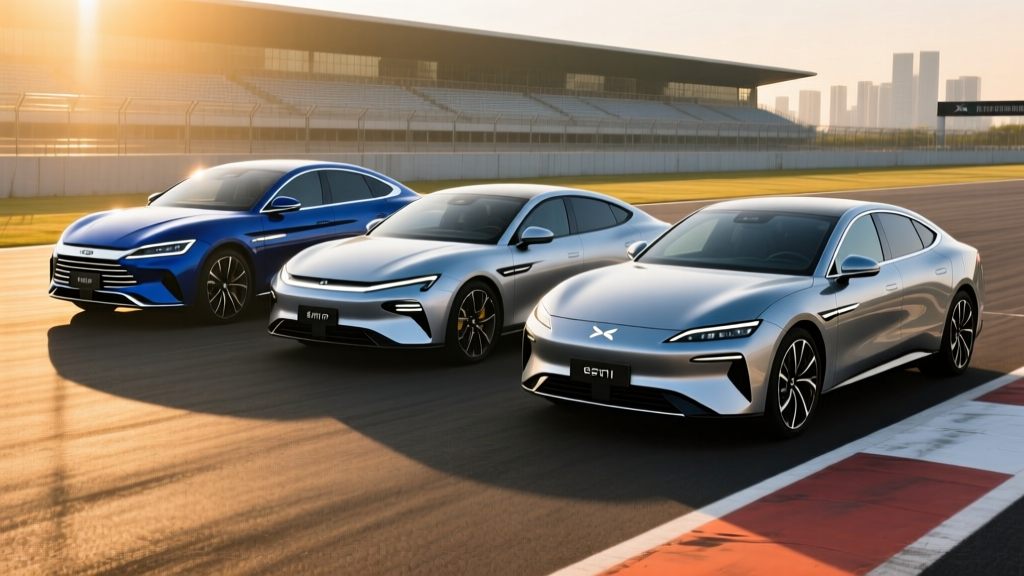
As of 2026, no Chinese-brand electric vehicle is available for retail purchase in the United States. Brands like BYD, NIO, Xpeng, Zeekr, and Li Auto produce globally competitive EVs — many with 300+ miles of range, sub-$35,000 pricing in their home markets, and advanced ADAS suites — but a combination of 100%+ cumulative US tariffs, national security concerns, and the absence of a US dealer and service network keeps them off American roads. If you're researching Chinese EV makers because you've seen headlines about their global dominance, this guide explains exactly where things stand, what these cars offer on paper, and what your realistic alternatives are in the US market right now.
Why Chinese EV Brands Can't Enter the US Market
The barriers aren't about vehicle quality — they're political and economic. Here's the tariff stack a Chinese-built EV would face if imported to the US in 2026:
- Baseline auto tariff: 2.5%
- Section 301 tariff (China-origin goods): 25%
- Additional EV-specific tariff (raised August 2024): 100% on Chinese-built battery electric vehicles
- Cumulative effective rate: approximately 102.5%+ of the vehicle's declared value
That means a BYD Seal that sells for roughly $32,000 in China would face over $32,000 in tariffs alone before shipping, compliance modifications, and dealer margin — pushing its US price well above $70,000, eliminating the very cost advantage that makes these brands competitive globally.
The US Treasury and USTR implemented these measures citing unfair trade practices, forced technology transfer, and state subsidies that distort global markets. Additionally, connected-vehicle data security rules proposed by the Department of Commerce in late 2024 specifically target Chinese and Russian connected vehicle hardware and software, effectively banning the sale of vehicles with Chinese-origin telematics, infotainment processors, or OTA update systems — which is virtually every modern Chinese EV.
What the Major Chinese EV Makers Actually Offer
Even though you can't buy them here, understanding what these manufacturers produce matters — it sets the global benchmark that pressures legacy automakers on price and accelerates the features you can get in US-market EVs.
BYD (Build Your Dreams)
The world's largest EV maker by volume. BYD's Blade Battery (LFP chemistry, prismatic cell design) is notable for passing nail-penetration tests without thermal runaway — a genuine safety advantage over many NMC packs. Key models:
- BYD Seal: 82.5 kWh LFP battery, ~354 miles WLTP range (~290 miles EPA equivalent), 0-60 in ~5.9s, 800V architecture enabling ~150 kW DC fast charging (10-80% in ~26 min)
- BYD Dolphin: 60.5 kWh LFP, ~264 miles WLTP (~215 EPA est.), priced under $30,000 globally
- BYD Atto 3 (Yuan Plus): 60.5 kWh, compact SUV, ~260 miles WLTP
Note: WLTP range figures are typically 15-25% higher than EPA estimates. We've converted to approximate EPA equivalents above for US reader context.
NIO
Premium positioning with a unique battery-swap model — NIO owners can exchange a depleted battery for a full one at a swap station in under 5 minutes, rather than waiting to charge. The NIO ET7 sedan offers:
- 75 kWh (LFP) or 100 kWh (NMC) battery options; a 150 kWh semi-solid-state pack (announced) claims over 620 miles WLTP
- ~310 miles EPA-equivalent range (100 kWh pack)
- Peak DC fast charge: ~180 kW (10-80% in ~20 min on 75 kWh pack)
- Level 2 ADAS suite (NIO Pilot/NIO Link) with LiDAR — comparable to Tesla Autopilot in SAE Level 2 classification
Xpeng
Known for aggressive ADAS development. The Xpeng G6 midsize SUV features:
- 87.5 kWh NMC battery, ~290 miles EPA-equivalent range
- 800V silicon-carbide platform, peak 280 kW DC charging (10-80% in ~20 min)
- XNGP driver-assist system (SAE Level 2) with dual LiDAR — one of the most capable systems in the Chinese domestic market
- 0-60 mph: ~6.2 seconds
Other Notable Brands
- Zeekr (Geely subsidiary): Zeekr 001 shooting brake, 100 kWh NMC, 800V, ~280 mi EPA-est. — shares SEA platform architecture with the Volvo EX30 and Polestar 4
- Li Auto: EREV (extended-range EV) focus — series-hybrid architecture with small ICE generator, 100+ miles electric-only range
- Geely/Volvo/Polestar: Geely owns Volvo and Polestar; Volvo's US-market EVs are built in Belgium, South Carolina, or Sweden — not China — to avoid tariffs
US-Market Alternatives: What You Can Actually Buy
If the appeal of Chinese EV makers is aggressive pricing and strong specs, here's what competes in the US market at accessible price points:
| Vehicle | EPA Range | Battery (kWh) | Peak DC Charge | 10-80% Time | Base MSRP | Est. After §30D Credit |
|---|---|---|---|---|---|---|
| Chevrolet Equinox EV 2LT | 319 mi | 85 kWh (NMC) | 150 kW | ~28 min | $33,600 | ~$26,100* |
| Hyundai Kona Electric SEL | 261 mi | 65 kWh (NMC) | 100 kW | ~38 min | $32,975 | ~$25,475* |
| Nissan Leaf SV Plus | 212 mi | 60 kWh (NMC) | 100 kW | ~40 min | $30,590 | ~$23,090* |
| Tesla Model 3 RWD | 272 mi | 57.5 kWh (LFP) | 170 kW | ~25 min | $38,990 | ~$31,490* |
| Volkswagen ID.4 Standard | 206 mi | 62 kWh (NMC) | 140 kW | ~30 min | $38,995 | ~$31,495* |
*§30D federal tax credit eligibility depends on MSRP caps ($55,000 sedans / $80,000 SUVs/trucks), buyer income limits ($150K single / $300K joint), and battery critical-mineral sourcing requirements that change annually. Verify current eligibility at IRS.gov. Point-of-sale transfer is available at participating dealers.
Real Cost Comparison: US Budget EV vs. Gas Equivalent
Let's compare a realistic US purchase — the Chevrolet Equinox EV — against a comparably priced gas compact SUV (Chevrolet Equinox AWD gas) to understand the true ownership economics:
| Category | Equinox EV 2LT | Equinox Gas AWD |
|---|---|---|
| Purchase price (after credit) | $26,100 | $28,600 |
| Fuel/energy (5 years) | $3,750 (home L2, $0.14/kWh avg) | $9,375 ($3.50/gal, 27 MPG combined) |
| Maintenance (5 years) | $1,200 (tire rotation, cabin filter, fluid top-offs) | $3,800 (oil changes, brakes, transmission fluid) |
| Insurance (5-year avg) | $8,500 (EV premium ~15-20%) | $7,200 |
| Estimated depreciation | $12,000 | $11,500 |
| Total 5-year cost | $51,550 | $60,475 |
The EV saves roughly $8,900 over 5 years, primarily from fuel and maintenance. However, this assumes reliable home Level 2 charging at residential electricity rates. Public DC fast charging at $0.35-$0.50/kWh narrows the fuel savings significantly, and insurance premiums for EVs remain elevated due to higher repair costs after collisions.
Common Misconceptions About Chinese EVs
| Myth | Fact |
|---|---|
| "Chinese EVs are low quality" | BYD, NIO, and Xpeng score well in Euro NCAP crash testing (the BYD Atto 3 earned 5 stars). Build quality on current models rivals Korean and European competitors. The gap has closed substantially since 2020. |
| "They'll be in the US any year now" | There is no announced timeline. The 100% tariff and Commerce Department connected-vehicle ban create structural barriers that require either a change in trade policy or Chinese automakers building US/Mexico/Canada factories — neither of which is imminent. BYD has stated publicly it has no US passenger-vehicle entry plans. |
| "I can import one myself" | Federal Motor Vehicle Safety Standards (FMVSS) compliance is required for any vehicle registered in the US. Chinese-market EVs are not FMVSS-certified, and individual importation for road use is effectively prohibited unless the vehicle is over 25 years old. |
| "Chinese batteries are inferior" | CATL (China) supplies batteries to Tesla, BMW, and others. BYD's Blade LFP battery is among the safest in thermal-stability testing. China dominates global battery cell manufacturing (~75% of global capacity) and leads in LFP chemistry refinement. |
| "Chinese EVs would qualify for the US tax credit" | No. §30D requires final assembly in North America, and battery components and critical minerals must meet escalating domestic-sourcing thresholds. A Chinese-built, Chinese-sourced EV would be categorically ineligible regardless of tariff status. |
Decision Framework: What Should You Actually Do?
Choose a US-market EV now if:
- You need a vehicle within 6 months and qualify for the §30D credit — the Chevy Equinox EV, Hyundai Kona Electric, or Tesla Model 3 offer strong value today
- You have access to home Level 2 charging (or can install it for $800-$2,000 including panel work)
- Your daily commute is under 80 miles round-trip — any current 250+ mile EPA-range EV handles this easily with a wide buffer
- You drive in moderate climates — cold-weather range loss (15-30% below 20°F) affects all EVs, but US-market models with heat pumps (Hyundai/Kia E-GMP platform, Tesla Model 3/Y) mitigate this
Choose a PHEV if:
- You lack reliable home charging and can't install a Level 2 outlet
- You regularly drive 300+ mile trips through areas with sparse DC fast-charging infrastructure
- You want electric commuting (25-40 miles) without range compromise — the Toyota RAV4 Prime (42 mi electric) or Hyundai Tucson PHEV (33 mi) are practical bridges
Wait and monitor if:
- You're specifically hoping for a Chinese EV brand to enter the US — based on current trade policy, this is unlikely before 2030 at the earliest
- You're targeting a sub-$25,000 EV — upcoming US-market models (next-gen Tesla Model 2, Chevrolet's next Bolt) may hit this price point by 2027-2028
Real-World Ownership Considerations No Spec Sheet Shows
Whether you're buying a US-market EV today or waiting for the market to evolve, these factors determine satisfaction more than headline range numbers:
Home charging is the single biggest ownership variable. If you can charge overnight on a Level 2 (240V, 32-48A circuit adding 25-40 miles per hour of charging), an EV integrates seamlessly into daily life. Without it, you're dependent on public infrastructure that remains inconsistent outside major metro corridors. Budget $500-$2,000 for a quality Level 2 home charger and professional installation — more if your electrical panel needs a 200A service upgrade ($1,500-$3,500 additional).
Charging curves matter more than peak kW. A vehicle advertising "250 kW peak charging" may only sustain that rate between 10-30% State of Charge before tapering. The EPA's fueleconomy.gov listings show combined efficiency but not charging-curve behavior. Real-world 10-80% times on DC fast chargers are the metric that determines road-trip viability — anything under 25 minutes is competitive; under 20 minutes is excellent.
Cold weather hits all EVs hard. Expect 15-30% range reduction at temperatures below 20°F, depending on whether the vehicle uses a heat pump (more efficient cabin heating) or resistive heating. A 300-mile EPA-rated EV may deliver 210-255 real-world miles in a Midwest winter. Preconditioning the battery while plugged in mitigates this but requires planning.
Insurance costs are real and often overlooked. EV insurance premiums run 15-25% higher than equivalent gas vehicles due to expensive battery replacements after collisions and limited repair-shop networks. Get quotes before purchasing — the savings on fuel can be partially offset at the insurance counter.
Frequently Asked Questions
Will BYD ever sell cars in the United States?
BYD has not announced any US passenger-vehicle launch timeline. The company sells commercial electric buses and trucks in the US (built at a Lancaster, California facility), but passenger cars face the full tariff stack and connected-vehicle software restrictions. BYD is expanding aggressively in Europe, Southeast Asia, South America, and Australia — markets with lower tariff barriers. A US entry would likely require a dedicated North American factory and a shift in trade policy.
Are Chinese EV batteries safe compared to US-market batteries?
Yes, in many cases. CATL and BYD are the world's two largest battery cell manufacturers, supplying Tesla, BMW, Mercedes, and others. BYD's Blade Battery (LFP chemistry) has demonstrated exceptional thermal stability in independent nail-penetration and crush tests. The safety question is less about country of origin and more about chemistry — LFP cells are inherently more thermally stable than NMC, regardless of manufacturer.
Can I buy a Volvo or Polestar and avoid supporting Chinese manufacturing?
This is complicated. Volvo and Polestar are owned by China's Geely Holding Group, but US-market Volvos are manufactured in Belgium (EX30, EX40) or South Carolina (EX90). Polestar models are built in China (Polestar 2) and South Korea (Polestar 4). If country of assembly matters to you, check the VIN origin — vehicles with VINs starting with "1," "4," or "5" are US-assembled; "Y" indicates Sweden; "S" indicates other European origins.
What's the cheapest EV I can actually buy in the US right now?
The Nissan Leaf S starts at approximately $28,140 MSRP (149-mile range, 40 kWh battery) and may qualify for the §30D credit, potentially bringing it to ~$20,640. However, its limited range and CHAdeMO connector (a fading standard as NACS dominates) make it best suited as a dedicated city commuter. The Chevrolet Equinox EV at ~$33,600 (319 miles, CCS/NACS via adapter) is a more versatile budget option.
How do Chinese EVs compare to Tesla on technology?
In some areas, they exceed it. Xpeng's XNGP and Huawei's ADS driver-assist systems use multiple LiDAR units and achieve SAE Level 2 performance comparable to Tesla's FSD (Supervised) in Chinese urban environments. NIO's battery-swap infrastructure is something Tesla abandoned years ago. However, Tesla's Supercharger network remains the most reliable DC fast-charging ecosystem globally, and its energy efficiency (miles per kWh) consistently leads the industry. Technology parity exists; ecosystem and charging infrastructure advantages still favor Tesla in North America.