Quick Answer: Should You Buy a Chinese EV in Australia?
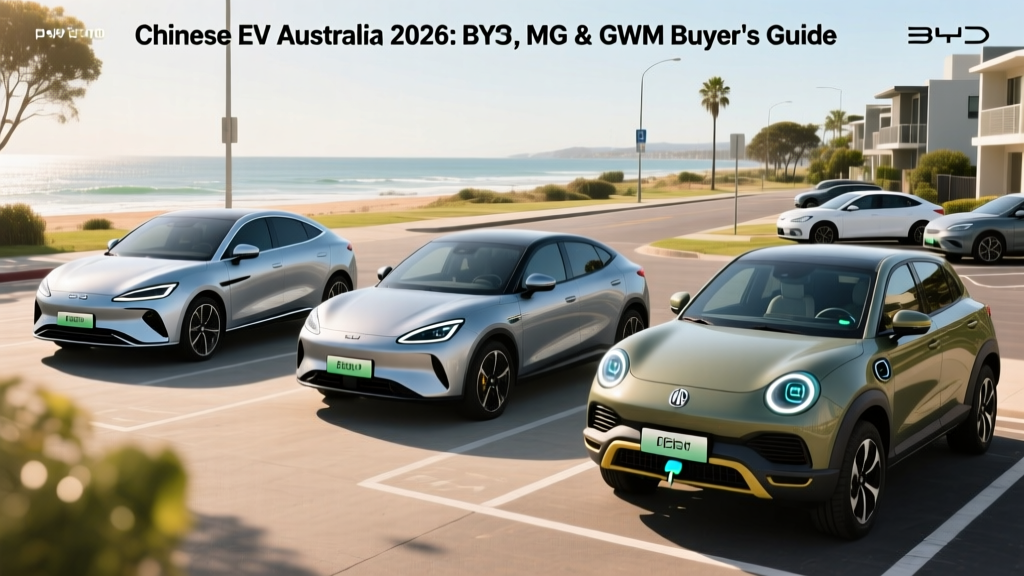
Chinese EV brands — led by BYD, MG, and GWM (Ora) — now account for roughly 25% of all new EVs sold in Australia. They undercut legacy competitors on price by $10,000–$20,000 while offering competitive range (400–550 km WLTP), fast DC charging (80–150 kW peak), and 6-year/150,000 km vehicle warranties. The catch: real-world range drops 15–25% on highway trips, public charging infrastructure outside capital cities remains patchy, and resale values for Chinese EVs are still unproven long-term. If you charge at home and drive under 60 km daily, a Chinese EV will save most Australian buyers $2,000–$3,500 per year in fuel and maintenance versus a comparable petrol car.
The Chinese EV Landscape in Australia: 2026 Market Snapshot
Australia's EV market has transformed dramatically. Where Tesla once dominated with over 80% of battery-electric sales, the 2026 landscape is genuinely competitive. BYD entered with the Atto 3 in 2022 and has since expanded to include the Dolphin, Seal, and Sealion 6 plug-in hybrid. MG's MG4 and MG ZS EV remain volume leaders in the sub-$45,000 segment. GWM's Ora 03 (formerly Good Cat) targets the small hatchback buyer, while newer entrants like Chery, Jaecoo, and Zeekr are pushing into the premium SUV space.
What makes these brands compelling isn't just price — it's that they've closed the gap on the metrics that matter: battery chemistry, charging speed, and ADAS features. But closing the gap and leading are different things, and the details matter when you're committing $40,000+ to a vehicle.
Spec Comparison: Top Chinese EVs Available in Australia
| Spec | BYD Atto 3 (2026) | BYD Dolphin (2026) | MG4 Excite (2026) | GWM Ora 03 (2026) |
|---|---|---|---|---|
| Base Price (drive-away) | $44,990 | $36,990 | $39,990 | $38,990 |
| Battery (usable kWh) | 60.48 kWh (LFP Blade) | 44.9 kWh (LFP Blade) | 51 kWh (NMC) | 48 kWh (NMC) |
| WLTP Range | 420 km | 340 km | 350 km | 400 km |
| Real-World Highway Range | ~320–350 km | ~260–285 km | ~270–300 km | ~310–340 km |
| Peak DC Charge Rate | 88 kW | 88 kW | 140 kW | 100 kW |
| 10–80% DC Charge Time | ~29 min | ~29 min | ~26 min | ~35 min |
| AC Level 2 Charge (7 kW) | ~9.5 hours | ~7 hours | ~7.5 hours | ~7 hours |
| Power (kW) / Torque (Nm) | 150 kW / 310 Nm | 130 kW / 290 Nm | 125 kW / 250 Nm | 126 kW / 250 Nm |
| 0–100 km/h | 7.3 sec | 7.0 sec | 7.9 sec | 8.3 sec |
| Vehicle Warranty | 6 yr / 150,000 km | 6 yr / 150,000 km | 7 yr / unlimited km | 7 yr / unlimited km |
| Battery Warranty | 8 yr / 160,000 km | 8 yr / 160,000 km | 7 yr / unlimited km | 8 yr / 160,000 km |
Key takeaway: BYD uses LFP (lithium iron phosphate) Blade battery chemistry across its lineup. LFP sacrifices some energy density (less range per kg) but offers superior thermal stability, longer cycle life (3,000+ cycles vs ~1,500 for NMC), and no cobalt. You can also charge LFP batteries to 100% regularly without accelerating degradation — a significant daily-use advantage. MG and GWM use NMC (nickel manganese cobalt), which offers more range per kWh but prefers staying between 20–80% for longevity.
Chinese EV vs Petrol Car: The Real Cost Breakdown
Price stickers only tell half the story. Let's compare a BYD Atto 3 against its closest petrol rival, the Toyota RAV2 Hybrid (a common cross-shop in Australia), over five years and 75,000 km of driving.
| Cost Category (5 yr / 75,000 km) | BYD Atto 3 (EV) | Toyota RAV2 Hybrid |
|---|---|---|
| Purchase Price (drive-away) | $44,990 | $42,500 |
| Fuel / Electricity Cost | $2,250 (home charging at $0.28/kWh avg) | $8,440 (petrol at $2.10/L, 5.0 L/100 km) |
| Maintenance (scheduled servicing) | $1,100 (cabin filter, brake fluid, tyre rotation) | $3,200 (oil, filters, spark plugs, brake pads) |
| Registration (NSW avg) | $2,850 (EV discount applied) | $3,400 |
| Insurance (comprehensive avg) | $7,500 | $5,800 |
| Estimated Resale Value (5 yr) | ~$22,500 (50% retention, unproven) | ~$25,500 (60% retention, strong track record) |
| Total 5-Year Cost of Ownership | $36,190 | $37,840 |
The EV wins on running costs by roughly $6,190 in fuel and maintenance savings alone. However, two factors erode that advantage: higher insurance premiums (EVs cost 15–30% more to insure due to repair complexity and parts pricing) and uncertain resale values. Toyota hybrids hold value exceptionally well in Australia. Chinese EVs don't yet have a proven depreciation curve — early Atto 3 resale data suggests 45–55% retention at five years, versus 55–65% for comparable Toyotas.
Break-even point: If you drive more than 15,000 km/year and charge primarily at home, the fuel savings alone cover the insurance premium gap within 3–4 years. If you drive less than 10,000 km/year or rely entirely on public DC fast charging (at $0.50–$0.65/kWh), the economics narrow significantly.
Home Charging: The Make-or-Break Factor
Every EV ownership experience lives or dies on charging access. Here's what Australian buyers need to budget for:
| Charging Setup | Equipment Cost | Installation | Charging Speed | Full Charge Time (60 kWh) |
|---|---|---|---|---|
| Level 1 (10A wall outlet) | $0 (included cable) | $0 | ~2.3 kW (~14 km/hr) | ~26 hours |
| Level 2 (7 kW wallbox, e.g., Wallbox Pulsar Max) | $1,000–$1,800 | $800–$2,500 | 7 kW (~42 km/hr) | ~8.5 hours |
| Level 2 (11–22 kW, 3-phase) | $1,500–$3,000 | $1,500–$4,000 | 11–22 kW (~66–130 km/hr) | ~3–5.5 hours |
| Solar-integrated (e.g., Fronius + wallbox) | $2,000–$3,500 | $1,500–$3,000 | Varies with solar output | Variable |
Panel upgrade reality: Most Australian homes built after 2000 have adequate switchboards for a 7 kW single-phase charger. Older homes (pre-1990s) or those with existing heavy loads (ducted A/C, electric cooking, pool pumps) may need a switchboard upgrade costing $1,200–$3,000. Always get a licensed electrician to assess your board capacity before purchasing equipment.
Solar synergy: Australia's rooftop solar penetration is among the highest globally. If you have a 6.6 kW+ solar system with a smart charger that tracks solar export (like a Wallbox Pulsar Max with Eco-Smart or a Zappi), you can effectively charge for $0.00/kWh during daylight hours. This turns the Atto 3's annual fuel cost from $450 to near zero.
Public Charging in Australia: Where Chinese EVs Fit
Chinese EVs sold in Australia use either CCS2 (BYD, MG) or GB/T (some GWM models) connectors. Most new GWM vehicles have shifted to CCS2 for the Australian market, but always verify before purchase. CCS2 is compatible with Australia's major public networks:
- Chargefox: 50–350 kW DC chargers, mostly along highway corridors and in capital cities
- Evie Networks: 50–350 kW DC, expanding rapidly in Queensland and NSW
- Ampol/AmpCharge: 50–150 kW at fuel stations
- Tesla Superchargers: Now open to non-Tesla vehicles (CCS2) at select locations, 150–250 kW
Charging curve reality check: The BYD Atto 3 peaks at 88 kW DC, but that peak only holds from roughly 10–40% State of Charge. From 40–80%, it tapers to 50–60 kW. This means a 10–80% charge takes ~29 minutes at a 150+ kW charger — but the same session at a 50 kW charger takes ~55 minutes. The MG4's 140 kW peak is more competitive for road trips, sustaining higher rates longer into the charge curve.
Regional charging gaps: If you live in or regularly travel through regional WA, NT, or outback Queensland, public DC charging infrastructure remains sparse. Plan routes carefully using the PlugShare app, and understand that a 50 kW charger adds roughly 250 km of range per hour — adequate for a lunch stop, not a quick top-up.
Common Misconceptions About Chinese EVs — Fact-Checked
| Myth | Fact |
|---|---|
| "Chinese EV batteries degrade quickly and cost $20,000+ to replace" | BYD's LFP Blade battery is rated for 3,000+ full charge cycles before reaching 80% capacity — that's 1.2+ million km. Real-world degradation data from early Atto 3 owners (2022–2025) shows 3–6% capacity loss at 60,000 km. Warranty covers replacement if capacity drops below 70% within 8 years/160,000 km. |
| "They're not as safe as European or Japanese cars" | The BYD Atto 3 and MG4 both achieved 5-star ANCAP ratings. The Atto 3 scored 91% adult occupant protection. BYD's Blade battery passed nail penetration testing without thermal runaway — a significant safety advantage of LFP chemistry. |
| "You can't take a Chinese EV on a road trip" | An Atto 3 with 320 km real-world highway range can handle Sydney–Melbourne (880 km) with two 30-minute DC charging stops. It's slower than a Tesla Model Y (which can do it with one 20-minute stop), but entirely feasible with planning. |
| "Chinese EVs have no resale value" | Early data from Carsales and RedBook shows 2022 Atto 3 models retaining 50–55% of purchase price at 3 years. This trails Toyota (60–65%) but matches or beats some European EVs. As market share grows, resale confidence will follow — but it remains a legitimate risk factor today. |
| "The software and infotainment are terrible" | This was true in 2022. BYD's 2025–2026 models feature significantly improved software with wireless Apple CarPlay/Android Auto, OTA updates, and faster processors. MG's infotainment still lags behind in responsiveness, but functionality is adequate. GWM's Ora interface is the weakest of the three. |
Decision Framework: Which Chinese EV (If Any) Should You Buy?
Choose a BYD Atto 3 if: You want the best all-rounder — practical SUV size, proven LFP battery longevity, 420 km WLTP range that's adequate for most commutes, and you plan to keep the car 7+ years. The LFP chemistry rewards long-term owners.
Choose a BYD Dolphin if: Budget is your top priority and you drive under 50 km daily. At $36,990 drive-away, it's the cheapest new EV in Australia. The 340 km WLTP range (real-world ~270 km) is tight for road trips but fine for city life with home charging.
Choose an MG4 if: You value driving dynamics and faster DC charging. The MG4's rear-wheel-drive chassis and 140 kW peak charge rate make it the most engaging and road-trip-friendly of this group. The 7-year/unlimited km warranty is the strongest on paper.
Choose a GWM Ora 03 if: Style and interior quality matter more than outright range or charging speed. The Ora 03 has the most premium-feeling cabin of this group, but its 100 kW peak charge rate and 8.3-second 0–100 time place it last on performance metrics.
Don't buy a Chinese EV (yet) if:
- You can't install a home charger (apartment without charging access, street parking only)
- You regularly drive 500+ km single-leg trips through regional areas with sparse charging
- You need a proven 5-year resale value for fleet or novated lease purposes
- You want advanced ADAS — Chinese EVs offer basic AEB and lane-keep, but nothing approaching Tesla Autopilot or Hyundai's Highway Driving Assist in sophistication
Frequently Asked Questions
Are Chinese EVs eligible for any Australian government incentives?
The federal EV discount (FBT exemption for novated leases) applies to all EVs under the luxury car tax threshold, regardless of origin — so Chinese EVs qualify equally. State-level incentives vary: NSW offers a $3,000 rebate for EVs under $68,000; Victoria's $3,000 subsidy ended in 2023; Queensland offers none as of 2026. Always check your state's current transport authority website for up-to-date incentive details.
How does cold weather affect Chinese EV range in Australia?
Australia's climate is mostly warm, so extreme cold-weather range loss (30–40% seen in Canadian or Scandinavian winters) is rarely relevant. However, in Tasmania, the Snowy Mountains, or frosty inland regions, expect 10–15% range reduction in winter. LFP batteries (BYD) are slightly more affected by cold than NMC (MG, GWM) due to higher internal resistance at low temperatures. Preconditioning the battery before DC charging — available on most 2025+ models — mitigates slow charging in cold conditions.
Can I get parts and service for a Chinese EV in regional Australia?
BYD has expanded to 60+ dealerships across Australia as of 2026, including regional centres like Townsville, Dubbo, and Bunbury. MG leverages its existing dealer network (100+ locations), making it the most accessible for regional buyers. GWM's network is smaller (~50 dealers), concentrated in capital cities. Parts availability has improved but still lags Toyota/Hyundai — expect 1–3 week waits for body panels or specialized components versus days for mainstream brands.
What happens if the Chinese brand exits the Australian market?
This is a legitimate concern. Under Australian Consumer Law, the importing distributor (not the manufacturer) is responsible for warranty obligations. If BYD's Australian distributor ceased operations, existing warranty claims would still be enforceable under ACL, but practical access to parts and authorized repairers could become difficult. Mitigate this risk by choosing brands with established local distributors and large installed bases — BYD and MG are the safest bets here.
Is it better to buy a Chinese EV or a used Tesla Model 3?
A 2023 Tesla Model 3 (used) costs roughly $45,000–$52,000 in 2026, overlapping with a new Atto 3 or Seal. The Tesla offers superior range (491 km WLTP), faster charging (170 kW peak), access to the full Supercharger network, and more advanced ADAS. The Chinese EV offers a full new-car warranty, zero wear, and lower insurance. If you value tech and charging infrastructure, go used Tesla. If you want warranty security and don't mind slower charging, go new Chinese EV.