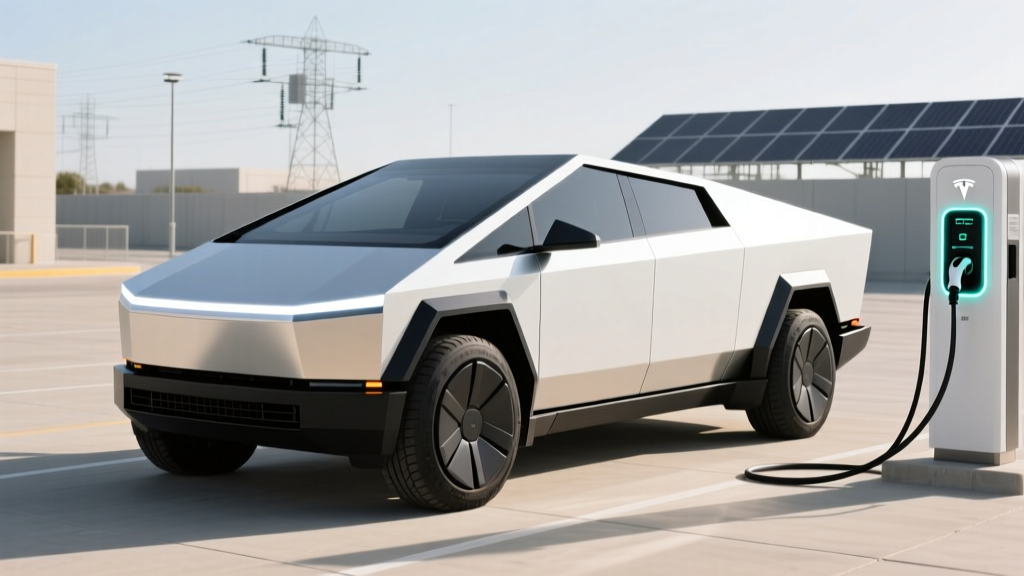
The Tesla Cybertruck's unpainted stainless-steel exoskeleton is its defining trait, but the optional color-matched or painted finishes—particularly the high-gloss white—have become some of the most requested configurations since Tesla opened the order books. If you're researching the Cybertruck white specifically, you're likely weighing aesthetics against cost, maintenance, and whether the paint holds up on a vehicle that weighs over 6,700 pounds and sees everything from highway commuting to job-site duty.
This review covers the 2026 Tesla Cybertruck lineup with the white paint option (officially called Pearl White Multi-Coat), breaking down EPA range, real-world efficiency, charging behavior, pricing, federal tax-credit eligibility under IRS §30D, and whether the Cybertruck earns its place against the Rivian R1T and Ford F-150 Lightning.
2026 Cybertruck Lineup and the White Paint Option
Tesla offers the Cybertruck in three primary trims for 2026: the Dual Motor AWD, the Cyberbeast (tri-motor), and the Long Range AWD. The stainless-steel body is standard and comes at no additional cost. Pearl White Multi-Coat is a $2,500 add-on that applies a traditional automotive clear-coat finish over the stainless panels, giving the truck a smoother, more conventional appearance while adding a layer of UV and scratch protection to the steel.
White is historically Tesla's most popular premium color across the Model Y and Model 3, and the Cybertruck is no exception. The Pearl White finish on the Cybertruck's angular geometry creates a striking contrast with the black trim, bed rails, and wheel arches. From a maintenance standpoint, the painted white finish is easier to keep clean than bare stainless (which shows fingerprints and water spots readily) but is susceptible to traditional paint chips and swirl marks.
| Spec | Dual Motor AWD | Cyberbeast (Tri-Motor) | Long Range AWD |
|---|---|---|---|
| EPA Range | 340 miles | 320 miles | 340+ miles (est.) |
| Battery (usable) | ~123 kWh (NMC) | ~123 kWh (NMC) | ~123 kWh (NMC) |
| Peak DC Charge Rate | 250 kW | 250 kW | 250 kW |
| 10–80% DC Fast Charge | ~27 min | ~27 min | ~27 min |
| Level 2 Home Charge Rate | 11.5 kW (~37 mi/hr) | 11.5 kW (~37 mi/hr) | 11.5 kW (~37 mi/hr) |
| 0–60 mph | 3.9 sec | 2.6 sec | ~4.1 sec |
| Horsepower | 600 hp | 845 hp | ~550 hp |
| Drivetrain | Dual Motor AWD | Tri-Motor AWD | Dual Motor AWD |
| Towing Capacity | 11,000 lbs | 11,000 lbs | 11,000 lbs |
| Payload Capacity | 2,500 lbs | 2,500 lbs | 2,500 lbs |
| Base MSRP | $79,990 | $99,990 | $69,990 (est.) |
| White Paint Add-On | +$2,500 | +$2,500 | +$2,500 |
EPA Range vs. Real-World Driving
The EPA rates the Dual Motor Cybertruck at 340 miles and the Cyberbeast at 320 miles, according to fueleconomy.gov. These are competitive figures for a full-size electric truck, but the Cybertruck's weight (roughly 6,700–6,800 lbs depending on trim) and blunt aerodynamic profile mean real-world results vary significantly.
- City/commuter driving: 310–330 mi (regen braking recovers energy in stop-and-go)
- Highway at 70 mph: 250–280 mi (aero drag and weight dominate)
- Highway at 75–80 mph: 230–260 mi
- Cold weather (below 30°F): Expect 15–25% range reduction, dropping to roughly 200–250 mi for highway driving
- Towing (loaded trailer, 8,000+ lbs): 130–170 mi depending on trailer profile and terrain
Efficiency lands at approximately 70 MPGe combined for the Dual Motor and 66 MPGe for the Cyberbeast, translating to roughly 48–52 kWh per 100 miles in mixed driving. That's thirstier than the Ford F-150 Lightning Extended Range (~49 kWh/100 mi) and considerably thirstier than a Rivian R1T Dual-Motor Max Pack (~45 kWh/100 mi). If you drive predominantly on the highway, budget for higher energy consumption.
Charging: DC Fast Charge and Home Level 2
The Cybertruck uses an 800-volt architecture and supports up to 250 kW peak DC fast charging at Tesla Supercharger V3 and V4 stalls. In controlled testing, the charge curve peaks around 250 kW below 30% State of Charge (SoC), tapers to roughly 180 kW by 50%, and drops steeply above 80% to protect the NMC cells. A 10–80% charge takes approximately 27 minutes at a functioning 250 kW Supercharger.
One practical note: the Cybertruck's size means it occupies two stalls at many older Supercharger locations with pull-through or angled configurations. Tesla has been deploying wider pull-through stalls at newer sites, but plan your road-trip stops accordingly, particularly in congested urban charging corridors.
| Charge Level | Power (kW) | Speed (mi/hr added) | Notes |
|---|---|---|---|
| Level 1 (120V household) | 1.2 kW | ~3 mi/hr | Emergency/trickle only |
| Level 2 (240V, 48A) | 11.5 kW | ~37 mi/hr | Full charge in ~10–11 hours |
| Level 2 (240V, 32A Mobile Connector) | 7.7 kW | ~25 mi/hr | Portable option |
| DC Fast (Supercharger V3/V4) | 250 kW peak | ~10–80% in ~27 min | Tapers above 80% SoC |
For home charging, a properly installed 60-amp circuit with a Tesla Wall Connector delivers 48 amps (11.5 kW), adding roughly 37 miles of range per hour of charging. That means a full overnight session easily replenishes daily driving. Most Cybertruck owners should budget $800–$2,000 for a professional Level 2 installation, with the potential for a panel upgrade (200-amp service) adding $1,500–$3,000 if your home's electrical panel is older or near capacity. Always consult a licensed electrician for final specifications.
The Cybertruck ships with a NACS (North American Charging Standard) port natively, so it accesses the full Tesla Supercharger network without adapters. For non-Tesla DC fast chargers using CCS, Tesla sells a NACS-to-CCS adapter, though the Cybertruck's size can make fitting into tight CCS-only stalls awkward.
Performance, Towing, and Drivetrain
The Cyberbeast's 2.6-second 0–60 mph time makes it one of the quickest production trucks ever built, regardless of powertrain. The Dual Motor AWD at 3.9 seconds is hardly slow. Both use permanent-magnet synchronous motors with torque vectoring across the rear axle on the Cyberbeast.
Towing capacity is rated at 11,000 lbs across all trims, with an integrated trailer brake controller and Tesla's trailer assist camera system. However, towing at or near max capacity cuts range roughly in half. If you tow a 7,000-lb boat or camper frequently, expect 150–180 miles of real-world range and plan charging stops every 120–140 miles to maintain a buffer.
The 48-volt electrical architecture (a first for a production vehicle at this scale) enables steer-by-wire steering and four-wheel steering, giving the Cybertruck a surprisingly tight 34-foot turning circle for a truck over 19 feet long. Rear-wheel steering makes parking-lot maneuvers and trailering more manageable than the dimensions suggest.
Pricing, Trims, and Federal Tax Credit Eligibility
The Cybertruck's pricing has shifted since its initial announcement, and 2026 reflects a stabilized lineup. Here's where the numbers land with the white paint option included:
| Trim | Base MSRP | + White Paint | As-Configured | §30D Credit Eligibility |
|---|---|---|---|---|
| Long Range AWD | $69,990 | +$2,500 | $72,490 | Eligible (under $80K truck cap) |
| Dual Motor AWD | $79,990 | +$2,500 | $82,490 | Not eligible (exceeds $80K MSRP cap) |
| Cyberbeast | $99,990 | +$2,500 | $102,490 | Not eligible (exceeds $80K MSRP cap) |
Under IRS §30D rules, the federal clean vehicle credit offers up to $7,500, but eligibility hinges on several criteria:
- MSRP cap: Trucks, SUVs, and vans must have an MSRP at or below $80,000. Only the Long Range AWD Cybertruck qualifies; the Dual Motor and Cyberbeast exceed the cap.
- Buyer income limits: Modified adjusted gross income must not exceed $150,000 (single), $225,000 (head of household), or $300,000 (joint filing).
- Battery sourcing: Critical minerals and battery components must meet escalating domestic-content thresholds. Tesla's use of Panasonic cells produced in Nevada positions the Cybertruck favorably, but annual threshold increases mean eligibility should be verified at point of sale.
- Point-of-sale transfer: As of 2024, the credit can be transferred to the dealer at purchase, reducing the purchase price directly rather than waiting for a tax refund.
For the Long Range AWD in white ($72,490), qualifying buyers could see the effective price drop to roughly $64,990 after the full $7,500 credit. The Dual Motor and Cyberbeast receive no federal credit, making the Long Range trim the value proposition for credit-eligible buyers.
Interior, Cargo, and Technology
The Cybertruck's interior is minimalist even by Tesla standards: an 18.5-inch center touchscreen handles virtually all vehicle functions, with no traditional instrument cluster. A rear 9.4-inch screen serves second-row passengers. The front trunk (frunk) offers approximately 7.1 cubic feet of lockable storage, while the 6-foot bed provides 67 cubic feet of enclosed volume under the power-operated tonneau cover.
Interior passenger space is competitive with mid-size trucks but falls short of full-size crew cabs:
- Front legroom: 41.3 inches
- Rear legroom: 37.2 inches
- Seating: 5-passenger (bench front seat option available)
The tonneau cover is motorized and can support up to 300 lbs of distributed weight—useful for gear or as a temporary platform. The bed features integrated LED lighting, 120V and 240V outlets (up to 11.5 kW of vehicle-to-load power output), and a powered tailgate that doubles as a loading ramp.
On the technology front, the Cybertruck runs Tesla's latest vehicle software with over-the-air updates, includes Enhanced Autopilot (SAE Level 2 driver assistance, not self-driving), and offers Full Self-Driving (Supervised) as a $8,000 add-on or $99/month subscription. Autopilot handles adaptive cruise and lane centering competently on highways, but the driver must remain attentive at all times—this is not a Level 4 autonomous system.
Tesla Autopilot and FSD (Supervised) are SAE Level 2 driver-assistance systems. The driver must keep hands on the wheel (or demonstrate attention via the cabin camera) and remain fully responsible for vehicle operation at all times. No current Tesla system is "self-driving."
Warranty and Battery Longevity
Tesla covers the Cybertruck with:
- Basic vehicle warranty: 4 years / 50,000 miles
- Battery and drive unit warranty: 8 years / 120,000 miles (minimum 70% capacity retention)
The Cybertruck uses an NMC (nickel manganese cobalt) battery pack. NMC offers higher energy density than LFP chemistry, which is necessary given the truck's weight and range targets, but it's more sensitive to sustained high-state-of-charge storage. Tesla recommends daily charging to 80–90% for routine use and 100% only before long trips. Following this guidance, degradation data from Tesla's fleet reports suggest roughly 10–12% capacity loss over 150,000 miles—well within the warranty threshold.
Battery replacement cost, should it be needed out of warranty, is estimated at $15,000–$25,000 for a pack of this size, though costs continue to decline as production scales.
Pros and Cons
Pros
- Class-leading acceleration (2.6 sec Cyberbeast, 3.9 sec Dual Motor)
- 11,000-lb towing capacity with integrated brake controller
- Stainless-steel exoskeleton is dent- and corrosion-resistant
- 48V architecture enables rear-wheel steering and steer-by-wire
- 240V bed outlet supports V2L for job-site or camping power (up to 11.5 kW)
- Access to Tesla Supercharger network (20,000+ stalls in North America)
- Pearl White paint adds UV protection and easier maintenance vs. bare steel
Cons
- Real-world highway range drops significantly below EPA (250–280 mi at 70 mph)
- Only Long Range trim qualifies for $7,500 federal tax credit
- High energy consumption (48–52 kWh/100 mi) means higher charging costs
- Large footprint makes some Supercharger stalls difficult to navigate
- Steer-by-wire requires an adjustment period; no mechanical backup
- $2,500 paint option on a vehicle already priced above $70,000
- Rear visibility is limited despite camera system; bed walls are tall
Cybertruck White vs. Key Competitors
- You want the quickest production truck available (Cyberbeast's 2.6 sec 0–60)
- You need 11,000-lb towing and 240V bed power for work or recreation
- You value access to the Tesla Supercharger network for road trips
- The stainless-steel or white-paint aesthetic fits your style
- You prefer a more refined interior with premium materials
- You want a quad-motor option with tank turns for off-road use
- You need the Max Pack's 410+ mile EPA range
- You want a more traditional truck layout with a larger cabin
- Pro Power Onboard (up to 9.6 kW) and a lower starting price matter
- You prefer a dealer-service network over Tesla's mobile-ranger model
Against the Rivian R1T (Dual-Motor Max Pack, ~$89,000), the Cybertruck offers more towing capacity and faster charging but a less luxurious cabin and a steeper learning curve with steer-by-wire. The R1T's 410-mile Max Pack range outdistances the Cybertruck significantly for road-trip use.
The Ford F-150 Lightning Extended Range (~$69,995) is the more conventional choice, with a familiar full-size truck interior, widely available dealer service, and comparable range (320 mi EPA). It lacks the Cybertruck's acceleration and stainless-steel body, but it's easier to live with for buyers who don't need exotic performance.
Frequently Asked Questions
What is the real-world range of the Cybertruck in white?
The EPA rates the Dual Motor at 340 miles and the Cyberbeast at 320 miles. Real-world highway driving at 70 mph typically yields 250–280 miles, and cold weather (below 30°F) can drop that to 200–250 miles. City driving with regenerative braking gets closer to the EPA figure, around 310–330 miles.
How fast does the Cybertruck charge at home and on the road?
At a 250 kW Tesla Supercharger, the Cybertruck charges from 10–80% in about 27 minutes. At home on a 240V / 48-amp Level 2 Wall Connector, it adds roughly 37 miles of range per hour, with a full charge taking 10–11 hours. Level 1 (120V) is impractical for daily use at ~3 miles per hour.
How much does the white Cybertruck cost after tax credits?
The Long Range AWD in white costs $72,490 before incentives. Qualifying buyers (under the IRS income caps) can apply the $7,500 §30D credit, bringing the effective price to roughly $64,990. The Dual Motor ($82,490 in white) and Cyberbeast ($102,490 in white) exceed the $80,000 MSRP cap and do not qualify for the federal credit.
Does the white paint on the Cybertruck hold up well?
Pearl White Multi-Coat is a conventional automotive clear-coat finish. It holds up as well as any modern factory paint but is subject to rock chips on the front panels and swirl marks from improper washing. It is significantly easier to keep clean than bare stainless steel, which shows water spots and fingerprints. Paint protection film (PPF) on the front third is a common owner upgrade.
Is the Cybertruck worth buying over the Rivian R1T or F-150 Lightning?
It depends on your priorities. The Cybertruck wins on acceleration, towing capacity, and Supercharger access. The Rivian R1T wins on interior quality, off-road capability, and maximum range (Max Pack). The F-150 Lightning wins on familiarity, cabin space, and dealer service availability. If you value performance and the Tesla ecosystem, the Cybertruck is compelling; if you need a refined daily driver or a traditional truck experience, look at the R1T or Lightning.
What is the Cybertruck's battery warranty?
Tesla covers the Cybertruck's battery and drive unit for 8 years or 120,000 miles, whichever comes first, with a minimum 70% capacity retention guarantee. The basic vehicle warranty is 4 years / 50,000 miles.