The Short Answer: China EVs in Canada in 2026
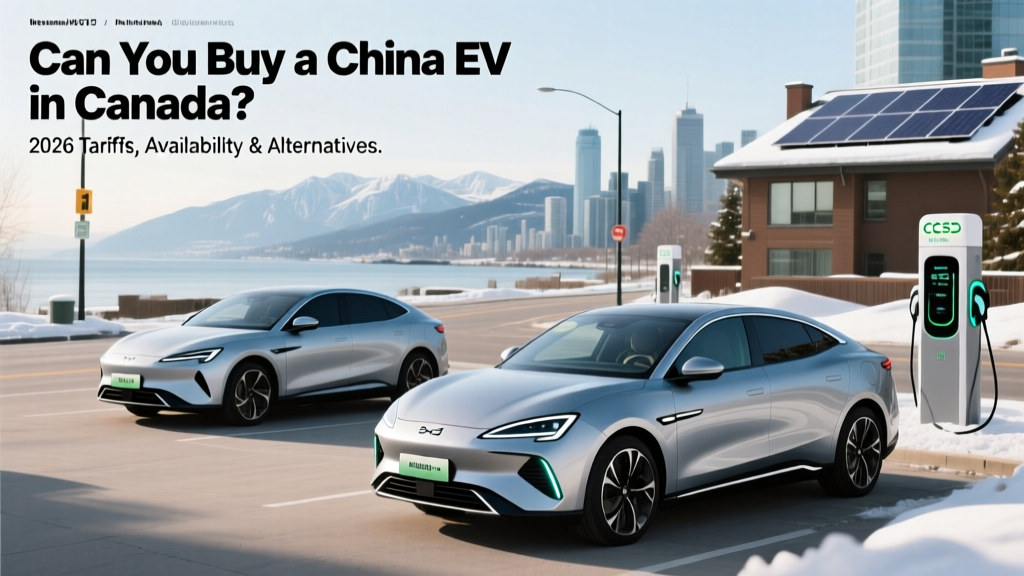
As of 2026, buying a Chinese-made electric vehicle in Canada is effectively off the table for most shoppers. The Canadian government imposed a 100% surtax on all Chinese-manufactured EVs starting October 1, 2024, mirroring U.S. trade policy. This tariff applies to battery electric vehicles, hybrids, and plug-in hybrids assembled in China — regardless of the brand badge on the hood. That means even EVs from Western brands built in Chinese factories (like certain Volvo and Polestar models) face the penalty. The result: a vehicle with a $35,000 factory price lands in Canada at roughly $70,000+ before freight, dealer fees, and provincial taxes. For the foreseeable future, Canadian EV buyers should look to Korean, European, North American, and Japanese alternatives — or the handful of models that shifted production outside China.
Why the 100% Tariff Exists and What It Covers
Canada's 100% surtax on Chinese EVs was announced in August 2024 and enacted to counter what the government described as unfair trade practices driven by China's state-subsidized EV manufacturing overcapacity. According to Canada's Department of Finance, the tariff applies to:
- All battery electric vehicles (BEVs) manufactured in China
- Plug-in hybrid electric vehicles (PHEVs) from China
- Hybrid electric vehicles (HEVs) assembled in China
- Certain EV components and battery cells (separate tariff schedules apply)
The surtax stacks on top of Canada's existing 6.1% auto import duty. So a Chinese-built EV entering Canada faces roughly 106.1% in combined federal import levies, before GST/HST and any provincial sales tax. This is not a temporary measure — Canadian officials have signaled it will remain in place as long as the trade distortion persists, and as of early 2026, no sunset clause has been announced.
The tariff also catches non-Chinese brands that manufacture EVs in China for export. Volvo's EX30, for example, was initially produced in Luqiao, China, and was hit by the tariff. Volvo has since accelerated plans to shift EX30 production for the North American market to its Ghent, Belgium plant, but Canadian supply of non-China-built units remains limited as of 2026.
Which Chinese EV Brands Were Coming — and Where They Stand Now
Before the tariff, several Chinese automakers were eyeing the Canadian market. Here's where they stand:
| Brand | Key Models | Canada Status (2026) | Notes |
|---|---|---|---|
| BYD | Seal, Atto 3, Dolphin | Not available | World's largest EV maker; no Canadian dealer network. Tariff makes pricing uncompetitive. |
| NIO | ET7, EL6 | Not available | Battery-swap model; focused on Europe and China. No North American entry planned. |
| MG (SAIC) | MG4 Electric | Not available | Popular in Europe; Canadian return stalled by tariff. |
| XPeng | G9, P7 | Not available | No confirmed North American timeline. |
| Zeekr (Geely) | Zeekr 001, X | Not available | Geely subsidiary; tariff blocks import. |
| Polestar (Geely/Volvo) | Polestar 2, 3, 4 | Limited availability | China-built units face tariff; production shifting to Korea (Polestar 4) and Europe. |
| VinFast (Vietnam) | VF 8, VF 9 | Available (not Chinese-made) | Vietnamese brand; not subject to China tariff. Dealerships in select provinces. |
The practical takeaway: the most competitive Chinese EVs — like the BYD Seal (which offers 354 miles of WLTP range, an 82.5 kWh LFP blade battery, and a European price around €45,000) — simply cannot compete at double their price. A BYD Seal that might cost $48,000 CAD before tariff lands at nearly $96,000 CAD after the surtax, placing it against the BMW i4 and Mercedes EQB rather than the Tesla Model 3 and Hyundai Ioniq 6 it was meant to undercut.
Cost Comparison: What a Chinese EV Would Cost vs. Available Alternatives
To make this concrete, here's a cost breakdown comparing a hypothetical Chinese EV import against real alternatives available in Canada in 2026:
| Vehicle | Base MSRP (CAD) | Tariff Impact | Effective Price (CAD) | EPA/WLTP Range | Federal iZEV Rebate |
|---|---|---|---|---|---|
| BYD Seal (hypothetical import) | ~$48,000 | +$48,000 (100%) | ~$96,000+ | 354 mi WLTP / ~300 mi EPA est. | Not eligible (over $55K) |
| Tesla Model 3 RWD | $54,990 | None (US-built) | $54,990 | 363 mi EPA | $5,000 eligible |
| Hyundai Ioniq 6 Preferred | $52,999 | None (Korea-built) | $52,999 | 361 mi EPA | $5,000 eligible |
| Volkswagen ID.4 Pro | $51,995 | None (US/Germany-built) | $51,995 | 291 mi EPA | $5,000 eligible |
| Chevrolet Equinox EV 2LT | $48,998 | None (US/Mexico-built) | $48,998 | 319 mi EPA | $5,000 eligible |
| Volvo EX30 (Belgium-built) | $52,450 | None (if non-China) | $52,450 | 296 mi EPA est. | $5,000 eligible |
Canada's federal iZEV program provides a $5,000 rebate for eligible BEVs with a base MSRP under $55,000 CAD (and a final trimmed price under $65,000). The tariff blows past that cap for any Chinese-built EV, eliminating rebate eligibility on top of doubling the price.
EV vs. Gas vs. Hybrid: What Canadian Buyers Should Actually Compare
If you were drawn to a Chinese EV for its value proposition, you're likely cost-sensitive. Here's how the real alternatives stack up over a 5-year ownership period in Canada (assuming 20,000 km/year, $1.55/L gas, $0.12/kWh home electricity):
| Category | EV (Tesla Model 3 RWD) | Hybrid (Toyota Camry LE Hybrid) | Gas (Honda Accord LX) |
|---|---|---|---|
| Purchase Price (CAD) | $54,990 − $5,000 rebate = $49,990 | $35,990 | $33,590 |
| Fuel/Energy (5 yrs) | $2,400 (home charging) | $8,970 | $13,250 |
| Maintenance (5 yrs) | ~$1,500 | ~$3,200 | ~$3,800 |
| Insurance (5 yrs est.) | ~$12,500 | ~$9,500 | ~$9,000 |
| 5-Year Total Cost | ~$66,390 | ~$57,660 | ~$59,640 |
| CO₂ (5 yrs, Ontario grid) | ~0.5 tonnes | ~10.2 tonnes | ~15.5 tonnes |
Key insight: the EV wins on fuel and maintenance but loses on purchase price and insurance. Over 5 years, the Camry Hybrid still comes out ahead on pure economics for a budget-focused buyer. The EV advantage grows significantly if you drive more than 25,000 km/year, have access to cheap overnight electricity (under $0.08/kWh in provinces like Quebec and Manitoba), or plan to keep the car 8+ years.
Real-World Canadian Ownership Considerations
Canadian EV ownership comes with challenges that a spec sheet won't tell you:
Cold-Weather Range Loss
This is the biggest factor for Canadian buyers. In testing at −20°C (common in Prairie and interior B.C. winters), most EVs lose 25% to 40% of their EPA-rated range. A Tesla Model 3 rated at 363 miles may deliver 220-250 miles in deep cold. Vehicles with heat pumps (standard on most 2025+ models from Hyundai, Kia, VW, and Tesla) lose closer to 25%. Models without heat pumps can lose 40%+. Always precondition your battery while plugged in — this warms the pack using grid power, not battery energy, preserving range.
Home Charging Access
Roughly 35% of Canadian households are condos or multi-unit dwellings without easy access to dedicated home charging. If you can install a Level 2 (240V) home charger, expect to pay $800-$2,500 CAD for the unit plus $1,000-$3,500 CAD for electrician installation, depending on whether your panel needs an upgrade to 200A. If you rely solely on public DC fast charging, your "fuel" cost roughly triples to ~$0.30-$0.45/kWh, erasing much of the EV cost advantage over gas.
Charging Infrastructure by Province
British Columbia, Ontario, and Quebec have the densest DC fast-charging networks (Electrify America, Petro-Canada Charge, Circuit électrique). Prairie provinces, Atlantic Canada, and northern regions remain under-served. A road trip from Winnipeg to Thunder Bay still requires careful planning around the NRCan public charger map.
Insurance Premiums
EV insurance in Canada runs 15-30% higher than equivalent gas vehicles, driven by higher repair costs (specialized body shops, battery replacement risk, and advanced sensor recalibration after collisions). Shop quotes from multiple providers — companies like Aviva and TD Insurance now offer specific EV discounts in some provinces.
Myths About Chinese EVs in Canada — Fact-Checked
| Myth | Fact |
|---|---|
| "Chinese EVs are cheap and low quality" | BYD, NIO, and XPeng vehicles score well in Euro NCAP testing (BYD Seal: 5 stars, 2023). Build quality and tech rival Korean and European competitors. The "cheap" label doesn't survive contact with current models. |
| "The tariff will be removed soon" | As of 2026, no timeline for tariff removal has been announced. The U.S. maintains its own 100% tariff on Chinese EVs, and Canada has aligned its trade posture. Expect this to persist through at least 2027. |
| "You can import a Chinese EV yourself" | The 100% surtax applies to all importers, including personal imports. Transport Canada also requires compliance with Canadian Motor Vehicle Safety Standards (CMVSS), which many Chinese-market models don't meet without modification. |
| "Chinese EV batteries are unsafe" | CATL and BYD are the world's two largest battery cell suppliers, providing cells to Tesla, BMW, Mercedes, and others. LFP blade batteries from BYD have demonstrated strong thermal stability in nail-penetration and crush tests. Chemistry and manufacturing quality meet international standards. |
| "Polestar and Volvo are Swedish, so they're exempt" | Both are owned by China's Geely, and several models are manufactured in China. The tariff is based on country of manufacture, not brand nationality. A Polestar 4 built in Luqiao, China faces the tariff; one built in Busan, South Korea does not. |
Decision Framework: What to Buy Instead
If you were considering a Chinese EV for...
Affordability (under $45K CAD): Look at the Chevrolet Equinox EV ($48,998 CAD, $5,000 rebate → ~$44K), Nissan Leaf ($42,990, limited range), or a certified pre-owned Tesla Model 3. If you don't need a BEV, the Toyota Corolla Hybrid ($28,000 CAD, 4.5 L/100 km) is unbeatable for budget.
Range and tech (BYD Seal competitor): The Hyundai Ioniq 6 Preferred ($52,999 CAD, 361 mi EPA, 800V architecture, 10-80% DC charge in ~18 min at 350 kW) is the closest match in capability and price. The Tesla Model 3 Long Range ($61,990 CAD, 363 mi EPA, NACS access to Supercharger network) is the default pick.
Compact crossover (BYD Atto 3 competitor): The Kia EV6 ($55,995 CAD, 310 mi EPA), Hyundai Ioniq 5 ($55,999 CAD, 361 mi EPA), or Volkswagen ID.4 ($51,995 CAD, 291 mi EPA) are strong alternatives. All qualify for the $5,000 iZEV rebate in base trims.
Waiting for the tariff to lift: Don't plan around this. If you need a vehicle in 2026, buy from the current market. The tariff shows no signs of reversal, and Chinese brands have not announced tariff-proof manufacturing strategies for Canada (unlike in Mexico or Southeast Asia for other markets).
Frequently Asked Questions
Can I buy a BYD in Canada?
No. BYD has no Canadian dealer network, and the 100% surtax on Chinese-manufactured EVs makes their vehicles prohibitively expensive even if you could import one. BYD has not announced plans for Canadian market entry.
Does the tariff affect Tesla vehicles sold in Canada?
No. Teslas sold in Canada are manufactured at the Fremont, California or Austin, Texas Gigafactories. They are not subject to the China surtax. However, if Tesla were to export Shanghai-built vehicles to Canada (which it currently does not), those would face the tariff.
Are Polestar and Volvo EVs affected?
It depends on where the specific model is built. The Polestar 2 (built in Luqiao, China) was affected until production shifted. The Polestar 4 is manufactured in Busan, South Korea, avoiding the tariff. Always check the VIN's country of origin — your dealer can confirm this. Volvo's EX30 for North America is transitioning to Belgian production.
Is it cheaper to buy a Chinese EV in the U.S. and import it to Canada?
No. The U.S. also imposes a 100% tariff on Chinese EVs (effective August 2024). Additionally, importing a U.S.-purchased vehicle to Canada involves RIV (Registrar of Imported Vehicles) fees, potential modifications for CMVSS compliance, and GST on the purchase price. There is no tariff-arbitrage path.
What's the best-value EV in Canada in 2026?
For pure value, the Chevrolet Equinox EV 2LT at $48,998 CAD (eligible for the $5,000 iZEV rebate, bringing it to ~$44,000) with 319 miles of EPA range is hard to beat. For tech and charging speed, the Hyundai Ioniq 5 or Ioniq 6 at ~$53,000 CAD with 800V architecture and 350 kW DC fast-charge capability (10-80% in ~18 minutes) lead the segment. For lowest total cost of ownership in cold climates, a Toyota Camry Hybrid or Prius remains the pragmatic choice if you lack home charging access.