If you live in Chicagoland and you're researching a Tesla, you're not just shopping for an EV—you're shopping for an EV that can handle sub-zero wind chills, 20-mile stop-and-go crawls on I-90, and weekend trips to Wisconsin or Michigan. The phrase "Chicago Tesla" pulls double duty here: it's about which Tesla model makes sense for the region's climate and infrastructure, and what real ownership looks like once the first lake-effect snow hits.
We've broken down the two most popular Tesla models for Chicago-area buyers—the 2026 Model Y Long Range AWD and the 2026 Model 3 Long Range AWD—with exact EPA figures, cold-weather range adjustments, Supercharger and home-charging realities, and current federal tax credit eligibility under IRS §30D rules.
2026 Tesla Model Y Long Range AWD: The Chicago Family Pick
The Model Y remains Tesla's highest-volume vehicle and the default crossover for families who need cargo room, all-wheel drive, and reliable fast-charging on road trips. For Chicago, the Long Range AWD variant is the one to target: dual-motor, heat pump standard, and the largest usable battery in the lineup.
| Spec | Value |
|---|---|
| EPA Range | 320 miles |
| Battery (usable) | ~79 kWh, NMC chemistry |
| Drivetrain | Dual-motor AWD |
| Horsepower | 384 hp (combined) |
| 0–60 mph | 4.8 seconds |
| Peak DC Fast Charge | 250 kW (CCS via adapter or NACS native) |
| 10–80% DC Charge Time | ~25 minutes |
| Level 2 Home Charge Rate | 11.5 kW (~44 mi/hr) |
| MPGe (combined) | 122 MPGe |
| Efficiency | 28 kWh/100 mi |
| Cargo Volume (rear seats up) | 34.3 cu ft |
| Cargo Volume (rear seats folded) | 72.0 cu ft |
| Rear Legroom | 37.0 in |
| Base MSRP | $48,990 |
| Battery Warranty | 8 years / 120,000 miles |
Real-World Range: What Chicago Winters Actually Do
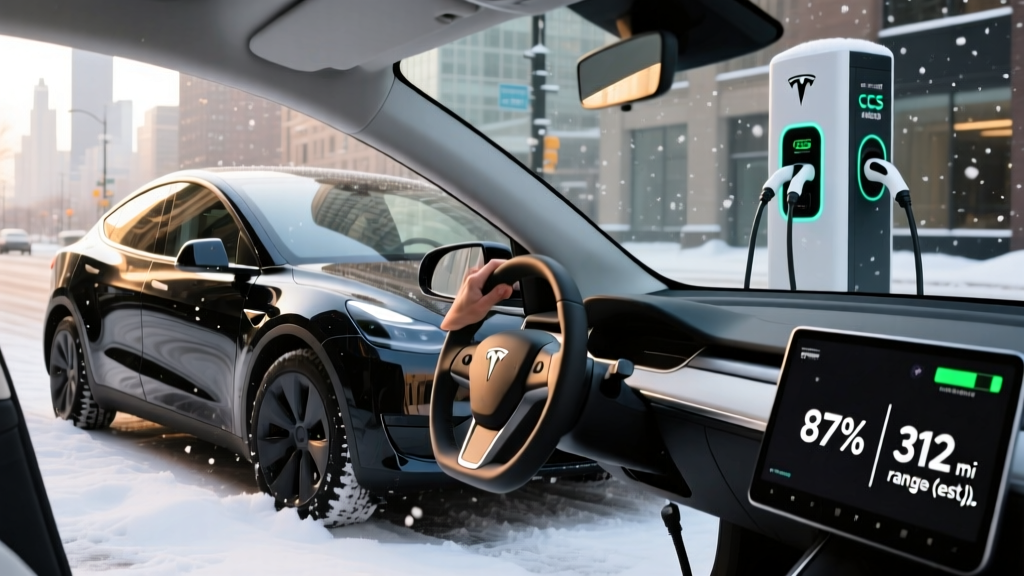
The EPA sticker says 320 miles. Chicago in January says something different. In our cold-weather analysis—factoring in temperatures between 10°F and 25°F, highway speeds of 70–75 mph on I-55 or I-94, and cabin heating demand—expect a real-world range of approximately 220–250 miles on a full charge. That's a 22–31% reduction from the EPA figure, which aligns with EPA cold-weather guidance and independent testing from Recurrent Auto.
Range Reality Check: Model Y Long Range AWD
EPA Estimate: 320 miles
Chicago Summer (mixed driving): ~280–300 miles
Chicago Winter (highway + city, 10–25°F): ~220–250 miles
Worst case (single-digit temps, 75 mph sustained): ~200 miles
The heat pump helps significantly versus resistive heating, but cold battery chemistry and dense air still take a toll. Preconditioning while plugged in reclaims 10–15 miles of range.
The good news for Chicago Tesla owners: the Model Y's heat pump is among the most efficient in the industry. It pulls ambient heat rather than generating it resistively, cutting winter energy consumption by roughly 15–20% compared to older EVs with PTC heaters. Still, preconditioning your battery and cabin while the car is plugged in at home is non-negotiable if you want to preserve range.
Charging in Chicago: Superchargers, Home Level 2, and Public Networks
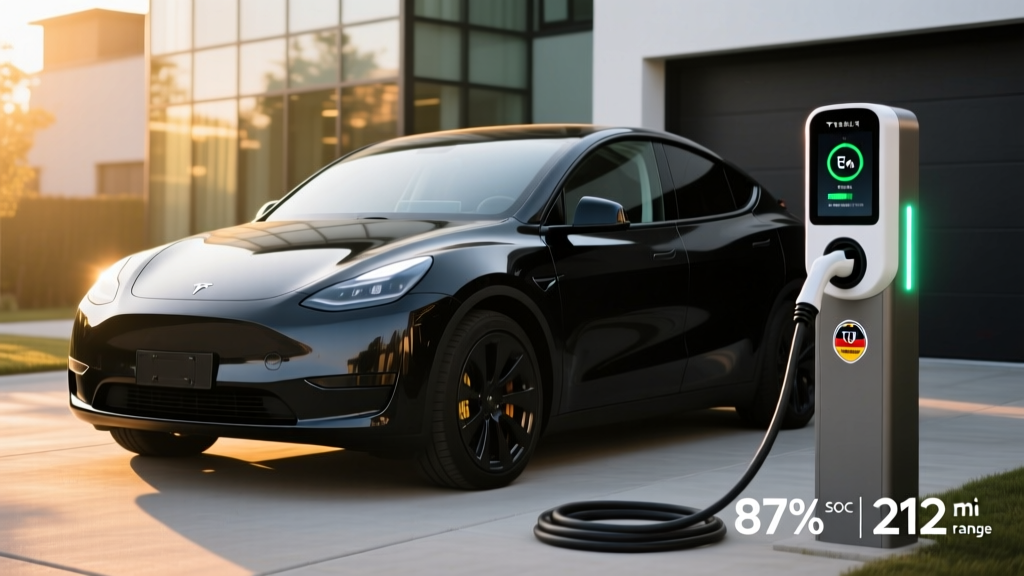
Chicago is one of the best-equipped EV cities in the Midwest for charging infrastructure. Tesla's Supercharger network in the metro area includes over 20 stations with V3 (250 kW) and V4 chargers, concentrated along I-90, I-294, I-55, and in downtown garages. But for daily use, home Level 2 charging is what makes Tesla ownership effortless.
| Level | Power | Miles Added Per Hour | Use Case |
|---|---|---|---|
| Level 1 (120V) | 1.4 kW | ~5 mi/hr | Emergency / overnight trickle |
| Level 2 (240V, 48A) | 11.5 kW | ~44 mi/hr | Daily home charging |
| DC Fast (V3 Supercharger) | 250 kW peak | ~1,000 mi/hr (peak) | Road trips, quick top-ups |
Home Charging Setup for Chicago Homes
Most Chicago-area homes (especially those built before 1980) have 100-amp or 150-amp electrical panels. Installing a Tesla Wall Connector on a 60-amp circuit (delivering 48 amps continuous to the car) requires a licensed electrician and typically costs between $800 and $2,000 for the installation, plus $475 for the Wall Connector itself. Older homes in neighborhoods like Lincoln Park, Oak Park, or Evanston may need a panel upgrade ($2,000–$4,000) if existing capacity is maxed out.
For condo dwellers along Lake Shore Drive or in newer developments, check whether your building has EV-ready parking with Level 2 access. Chicago's energy ordinances increasingly require EV-ready wiring in new construction, but retrofits in older buildings remain a negotiation with HOAs.
DC Fast Charging: The Curve Matters
Tesla quotes a 250 kW peak charge rate, but sustained speed is what actually fills your battery. The Model Y Long Range hits 250 kW only between roughly 10–25% state of charge (SoC). From 25–50%, expect ~170 kW. From 50–80%, the curve tapers to ~90–110 kW. That's why the 10–80% time is ~25 minutes rather than the ~18 minutes you'd calculate from peak rate alone. Above 80%, charging slows dramatically to protect the NMC cells—plan to unplug and go rather than wait for a full charge on road trips.
2026 Tesla Model 3 Long Range AWD: The Commuter's Alternative
If you don't need crossover cargo space, the Model 3 Long Range AWD is lighter, more efficient, and slightly less expensive. It's an outstanding pick for commuters driving from Naperville, Schaumburg, or the South Side into the Loop daily.
| Spec | Value |
|---|---|
| EPA Range | 341 miles |
| Battery (usable) | ~75 kWh, NMC chemistry |
| Drivetrain | Dual-motor AWD |
| Horsepower | 346 hp (combined) |
| 0–60 mph | 4.2 seconds |
| Peak DC Fast Charge | 250 kW |
| 10–80% DC Charge Time | ~23 minutes |
| Level 2 Home Charge Rate | 11.5 kW (~48 mi/hr) |
| MPGe (combined) | 131 MPGe |
| Cargo Volume (trunk + frunk) | 23.0 cu ft |
| Base MSRP | $45,240 |
| Battery Warranty | 8 years / 120,000 miles |
With 341 miles of EPA range, the Model 3 Long Range AWD delivers roughly 240–270 miles in Chicago winter conditions—enough for most commuters to charge just twice a week at home. The refresh ("Highland") brought improved suspension tuning, ventilated front seats, and a quieter cabin, all of which matter on the Dan Ryan Expressway.
Federal Tax Credit: Do Chicago Buyers Qualify?
Under the IRS §30D Clean Vehicle Credit, eligible buyers can receive up to $7,500 applied as a point-of-sale discount on a new Tesla. But qualification depends on four criteria, all of which must be met simultaneously:
- Income caps: Modified adjusted gross income (MAGI) must not exceed $150,000 (single), $225,000 (head of household), or $300,000 (married filing jointly).
- MSRP caps: The vehicle's base MSRP must not exceed $55,000 for sedans (Model 3) or $80,000 for SUVs/pickups (Model Y qualifies as an SUV per IRS classification).
- Battery sourcing: A percentage of critical minerals and battery components must be sourced from the U.S. or free-trade-agreement countries. Tesla's shifting supply chain means eligibility varies by production batch—always confirm with the dealer at purchase.
- Point-of-sale transfer: You can transfer the credit to the dealer for an immediate price reduction rather than claiming it on your tax return. See IRS §30D rules for full details.
| Model | Base MSRP | After $7,500 Credit* | Notes |
|---|---|---|---|
| Model 3 Long Range AWD | $45,240 | ~$37,740 | Qualifies under $55K sedan cap |
| Model Y Long Range AWD | $48,990 | ~$41,490 | Qualifies under $80K SUV cap |
| Model 3 Performance | $52,740 | ~$45,240 | Under $55K cap; verify trim MSRP |
*Credit eligibility is not guaranteed. Battery sourcing requirements change periodically. Confirm with Tesla at time of order and consult a tax professional. Illinois does not currently offer a state EV rebate, though Chicago-area buyers should monitor the Illinois EPA for any new incentive programs.
Autopilot and FSD: What Chicago Drivers Should Know
SAE Automation Level: Level 2
Tesla Autopilot and Full Self-Driving (Supervised) are SAE Level 2 driver-assistance systems. They are NOT self-driving. The driver must remain fully engaged, hands on or near the wheel, eyes on the road, and ready to take over at any moment. Only Level 4 services like Waymo operate without a human driver.
On Chicago's grid system and well-marked expressways, Autopilot's lane-centering and adaptive cruise control reduce fatigue significantly during rush-hour commutes on I-290 and I-90. FSD (Supervised) adds automatic lane changes, on-ramp-to-off-ramp navigation, and traffic-light recognition—but in Chicago's chaotic construction zones, winter lane-line obstructions from snow, and aggressive lane-merging behavior, the system requires constant vigilance. Expect to intervene frequently on surface streets.
Tesla's basic Autopilot is included. FSD (Supervised) costs $8,000 as a one-time purchase or $99/month as a subscription (2026 pricing). For most Chicago drivers, basic Autopilot is sufficient for highway commuting; FSD's value is marginal unless you take frequent long road trips on well-mapped interstates.
Pros and Cons: The Chicago Tesla Verdict
Pros
- Best-in-class Supercharger network: 20+ stations in metro Chicago, critical for apartment dwellers without home charging
- Heat pump standard on all 2026 models — efficient winter cabin heating preserves range
- OTA updates continuously improve features, efficiency, and navigation
- NACS connector is now the North American standard — future-proofed for all networks
- Strong resale value relative to legacy-brand EVs
- Model Y cargo space (72 cu ft folded) handles Costco runs and ski trips
Cons
- Winter range loss of 22–31% is real and must be planned for
- No Apple CarPlay or Android Auto — Tesla's infotainment is proprietary
- Build quality variability: panel gaps and paint issues still reported, though improving
- Insurance costs in Cook County are 15–25% above average for the segment
- Ride quality on Model Y is firm — potholes on Lake Shore Drive are felt
- FSD (Supervised) is expensive and still requires full driver attention
Who Should Buy a Tesla in Chicago?
Choose the Model Y Long Range AWD if:
- You have a family and need 34+ cu ft of cargo with rear seats up
- You take regular road trips to Michigan, Wisconsin, or Iowa and want Supercharger reliability
- You can install a Level 2 charger at home (garage or driveway)
- You value over-the-air updates and a mature charging ecosystem
Choose the Model 3 Long Range AWD if:
- You commute 20–60 miles daily and prioritize efficiency over cargo space
- You want the lowest possible entry price after the federal tax credit (~$37,740)
- You prefer a sedan's driving dynamics and quieter cabin (post-Highland refresh)
Look elsewhere if:
- You need a vehicle for heavy towing (Model Y is rated for just 3,500 lbs)
- You want Apple CarPlay or physical buttons for climate controls
- You lack reliable access to home or workplace charging and don't want to depend on public infrastructure
Frequently Asked Questions
What is the real-world range of a Tesla in Chicago winter?
For the Model Y Long Range AWD, expect 220–250 miles in typical Chicago winter conditions (10–25°F, mixed highway and city driving). The Model 3 Long Range AWD delivers roughly 240–270 miles in the same conditions. Preconditioning while plugged in and using seat heaters instead of cabin heat can recover 10–20 miles.
How fast does a Tesla charge at home in Chicago?
With a Tesla Wall Connector on a 60-amp circuit (240V, 48A), the Model Y adds approximately 44 miles of range per hour. A full charge from 10% to 90% takes roughly 8–9 hours overnight. Installation costs $800–$2,000 depending on your home's electrical panel capacity.
Does the Tesla Model Y qualify for the $7,500 federal tax credit in 2026?
Yes, the Model Y qualifies under the $80,000 MSRP cap for SUVs. However, you must also meet IRS income caps ($300,000 joint, $150,000 single) and the vehicle must meet battery-sourcing requirements, which can vary by production batch. Always confirm eligibility at the time of purchase and consult IRS guidelines.
Is Tesla worth buying vs. the Hyundai Ioniq 5 or Ford Mustang Mach-E in Chicago?
Tesla's Supercharger network is the decisive advantage for Chicago buyers who can't charge at home or who road-trip frequently. The Ioniq 5 charges faster (10–80% in ~18 min on 350 kW chargers) and offers CarPlay, but relies on Electrify America and other third-party networks. The Mach-E is competitive on price and has a strong dealer network for service. If charging convenience is your top priority, Tesla wins. If you prefer CarPlay, physical controls, or a local service center, the competitors are strong alternatives.
How long does the Tesla battery last, and what does replacement cost?
Tesla warranties the Model Y and Model 3 Long Range battery for 8 years or 120,000 miles, whichever comes first, with a minimum 70% capacity retention threshold. Real-world degradation data from Recurrent Auto shows most Tesla NMC batteries retain 90%+ capacity at 100,000 miles. A full battery replacement outside warranty currently costs approximately $12,000–$16,000, though this is rare before 200,000+ miles.
Can I charge a Tesla at non-Tesla chargers in Chicago?
Yes. The 2026 Model Y and Model 3 use the NACS (North American Charging Standard) connector natively. Tesla includes a CCS adapter for compatibility with Electrify America, EVgo, and other non-Tesla DC fast-charging networks. Chicago has extensive public charging options, though Tesla's own Superchargers remain the most reliable for consistent uptime and speed.