Tesla Model Y Towing Capacity: The Quick Verdict
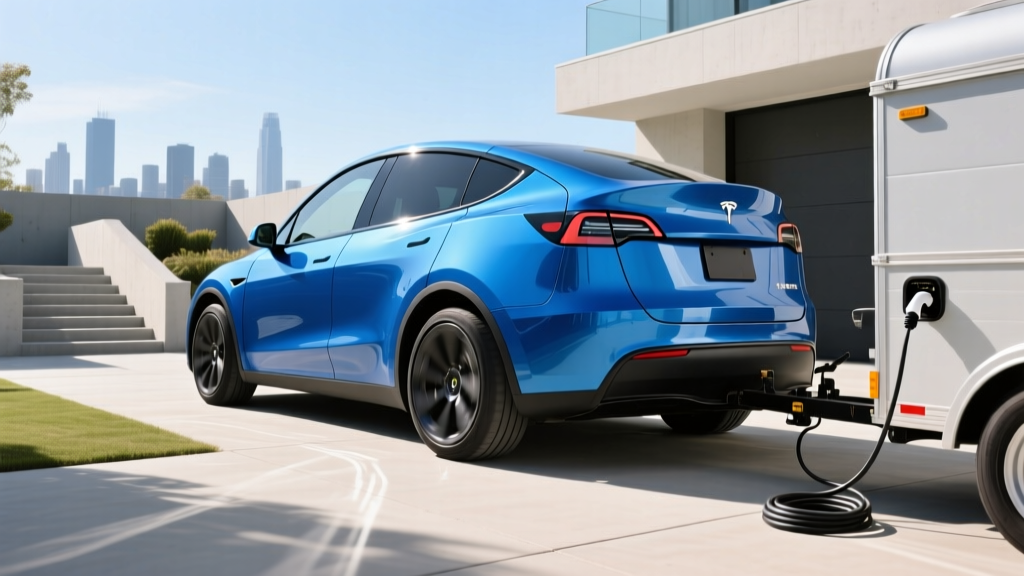
If you're researching the Tesla Model Y towing capacity before buying, here's the number you need: 3,500 pounds (1,587 kg) maximum tow rating across all 2026 trims equipped with the optional tow package. That's enough for a light utility trailer, a pair of jet skis, a small camping trailer, or a single-horse trailer — but it falls short of the 5,000+ lbs many midsize SUV buyers expect for larger boat or travel trailers.
The 2026 Model Y (the Juniper-refreshed generation introduced for the 2025 model year) retains the same structural tow rating as its predecessor, but gains meaningful upgrades in cabin refinement, suspension tuning, and range efficiency. Below, we cover everything a towing-intent buyer or everyday owner needs to know: real-world range (including what happens when you're pulling a trailer), charging speed, battery chemistry, tax-credit math, and how it stacks up against the Ford Mustang Mach-E, Hyundai Ioniq 5, and Rivian R1S for tow duty.
Spec Sheet: 2026 Tesla Model Y at a Glance
| Spec | Long Range RWD | Long Range AWD | Performance AWD |
|---|---|---|---|
| EPA Range | 320 mi | 308 mi | 280 mi |
| Battery (usable) | ~75 kWh (NMC) | ~75 kWh (NMC) | ~75 kWh (NMC) |
| Max DC Fast Charge | 250 kW | 250 kW | 250 kW |
| 10–80% DCFC Time | ~27 min | ~27 min | ~27 min |
| Level 2 Home Rate | 11.5 kW (~44 mi/hr) | 11.5 kW (~44 mi/hr) | 11.5 kW (~44 mi/hr) |
| 0–60 mph | 5.8 sec | 4.8 sec | 3.5 sec |
| Horsepower | 346 hp | 384 hp | 456 hp |
| Drivetrain | RWD (single motor) | AWD (dual motor) | AWD (dual motor) |
| Towing Capacity | 3,500 lbs* | 3,500 lbs* | 3,500 lbs* |
| MPGe (combined) | 122 MPGe | 116 MPGe | 109 MPGe |
| Efficiency | 28 kWh/100mi | 29 kWh/100mi | 31 kWh/100mi |
| Base MSRP | $44,990 | $47,990 | $52,990 |
*Tow rating requires the $1,000 factory tow package (includes hitch receiver, wiring harness, and trailer sway control software). Without it, the Model Y is not rated for towing.
Real-World Range — And What Towing Does to It
Tesla's efficiency engineering remains class-leading, and the Juniper refresh improved aerodynamic drag slightly. But physics doesn't negotiate: towing a 2,500–3,000 lb trailer typically cuts range by 40–55%. On a Long Range AWD, plan for 130–170 miles of practical tow range in fair weather and 70 mph cruising, less with a boxy camper or headwind. That means towing trips longer than ~120 miles one-way will require a mid-route DC fast-charge stop — and you'll want to confirm your route's Superchargers or Electrify America stations can physically accommodate a truck-and-trailer combo (pull-through stalls remain limited but are expanding).
For context, the Model Y's 75 kWh usable NMC (nickel-manganese-cobalt) battery gives it solid energy density, but NMC chemistries are more sensitive to sustained 100% SoC holds than LFP. If you tow frequently, daily-charge to 80% and only hit 100% immediately before a tow trip.
Charging Speed: DC Fast, Level 2, and Towing Logistics
The 2026 Model Y still uses Tesla's 4680-cell structural pack on some trims and 2170 cells on others, but max DC charge rate holds at 250 kW peak on V3 Superchargers. Here's what that translates to in actual time:
| Charging Level | Power | Speed (miles added) | Notes |
|---|---|---|---|
| Level 1 (120V outlet) | ~1.4 kW | ~4–5 mi/hr | Emergency only; impractical for daily use |
| Level 2 (240V, 48A) | 11.5 kW | ~44 mi/hr | Full overnight charge in ~7–8 hours |
| DC Fast (V3 Supercharger) | 250 kW peak | ~160 mi in 15 min | 10–80% in ~27 min; tapers sharply above 80% |
| DC Fast (V4 Supercharger) | 250 kW (CCS-adapter capable) | ~160 mi in 15 min | Newer stalls with pull-through layouts for towing |
Charge curve reality check: The 250 kW peak holds only between roughly 10–30% SoC. From 50–80%, expect an average closer to 110–130 kW. That's why the 10–80% time is ~27 minutes rather than the ~18 minutes a sustained 250 kW would suggest. For tow-trip planning, budget 30–35 minutes per DC stop including parking, plugging, and the taper phase.
Home Level 2 charging requires a 60A dedicated circuit for full 48A/11.5 kW delivery. Tesla's Wall Connector runs ~$420 for the hardware; expect $800–$2,000 for a licensed electrician to install, depending on panel proximity and whether your home's 200A service needs an upgrade (a $1,500–$3,500 extra if it does).
How Towing Affects the Ownership Equation
The Model Y's 3,500-lb tow rating is legitimate and useful — but it's a light-duty rating. Here's how it compares to other EVs in the segment:
- Tesla Model Y: 3,500 lbs (tow package required, ~$1,000)
- Ford Mustang Mach-E: Not rated for towing (Ford explicitly discourages it)
- Hyundai Ioniq 5: 2,300 lbs (with tow package, AWD only)
- Kia EV6: 2,700 lbs (with tow package, AWD only)
- Rivian R1S: 7,700 lbs (true body-on-frame capability, but ~$80k+)
- Ford F-150 Lightning: 7,700–10,000 lbs (truck class, different segment)
If your towing needs stay under ~3,000 lbs — think a 14-foot aluminum boat on a single-axle trailer, two snowmobiles, a small enclosed cargo hauler, or a teardrop camper — the Model Y handles it well, with standard trailer sway control integrated into the stability system. The dual-motor AWD trims are strongly preferred for towing: the rear motor provides the low-end torque needed for hill starts, and AWD traction matters on wet boat ramps.
The big caveat: payload. The Model Y's max payload (passengers + cargo + tongue weight) is roughly 900–1,000 lbs depending on trim. A 3,500-lb trailer typically generates 350–500 lbs of tongue weight. Add two adults and luggage, and you're near the limit. Always weigh your loaded rig at a CAT scale before a long trip.
Pricing, Trims, and Federal Tax Credit (2026)
The 2026 Model Y lineup is simpler than in prior years. Here's how pricing breaks down before and after the federal credit:
| Trim | MSRP | + Tow Pkg | Est. §30D Credit* | Effective Price |
|---|---|---|---|---|
| Long Range RWD | $44,990 | +$1,000 | Up to $7,500 | ~$38,490 |
| Long Range AWD | $47,990 | +$1,000 | Up to $7,500 | ~$41,490 |
| Performance AWD | $52,990 | +$1,000 | Up to $7,500 | ~$46,490 |
*Under IRS §30D rules for 2026, the full $7,500 credit requires meeting BOTH critical-minerals and battery-component sourcing thresholds, which shift annually. The Model Y built at Giga Texas has historically qualified for the full amount, but always verify current eligibility at purchase. Buyer income caps apply: $150k single / $225k HoH / $300k joint MAGI. SUV MSRP cap is $80,000 — all Model Y trims clear this. Credit can be transferred to the dealer at point of sale as an immediate price reduction.
Destination fee adds ~$1,390. FSD (Supervised) remains a $8,000 option or $99/month subscription; it is an SAE Level 2 driver-assist system, meaning the driver must remain actively engaged at all times — it is not self-driving.
Cargo, Passenger Space, and Daily Practicality
The Juniper-generation Model Y preserved the cargo volume that made the pre-refresh version a best-seller:
- Cargo (rear seats up): 30.2 cu ft
- Cargo (rear seats folded): 72.1 cu ft
- Front trunk (frunk): 4.1 cu ft
- Rear legroom: 40.5 in
- Front headroom: 40.8 in
- Seating: 5-passenger standard (7-seat option discontinued for 2026)
For towing families, the cargo area easily fits a full weekend's gear alongside the hitch-mounted bike rack (which, note, is a separate accessory and doesn't count against tow capacity but does reduce range modestly due to drag). The power liftgate and low load floor make it one of the easier EVs to load.
Battery, Warranty, and Long-Term Ownership
Tesla equips the 2026 Model Y with an NMC lithium-ion pack (nickel-manganese-cobalt chemistry), chosen for its high energy density versus LFP. The trade-off: NMC degrades slightly faster than LFP when routinely held at 100% SoC or exposed to high heat, and Tesla recommends daily charging to 80% for non-trip days.
Warranty coverage:
- Basic vehicle: 4 years / 50,000 miles
- Battery & drive unit: 8 years / 120,000 miles (Long Range), 8 years / 100,000 miles (Performance)
- Battery capacity retention threshold: 70% of original capacity during warranty period
Real-world degradation data from large fleet samples (via fueleconomy.gov and owner surveys) suggests Model Y packs lose roughly 5–8% capacity over the first 50,000 miles, then flatten to ~1–2% per 20,000 additional miles. At 150,000 miles, expect ~85–90% state of health if you've followed the 80% daily / 100% trip-only charging discipline.
Tech, Driver Assist, and Drawbacks
The Juniper cabin is a meaningful step up from the pre-2025 Model Y: ventilated front seats, ambient lighting, a rear-seat touchscreen, and substantially improved sound deadening. The 15.4-inch center display runs Tesla's latest software with wireless CarPlay (finally) alongside the native Tesla UI.
Standard driver-assist is Basic Autopilot (lane centering + adaptive cruise). Enhanced Autopilot ($6,000) adds auto lane change and navigate-on-autopilot. FSD (Supervised) adds traffic-light and stop-sign recognition plus city-street autosteer — but remains SAE Level 2. You are the driver. NHTSA continues to scrutinize Tesla's driver-monitoring; keep hands on the wheel and eyes on the road.
Pros
- Class-leading efficiency (28–31 kWh/100mi)
- 250 kW DC fast charging on a vast Supercharger network
- 3,500-lb tow rating beats Mach-E and Ioniq 5
- Over-the-air updates continuously add features
- Strong resale value relative to EV peers
- Spacious cargo area with practical frunk
Cons
- Tow package is a cost adder, not standard
- Tow range drops to ~130–170 miles — trip planning required
- No Apple CarPlay-native integration on instrument cluster
- Ride quality firm on 20-inch Performance wheels
- FSD is expensive and still Level 2, not autonomous
- Payload ceiling limits heavily-loaded tow trips
Who Should Buy the Model Y for Towing?
Choose the Model Y with tow package if: Your trailer is under 3,000 lbs loaded, most towing is within 100 miles of home, you have Level 2 home charging, and you value daily-driving efficiency when not towing.
Look elsewhere if: You need to pull a 24+ foot travel trailer, a large boat, or a horse trailer (step up to Rivian R1S, F-150 Lightning, or Chevy Silverado EV); you lack home charging and depend on public DCFC for daily use; or you want true hands-free highway driving (GM's Super Cruise on the Cadillac Lyriq is a Level 2 alternative with better hands-off coverage on mapped highways).
Frequently Asked Questions
What is the real-world range of the 2026 Tesla Model Y?
EPA rates the Long Range RWD at 320 miles and the Long Range AWD at 308 miles. Real-world mixed driving typically yields 270–290 miles; sustained 75-mph highway driving drops it to 240–260 miles; sub-30°F winter weather can push it down to 210–240 miles. Towing cuts range roughly in half.
How fast does the Model Y charge at home and on the road?
On a 48A Level 2 home charger, the Model Y adds ~44 miles of range per hour, fully recharging overnight in 7–8 hours. On a 250 kW V3 Supercharger, 10–80% takes ~27 minutes, with ~160 miles added in the first 15 minutes. The charge curve tapers significantly above 80% SoC.
Does the 2026 Model Y qualify for the federal EV tax credit?
As of 2026, the Giga Texas–built Model Y has historically qualified for the full $7,500 §30D credit, but eligibility depends on current-year critical-mineral and battery-component sourcing percentages, buyer MAGI (income) limits, and the $80,000 SUV MSRP cap. Verify on IRS.gov at purchase. The credit can be transferred to the dealer as a point-of-sale discount.
Can the Model Y tow a travel trailer or boat?
Yes — up to 3,500 lbs with the factory tow package. That covers most teardrop campers, small pop-up trailers, a 14–16 foot aluminum boat on a single-axle trailer, and small utility/cargo trailers. It cannot safely tow a large dual-axle travel trailer or a heavy boat on a tandem-axle trailer.
Is the Model Y worth buying vs. the Mach-E or Ioniq 5 for towing?
For towing specifically, yes. The Mach-E is not rated for towing at all. The Ioniq 5 tops out at 2,300 lbs. The Model Y's 3,500-lb rating, Supercharger pull-through availability, and 250 kW charging give it a clear edge for light-duty tow buyers who also want a daily driver. For heavier tows, only a truck-platform EV (Lightning, R1S, Silverado EV) will suffice.
What's the biggest drawback of towing with an EV?
Range loss. Expect a 40–55% reduction when towing near the max rating at highway speeds. This makes trip planning around DC fast chargers essential — and not all charger sites have pull-through stalls that accommodate a towed trailer. Tesla's Supercharger network is gradually adding pull-through locations; NHTSA and the DOT's NEVI program are also pushing for more tow-friendly public charging nationwide.