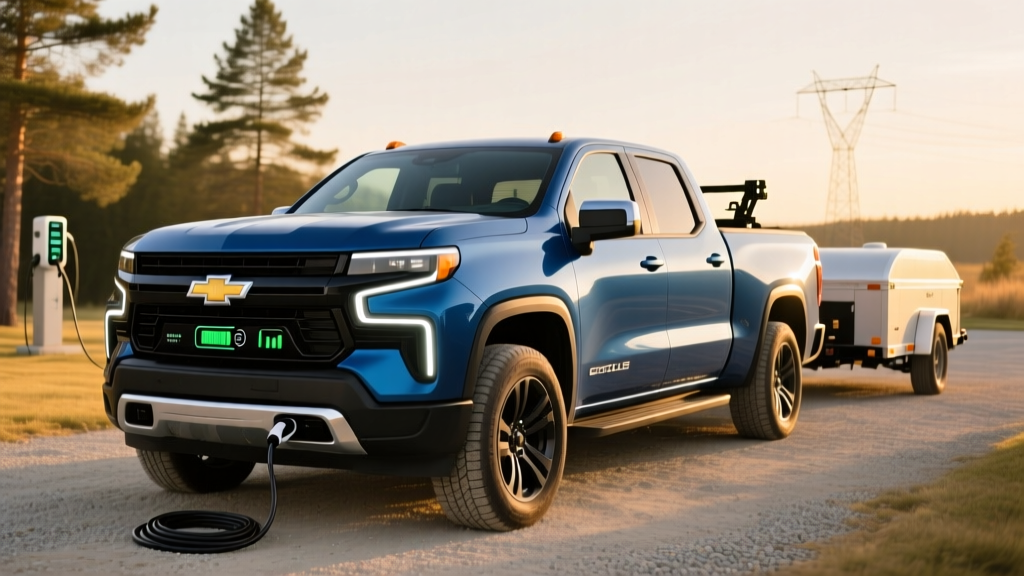
If you're researching the Chevy Silverado electric truck, the short answer is this: the 2026 Silverado EV offers up to 492 miles of EPA-estimated range on the 4WT Work Truck trim with its massive 24-module Ultium battery (~200+ kWh usable), peaks at roughly 350 kW on DC fast charging (10–80% in about 20 minutes on a compatible 350 kW+ station), and starts near $55,000 before incentives. It's a serious electric workhorse, but real-world highway range drops 15–25% below EPA, towing cuts range roughly in half, and the higher trims push well past $90,000. Read on for the exact numbers you need to decide.
Quick Verdict: 2026 Chevy Silverado EV
Best for: Fleet operators, homeowners with Level 2 charging who need a daily-driver truck with massive range and a front trunk (eMultiPro tailgate + frunk).
Think twice if: You tow heavy trailers long distances frequently, rely solely on public charging, or need a sub-$50K entry price.
Key spec: Up to 492 mi EPA range | ~200+ kWh Ultium battery | 350 kW peak DC charge | 0–60 in ~4.5 sec (RST)
Silverado EV Trims, Range, and Battery Specs
The 2026 Silverado EV lineup spans work-oriented and lifestyle trims, all riding on GM's BT1 electric platform with dual-motor AWD. Battery capacity varies by trim, which is the single biggest factor in range and price. The Ultium platform uses NMC (nickel manganese cobalt) lithium-ion pouch cells — chosen for energy density over the LFP chemistry you'd find in a Tesla Model 3 RWD. That means excellent range per pound, but you'll want to follow the 20–80% daily charging guideline to minimize long-term degradation.
| Trim | Battery (usable kWh) | EPA Range | HP / lb-ft | 0–60 mph | Base MSRP |
|---|---|---|---|---|---|
| 4WT (Work Truck) | ~200 kWh | 492 mi | 510 / 615 | ~5.5 sec | $55,000 |
| 3WT (Work Truck) | ~170 kWh (est.) | ~380 mi | 510 / 615 | ~5.8 sec | $52,000 |
| LT (Fleet/Retail) | ~170 kWh | ~380 mi | 664 / 780 | ~4.8 sec | $70,000 |
| RST First Edition | ~200 kWh | 440 mi | 754 / 785 | ~4.5 sec | $94,500 |
| Trail Boss | ~170 kWh | ~350 mi | 664 / 780 | ~4.8 sec | $75,000 |
Real-World Range Reality Check
The EPA estimates are impressive — especially 492 miles on the 4WT. But real-world conditions matter enormously on a truck this heavy (curb weight exceeds 8,800 lbs on some trims):
- Highway cruising (70–75 mph): Expect 15–20% less than EPA. A 492-mi sticker translates to roughly 390–420 mi on a flat interstate.
- Cold weather (below 30°F): Range drops 20–30% due to battery resistance and cabin heating. Plan for 320–370 mi on the 4WT in winter.
- Towing a 5,000-lb trailer: Range roughly halves. GM rates the Silverado EV up to 10,000 lbs towing (12,500 with max trailering package), but at max tow, expect 120–180 miles before needing a charge.
- City/regenerative driving: You'll actually beat EPA in stop-and-go traffic thanks to aggressive regen recapturing energy.
Charging: Speeds, Connectors, and What You'll Actually Experience
The Silverado EV uses the NACS (North American Charging Standard) connector natively — the Tesla-style plug that has become the industry standard. This gives you direct access to Tesla Superchargers (over 25,000 stalls in North America) without an adapter, a major practical advantage over CCS-equipped trucks like the Ford F-150 Lightning or Rivian R1T.
| Level | Power (kW) | Charge Time / Rate | Typical Use Case |
|---|---|---|---|
| Level 1 (120V) | ~1.4 kW | ~3 mi/hr added | Emergency/trickle only — 200 kWh battery would take 140+ hours |
| Level 2 (240V, 48A) | 11.5 kW | ~33 mi/hr; full charge ~18 hrs | Home overnight charging — the daily-driver standard |
| Level 2 (240V, 80A) | 19.2 kW | ~52 mi/hr; full charge ~11 hrs | High-power home/workplace — ideal for large batteries |
| DC Fast (350 kW peak) | Up to 350 kW | 10–80% in ~20 min | Road trips — requires 350 kW+ station (EA, Tesla V4) |
| DC Fast (150 kW) | Up to 150 kW | 10–80% in ~40 min | Most common public DC stations |
Charging curve reality: The Silverado EV peaks near 350 kW only at low state-of-charge (roughly 5–25% SoC) and at a station capable of delivering that power. Above 60% SoC, the charge rate tapers significantly — by 80%, you're pulling roughly 80–100 kW. This is normal lithium-ion physics, not a defect, but it means the "20-minute 10–80%" claim only holds at the best chargers. At a typical 150 kW Electrify America stall, budget 35–45 minutes for the same session.
Home charging is essential. A 200 kWh battery simply cannot be replenished overnight on a standard 120V outlet. You need a Level 2 home charger (240V, 48A minimum) to wake up to a full battery. Budget $1,200–$2,500 for a quality Level 2 EVSE (like a ChargePoint Home Flex or Tesla Wall Connector) plus $800–$2,500 for electrician installation. If your home has a 100-amp electrical panel, you may need a $1,500–$3,000 panel upgrade to 200 amps — a non-trivial cost that first-time EV buyers often overlook.
Silverado EV vs Gas Silverado: The Ownership Cost Breakdown
The sticker price of the Silverado EV is higher than a comparable gas Silverado 1500, but total cost of ownership (TCO) tells a more nuanced story — especially if you charge at home on off-peak electricity rates.
| Factor | 2026 Silverado EV (LT, ~$70K) | 2026 Silverado 1500 Gas (LTZ, ~$58K) |
|---|---|---|
| Base MSRP | $70,000 | $58,000 |
| Federal Tax Credit (§30D) | Up to $7,500 (see eligibility below) | $0 |
| Effective Price (after credit) | ~$62,500 | $58,000 |
| Fuel/Energy Cost (15,000 mi/yr) | ~$600–$900/yr (home charging at $0.13/kWh) | ~$2,400–$3,000/yr (19 MPG avg, $3.50/gal) |
| Annual Maintenance | ~$300–$500 (no oil, fewer moving parts) | ~$800–$1,200 (oil, filters, brakes wear faster) |
| Insurance (annual avg) | ~$2,800–$3,500 | ~$2,000–$2,600 |
| 5-Year Energy/Fuel Cost | ~$3,000–$4,500 | ~$12,000–$15,000 |
| 5-Year Maintenance | ~$1,500–$2,500 | ~$4,000–$6,000 |
The takeaway: Over five years and 75,000 miles, the Silverado EV can save $10,000–$14,000 in fuel and maintenance — enough to close the upfront price gap and then some. But this assumes reliable home charging at residential electricity rates. If you rely on public DC fast charging at $0.40–$0.60/kWh, your annual energy cost jumps to $1,800–$2,700, significantly eroding the savings advantage.
According to fueleconomy.gov, the Silverado EV achieves roughly 56–61 MPGe combined depending on trim, which translates to about 1.8–2.0 kWh per mile — a critical number for calculating your actual charging costs based on your local electricity rate.
Towing, Payload, and the Work-Truck Reality
GM rates the Silverado EV for up to 10,000 lbs towing (standard) and up to 12,500 lbs with the available Max Trailering package on WT trims. Payload tops out around 1,800 lbs on the 4WT. The instant torque (up to 785 lb-ft) makes for remarkably confident trailer launches and low-speed maneuvering — no turbo spool-up lag, no transmission hunting.
But here's the physics-based limitation that no automaker can engineer away: towing destroys range. A 5,000-lb box trailer at highway speed increases aerodynamic drag and rolling resistance so dramatically that energy consumption roughly doubles. On the 4WT with 492 miles of EPA range, plan for 180–220 miles of real towing range. On the RST with 440 miles EPA, expect 160–200 miles. If your work involves towing 8,000+ lbs over 100-mile round trips without a charging destination, the gas or diesel Silverado remains the pragmatic choice.
The eMultiPro tailgate and front eTrunk (a lockable, weather-sealed front trunk where the engine would be) add genuine utility. The eTrunk alone offers roughly 10 cu ft of cargo space — enough for tools, groceries, or gear you want secured and separated from the bed. The available Multi-Flex midgate lets you extend the effective bed length into the cabin by folding down the rear wall, creating a nearly 11-foot load floor.
Federal Tax Credit Eligibility (§30D) — What You Actually Qualify For
The Silverado EV is assembled at GM's Factory ZERO in Detroit-Hamtramck, Michigan, which satisfies the North American final assembly requirement. However, the full $7,500 federal tax credit under IRS §30D depends on multiple criteria that change frequently:
- MSRP cap: Trucks/vans/SUVs must have an MSRP at or below $80,000. This means the RST First Edition ($94,500) does NOT qualify, but 4WT, 3WT, LT, and Trail Boss trims do.
- Buyer income cap: Modified adjusted gross income (MAGI) must not exceed $150,000 (single), $225,000 (head of household), or $300,000 (joint filing).
- Battery component sourcing: A percentage of battery components must be manufactured or assembled in North America, and critical minerals must be sourced from the US or free-trade-agreement countries. These thresholds tighten annually — check fueleconomy.gov for the latest per-model eligibility.
- Point-of-sale transfer: As of 2024, you can transfer the credit to the dealer at purchase, reducing your out-of-pocket cost immediately rather than waiting to claim it on your tax return.
Critical caveat: Battery sourcing rules are the most volatile part of §30D eligibility. A vehicle that qualifies in January may not qualify in July if supply chains shift. Always verify current eligibility on fueleconomy.gov before signing a purchase agreement, and consult a tax professional for your specific situation.
Common Misconceptions About the Silverado EV
| Myth | Fact |
|---|---|
| "The battery will need replacing in 5 years." | GM covers the Ultium battery for 8 years / 100,000 miles (whichever comes first) against defects and excessive degradation (typically below 60–70% capacity retention). Real-world data from GM's Ultium fleet shows degradation of roughly 5–10% over the first 100K miles with normal use. |
| "Electric trucks can't tow anything." | The Silverado EV tows up to 12,500 lbs — competitive with many gas V8 Silverado configurations. The limitation is range while towing, not capability. |
| "I can charge it on a regular outlet overnight." | Level 1 (120V) adds about 3 miles per hour. A depleted 200 kWh battery would take over 140 hours. Level 2 (240V) home charging is effectively mandatory for daily use. |
| "It qualifies for the full $7,500 tax credit, no questions." | Eligibility depends on MSRP cap, buyer income, and battery sourcing rules that change frequently. The RST trim exceeds the $80K MSRP cap and does not qualify at all. |
| "Super Cruise means I don't have to pay attention." | GM's Super Cruise is an SAE Level 2 driver-assistance system. It handles steering and speed on mapped divided highways, but you must remain attentive. An infrared camera monitors your eyes, and the system will disengage with escalating warnings if you look away. |
Super Cruise: Level 2, Not Self-Driving
GM's Super Cruise is available on Silverado EV LT and above trims. It enables hands-free driving on over 750,000 miles of mapped divided highways in North America. However, it is SAE Level 2 automation — the driver must remain engaged and ready to take over at any moment. It does not handle construction zones, unmapped roads, or complex urban intersections. This is fundamentally different from Level 4 robotaxi services like Waymo, which operate without a driver in geofenced areas.
Decision Framework: Should You Buy the Silverado EV?
Buy the Silverado EV If:
- You have (or can install) Level 2 home charging and drive under 250 miles round-trip on most days.
- You want the lowest per-mile operating cost in a full-size truck — home charging at $0.13/kWh costs roughly $0.05/mile vs $0.18/mile for gas.
- You value the frunk (eTrunk), instant torque for trailer launches, and near-silent operation.
- You qualify for the §30D tax credit and the trim you want falls under the $80K MSRP cap.
- You rarely tow heavy loads over 150-mile round trips without a destination charger.
Stick With a Gas or Diesel Silverado If:
- You regularly tow 5,000+ lbs on highway routes longer than 150 miles one-way.
- You live in an apartment or lack any access to home or workplace Level 2 charging.
- Your budget is firmly under $50,000 — the Silverado EV doesn't reach that price point even after incentives.
- You operate in extreme cold (consistent sub-zero °F) where range loss compounds with towing demands.
- You need the widest possible service network in rural areas — GM dealers can service a gas Silverado anywhere; EV-specific repairs may require a certified EV technician.
Consider a PHEV or Hybrid Alternative If:
- You want some electric daily driving but can't compromise on long-distance towing range. The Silverado 1500 with the 3.0L Duramax diesel offers 27 MPG highway and 13,000+ lbs towing with zero range anxiety. A plug-in hybrid full-size truck option may emerge from GM by 2027–2028, but as of 2026, no PHEV Silverado exists.
Battery Warranty, Longevity, and Replacement Costs
GM provides an 8-year / 100,000-mile warranty on the Ultium battery pack, covering defects and capacity loss below a defined threshold (typically 60–70% of original capacity, though the exact retention floor should be confirmed in your purchase documentation). For context, GM's internal testing and early Ultium fleet data suggest the NMC pouch cells retain approximately 90–93% capacity after 100,000 miles under normal charging patterns (avoiding frequent 100% charges and DC fast-charging daily).
If the battery does need replacement out of warranty — a scenario most owners will never face based on current degradation curves — expect a cost in the range of $15,000–$25,000 for the pack alone, plus $2,000–$4,000 in labor. This is a worst-case number that should factor into long-term ownership planning, especially for fleet buyers planning to hold trucks beyond 150,000 miles. Battery prices per kWh continue to decline year over year, so replacement costs in 2034 will likely be lower than today's estimates.
Maximize battery longevity by:
- Setting daily charge limits to 80–85% for routine use (the infotainment system allows this).
- Using DC fast charging for road trips, not as your daily charging method.
- Preconditioning the battery before fast charging (the Silverado EV does this automatically when you navigate to a charger in the infotainment system).
- Avoiding letting the battery sit at 0% or 100% SoC for extended periods.
Frequently Asked Questions
What is the real-world range of the Chevy Silverado EV on the highway?
On the 4WT trim with a 492-mile EPA rating, expect roughly 390–420 miles of real-world highway range at 70–75 mph in moderate temperatures. The RST trim (440 mi EPA) delivers roughly 350–380 miles on the highway. Cold weather (below 30°F) reduces these figures by an additional 10–15%.
How long does it take to charge the Silverado EV at home?
On a 240V Level 2 charger at 48 amps (11.5 kW), a full charge from empty takes roughly 17–18 hours for the 200 kWh battery (4WT/RST) or 14–15 hours for the ~170 kWh battery (LT/Trail Boss). At 80 amps (19.2 kW), those times drop to about 10–11 hours and 8–9 hours respectively. Most owners charge from 20–80% overnight, which takes 8–10 hours at 48A — perfectly suited for overnight charging.
Can the Silverado EV use Tesla Superchargers?
Yes. The 2026 Silverado EV comes with a native NACS charge port, meaning it plugs directly into Tesla Supercharger stalls without an adapter. GM has confirmed access to Tesla's network of 25,000+ Superchargers for its NACS-equipped vehicles. You'll use the MyChevrolet app or the Tesla app to initiate and pay for sessions.
Does the Silverado EV qualify for the $7,500 federal tax credit?
It depends on the trim and your income. Trims with an MSRP at or below $80,000 (4WT, 3WT, LT, Trail Boss) meet the vehicle price cap. The RST First Edition at $94,500 does not qualify. You must also meet IRS income caps ($150K single / $300K joint) and the battery must meet current-year critical mineral and component sourcing requirements. Always verify on fueleconomy.gov before purchasing, as sourcing rules can change mid-year.
How much does it cost to charge the Silverado EV vs fueling a gas Silverado?
At the US average residential electricity rate of ~$0.16/kWh (as of early 2026), fully charging the 200 kWh 4WT battery costs about $32 for roughly 400 real-world miles — or about $0.08 per mile. A gas Silverado 1500 averaging 19 MPG at $3.50/gallon costs about $0.18 per mile. That's a fuel savings of roughly $1,500–$2,000 per year at 15,000 miles driven annually. Public DC fast charging at $0.48/kWh raises the EV cost to ~$0.24/mile, which is more expensive than gas — reinforcing why home charging is critical to the value proposition.
What is the towing capacity and how does towing affect range?
The Silverado EV tows up to 10,000 lbs standard and up to 12,500 lbs with the Max Trailering package on WT trims. When towing a 5,000-lb trailer at highway speeds, expect range to drop by roughly 45–55%. For the 4WT (492 mi EPA), that means approximately 200–240 miles of real towing range. Plan charging stops accordingly and look for pull-through DC fast charging stations (Electrify America and some Tesla Supercharger locations now offer these).
Is the Silverado EV good in snow and off-road?
The dual-motor e4WD system provides excellent traction in snow and mud, with instant torque vectoring to the wheels with grip. The Trail Boss trim adds a 2-inch factory lift, 35-inch all-terrain tires, and adaptive air ride suspension for improved ground clearance. However, cold temperatures reduce battery range by 20–30%, so winter range planning is essential. The available heated steering wheel, heated seats, and heat pump (on equipped trims) help reduce cabin-heating energy draw compared to resistive heaters.