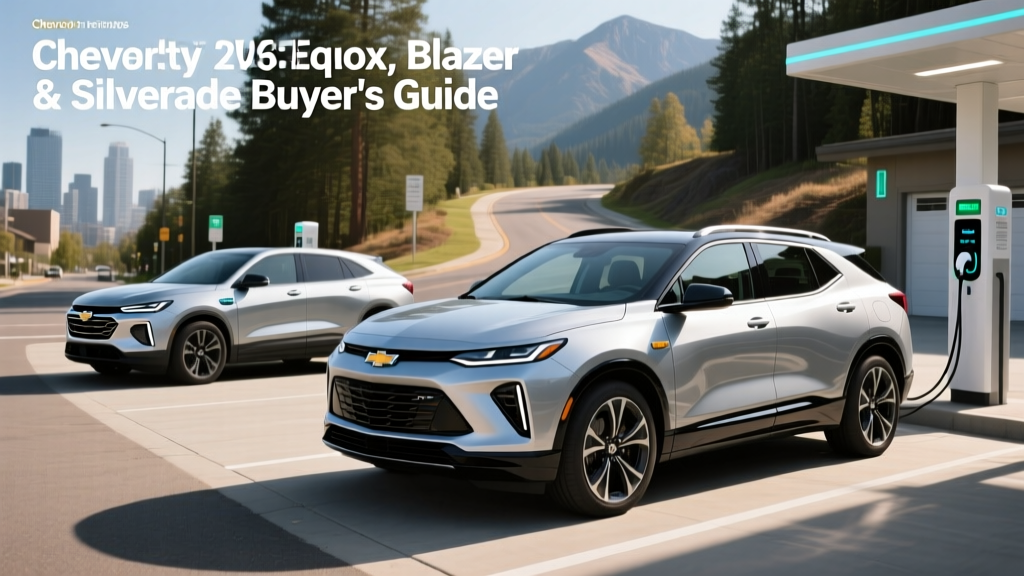
Which Chevy EV should you buy in 2026? The Equinox EV (starting ~$33,600) delivers up to 319 miles EPA and qualifies for the federal tax credit — making it the best value for most buyers. The Blazer EV (~$44,600) adds space, AWD, and 324 miles for families. The Silverado EV (~$57,900+) targets truck buyers needing 400+ miles and towing, but loses most federal credit eligibility due to MSRP caps. All three use GM's Ultium platform with NMC batteries and NACS charge ports for Supercharger access.
The 2026 Chevy EV Lineup at a Glance
Chevrolet's electric portfolio has matured significantly since the Bolt's discontinuation. For 2026, three core Ultium-based models cover the mainstream market: a compact crossover, a midsize SUV, and a full-size pickup. Each shares the BTX/BTX2 Ultium architecture but targets distinctly different buyers.
| Spec | Equinox EV | Blazer EV | Silverado EV |
|---|---|---|---|
| EPA Range (max) | 319 mi (LT FWD) | 324 mi (RS RWD) | 440 mi (RST Max Range) |
| Battery (usable) | ~85 kWh, NMC | ~102 kWh, NMC | ~200 kWh, NMC (Max Range) |
| Peak DC Fast Charge | 150 kW | 190 kW | 350 kW |
| 10–80% DCFC Time | ~34 min | ~30 min | ~20 min |
| Level 2 Rate | 11.5 kW | 11.5 kW | 19.2 kW (optional) |
| 0–60 mph | ~8.0 sec (FWD) | ~5.4 sec (AWD RS) | ~4.5 sec (RST AWD) |
| Horsepower | 213 hp (FWD) | 293–557 hp | 510–754 hp |
| Starting MSRP | ~$33,600 | ~$44,600 | ~$57,900 |
| §30D Federal Credit | Up to $7,500 | Up to $7,500 | Varies by trim (MSRP cap) |
| Battery Warranty | 8 yr / 100,000 mi | 8 yr / 100,000 mi | 8 yr / 100,000 mi |
Sources: fueleconomy.gov, Chevrolet.com configurator. Silverado EV credit eligibility is limited — trims above the $80,000 MSRP cap for trucks do not qualify. Always verify current-year rules at IRS.gov §30D.
Real-World Range: What the EPA Sticker Doesn't Tell You
EPA vs. Reality: The Equinox EV LT FWD posts 319 miles on the window sticker. In real-world mixed driving (70 mph highway, moderate climate control), expect ~265–285 miles. In sub-freezing temperatures (20°F–32°F), plan for ~220–245 miles due to battery heating demands and cabin HVAC load. The Ultium platform includes a heat pump on higher trims, which mitigates some cold-weather loss, but physics still applies — cold batteries charge slower and hold less usable energy.
The Blazer EV RS with the larger 102 kWh pack delivers 324 miles EPA in RWD form. AWD trims drop to approximately 279–283 miles EPA. Highway-heavy driving at 75+ mph will reduce that to roughly 240–260 real miles in mild weather. The Silverado EV RST Max Range achieves an impressive 440 miles EPA, but towing even a moderate 5,000-pound trailer cuts effective range to ~200–250 miles depending on speed and terrain. This is consistent with all electric trucks — towing is the range killer, not daily commuting.
For context, GM's NMC Ultium chemistry provides strong energy density (favoring range per pound) but requires more careful thermal management than LFP. You'll want to avoid routinely charging to 100% on NMC packs — GM recommends daily charging to 80–90% and saving 100% for road trips. The battery management system includes a buffer (roughly 3–5% top and bottom), so the "usable" kWh figure already accounts for this protection.
Charging Speed and Infrastructure: NACS Access Is a Real Advantage
For 2026, all Chevy EVs ship with the NACS (North American Charging Standard) port, meaning native access to Tesla Supercharger stations — the most reliable and extensive DC fast-charging network in the U.S. This is a significant practical advantage over CCS-only vehicles that rely on Electrify America, EVgo, or ChargePoint for fast charging.
| Charging Level | Power | Connector | Miles Added Per Hour | Best For |
|---|---|---|---|---|
| Level 1 (120V) | ~1.4 kW | NACS (J3400) | ~4–5 mi/hr | Overnight top-off, low-mileage drivers |
| Level 2 (240V home) | 11.5 kW (19.2 kW Silverado opt.) | NACS (J3400) | ~38–52 mi/hr (Silverado: ~65 mi/hr) | Daily home charging |
| DC Fast (public) | 150–350 kW peak | NACS (J3400) | ~150–250 mi in 15 min | Road trips, quick stops |
Understanding the charge curve: Peak kW ratings (150 kW for Equinox, 190 kW for Blazer, 350 kW for Silverado) are not sustained. The Equinox EV peaks near 150 kW around 20–40% state of charge, then tapers to ~80 kW by 60%, and ~40 kW above 80%. This is why manufacturers quote 10–80% times rather than 0–100%. Charging from 80% to 100% on DC fast charging can take as long as the entire 10–80% session. For daily driving, plan your fast-charge stops around the 10–80% window.
Home Level 2 charging requires a 240V circuit — typically a 48-amp or 60-amp dedicated circuit installed by a licensed electrician. Expect $500–$2,500 for installation depending on panel proximity, conduit run length, and whether your electrical panel needs upgrading (a 200-amp panel upgrade adds $1,500–$3,000). The Equinox and Blazer at 11.5 kW will fully recharge overnight from near-empty in about 8–9 hours. The Silverado's optional 19.2 kW onboard charger cuts that to ~10 hours for its massive pack, but requires a hardwired 80-amp circuit.
Total Cost of Ownership: Chevy EV vs. Gas Equivalent
EV economics depend heavily on your electricity rate, annual mileage, and whether you can charge at home. Here's a 5-year comparison for the Equinox EV LT versus a comparably equipped gas-powered Equinox LT AWD (1.5L turbo, ~26 MPG combined):
| Cost Factor (5 years / 75,000 mi) | Equinox EV LT (FWD) | Equinox Gas LT (AWD) |
|---|---|---|
| Purchase Price (MSRP) | $33,600 | $31,200 |
| Federal Tax Credit (§30D) | −$7,500 (if eligible) | $0 |
| Effective Purchase Price | $26,100 | $31,200 |
| Fuel / Energy (15,000 mi/yr) | $3,375 ($0.15/kWh avg, 3.2 mi/kWh) | $10,095 ($3.47/gal, 26 MPG) |
| Maintenance (5 yr) | ~$1,200 (tires, cabin filter, wipers) | ~$3,800 (oil, filters, brakes, belts) |
| Insurance (avg) | ~$9,500 (EV premium ~15–20%) | ~$7,800 |
| Estimated Depreciation | ~$13,000 | ~$14,500 |
| 5-Year Total | ~$53,175 | ~$67,395 |
Key takeaway: With the full $7,500 federal credit and home charging, the Equinox EV saves roughly $14,000 over 5 years versus the gas equivalent. Without the credit (income above cap or credit phases out), savings narrow to ~$6,500, still favoring the EV primarily through fuel and maintenance. Public-only charging at $0.35–$0.48/kWh erodes the fuel-cost advantage significantly — home charging access is the single biggest economic variable.
Note on the §30D federal tax credit: Eligibility for 2026 requires meeting buyer income caps ($150K single / $300K joint MAGI), vehicle MSRP caps ($55K for SUVs/cars, $80K for trucks/vans), and battery critical-mineral and component sourcing thresholds that tighten annually. The credit can now be transferred to the dealer at point of sale as an immediate discount. Always confirm your specific eligibility with a tax professional and check current rules at IRS.gov.
Common Misconceptions About Chevy EVs
| Myth | Fact |
|---|---|
| "EV batteries need replacing every 5 years and cost $20K" | GM warranties Ultium packs for 8 years/100,000 miles against dropping below 70% capacity. Real-world data from Bolt owners (similar chemistry generation) shows ~5–8% degradation at 100K miles. Replacement is rare and typically covered under warranty during the coverage period. |
| "Charging takes too long for road trips" | The Blazer EV adds ~150 miles in 15 minutes at a 190 kW NACS Supercharger. Most road-trip stops involve a 20–30 minute break anyway. Planning with the myChevrolet app or A Better Routeplanner makes stops seamless. |
| "Chevy EVs can't handle cold weather" | Expect 25–35% range loss below freezing — this affects all EVs. The Ultium platform's thermal management and available heat pump help. Preconditioning the battery while plugged in (via the app) restores much of the lost efficiency and improves charge speed. |
| "You need a $5,000 home charging setup" | A basic Level 2 installation (48-amp circuit, NACS wall connector) runs $500–$1,500 if your panel is adequate and the run is short. Only panel upgrades or long conduit runs push costs above $2,500. Many utility companies offer rebates of $250–$1,000 for charger installation. |
| "The Silverado EV qualifies for the full $7,500 credit" | Only Silverado EV trims below the $80,000 truck MSRP cap qualify. The WT fleet trim and some LT configurations may qualify, but the RST and high-option trims exceed the cap. Check fueleconomy.gov for trim-level eligibility. |
Who Should Buy Which Chevy EV?
Choose the Equinox EV if:
- Your budget is under $40,000 (after credit)
- You commute 30–60 miles daily and want minimal charging hassle
- You prioritize maximum federal tax credit eligibility
- You don't need AWD or towing capability
Choose the Blazer EV if:
- You need AWD for snow/terrain or a roomier second row
- You want faster DC charging (190 kW vs. 150 kW) for frequent road trips
- You're willing to pay ~$11,000 more for extra space and performance
- Still qualifies for the $7,500 credit at most trims (SUV MSRP cap: $80K)
Choose the Silverado EV if:
- You need a truck bed, towing (up to 10,000 lbs), or commercial use
- 400+ mile range is critical for your work or lifestyle
- You accept that high trims won't qualify for federal credits
- You can install a 19.2 kW Level 2 charger (requires 80-amp circuit)
Skip Chevy EVs and consider a PHEV (like the upcoming Chevy Equinox PHEV or a competitor) if:
- You lack home charging access and rely on apartment/street parking
- You regularly drive 400+ miles in areas with sparse charging infrastructure
- Your budget is below $30,000 and you can't wait for used-market depreciation
First-Time EV Buyer Essentials
If this is your first electric vehicle, a few ownership realities differ from gas cars:
- Home charging is non-negotiable for most owners. Over 80% of EV charging happens at home. If you can install Level 2 (or even use Level 1 on a standard 120V outlet for low daily mileage), an EV is seamless. If you cannot charge at home, weigh the inconvenience and cost of public charging carefully — it's 2–4× more expensive per mile than home rates.
- Regenerative braking changes how you drive. The Equinox and Blazer offer one-pedal driving modes that slow the vehicle significantly when you lift off the accelerator, recovering energy back into the battery. It takes a few days to adapt but reduces brake wear dramatically — many EV owners go 100,000+ miles on original brake pads.
- Tire wear increases. EVs are heavier (the Blazer EV weighs ~5,600 lbs) and deliver instant torque. Expect to replace tires 15–25% sooner than on a comparable gas vehicle. Budget ~$800–$1,400 for a set of EV-rated touring tires every 35,000–45,000 miles.
- Insurance costs more. EV insurance premiums run 15–25% higher than gas equivalents due to higher repair costs and battery replacement risk. Shop quotes before purchasing — GEICO, Progressive, and State Farm vary significantly on EV pricing.
- Preconditioning matters. Use the myChevrolet app to warm the battery and cabin while the car is still plugged in at home. This preserves range (the grid powers heating, not the battery) and enables faster DC charging when you hit a Supercharger.
Charging at Home: What You Actually Need
Before taking delivery, arrange your home charging setup. Here's a realistic cost breakdown:
| Item | Low End | High End | Notes |
|---|---|---|---|
| Level 2 Charger (NACS, 48A) | $400 | $700 | ChargePoint Home Flex, Emporia, or GM-branded unit |
| Electrician (install + permit) | $500 | $1,800 | Varies by conduit run, wall type, local rates |
| Permit / inspection | $50 | $250 | Required in most jurisdictions |
| Panel upgrade (if needed) | $1,500 | $3,500 | Only if existing panel lacks capacity (e.g., 100A service) |
| Total (typical, no panel upgrade) | $950 | $2,750 | Most homes with 200A panels fall in this range |
Hire a licensed electrician — not a general contractor — for EV charger installation. The circuit must be dedicated, properly grounded, and permitted. Ask for a load calculation on your panel before committing. Many utilities offer time-of-use (TOU) rates that make overnight charging as cheap as $0.06–$0.10/kWh, further improving the EV cost advantage.
Frequently Asked Questions
Do all 2026 Chevy EVs qualify for the $7,500 federal tax credit?
No. The Equinox EV and most Blazer EV trims qualify (assuming you meet income limits: $150K single / $300K joint). The Silverado EV qualifies only on trims under the $80,000 MSRP cap for trucks — that excludes the RST and high-option configurations. Battery sourcing requirements also tighten each year under §30D rules. Check IRS.gov or ask your dealer for the latest point-of-sale credit eligibility.
How long does it take to charge a Chevy Equinox EV at home?
On a Level 2 home charger (11.5 kW, 48-amp circuit), the Equinox EV's ~85 kWh battery charges from empty to full in approximately 8.5 hours. Most owners plug in overnight and wake up to a full battery. On a standard 120V outlet (Level 1), expect ~4 miles of range per hour of charging — adequate only if you drive fewer than 40 miles daily.
Can the Silverado EV tow as much as a gas Silverado?
The Silverado EV is rated for up to 10,000 pounds of towing (RST and WT trims with the Max Trailering package). That's competitive with many gas Silverado 1500 configurations. However, towing at capacity reduces range to roughly 200–250 miles from the 440-mile EPA figure. Plan charging stops accordingly on long hauls.
Is the Chevy Blazer EV being discontinued?
Chevrolet temporarily paused Blazer EV deliveries in early 2024 due to software issues, but sales resumed mid-2024 after OTA updates. The 2026 Blazer EV is in active production and available at dealers. GM has not announced any discontinuation — it remains a core Ultium product.
What happens if the Ultium battery degrades?
GM warrants the battery for 8 years or 100,000 miles, guaranteeing it will retain at least 70% of original capacity. If it drops below that threshold within the warranty period, GM replaces or repairs it at no cost. Real-world data from earlier GM EVs suggests most packs retain 90%+ capacity at 100,000 miles with normal charging habits (avoiding frequent 100% charges and deep discharges).