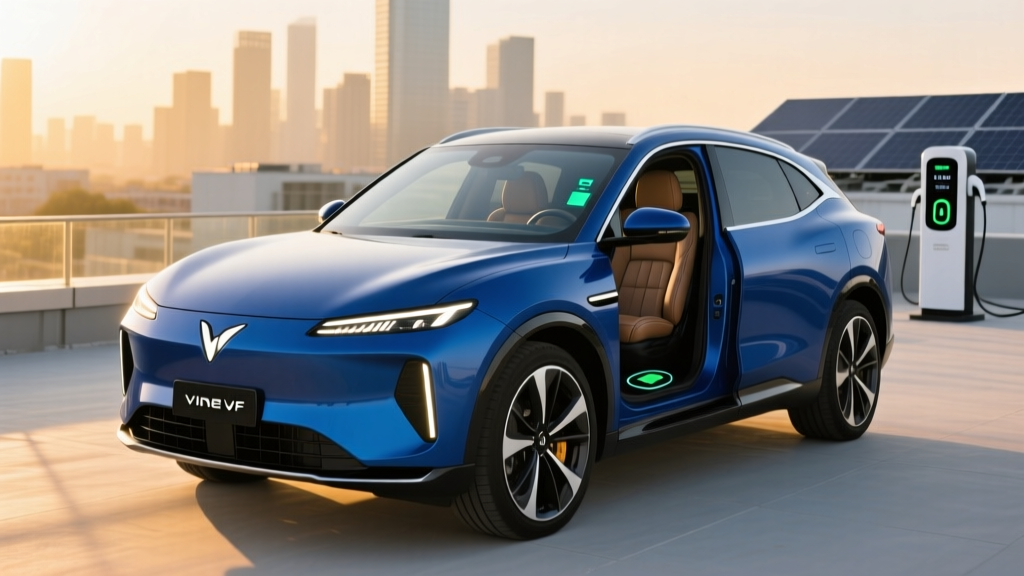
If you've been searching for a VinFast VF 9 for sale, you're likely weighing a three-row electric SUV that undercuts legacy luxury brands on price while offering competitive range and standard all-wheel drive. The Vietnamese automaker's flagship has been on U.S. soil since mid-2024, and by the 2026 model year, VinFast has refined software, expanded its dealer footprint, and clarified its battery-ownership strategy. This review covers everything a prospective buyer needs: real-world range expectations, charging logistics, total cost, and whether the VF 9 holds up against the Tesla Model X, Kia EV9, and Rivian R1S.
2026 VinFast VF 9: At-a-Glance Specs
| Spec | VF 9 Eco (Extended Range) | VF 9 Plus (Extended Range) |
|---|---|---|
| EPA Range | 291 miles | 291 miles |
| Battery (usable) | ~92 kWh, NMC | ~92 kWh, NMC |
| Drivetrain | Dual-motor AWD | Dual-motor AWD |
| Horsepower / Torque | 402 hp / 457 lb-ft | 402 hp / 457 lb-ft |
| 0–60 mph | ~6.2 sec (est.) | ~6.2 sec (est.) |
| Max DC Fast Charge | 200 kW (peak) | 200 kW (peak) |
| 10–80% DCFC Time | ~30 min (est.) | ~30 min (est.) |
| Level 2 Home Charge | 11 kW (~27 mi/hr) | 11 kW (~27 mi/hr) |
| MPGe (city/hwy/combined) | 87 / 78 / 83 MPGe | 87 / 78 / 83 MPGe |
| Efficiency | ~40 kWh/100 mi | ~40 kWh/100 mi |
| Seating | 7-passenger (2-3-2) | 6-passenger (2-2-2) captain's chairs |
| Cargo (behind 3rd / 2nd / 1st row) | ~12 / 38 / 78 cu ft | ~12 / 42 / 82 cu ft |
| Base MSRP | $69,800 | $73,800 |
| Battery/Powertrain Warranty | 10 yr / 125,000 mi | 10 yr / 125,000 mi |
Source: fueleconomy.gov and VinFast U.S. specifications. Figures reflect 2025/2026 Extended Range trims.
Range and Efficiency: EPA Sticker vs. Real-World Expectations
Real-World Highway (70–80 mph, mild weather): ~230–250 miles
Real-World Cold Weather (below 32°F, highway): ~185–210 miles
Efficiency: ~40 kWh/100 mi combined (83 MPGe)
The VF 9's 291-mile EPA rating puts it in a respectable tier among three-row electric SUVs, trailing the Rivian R1S Dual-Motor Max (up to 352 miles with the larger pack) but ahead of the base Kia EV9 Long Range AWD (279 miles). However, the sticker number deserves context.
At sustained highway speeds of 70–80 mph, large, heavy SUVs consume energy faster than the EPA's mixed-cycle test suggests. Expect roughly 230–250 miles on a warm-weather road trip before you need to stop. In freezing temperatures, the VF 9's liquid-cooled NMC pack will lose approximately 25–30% of its range — a common trait among EVs without a dedicated heat pump for the cabin (the VF 9 uses resistive heating in earlier builds, though VinFast has indicated heat-pump integration for newer production). Plan for 185–210 miles of usable range in deep winter highway driving.
At ~40 kWh per 100 miles, the VF 9 is not the most efficient vehicle in its class. The Kia EV9 AWD achieves around 35 kWh/100 mi. That delta matters on road trips: the VF 9 will stop more often or charge longer to cover the same distance. For daily commuting under 60 miles round-trip, the difference is negligible — you'll charge at home overnight and rarely notice.
Charging Speed and Infrastructure
| Charging Level | Power | Speed (approx.) | Use Case |
|---|---|---|---|
| Level 1 (120V household) | ~1.4 kW | ~3–4 mi/hr | Emergency / trickle top-up |
| Level 2 (240V home, 48A) | 11 kW | ~27 mi/hr | Overnight home charging; 0–100% in ~9 hr |
| DC Fast Charge (peak) | 200 kW | ~180 mi in 30 min (10–80%) | Road trips; tapers above 80% SoC |
The VF 9 peaks at 200 kW on DC fast chargers using the CCS1 connector (2024–2025 builds) or NACS (newer 2026 production vehicles are expected to transition to Tesla's North American Charging Standard, with Supercharger access planned). At peak rate, a 10–80% session takes approximately 30 minutes. That's slower than the Hyundai Ioniq 5 or Kia EV9, which can peak at 236–240 kW on 800V architectures and complete the same session in roughly 18–20 minutes.
A critical nuance: peak kW is not sustained kW. The VF 9's charge curve tapers noticeably above 60% state of charge. If you arrive at a charger at 10% SoC, you'll see close to 200 kW for the first 15–20 minutes, then the rate drops to protect the battery. Plan road-trip stops around 10–80% windows — charging from 80–100% can add another 25–35 minutes for relatively few miles.
At home on a Level 2 charger (11 kW / 48 amps), the VF 9 adds roughly 27 miles of range per hour, meaning a full overnight session (8–9 hours) replenishes the pack from near-empty. Installation of a Level 2 home charger typically costs $800–$2,000 including equipment and electrician labor, depending on panel capacity and run length. Budget for a possible panel upgrade ($1,500–$3,000) if your home still has a 100-amp service.
Performance and Driving Dynamics
Both the Eco and Plus trims share a dual-motor all-wheel-drive powertrain producing 402 horsepower and 457 lb-ft of torque. VinFast quotes a 0–60 mph time in the low 6-second range, which is adequate for a 5,800-pound family SUV but not thrilling. The Tesla Model X Long Range (670 hp, ~3.8 sec 0–60) and Rivian R1S Dual-Motor (533 hp, ~4.5 sec) are substantially quicker.
Where the VF 9 earns points is ride comfort. The adaptive damping suspension (standard on Plus, available on Eco) soaks up highway imperfections well, and the cabin is quiet at speed. Steering is light and predictable — this is a cruiser, not a canyon carver. Regenerative braking offers multiple levels via steering-wheel paddles, though true one-pedal driving (full stop without brake pedal) is less aggressive than Tesla or Hyundai implementations.
Towing capacity is rated at ~4,000 lbs when properly equipped, sufficient for a small boat or utility trailer but below the Rivian R1S (7,700 lbs) and Tesla Model X (5,000 lbs).
Interior, Technology, and Driver Assistance
The VF 9 cabin is spacious, with the Eco trim offering a 2-3-2 seating layout for seven and the Plus trim featuring second-row captain's chairs for six. Third-row legroom is tight (~28 inches) — fine for children on short trips, less ideal for adults. Cargo space behind the third row is modest at roughly 12 cubic feet, expanding to ~78–82 cu ft with both rear rows folded.
The centerpiece is a 15.6-inch portrait-oriented touchscreen running VinFast's proprietary infotainment system. Early software was criticized for sluggish response and limited app availability. Over-the-air updates through 2025 and 2026 have improved responsiveness and added wireless Apple CarPlay/Android Auto as standard. A virtual assistant with voice control handles climate, navigation, and media commands.
Driver-assistance features fall under the ADAS 2.0 suite, which includes adaptive cruise control, lane-centering assist, automatic emergency braking, blind-spot monitoring, and a 360-degree camera system. This is a SAE Level 2 system — the driver must remain attentive and keep hands on the wheel at all times. It does not offer hands-free driving like GM's Super Cruise or Ford's BlueCruise. Lane-centering can feel tentative on faded highway markings, a common complaint in early owner forums.
Pricing, Tax Credit Eligibility, and Total Cost
| Trim | Base MSRP | Destination | Federal §30D Credit | Est. Net Price |
|---|---|---|---|---|
| VF 9 Eco (Extended Range) | $69,800 | $1,500 | Varies (see below) | ~$63,800–$71,300 |
| VF 9 Plus (Extended Range) | $73,800 | $1,500 | Varies (see below) | ~$67,800–$75,300 |
The VF 9's pricing places it between the Kia EV9 GT-Line AWD (~$73,900) and the Rivian R1S Dual-Motor Standard (~$79,900). VinFast initially offered a battery-subscription model that lowered the purchase price, but as of 2025, U.S. sales shifted to a traditional purchase with the battery included in the MSRP.
Federal Tax Credit: Does the VF 9 Qualify?
The IRS §30D Clean Vehicle Credit offers up to $7,500 for qualifying new EVs, but eligibility depends on several factors that change frequently:
- MSRP Cap: SUVs must be under $80,000 — both VF 9 trims qualify.
- Buyer Income Cap: AGI must not exceed $300,000 (joint), $225,000 (head of household), or $150,000 (individual).
- Battery Sourcing: Critical minerals and battery components must meet escalating U.S./FTA-country thresholds. As of the 2026 tax year, 80% of critical minerals and 100% of battery components must come from qualifying sources — vehicles with any "foreign entity of concern" (FEOC) battery content are disqualified.
- Point-of-Sale Transfer: Eligible buyers can transfer the credit to the dealer at purchase, reducing the out-of-pocket price immediately rather than waiting for a tax refund.
- Final Assembly: Must occur in North America. The VF 9 is assembled in Vietnam, which disqualifies it from the new-vehicle §30D credit.
Key takeaway: Because the VF 9 is manufactured in Vietnam, it does not meet the final-assembly requirement for the new-vehicle federal tax credit. Buyers will not receive the $7,500 §30D credit. However, some state and local incentives (such as California's CVRP or Colorado's state tax credit) may still apply — check your state's energy office or consult a tax professional for current eligibility. Always verify rules on IRS.gov before purchasing.
Warranty and Long-Term Ownership
VinFast provides one of the more competitive warranty packages in the EV space:
- Battery & Powertrain: 10 years / 125,000 miles (whichever comes first)
- Bumper-to-Bumper: 7 years / 75,000 miles
- Roadside Assistance: 7 years / 75,000 miles
The battery warranty guarantees a minimum of 70% state of health (SoH) over the coverage period. If the pack degrades below that threshold, VinFast will repair or replace it. The NMC chemistry in the VF 9 typically sees 10–15% degradation over the first 100,000 miles based on industry averages — well within the warranty floor.
One ownership concern is VinFast's service network density. As of early 2026, the company operates roughly 30–40 showrooms and service centers in the U.S., concentrated in California, Texas, Florida, and the Northeast. If you live outside these regions, warranty service may require long-distance travel or mobile service (availability varies). This is a meaningful risk compared to Tesla's 200+ service locations or Kia's 800-dealer network.
How the VF 9 Compares to Key Competitors
| Attribute | VinFast VF 9 Plus | Kia EV9 GT-Line AWD | Rivian R1S Dual-Motor | Tesla Model X LR |
|---|---|---|---|---|
| EPA Range | 291 mi | 279 mi | ~291 mi (Std) / 352 mi (Max) | 335 mi |
| Battery | ~92 kWh NMC | 100 kWh NMC | ~95 / 128 kWh NMC | ~100 kWh |
| Peak DCFC | 200 kW | 240 kW | 200 kW | 250 kW |
| 10–80% Time | ~30 min | ~20 min | ~30 min | ~25 min |
| 0–60 mph | ~6.2 sec | ~5.0 sec | ~4.5 sec | ~3.8 sec |
| Base MSRP | $73,800 | $73,900 | $79,900 | $79,990 |
| §30D Credit | No (Vietnam) | Yes (GA assembly) | Yes (IL assembly) | Yes (CA assembly) |
| 3rd-Row Space | Tight | Usable for adults | Tight | Tight |
The comparison table reveals the VF 9's central challenge: it doesn't qualify for the $7,500 federal credit, while every major competitor does. That immediately shifts the effective price. A Kia EV9 GT-Line at $73,900 drops to ~$66,400 after the credit — undercutting the VF 9 Eco by several thousand dollars while offering faster charging, better third-row space, and a vastly larger dealer network.
The VF 9's advantages are its 10-year/125,000-mile battery warranty (Kia offers 10/100,000), distinctive styling, and a less common road presence. For buyers who prioritize warranty length and want something outside the Tesla/Kia mainstream, it has appeal. But the math is harder.
- You live near a VinFast service center (CA, TX, FL, NY metro)
- The 10-year/125,000-mile battery warranty is a top priority
- You qualify for state-level incentives that offset the lack of federal credit
- You want a distinctive, non-Tesla three-row EV and don't mind a smaller brand
- You need the $7,500 federal tax credit to make the math work
- Fast DC charging (sub-20-minute 10–80%) matters for road trips
- You live outside VinFast's current service footprint
- You want proven long-term resale value and dealer support
Pros and Cons
- Competitive 291-mile EPA range for a three-row SUV
- Class-leading 10-year/125,000-mile battery warranty
- Standard dual-motor AWD across all trims
- Comfortable ride quality with adaptive suspension (Plus)
- Distinctive design — stands out in a growing segment
- Does NOT qualify for $7,500 federal §30D tax credit (Vietnam assembly)
- 200 kW peak DC charging is slower than key rivals (Kia EV9: 240 kW)
- Limited U.S. service network (~30–40 locations)
- Third-row space is tight for adults
- Infotainment software improving but still behind class leaders
- No hands-free Level 2+ driving feature (unlike Super Cruise / BlueCruise)
- Resale value is uncertain for a new brand
Who Is the VinFast VF 9 Best Suited For?
The VF 9 fits a specific buyer profile: a family in a VinFast-supported metro area that values warranty coverage and wants a three-row EV without choosing Tesla or waiting for a Rivian build slot. It works well as a daily commuter and school-run vehicle with overnight home charging, where the 291-mile range is more than sufficient and DC charging speed is irrelevant.
It's less ideal for frequent road-trippers who need fast charging and reliable service coverage across rural America, or for buyers who need the federal tax credit to justify the purchase price. If you tow regularly, the 4,000-lb capacity is adequate for light duty but falls short of the Rivian R1S.
Frequently Asked Questions
What is the real-world range of the VinFast VF 9?
The EPA rates the VF 9 Extended Range at 291 miles combined. In real-world highway driving at 70–80 mph in mild weather, expect roughly 230–250 miles. In cold weather (below 32°F), plan for 185–210 miles before needing to charge.
How fast does the VF 9 charge at home and on the road?
On a Level 2 home charger (11 kW / 48A), the VF 9 adds about 27 miles of range per hour, fully charging overnight in ~9 hours. On DC fast chargers, it peaks at 200 kW, completing a 10–80% session in approximately 30 minutes. Charging slows above 80% to protect battery health.
Does the VinFast VF 9 qualify for the federal EV tax credit?
No. The VF 9 is assembled in Vietnam and does not meet the §30D final-assembly-in-North-America requirement. It is ineligible for the $7,500 federal new-vehicle credit regardless of buyer income or battery sourcing. State incentives may still apply — check your state's clean-vehicle program and consult a tax professional. See IRS.gov for official rules.
How much does the VF 9 cost after incentives?
The VF 9 Eco starts at $69,800 + $1,500 destination ($71,300 total). The Plus starts at $73,800 + $1,500 ($75,300 total). Without the federal credit, the net price equals the sticker price minus any state or local incentives you may qualify for.
Is the VinFast VF 9 worth buying vs. the Kia EV9 or Rivian R1S?
It depends on your priorities. The Kia EV9 offers faster charging, better third-row space, a larger dealer network, and federal tax-credit eligibility — making it the more practical choice for most buyers. The Rivian R1S is more capable off-road and for towing. The VF 9's advantages are its longer battery warranty and distinctive styling, but the lack of a federal credit and limited service footprint are significant drawbacks.
What battery chemistry does the VF 9 use?
The VF 9 uses an NMC (nickel-manganese-cobalt) lithium-ion battery pack with approximately 92 kWh of usable capacity. NMC offers high energy density, which helps achieve the 291-mile range in a manageable pack size. The trade-off versus LFP (lithium iron phosphate) chemistry is a somewhat shorter overall cycle life, though the 10-year warranty mitigates this concern.
What is the VinFast service experience like in the U.S.?
VinFast operates approximately 30–40 showrooms and service centers in the U.S. as of early 2026, concentrated in California, Texas, Florida, and the New York metro area. Mobile service is available in some regions. If you live outside these areas, warranty service could require significant travel. Research your nearest service location before purchasing.