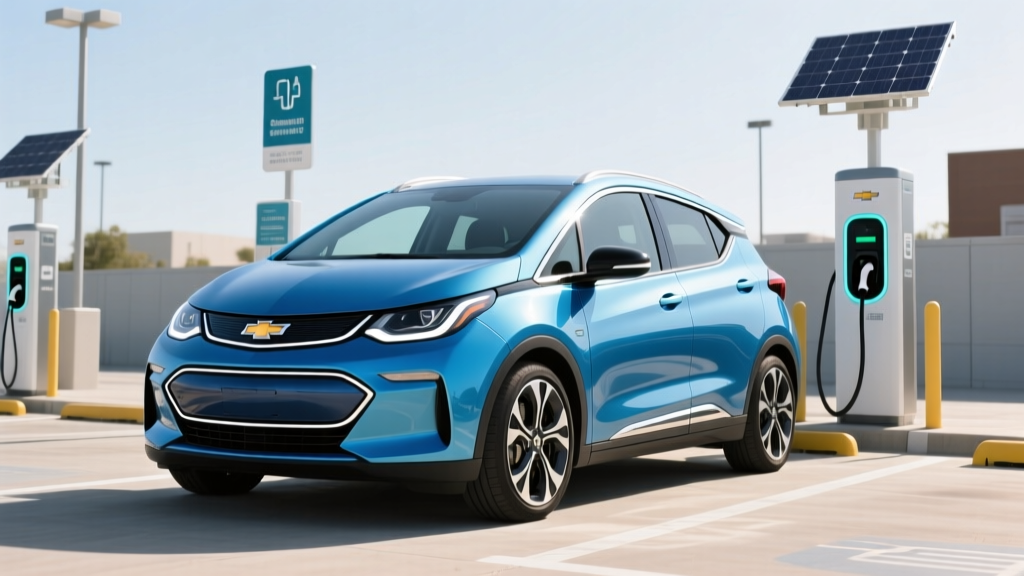
If you've searched for an affordable entry into electric vehicles, the Chevrolet Bolt EV likely sits at the top of your list. With a base MSRP starting around $27,800 for the 2026 model year and an EPA-estimated 259 miles of range, it undercuts nearly every competitor on price. But the sticker price is only the beginning. The true Bolt EV cost of ownership includes charging, insurance, maintenance, depreciation, and the federal tax credit that can knock up to $7,500 off your effective purchase price — if you qualify.
This guide walks through every dollar you'll spend (and save) over five years of Bolt EV ownership, using real EPA data, current IRS §30D rules, and industry insurance and depreciation benchmarks.
2026 Chevrolet Bolt EV: Quick Specs at a Glance
Before we crunch ownership costs, here are the numbers that define the 2026 Bolt EV. Chevrolet reintroduced the Bolt on the updated BEV3 platform with a revised LFP (lithium iron phosphate) battery pack, faster DC charging, and standard NACS compatibility.
| Spec | Value |
|---|---|
| Base MSRP (1LT) | $27,800 |
| EPA Range | 259 miles |
| Battery Capacity | 65 kWh usable (LFP chemistry) |
| Peak DC Fast Charge | 150 kW (NACS connector) |
| 10–80% DC Charge Time | ~30 minutes |
| Level 2 AC Charge Rate | 11.5 kW |
| Efficiency | 120 MPGe combined (28 kWh/100 mi) |
| Motor Output | 200 hp / 266 lb-ft torque |
| 0–60 mph | ~6.5 seconds |
| Battery/Powertrain Warranty | 8 years / 100,000 miles |
| Federal Tax Credit (§30D) | Up to $7,500 (eligibility required) |
5-Year Total Cost of Ownership: The Full Bolt EV Cost Breakdown
To understand what owning a Bolt EV actually costs, we modeled five years of ownership assuming 12,000 miles driven annually (60,000 miles total), a home Level 2 charger, and the federal tax credit applied at point of sale. We've compared it against a similarly priced gas compact — the 2026 Honda Civic (MSRP ~$25,000, 35 MPG combined) — to show where EV ownership saves money and where it costs more.
| Cost Category | Bolt EV | Gas Compact (35 MPG) |
|---|---|---|
| Purchase Price (MSRP) | $27,800 | $25,000 |
| Federal Tax Credit (§30D) | −$7,500 | $0 |
| Effective Purchase Price | $20,300 | $25,000 |
| Home Charger Install (Level 2) | $1,200 | $0 |
| Fuel/Energy (60,000 mi) | $2,520 | $5,830 |
| Maintenance (5 years) | $1,100 | $3,200 |
| Insurance (5 years) | $9,600 | $7,500 |
| Depreciation (5-year) | −$9,500 | −$10,000 |
| Net 5-Year Cost | $25,220 | $31,530 |
Bottom line: Over five years, the Bolt EV costs approximately $6,310 less than a comparable gas compact, primarily due to the federal tax credit, lower fuel costs, and reduced maintenance. However, higher insurance premiums and the upfront charger installation cost partially offset those savings.
Federal Tax Credit: Do You Qualify for the Full $7,500?
The IRS §30D Clean Vehicle Credit can reduce your Bolt EV cost by up to $7,500 — and under current rules, you can transfer it to the dealer at point of sale, effectively lowering your purchase price on the spot. But not every buyer qualifies. The credit has strict income caps, MSRP limits, and battery-sourcing requirements that you must meet simultaneously.
- MSRP Cap: Vehicle MSRP must not exceed $55,000 for sedans/hatchbacks (the Bolt EV at $27,800–$32,000 clears this easily).
- Income Limits (Modified AGI): $150,000 single filers / $225,000 head of household / $300,000 joint filers. Your income in the purchase year or prior year (whichever is lower) must fall under these caps.
- Battery Critical Minerals: A percentage of critical minerals must be sourced from the U.S. or a free-trade-agreement country (threshold increases annually — 80% for 2026). This determines $3,750 of the credit.
- Battery Component Assembly: A percentage of battery components must be manufactured or assembled in North America (threshold: 90% for 2026). This determines the other $3,750.
- Foreign Entity of Concern (FEOC): Vehicles with battery components or critical minerals from a FEOC (e.g., certain Chinese suppliers) are disqualified entirely.
- Point-of-Sale Transfer: You can transfer the credit to the dealer for an immediate price reduction, or claim it on your federal tax return. You must file IRS Form 8936.
- One Credit Per VIN: The credit is tied to the vehicle, not the buyer. A used Bolt EV does not qualify for the new-vehicle credit (but may qualify for the separate used-EV credit of up to $4,000 under §25E).
For the 2026 Bolt EV: Chevrolet's Ultium-based LFP pack sources materials and assembles components in North America. As of early 2026, GM has listed the Bolt EV on the fueleconomy.gov qualifying vehicles page as eligible for the full $7,500 credit. However, always verify the specific VIN with the dealer and cross-reference the IRS Clean Vehicle Credit page before signing — sourcing rules can shift mid-year.
Charging Cost vs. Gasoline: The Per-Mile Math
This is where the Bolt EV cost story turns decisively in the owner's favor. Electricity is substantially cheaper per mile than gasoline, especially when you charge at home.
| Scenario | Rate | Cost Per Mile | Annual Cost (12,000 mi) |
|---|---|---|---|
| Home Level 2 (national avg $0.15/kWh) | 28 kWh/100 mi | $0.042 | $504 |
| Home with utility EV rate ($0.10/kWh off-peak) | 28 kWh/100 mi | $0.028 | $336 |
| Public DC fast charging ($0.40/kWh avg) | 28 kWh/100 mi | $0.112 | $1,344 |
| Gas compact (35 MPG, $3.40/gal) | — | $0.097 | $1,166 |
Key takeaway: If you charge primarily at home on a standard residential rate ($0.15/kWh), you'll spend roughly $504/year on electricity — less than half the $1,166 a gas compact driver spends. Even on an off-peak utility EV rate ($0.10/kWh), annual fuel cost drops to just $336.
However, if you rely exclusively on public DC fast charging at $0.40/kWh, your annual cost rises to $1,344 — more than the gas car. This is why home charging access is critical to the Bolt EV cost equation. The Bolt's 150 kW peak DC charge rate (with a 10–80% time of ~30 minutes) means road trips are practical, but daily public charging erodes savings.
Over 60,000 miles and five years, assuming 80% home charging and 20% public DC fast charging, a realistic blended energy cost is approximately $2,520, compared to $5,830 for gasoline.
Maintenance Savings: What You Won't Pay For
EVs have dramatically fewer moving parts than internal combustion vehicles. The Bolt EV's single-speed reduction gear and permanent-magnet motor require no oil changes, no spark plugs, no timing belts, and no exhaust system repairs.
| Service Item | Bolt EV | Gas Compact |
|---|---|---|
| Oil Changes (5 years) | $0 | $600 (10 changes @ $60) |
| Brake Pads | $0–$200 (regen extends life) | $400–$600 |
| Transmission Fluid | $0 (sealed unit) | $150–$250 |
| Air Filters / Spark Plugs | $0 | $200–$300 |
| Cabin Air Filter | $150 | $150 |
| Tire Rotation/Replacement | $800 (EVs wear tires faster) | $700 |
| Coolant Flush | $100 | $150 |
| Total (5 years) | ~$1,100 | ~$3,200 |
The Bolt EV's regenerative braking system does most of the deceleration work, meaning the friction brake pads can last well beyond 100,000 miles. The one area where EVs cost slightly more is tires — the instant torque and heavier weight (the Bolt EV weighs approximately 3,600 lbs) accelerate tread wear. Budget for a tire replacement around year 4.
GM's 8-year/100,000-mile battery and powertrain warranty covers the traction battery against defects and capacity loss below 60% of original capacity, providing long-term peace of mind that gas-car powertrain warranties (typically 5 years/60,000 miles) don't match.
Insurance: The Bolt EV Cost Factor Most Buyers Overlook
Here's where the Bolt EV cost equation works against you. EV insurance premiums are typically 15–25% higher than equivalent gas vehicles. For the Bolt EV, expect annual premiums in the range of $1,800–$2,100 depending on your state, driving record, and coverage level — compared to $1,400–$1,600 for a gas compact.
Why are EVs more expensive to insure?
- Higher repair costs: EV battery packs and power electronics are expensive to replace after a collision. Even minor damage near the battery enclosure can trigger a total-loss declaration.
- Specialized repair network: Fewer body shops are certified to work on high-voltage systems, increasing labor rates.
- Vehicle weight: Heavier vehicles cause more damage in multi-vehicle accidents, raising liability payouts.
- Parts availability: EV-specific components (inverters, onboard chargers) have longer lead times than commodity ICE parts.
Over five years, expect to pay approximately $9,600 in insurance for the Bolt EV versus $7,500 for a gas compact — a $2,100 gap. Shop quotes from multiple insurers; companies like State Farm, Progressive, and GEICO have varying EV-specific rating models, and some offer EV discounts or low-mileage credits.
Depreciation and Resale Value: How the Bolt EV Holds Up
EV depreciation has been volatile. The original Bolt EV (discontinued after 2023) suffered steep depreciation partly due to the battery recall and partly because the $26,500 MSRP reset on the new generation undercut used values. The 2026 Bolt EV on the BEV3 platform with LFP chemistry is a different proposition.
Projected 5-year depreciation for the 2026 Bolt EV:
- Year 1: ~20% loss (typical new-car first-year drop)
- Years 2–5: ~10–12% annually
- Estimated 5-year resale value: ~$10,800–$12,500 (approximately 40–45% of MSRP retained)
- Total depreciation cost: ~$9,500 over 5 years
LFP battery chemistry is a depreciation positive — it degrades more slowly than NMC and can be charged to 100% daily without accelerated wear, meaning a 5-year-old Bolt EV should retain a strong state of health (SoH). The NACS connector is also future-proof, as the industry standardizes on Tesla's charging plug.
For comparison, a gas compact at $25,000 typically retains ~$15,000 after five years (60% retention), meaning ~$10,000 in depreciation. The Bolt EV's depreciation in absolute dollars is slightly lower, but its percentage retention is weaker — a common EV pattern driven by rapid tech advancement and battery-health uncertainty among used buyers.
State, Local, and Utility Incentives Beyond the Federal Credit
Examples of additional incentives that may apply (verify current availability with your state and utility):
- California (CVRP): Up to $2,000 rebate for income-qualified buyers (program funding varies).
- Colorado: State tax credit of up to $5,000 for new EVs under $50,000 MSRP.
- New York (Drive Clean Rebate): Point-of-sale rebate up to $2,000 based on income and vehicle price.
- Utility rebates: Many electric utilities offer $250–$1,000 for EV purchase and $200–$500 for Level 2 charger installation. Check with your local provider (e.g., PG&E, ConEdison, Xcel Energy).
- HOV lane access: States like California, Virginia, and Maryland offer carpool-lane stickers for EVs — a non-monetary perk with real time value.
These incentives change frequently and often have income qualifications or funding caps. Check the Alternative Fuels Data Center for a state-by-state database of current incentives.
Who Should Buy the Bolt EV (and Who Shouldn't)?
Choose the Bolt EV if:
- You qualify for the full $7,500 federal tax credit (effective price ~$20,300).
- You can install a Level 2 home charger and charge overnight.
- Your daily commute is under 100 miles round-trip.
- You want the lowest possible entry price for a 250+ mile EV.
- You value LFP battery longevity and can charge to 100% without worry.
Look elsewhere if:
- You lack home charging access and would rely on public DC fast chargers daily.
- You regularly drive 300+ miles between stops (the Bolt's 150 kW peak charge rate is slower than 800V competitors).
- You exceed the §30D income caps and cannot claim the credit.
- You need AWD or towing capability (the Bolt EV is FWD only, no tow rating).
Frequently Asked Questions
How much does it really cost to own a Chevy Bolt EV over 5 years?
Based on our analysis — factoring in the $7,500 federal tax credit, home charging, insurance, maintenance, and depreciation — the net 5-year cost of a 2026 Bolt EV is approximately $25,220. That's roughly $6,310 less than a comparably priced gas compact over the same period. Your actual cost will vary based on local electricity rates, insurance premiums, and whether you qualify for the full tax credit.
Do I qualify for the $7,500 federal EV tax credit on the Bolt EV?
You likely qualify if your modified adjusted gross income is under $150,000 (single) or $300,000 (joint), and you purchase the vehicle new. The 2026 Bolt EV's MSRP ($27,800–$32,000) is well under the $55,000 sedan cap. The vehicle must also meet battery critical-mineral and component-sourcing requirements, which GM has indicated the 2026 Bolt EV satisfies for the full $7,500. Always confirm via the IRS Clean Vehicle Credit page and your dealer before purchase.
How much do I save on fuel and maintenance vs. a gas car?
Over 60,000 miles, Bolt EV owners who charge primarily at home save approximately $3,310 on fuel ($2,520 vs. $5,830 for gas) and roughly $2,100 on maintenance ($1,100 vs. $3,200). Combined, that's over $5,400 in operational savings over five years.
Are EVs more expensive to insure than gas cars?
Yes. Expect Bolt EV insurance premiums to run 15–25% higher than a gas compact — roughly $1,800–$2,100 per year versus $1,400–$1,600. Higher repair costs, specialized labor, and vehicle weight contribute. Over five years, that's approximately $2,100 more in insurance costs, which partially offsets fuel and maintenance savings.
How well does the Bolt EV hold its resale value?
The 2026 Bolt EV is projected to retain approximately 40–45% of its MSRP after five years, translating to roughly $9,500 in depreciation. This is slightly better in absolute dollars than a gas compact (~$10,000 depreciation) but weaker in percentage terms. The LFP battery's slower degradation and NACS connector compatibility should support stronger used-EV demand compared to earlier Bolt generations.
Can I charge the Bolt EV to 100% every day?
Yes. The 2026 Bolt EV uses LFP (lithium iron phosphate) battery chemistry, which tolerates daily 100% charging far better than NMC chemistry. GM recommends periodic full charges for LFP packs to allow the battery management system to calibrate accurately. This is a significant ownership advantage — you get the full 259 miles of range every day without accelerated degradation.