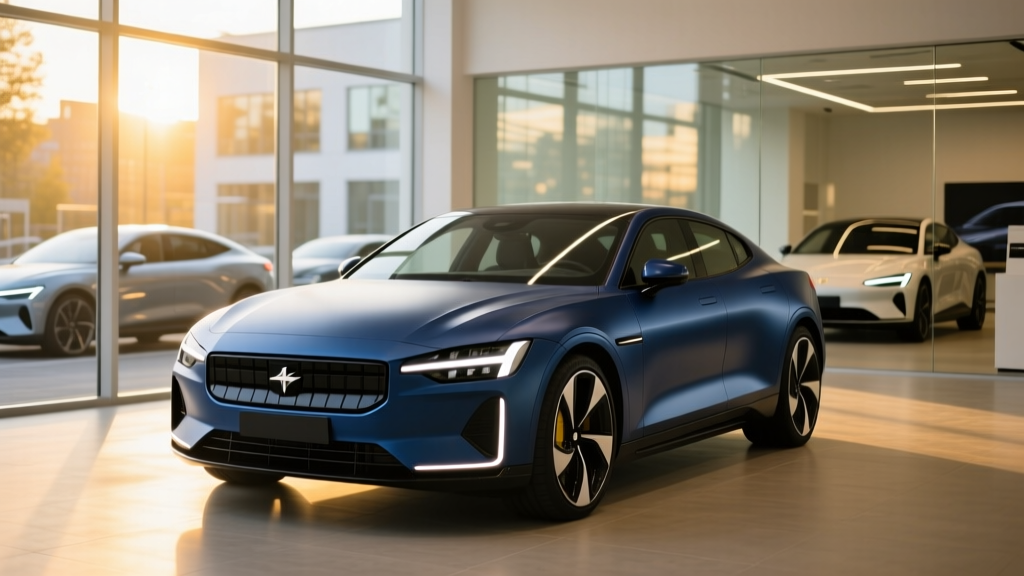
When shoppers search for the true Polestar cost, they often find a headline MSRP and stop there. But the actual price you pay — and the value you receive over five years — depends on trim selection, federal tax credit eligibility under IRS §30D, home charging economics, and how the car's real-world range stacks up against its EPA sticker. This guide breaks down the full cost picture for Polestar's 2026 U.S. lineup: the Polestar 2 sedan, the Polestar 3 SUV, and the Polestar 4 fastback SUV.
2026 Polestar Lineup at a Glance
Polestar positions itself as a premium Scandinavian EV brand, competing directly with Tesla, BMW, Audi, and Volvo (its corporate sibling under Geely). The 2026 lineup spans three distinct body styles, each targeting a different buyer profile. Below is the core specification matrix for the most popular trims.
| Spec | Polestar 2 Long Range Dual Motor | Polestar 3 Long Range Dual Motor | Polestar 4 Long Range Dual Motor |
|---|---|---|---|
| Base MSRP | $49,900 | $67,900 | $59,900 |
| EPA Range | 320 mi | 315 mi | 300 mi |
| Battery (usable) | 79 kWh (NMC) | 107 kWh (NMC) | 100 kWh (NMC) |
| Drivetrain | AWD (Dual Motor) | AWD (Dual Motor) | AWD (Dual Motor) |
| Horsepower | 421 hp | 489 hp | 544 hp |
| 0–60 mph | 4.3 sec | 4.7 sec | 3.8 sec |
| Max DC Fast Charge | 200 kW | 250 kW | 200 kW |
| 10–80% DC Time | ~28 min | ~30 min | ~30 min |
| Level 2 Home Charge | 11 kW (~37 mi/hr) | 11 kW (~37 mi/hr) | 11 kW (~34 mi/hr) |
| MPGe (combined) | 107 MPGe | 89 MPGe | 94 MPGe |
| Battery Warranty | 8 yr / 100,000 mi | 8 yr / 100,000 mi | 8 yr / 100,000 mi |
Real-World Range: What the EPA Sticker Doesn't Tell You
Polestar 2 LRDM: EPA 320 mi → Expect ~270–285 mi on highway road trips at 70+ mph; ~240–260 mi in freezing weather.
Polestar 3 LRDM: EPA 315 mi → Expect ~265–280 mi highway; ~230–250 mi in sub-30°F conditions.
Polestar 4 LRDM: EPA 300 mi → Expect ~255–270 mi highway; ~220–240 mi in deep cold.
Polestar's EPA range figures are competitive within each segment, but as with all EVs, real-world results depend heavily on driving style, ambient temperature, and terrain. The Polestar 2's 320-mile rating benefits from its relatively low curb weight (~4,680 lbs) and aerodynamic fastback sedan shape. In our experience and consistent with fueleconomy.gov data, highway driving at sustained speeds above 70 mph reduces effective range by roughly 10–15% compared to the EPA combined cycle.
Cold weather is the larger variable. NMC (nickel manganese cobalt) chemistry, which all three models use, loses approximately 15–25% of usable capacity in sustained sub-freezing temperatures. Polestar includes a heat pump across the lineup, which mitigates cabin-heating energy draw, but the battery still requires thermal preconditioning. If you commute in Minnesota winters, budget for a real-world range closer to 240 miles on the Polestar 2 and plan charging stops accordingly.
The Polestar 3's massive 107 kWh usable battery provides a buffer against range loss, but its larger, heavier SUV body (over 5,500 lbs) and boxier profile work against efficiency. The 89 MPGe combined rating reflects this — it's noticeably thirstier per mile than the Polestar 2, which translates directly into higher charging costs over time.
Charging Speed and Infrastructure: The Full Picture
| Charge Level | Power | Polestar 2 | Polestar 3 | Polestar 4 |
|---|---|---|---|---|
| Level 1 (120V) | ~1.4 kW | ~4 mi/hr | ~3 mi/hr | ~3 mi/hr |
| Level 2 (240V home) | 11 kW | ~37 mi/hr | ~37 mi/hr | ~34 mi/hr |
| DC Fast Charge (peak) | 200–250 kW | 200 kW | 250 kW | 200 kW |
| 10–80% DC Time | — | ~28 min | ~30 min | ~30 min |
Home Level 2 charging is where Polestar owners will do the vast majority of their energy replenishment. All three models accept up to 11 kW on AC, which means a full charge from 10% to 100% takes roughly 7–9 hours depending on battery size. That's an overnight top-up for most owners with a properly installed 48-amp Level 2 home charger on a 60-amp circuit.
DC fast charging is where the nuances matter. The Polestar 3's 250 kW peak rate is competitive with the best in the luxury SUV segment (BMW iX, Audi Q8 e-tron). However, peak rate is not sustained rate. Like all EVs, Polestar models follow a charging curve that tapers significantly above 80% state of charge. The 10–80% times listed above are achievable at a properly functioning 350 kW Electrify America or Tesla Supercharger (with NACS adapter), but expect the final 80–100% to add another 20–30 minutes. For road-trip planning, plan your stops around the 10–80% window and move on.
All 2026 Polestar models sold in the U.S. come equipped with the NACS (North American Charging Standard) port natively, granting access to Tesla's Supercharger network without an adapter. This is a significant practical advantage over older CCS-equipped vehicles and eliminates one major pain point for road-trip charging.
Polestar Cost by Trim: MSRP, Options, and As-Tested Pricing
| Model / Trim | Base MSRP | Typical As-Tested | Destination |
|---|---|---|---|
| Polestar 2 Standard Range Single Motor | $42,900 | $45,000–$48,000 | $1,400 |
| Polestar 2 Long Range Single Motor | $46,900 | $49,000–$53,000 | $1,400 |
| Polestar 2 Long Range Dual Motor | $49,900 | $54,000–$58,000 | $1,400 |
| Polestar 2 Long Range Dual Motor w/ Performance | $55,900 | $58,000–$62,000 | $1,400 |
| Polestar 4 Long Range Single Motor | $54,900 | $58,000–$63,000 | $1,400 |
| Polestar 4 Long Range Dual Motor | $59,900 | $64,000–$70,000 | $1,400 |
| Polestar 3 Long Range Dual Motor | $67,900 | $73,000–$80,000 | $1,400 |
| Polestar 3 Long Range Dual Motor w/ Performance | $73,900 | $78,000–$85,000 | $1,400 |
Polestar's pricing places it firmly in the premium segment. The Polestar 2 starts accessibly at $42,900 for the Standard Range Single Motor, but most buyers gravitate toward the Long Range Dual Motor for its 320-mile range and all-wheel-drive traction. Option packages — the Plus Pack (panoramic roof, Harman Kardon audio, heated rear seats), the Pilot Pack (advanced driver assists with Pixel LED headlights), and the Performance Pack (Öhlins dampers, Brembo brakes, gold seatbelts) — can add $4,000–$8,000 to the bottom line.
The Polestar 4 occupies a unique niche: a coupe-like SUV that eliminates the traditional rear window in favor of a digital rearview camera system and a roof-mounted camera feed. This design choice polarizes buyers but enables a sleek roofline and generous rear headroom. At $54,900–$59,900, it undercuts the Polestar 3 while offering comparable performance in Dual Motor form.
The Polestar 3, at $67,900 and up, is the brand's flagship and competes directly with the BMW iX xDrive50, Audi Q8 e-tron, and Mercedes EQE SUV. Its 107 kWh battery is one of the largest in the segment, and the available air suspension and Bowers & Wilkins audio system push as-tested prices well past $80,000 with options.
Federal Tax Credit: Does Polestar Qualify for §30D?
- MSRP Cap: Sedans (Polestar 2) must be ≤$55,000; SUVs/trucks (Polestar 3, 4) must be ≤$80,000.
- Buyer Income Cap: AGI ≤$150,000 (single), ≤$225,000 (head of household), ≤$300,000 (joint).
- Battery Sourcing: Critical minerals and battery components must meet phased-in domestic/free-trade-partner thresholds per IRS guidelines.
- Point-of-Sale Transfer: Eligible buyers can transfer the credit to the dealer for an upfront price reduction.
- FEOC Restriction: Vehicles with battery components from a "foreign entity of concern" (e.g., certain Chinese suppliers) may be disqualified.
The Polestar 2 Long Range Dual Motor at $49,900 base falls under the $55,000 sedan MSRP cap, making it potentially eligible for the full $7,500 credit — provided the buyer meets income limits and the vehicle's battery sourcing satisfies current-year critical mineral and component requirements. However, Polestar's supply chain has historically relied on battery cells manufactured by LG Energy Solution and CATL, and the FEOC (Foreign Entity of Concern) restrictions enacted under the Inflation Reduction Act have made eligibility unpredictable for models with Chinese-sourced battery components.
The Polestar 4 and Polestar 3, classified as SUVs, benefit from the higher $80,000 MSRP cap. Most trims fall under this threshold at base, though heavily optioned Polestar 3 configurations can exceed it. As of early 2026, buyers should verify eligibility on the fueleconomy.gov credit lookup tool before committing to a purchase, as battery sourcing compliance can change with model-year production batches.
| Model | Base MSRP | Max §30D Credit | Effective Price* |
|---|---|---|---|
| Polestar 2 SRSM | $42,900 | Up to $7,500 | ~$35,400 |
| Polestar 2 LRSM | $46,900 | Up to $7,500 | ~$39,400 |
| Polestar 2 LRDM | $49,900 | Up to $7,500 | ~$42,400 |
| Polestar 4 LRSM | $54,900 | Up to $7,500 | ~$47,400 |
| Polestar 4 LRDM | $59,900 | Up to $7,500 | ~$52,400 |
| Polestar 3 LRDM | $67,900 | Up to $7,500 | ~$60,400 |
*Effective price assumes full $7,500 credit eligibility. Actual credit may be $0, $3,750, or $7,500 depending on battery sourcing compliance. Consult a tax professional and verify at fueleconomy.gov.
Ownership Costs: Charging, Insurance, and Depreciation
The purchase price is only the beginning. Total cost of ownership for a Polestar depends on three major ongoing factors: electricity cost, insurance premiums, and depreciation.
Charging cost: At the U.S. average residential electricity rate of ~$0.16/kWh (EIA, 2025), fully charging a Polestar 2's 79 kWh battery at home costs roughly $12.64 — yielding a fuel cost of approximately $0.04 per mile. Compare that to a gas sedan at 30 MPG with fuel at $3.50/gallon: $0.12 per mile. Over 15,000 miles per year, home charging saves roughly $1,200 annually. DC fast charging on road trips at $0.35–$0.50/kWh narrows the gap but still undercuts gasoline.
Insurance: Premium EVs carry higher insurance costs. Polestar 2 owners report annual premiums in the $1,800–$2,400 range depending on state and driving record, while the Polestar 3 can push $2,500–$3,200 annually. These figures run 15–30% higher than equivalent gas-powered sedans and SUVs, driven by higher repair costs and parts pricing.
Depreciation: Polestar has historically experienced steeper depreciation than Tesla or Porsche in the EV segment. Industry data from sources like iSeeCars and Kelley Blue Book suggest 5-year depreciation of 45–55% for the Polestar 2, compared to ~35–40% for the Tesla Model 3. The Polestar 3 and 4 are newer entries and lack long-term data, but luxury EV SUVs broadly retain 40–50% of value at five years. Buyers who lease may sidestep depreciation risk entirely, and Polestar frequently offers competitive lease deals that factor in estimated residual values.
Cargo, Space, and Daily Practicality
The Polestar 2 is a liftback sedan with 14.4 cubic feet of rear cargo space (seats up) and 40.5 cubic feet with the rear seats folded. There's also a small front trunk (frunk) at ~1.2 cubic feet — enough for charging cables and a small bag. Rear legroom measures 35.6 inches, which is adequate for adults but tighter than a Tesla Model 3 (35.2 inches, though the Tesla's cabin feels airier due to its glass roof and lower beltline).
The Polestar 4 offers 18.9 cubic feet behind the second row and approximately 49 cubic feet with seats folded. Its sloping roofline limits vertical cargo space for tall items, but the wide load floor accommodates strollers and luggage easily. Rear legroom is generous at 37.2 inches.
The Polestar 3 provides 24.3 cubic feet of cargo space (seats up) and up to 55 cubic feet with the rear row folded. Its SUV form factor makes it the most practical of the three for families with gear, and the available air suspension can lower the load height for easier access.
Pros and Cons: The Honest Verdict
- Striking Scandinavian design that stands out in a sea of Tesla ubiquity
- Google-built Android Automotive OS with native Google Maps, Assistant, and Play Store
- Standard NACS port for native Tesla Supercharger access
- Performance Pack with Öhlins dampers offers genuine handling engagement (Polestar 2)
- Heat pump standard across the lineup for cold-weather efficiency
- Over-the-air updates continue to refine vehicle software post-purchase
- Tax credit eligibility uncertain due to battery sourcing (FEOC rules)
- Depreciation steeper than Tesla and some German rivals
- Polestar 2 rear seat is snug for tall adults on long trips
- Polestar 4 eliminates rear window — digital camera feed takes adjustment
- Service center network still limited outside major metro areas
- DC fast charging at 200 kW (Polestar 2 and 4) trails Hyundai/Kia 800V architecture
Who Should Buy a Polestar — And Who Should Look Elsewhere?
- Choose Polestar 2 if: You want a premium electric sedan with distinctive design, Google-native infotainment, and AWD traction — and you don't need class-leading rear-seat space or 350 kW charging speeds.
- Choose Polestar 4 if: You want SUV practicality with coupe styling, strong acceleration, and a tech-forward cabin — and you're comfortable with a camera-based rearview system instead of a traditional rear window.
- Choose Polestar 3 if: You need a premium family EV SUV with a large battery buffer, air suspension comfort, and flagship build quality — and your budget accommodates $70,000+ as-tested pricing.
- Look at Tesla Model 3/Y if: Maximum charging speed, Supercharger network density, and resale value are your top priorities.
- Look at Hyundai Ioniq 5 / Kia EV6 if: You want 800V architecture for 10–80% charging in ~18 minutes and lower entry pricing.
- Look at BMW i4 / iX if: Traditional luxury dealership service networks and proven long-term reliability data matter more than Scandinavian minimalism.
Frequently Asked Questions
What is the real-world range of a Polestar?
The Polestar 2 Long Range Dual Motor is EPA-rated at 320 miles, but expect 270–285 miles on sustained highway driving and 240–260 miles in freezing weather. The Polestar 3 (EPA 315 mi) and Polestar 4 (EPA 300 mi) deliver proportionally less in real-world highway and cold conditions due to their larger, heavier bodies.
How fast does a Polestar charge at home and on the road?
At home on a Level 2 (240V, 48A) charger, all Polestar models accept 11 kW and add roughly 34–37 miles of range per hour — enough for a full overnight charge. On DC fast chargers, the Polestar 2 and 4 peak at 200 kW (10–80% in ~28–30 minutes), while the Polestar 3 peaks at 250 kW (10–80% in ~30 minutes). These times assume a properly functioning high-power charger and battery preconditioning.
How much does a Polestar cost after tax credits?
If fully eligible for the $7,500 IRS §30D credit, a Polestar 2 LRDM drops from $49,900 to approximately $42,400. However, eligibility depends on battery sourcing compliance, buyer income, and MSRP caps. The credit may be $0, $3,750, or $7,500 depending on the specific vehicle's supply chain. Always verify at fueleconomy.gov before purchasing.
Is Polestar worth buying vs Tesla, BMW, or Hyundai?
Polestar wins on design distinctiveness, Google-native software, and build quality that feels more premium than Tesla's interior. It loses on charging speed (200 kW vs Hyundai's 800V/~350 kW capability), resale value, and service center density. If you value Scandinavian aesthetics and don't mind a smaller service footprint, Polestar is compelling. If charging speed and resale are paramount, Tesla or Hyundai/Kia may serve you better.
Does the Polestar qualify for the federal EV tax credit?
It depends on the specific model, trim, and production batch. The Polestar 2 sedan must stay under the $55,000 MSRP cap; the Polestar 3 and 4 (classified as SUVs) must stay under $80,000. Additionally, battery critical minerals and components must meet domestic/free-trade-partner sourcing thresholds, and the buyer must fall under IRS income caps. Polestar's use of CATL and LG Energy Solution cells has made eligibility inconsistent — confirm per-VIN eligibility before purchase.
What is Polestar's battery warranty?
All 2026 Polestar models include an 8-year/100,000-mile battery and powertrain warranty, which covers defects and capacity loss below 70% of original capacity. This is industry-standard and matches Tesla, BMW, and Hyundai's EV battery warranty terms.
Sources: EPA / fueleconomy.gov, IRS §30D Clean Vehicle Credits, Polestar USA official specifications.