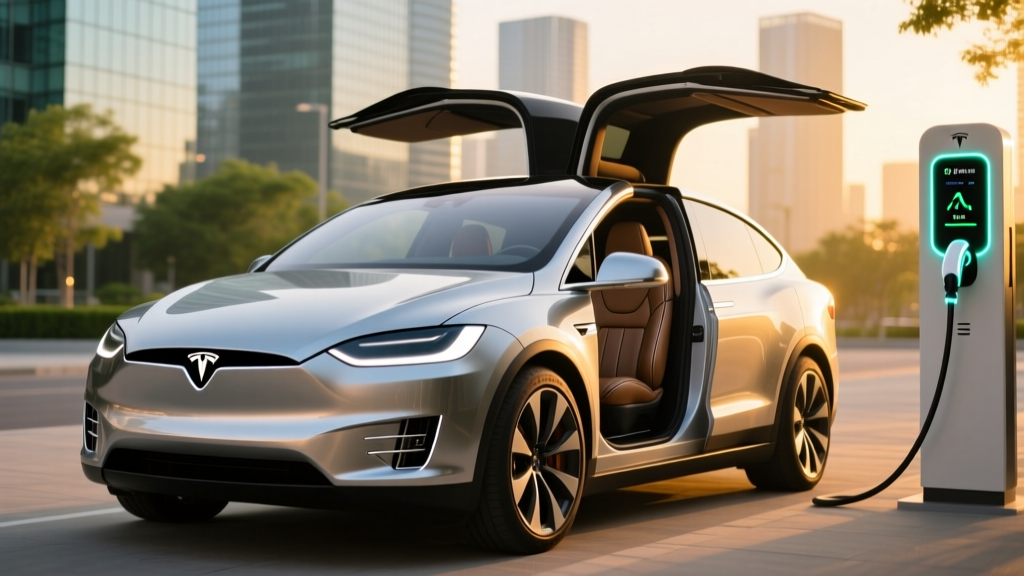
The Tesla Model X has long occupied a unique space in the EV market: a luxury electric SUV with falcon-wing doors, massive cargo volume, and seating for up to seven. For 2026, Tesla continues to refine its flagship SUV, but the competitive landscape has shifted dramatically. With rivals like the Rivian R1S, BMW iX, and Mercedes EQS SUV offering compelling alternatives, the Model X must lean on its core strengths — including its versatile Model X seats configuration, expansive Supercharger network access, and blistering performance — to justify its premium pricing.
Below, we cover everything a prospective buyer needs: real-world range versus EPA estimates, DC fast-charging speeds and home charging, interior space by seat configuration, federal tax credit eligibility under current IRS §30D rules, and whether the Model X is still the right call for families who need three rows of electric seating.
2026 Tesla Model X: Quick Specs at a Glance
| Spec | Model X Long Range (AWD) | Model X Plaid (Tri-Motor AWD) |
|---|---|---|
| EPA Range | 311 miles | 285 miles |
| Battery (usable) | ~100 kWh (NMC) | ~100 kWh (NMC) |
| 0–60 mph | 3.8 seconds | 2.5 seconds |
| Horsepower | 670 hp | 1,020 hp |
| Drivetrain | Dual-motor AWD | Tri-motor AWD |
| Max DC Fast Charge | 250 kW | 250 kW |
| 10–80% DCFC Time | ~30 min | ~30 min |
| Level 2 Home Charge | 11.5 kW (~34 mi/hr) | 11.5 kW (~34 mi/hr) |
| EPA Efficiency (MPGe) | 102 MPGe combined | 96 MPGe combined |
| Seating Configurations | 5, 6, or 7 seats | 5, 6, or 7 seats |
| Cargo (behind 3rd row) | 14.1 cu ft (5-seat: 42.1 cu ft) | 14.1 cu ft (5-seat: 42.1 cu ft) |
| Max Cargo (seats folded) | 83.1 cu ft | 83.1 cu ft |
| Base MSRP | $79,990 | $94,990 |
| Battery/Drive Warranty | 8 yr / 150,000 mi | 8 yr / 150,000 mi |
Model X Seats: 5, 6, or 7 — Which Configuration Works Best?
The Model X seats configuration is one of the few areas where Tesla offers genuine buyer choice at the order screen. Three layouts are available, and the right one depends entirely on how you plan to use the vehicle day-to-day.
5-Seat Configuration (Standard)
The base layout uses a traditional two-row setup with a 60/40-split second-row bench. This maximizes cargo flexibility: you get 42.1 cubic feet behind the second row and a full 83.1 cubic feet with seats folded. For couples or single-child families who prioritize cargo over passenger count, this is the most practical setup. Legroom is generous — 41.0 inches up front and 38.4 inches in the second row.
6-Seat Configuration ($6,500 Option)
This replaces the second-row bench with two individual captain's chairs and a center walk-through to the third row. The captain's chairs are individually adjustable, heated, and arguably the most comfortable seats in the vehicle. The walk-through makes third-row access significantly easier than climbing over a bench. This is the sweet spot for families who regularly carry four to six passengers and want adult-usable rear seats.
7-Seat Configuration ($3,500 Option)
Tesla adds a small center seat to the second row, creating a 2-3-2 layout. In practice, that center second-row seat is narrow and best suited for a child in a booster. The third row fits two passengers, but headroom and legroom (28.9 inches) are tight for adults on anything beyond short trips. If you regularly need to carry six or seven passengers, a Rivian R1S or a larger SUV may serve you better. The 7-seat Model X works best as an occasional-use third row for kids or carpools.
Range, Efficiency, and Real-World Expectations
The Model X uses a ~100 kWh (usable) battery pack with NMC (nickel-manganese-cobalt) chemistry. NMC offers higher energy density than LFP (lithium iron phosphate), which is necessary in a large, heavy SUV like the Model X (curb weight exceeds 5,100 lbs). However, NMC batteries benefit from daily charging limits around 80–90% for longevity, unlike LFP packs that tolerate regular 100% charges.
Efficiency varies significantly by configuration and driving style. The Long Range achieves 102 MPGe combined (approximately 33 kWh/100 mi), while the Plaid's extra motor and performance tuning drop it to 96 MPGe (~35 kWh/100 mi). For context, the lighter BMW iX xDrive50 achieves 87 MPGe but offers less range and no third row, while the Rivian R1S (Large Pack) returns around 96 MPGe with genuine off-road capability the Model X lacks.
According to fueleconomy.gov, the Model X Long Range's combined kWh/100mi figure translates to roughly $0.045–$0.065 per mile depending on your local electricity rate — substantially less than a comparable gas-powered BMW X5 or Mercedes GLE at $0.18–$0.24 per mile.
Charging Speed: DC Fast Charging and Home Level 2
| Charging Method | Power | Speed / Time | Notes |
|---|---|---|---|
| Level 1 (120V outlet) | ~1.4 kW | ~3–4 mi/hr | Emergency/trickle only; not practical for daily use |
| Level 2 (240V, 48A) | 11.5 kW | ~34 mi/hr (full charge ~10 hr) | Requires NACS Wall Connector or J1772 adapter; 60A circuit recommended |
| DC Fast Charge (Supercharger V3) | Up to 250 kW | 10–80% in ~30 min | Peak rate only sustained briefly; tapers above 50% SoC |
| DC Fast Charge (CCS via adapter) | Up to 150–175 kW | 10–80% in ~40 min | Adapter included with new vehicles; speed varies by network |
The Model X charges at a peak rate of 250 kW on Tesla's V3 Superchargers using its native NACS connector. In practice, the charge curve tells a more nuanced story than the peak number suggests. The vehicle holds near-peak rate from roughly 10–40% state of charge, then tapers progressively through the 50–80% range. A typical 10–80% session takes approximately 30 minutes — adequate for road-trip rest stops but not class-leading. The Hyundai Ioniq 5 and Kia EV9, with 800V architectures, can achieve 10–80% in roughly 18–20 minutes at 350 kW chargers.
For home charging, Tesla's Wall Connector at 48 amps delivers 11.5 kW, adding approximately 34 miles of range per hour. A full overnight charge from near-empty takes roughly 10 hours. Installation typically requires a 60-amp dedicated circuit; budget $500–$2,000 for a licensed electrician depending on your panel capacity and run distance. Homes with older 100-amp electrical panels may need a panel upgrade ($1,500–$3,000) to support simultaneous high-draw appliances.
Tesla's CCS adapter (included with new Model X deliveries) opens access to Electrify America, EVgo, and other CCS networks. However, charging speeds via adapter are often capped around 150–175 kW, and connector reliability on non-Tesla networks remains a common owner complaint. The expanding adoption of NACS by Ford, GM, Rivian, and others throughout 2024–2025 means the Supercharger network — already the most reliable DC network in the U.S. — is becoming the de facto standard, which benefits Model X owners directly.
Performance: From Family Hauler to Supercar SUV
The Model X Long Range's dual-motor AWD setup produces 670 horsepower and achieves a 3.8-second 0–60 mph time — faster than most sports sedans, let alone a 5,100-pound three-row SUV. Power delivery is instant and linear, with no transmission lag. Highway passing confidence is exceptional.
The Plaid variant adds a third rear motor for 1,020 horsepower and a 2.5-second 0–60 time. This is absurd performance that no buyer needs and every enthusiast appreciates. The tri-motor setup also provides torque vectoring across the rear axle, improving cornering stability. However, the Plaid's 26-mile range penalty and higher price make it hard to recommend unless you specifically want supercar acceleration in a family vehicle.
Ride quality on the adaptive air suspension is competent but not plush. The Model X communicates road imperfections more than a Mercedes EQS SUV or BMW iX, particularly on larger 22-inch wheels. Wind and road noise are well-managed at highway speeds. The yoke steering remains polarizing — some owners adapt quickly, others find it impractical for low-speed maneuvering and parking. A conventional round steering wheel is available as a no-cost option and is recommended for most buyers.
Pricing, Trims, and Federal Tax Credit Eligibility
| Trim | Base MSRP | Est. As-Tested | §30D Federal Credit |
|---|---|---|---|
| Model X Long Range (5-seat) | $79,990 | $85,000–$95,000 | Not eligible (MSRP exceeds $80,000 cap) |
| Model X Plaid (5-seat) | $94,990 | $100,000–$115,000 | Not eligible (MSRP exceeds $80,000 cap) |
Under current IRS §30D rules, the federal EV tax credit caps SUV eligibility at an MSRP of $80,000. The Model X Long Range starts at $79,990, which technically squeaks under the cap at base price — but adding any options (6-seat or 7-seat configuration, premium paint, FSD) pushes the vehicle above $80,000 and disqualifies it. The Plaid, starting at $94,990, is ineligible regardless of configuration.
Additionally, §30D imposes buyer income caps ($300,000 joint / $150,000 single for new vehicles), battery critical-mineral sourcing requirements, and North American final assembly rules. The Model X is assembled in Fremont, California, satisfying the assembly requirement. However, battery sourcing compliance varies by production batch — always verify the specific vehicle's credit eligibility with the dealer and cross-reference the IRS qualified vehicle list before relying on the credit in your purchase decision.
The point-of-sale transfer provision (effective 2024) allows eligible buyers to apply the credit as an immediate price reduction rather than waiting for a tax refund. But given the MSRP cap issue, most Model X buyers should plan to pay full price and consult a tax professional about any state-level incentives that may apply.
Technology, Driver Assistance, and Interior
The Model X interior centers on a 17-inch landscape touchscreen running Tesla's proprietary infotainment OS. The system handles navigation, media, climate, vehicle settings, and gaming (yes, gaming — the Model X can run Cyberpunk 2077 while parked). A secondary 8-inch screen serves rear passengers for climate control and media. The instrument cluster is a small display behind the yoke/wheel showing speed, range, and navigation prompts.
Build quality on recent Model X vehicles has improved significantly over early-production units, with tighter panel gaps and better material quality. However, at this price point, the interior still lacks the material richness of a Mercedes EQS SUV or BMW iX. Vegan leather seats are standard; there is no option for genuine leather or premium wood trim packages that competitors offer.
Tesla's Autopilot driver assistance comes standard and includes adaptive cruise control, lane-keeping, and automatic emergency braking. Full Self-Driving (Supervised) is a $8,000 option (or $99/month subscription) that adds city-street navigation, traffic-light recognition, and automated parking. It is critical to understand that FSD is a SAE Level 2 driver-assist system — the driver must remain fully engaged, hands on the wheel (or torque applied to the yoke), and eyes on the road at all times. It is not autonomous driving.
Standout features include the HEPA air filtration system (Bioweapon Defense Mode, which genuinely filters wildfire smoke and allergens), the panoramic windshield that extends over the front seats, power-folding second and third rows accessible from the touchscreen, and the front trunk (frunk) offering 6.6 cubic feet of additional storage.
Ownership Costs and Warranty
Tesla provides a 4-year/50,000-mile basic vehicle warranty and an 8-year/150,000-mile battery and drive unit warranty. The battery warranty guarantees retention of at least 70% capacity over the warranty period — if degradation exceeds 30%, Tesla will repair or replace the pack. Real-world data from high-mileage Tesla owners suggests NMC packs in the Model X typically retain 85–90% capacity at 100,000 miles when following recommended charging practices (daily limit of 80–90%, avoiding prolonged storage at 100% or below 10%).
Insurance costs for the Model X are among the highest in the EV segment. Expect annual premiums of $3,500–$5,500 depending on your location, driving record, and coverage level — roughly 40–60% higher than a comparable gas SUV. Tesla offers its own insurance product in many states, which uses real-time driving data to set premiums and can be competitive for safe drivers.
Maintenance costs are low relative to internal-combustion vehicles — no oil changes, spark plugs, or transmission fluid. Budget for cabin air filter replacement ($150–$250 every 2–3 years), tire rotation ($50–$100 every 6,250 miles), and brake fluid checks. The Model X's weight and instant torque mean tire wear is faster than a gas SUV; expect to replace tires every 25,000–35,000 miles at $1,200–$1,800 for a set of four.
Pros, Cons, and Who Should Buy the Model X
Pros
- Up to 7 seats — one of very few 3-row electric SUVs
- Access to Tesla Supercharger network (most reliable DC network in the U.S.)
- Falcon-wing doors make car-seat loading exceptionally easy
- Class-leading performance (3.8s 0–60 Long Range, 2.5s Plaid)
- Massive cargo volume (83.1 cu ft max) plus frunk
- Over-the-air updates continuously add features
- HEPA air filtration system
Cons
- Mostly ineligible for $7,500 federal tax credit (MSRP cap)
- 250 kW peak charge rate trails 800V competitors (Ioniq 5, EV9)
- Third-row space tight for adults on long trips
- Insurance premiums significantly above segment average
- Falcon-wing doors add repair complexity and cost
- Interior materials don't match German luxury rivals at this price
- No Apple CarPlay or Android Auto
Who the Model X Suits Best
The Model X is ideal for tech-forward families who need three rows occasionally, prioritize access to the Supercharger network for road trips, and value performance. It works well as a daily commuter for households with home Level 2 charging and as a long-distance traveler thanks to Supercharger density. It is less suited for buyers who need adult-comfortable third-row seating on a regular basis, who want traditional luxury materials, or who are budget-conscious about total ownership cost.
Key Competitors to Cross-Shop
- Rivian R1S — Better off-road capability, more usable third row, but smaller Supercharger-adjacent charging network (though Rivian now has Supercharger access via adapter). Starts around $75,900.
- Kia EV9 — Significantly cheaper ($54,900+), faster charging (800V architecture), eligible for tax credit, but less range and performance.
- BMW iX — Superior interior luxury and ride comfort, but only two rows of seating.
- Mercedes EQS SUV — Available third row, exceptional comfort, but higher starting price and slower charging.
Frequently Asked Questions
What is the real-world range of the Tesla Model X?
The EPA rates the Model X Long Range at 311 miles and the Plaid at 285 miles. In real-world highway driving at 70–75 mph in moderate temperatures, expect 260–280 miles (Long Range) and 230–250 miles (Plaid). Cold weather below 30°F reduces range by an additional 15–25%, bringing the Long Range down to roughly 220–250 miles. Preconditioning the battery while navigating to a Supercharger helps mitigate cold-weather charging slowdowns but does not fully eliminate range loss.
How fast does the Model X charge at home and on the road?
At home on a Level 2 (240V, 48A) Tesla Wall Connector, the Model X charges at 11.5 kW, adding approximately 34 miles of range per hour — a full overnight charge from near-empty takes about 10 hours. On DC fast chargers, the Model X peaks at 250 kW on V3 Superchargers, achieving 10–80% in approximately 30 minutes. On CCS networks via the included adapter, expect 150–175 kW peak rates and 10–80% in roughly 40 minutes.
Does the Model X qualify for the $7,500 federal EV tax credit?
Generally, no. The IRS §30D tax credit caps SUV eligibility at an MSRP of $80,000. The Model X Long Range starts at $79,990, but adding any options (seat configuration upgrades, paint, FSD) pushes it over the cap. The Plaid starts well above at $94,990. Additionally, buyers must meet income caps ($300,000 joint / $150,000 single), and battery critical-mineral sourcing requirements must be met. Always verify eligibility on the IRS qualified vehicles list for your specific VIN before purchase.
Is the Model X third row practical for adults?
For short trips, yes — for long drives, no. Third-row legroom is 28.9 inches, which is adequate for children and smaller adults on 20–30 minute rides. Adults over 5'8" will find their knees pressed into the second-row seatbacks on longer journeys. The 6-seat configuration's walk-through makes third-row access far easier than the 7-seat bench layout. If you regularly carry adults in the third row, test the Rivian R1S or Mercedes EQS SUV, both of which offer more rear headroom and legroom.
How does the Model X compare to the Rivian R1S?
The R1S offers more usable third-row space, genuine off-road capability (8.9 inches of ground clearance vs. the Model X's adjustable 5.4–8.1 inches), and a lower starting price. The Model X counters with Supercharger network access (though Rivian now has adapter-based access), faster acceleration, a larger frunk, and more total cargo volume. The R1S uses a ~149 kWh Max Pack (NMC) for up to 410 miles of range but charges at a slower peak rate. For families prioritizing third-row comfort and adventure capability, the R1S has the edge. For tech, performance, and road-trip charging infrastructure, the Model X still leads.
What does it cost to maintain a Model X?
Annual maintenance runs roughly $400–$700 — cabin air filters, tire rotation, wiper fluid, and brake fluid checks. The biggest recurring cost is tires ($1,200–$1,800 every 25,000–35,000 miles) due to the vehicle's weight and torque. Brake pads last exceptionally long thanks to regenerative braking — many owners report 80,000+ miles on original pads. Out-of-warranty repairs on the air suspension, falcon-wing door mechanisms, or drive units can be expensive ($2,000–$8,000+), making an extended warranty worth considering for owners who plan to keep the vehicle past the 4-year/50,000-mile basic coverage.