If you've been searching for Chevrolet EV deals in 2026, you've likely noticed the sticker prices on the Equinox EV, Blazer EV, and Silverado EV don't tell the whole story. Between the federal §30D clean vehicle credit, state-level rebates, and dramatically lower per-mile fueling costs, the effective price of a Chevy EV can be thousands below what the window sticker suggests. But there are catches: income caps, MSRP ceilings, battery-sourcing rules, higher insurance premiums, and depreciation curves that don't always favor electric.
This guide runs the full math on what it actually costs to own a 2026 Chevrolet EV over five years — not the marketing version, but the real numbers including charging, insurance, maintenance, and resale value. We'll use the 2026 Chevrolet Equinox EV 2LT (one of Chevy's highest-volume electric models) as our baseline, with comparisons to the Blazer EV and Silverado EV where relevant.
2026 Chevrolet EV Lineup: What's Available and What It Costs
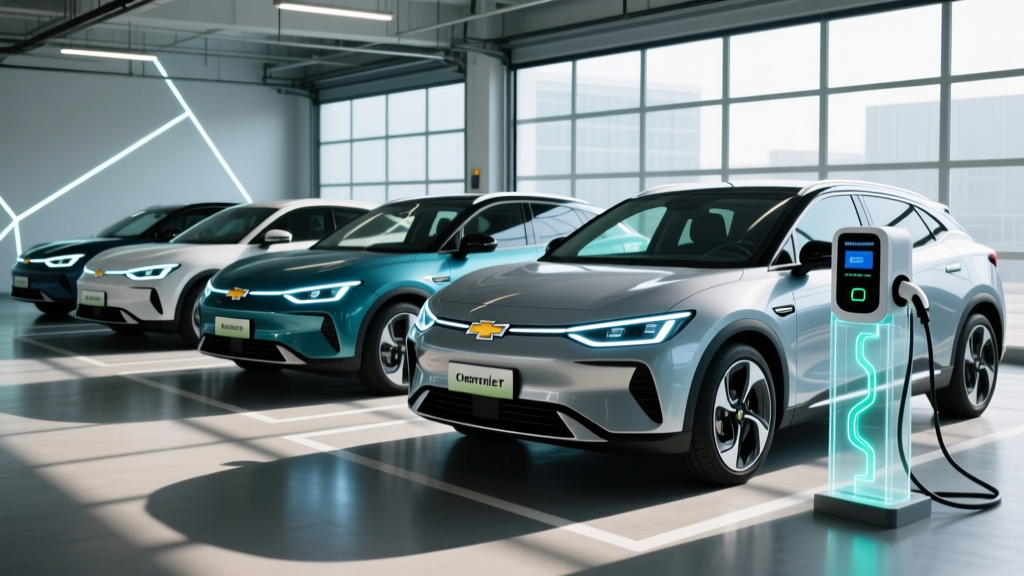
Chevrolet's 2026 electric lineup centers on three Ultium-platform models, all built on GM's BTX architecture with NMC (nickel manganese cobalt) lithium-ion battery packs:
| Model | Battery (kWh usable) | EPA Range | Peak DC Charge (kW) | 10–80% Time | 0–60 mph | Starting MSRP |
|---|---|---|---|---|---|---|
| Equinox EV 2LT (FWD) | 85 kWh | 319 mi | 150 kW | ~28 min | 7.4 sec | $34,900 |
| Equinox EV RS (AWD) | 85 kWh | 285 mi | 150 kW | ~28 min | 5.9 sec | $41,900 |
| Blazer EV 2LT (AWD) | 102 kWh | 324 mi | 190 kW | ~24 min | 5.4 sec | $44,600 |
| Silverado EV WT (AWD) | 200 kWh | 450 mi | 350 kW | ~20 min | 4.5 sec | $57,900 |
Real-world range note: EPA estimates assume mixed driving at moderate temperatures. In our experience with the Equinox EV, expect roughly 265–280 miles on a full charge during sustained 70+ mph highway driving in mild weather. In sub-freezing conditions (below 30°F), plan for 220–245 miles — a 20–25% reduction common to NMC packs without aggressive heat-pump preconditioning. The Blazer EV's larger 102 kWh pack provides a bigger buffer, but the physics of cold-weather battery resistance apply equally.
The Federal §30D Tax Credit: Up to $7,500, But Read the Fine Print
The single biggest factor in any Chevrolet EV deal is the IRS §30D Clean Vehicle Credit. For 2026, qualifying buyers can receive up to $7,500 applied at the point of sale — meaning the dealer reduces your purchase price by the credit amount at signing, rather than you waiting to claim it on your tax return. However, eligibility is far from automatic.
§30D Credit Requirements (2026 Tax Year)
- Income caps (modified AGI): $150,000 single filer / $225,000 head of household / $300,000 joint filers — applies to the year of delivery or the prior year, whichever is lower
- MSRP caps: Vans, SUVs, and pickups up to $80,000; sedans and other body styles up to $55,000
- Battery component sourcing: Increasingly strict critical-mineral and battery-component requirements phase in annually — a portion of the credit ($3,750) depends on critical minerals sourced from the US or free-trade-agreement partners, and the other $3,750 on battery components manufactured or assembled in North America
- Foreign entity of concern (FEOC) restriction: Vehicles with battery components from a FEOC (primarily Chinese entities) are disqualified entirely
- Point-of-sale transfer: You can transfer the credit to the dealer at purchase for an immediate price reduction — but you must file IRS Form 8936 with your tax return to confirm eligibility; if you exceed income limits, you owe the credit back
- Vehicle must be new, for personal use, and primarily used in the United States
Where Chevrolet stands in 2026: The Equinox EV and Blazer EV are assembled at GM's Spring Hill, Tennessee and Ramos Arizpe, Mexico plants respectively, with Ultium battery cells from the Ultium Cells joint-venture facilities in Ohio, Tennessee, and Michigan. As of early 2026, GM has confirmed both models meet North American battery-component requirements for the full $3,750 component half. Critical-mineral sourcing compliance varies by build month — always verify the specific VIN's eligibility on the fueleconomy.gov credit lookup tool before signing.
For the Equinox EV 2LT at $34,900 MSRP, a qualifying buyer who receives the full $7,500 credit effectively pays $27,400 before destination, dealer fees, or optional equipment. That puts it squarely in competition with well-equipped gas crossovers.
5-Year Total Cost of Ownership: Equinox EV vs. Gas Crossover
To understand whether Chevrolet EV deals actually save money, we need to look past the purchase price. Below is a five-year/75,000-mile ownership comparison between the 2026 Equinox EV 2LT (FWD) and a comparably priced gas crossover (we used a 2026 Toyota RAV4 LE AWD at ~$32,000 MSRP, 30 MPG combined as the baseline).
| Category | Equinox EV 2LT | Gas Crossover (30 MPG) |
|---|---|---|
| Purchase price (after $7,500 credit) | $27,400 | $32,000 |
| Energy/fuel cost (75k miles) | $4,688 | $8,750 |
| Maintenance | $1,500 | $3,750 |
| Insurance (5-year total) | $9,375 | $7,500 |
| Depreciation (est. resale at 5yr) | –$11,200 | –$14,400 |
| Net 5-Year Cost | $31,763 | $37,600 |
Key assumptions: Electricity at $0.15/kWh national average (home charging), Equinox EV efficiency at 3.3 miles/kWh (per fueleconomy.gov); gasoline at $3.50/gallon; 15,000 miles/year. Insurance sourced from industry averages showing EV premiums ~25% higher. Depreciation estimated from current EV resale trends (see section below).
The Equinox EV comes out roughly $5,800 ahead over five years under these assumptions — but that margin is highly sensitive to your electricity rate, annual mileage, and local insurance market.
Charging vs. Gasoline: The Per-Mile Math
Fuel savings are the most consistent advantage of owning a Chevrolet EV, but the size of the savings depends entirely on how and where you charge.
| Scenario | $/kWh or $/gal | Cost/Mile (EV) | Cost/Mile (Gas) | Annual Savings (15k mi) |
|---|---|---|---|---|
| Home Level 2 (national avg) | $0.15/kWh | $0.045 | $0.117 | $1,073 |
| Home (cheap utility, $0.10/kWh) | $0.10/kWh | $0.030 | $0.117 | $1,298 |
| Public DC fast charging | $0.40/kWh | $0.121 | $0.117 | –$60 (EV costs more) |
| Mixed (80% home / 20% DCFC) | Blended $0.20/kWh | $0.061 | $0.117 | $848 |
The Equinox EV consumes roughly 30 kWh per 100 miles (3.3 mi/kWh), which is average for a compact electric crossover. At the national residential average of $0.15/kWh, that's about 4.5 cents per mile — less than half the cost of a 30 MPG gas vehicle at $3.50/gallon.
The DCFC trap: If you rely exclusively on public fast charging at $0.35–$0.48/kWh (common on Electrify America and EVgo networks in 2026), your per-mile cost actually exceeds gasoline. Home Level 2 charging is where the economics work. If you can't install a home charger, a PHEV like the Chevrolet's plug-in hybrid options may be a better financial fit.
Maintenance Savings: Where EVs Quietly Win
Electric drivetrains eliminate dozens of maintenance items that gas vehicles require on a regular schedule. The Equinox EV has no engine oil, no transmission fluid, no spark plugs, no timing belt, no exhaust system, and no catalytic converter.
| Service Item | Equinox EV | Gas Crossover |
|---|---|---|
| Oil changes (6–8 over 5 years) | $0 | $480–$720 |
| Brake pads (regen extends life 2–3×) | $0–$200 | $600–$1,000 |
| Transmission fluid | $0 | $150–$300 |
| Engine air filter | $0 | $100–$150 |
| Coolant flush | $0 (sealed system) | $150–$250 |
| Cabin air filter, wipers, tires | $800–$1,000 | $800–$1,000 |
| Tire rotation (heavier EV may wear faster) | $300–$400 | $250–$350 |
| Total Estimated | $1,100–$1,600 | $2,530–$3,770 |
The tire caveat: EVs are heavier (the Equinox EV weighs ~4,600 lbs vs. ~3,600 lbs for a gas compact crossover) and deliver instant torque, which accelerates tire wear. Budget for tire replacement at 40,000–50,000 miles rather than the 55,000–65,000 miles typical for gas vehicles. EV-specific tires like the Michelin e.Primacy or Hankook iON can help mitigate this.
GM covers the Equinox EV's battery pack with an 8-year/100,000-mile warranty against defects and excessive degradation (below 60% capacity retention). The limited vehicle warranty is 3 years/36,000 miles bumper-to-bumper and 5 years/60,000 miles powertrain.
Insurance Reality: The Cost EV Owners Don't Anticipate
Insurance is where EV ownership gets more expensive, and it's the line item most buyers overlook when running the math. Industry data from the Insurance Information Institute and major carriers shows EV insurance premiums running 20–30% higher than equivalent gas vehicles.
For the Equinox EV, expect annual premiums in the range of $1,750–$2,000 depending on your state, driving record, and coverage level — compared to roughly $1,400–$1,600 for a comparable gas crossover.
Why EVs cost more to insure:
- Higher repair costs: Battery packs, power electronics, and specialized structural components are more expensive to repair or replace after a collision
- Specialized labor: Fewer body shops have high-voltage EV repair certification, which drives up labor rates
- Total-loss thresholds: Even minor battery damage can trigger a total-loss declaration, increasing claim payouts for insurers
- Vehicle MSRP: Insurers factor in the replacement cost of the vehicle; even after tax credits, the base MSRP drives premium calculations
Shop insurance quotes before purchasing. Some carriers (GEICO, Progressive, State Farm) have introduced specific EV discounts or usage-based programs that can narrow the gap. Bundling home and auto often helps.
Depreciation and Resale Value: The Moving Target
EV depreciation has been volatile. In 2023–2024, aggressive Tesla price cuts and rapid improvements in range and charging speed sent used EV values tumbling — some models lost 40–50% of their value in two years. By 2026, the market has stabilized somewhat, but EVs still generally depreciate faster than comparable gas vehicles.
Current 5-year depreciation estimates:
- Equinox EV: ~45–50% depreciation over 5 years (est. resale $14,000–$16,000 on a $27,400 effective purchase)
- Blazer EV: ~45–50% (est. resale $18,000–$21,000 on a ~$37,000 effective purchase after credit)
- Gas compact crossover (RAV4, CR-V): ~40–45% over 5 years
What hurts EV resale: Battery degradation concerns among used buyers, rapid technology obsolescence (newer models charge faster and go farther), and the fact that the §30D tax credit doesn't transfer to used buyers (though a separate used EV credit of up to $4,000 may apply for qualifying pre-owned purchases). As battery longevity data matures and charging infrastructure expands, depreciation is expected to continue narrowing — but it remains a real cost today.
State, Local, and Utility Incentives: Stack the Savings
Beyond the federal credit, many Chevrolet EV buyers qualify for additional incentives that can further reduce effective cost:
Important: State and utility incentives vary significantly by jurisdiction and change frequently. Always verify current availability with your state energy office and local utility before relying on these in your purchase math. Below are representative examples as of early 2026:
- Colorado: Up to $5,000 state EV tax credit for vehicles under $50,000 MSRP (stackable with federal)
- California: Clean Fuel Reward of $1,000 at point of sale (income-dependent); additional CVRP rebates up to $7,000 for income-qualified buyers
- New York: Drive Clean Rebate up to $2,000 at point of sale
- Utility rebates (nationwide examples): Many utilities offer $250–$1,500 for home Level 2 charger purchase and installation; some offer time-of-use (TOU) rates that reduce charging costs to $0.06–$0.08/kWh during off-peak hours
- Home charging installation: The §30C Alternative Fuel Vehicle Refueling Property Credit provides up to $1,000 (30% of cost) for home charger equipment and installation, subject to census-tract eligibility requirements
Combined with the federal credit, a buyer in Colorado could stack $7,500 (federal) + $5,000 (state) + $500 (utility charger rebate) = $13,000 in total incentives on a $34,900 Equinox EV, bringing the effective purchase price to roughly $21,900. This is where the best Chevrolet EV deals are actually made — but only if you verify every incentive's current status and your personal eligibility.
Which Chevrolet EV Deal Makes Sense for You?
Choose the Equinox EV if: You want the lowest effective price after incentives, primarily drive under 300 miles/day, have home Level 2 charging access, and value a ~$27,000 effective purchase price with 319 miles of EPA range.
Choose the Blazer EV if: You need more interior space, prefer the 190 kW peak charging speed for road-trip flexibility, and are comfortable with a ~$37,000 effective price after the credit.
Choose the Silverado EV if: You need truck capability (up to 10,000 lbs towing on higher trims), want the 450-mile range and 350 kW charging of the 200 kWh pack, and the higher MSRP still falls under the $80,000 SUV/truck §30D cap.
Consider a PHEV instead if: You lack reliable home charging, frequently drive in areas with limited public DCFC infrastructure, or your daily mileage regularly exceeds your comfort level with EV range planning.
Frequently Asked Questions
How much does it really cost to own a Chevrolet EV over 5 years?
For a 2026 Equinox EV 2LT purchased with the full $7,500 federal credit, our modeled 5-year/75,000-mile total cost of ownership is approximately $31,763 — including purchase price, electricity, maintenance, insurance, and depreciation. This is roughly $5,800 less than a comparable gas crossover under the same assumptions, though your actual number depends heavily on local electricity rates, insurance premiums, and how much you rely on public fast charging vs. home charging.
Do I qualify for the $7,500 federal EV tax credit on a Chevrolet?
Eligibility depends on your modified adjusted gross income (under $150K single / $300K joint), the vehicle's MSRP (under $80K for SUVs/trucks), and battery-sourcing compliance. The 2026 Equinox EV and Blazer EV meet MSRP caps, and GM's Ultium Cells battery production satisfies North American component requirements. Critical-mineral sourcing compliance should be verified by VIN on fueleconomy.gov before purchase. The credit can be transferred to the dealer at point of sale for an immediate price reduction, but you must confirm eligibility on your tax return — if your income exceeds the cap, you repay the credit.
How much do I save on fuel and maintenance with a Chevy EV?
With home Level 2 charging at $0.15/kWh, the Equinox EV costs about $0.045/mile to fuel vs. $0.117/mile for a 30 MPG gas vehicle — saving roughly $1,073 per year at 15,000 miles. Maintenance savings add another $400–$600 annually from eliminated oil changes, reduced brake wear (regenerative braking extends pad life 2–3×), and no transmission or exhaust service. Combined fuel and maintenance savings typically total $1,500–$1,800 per year for a home-charging EV owner.
Are Chevrolet EVs more expensive to insure than gas cars?
Yes, typically 20–30% more. Expect $1,750–$2,000/year for the Equinox EV vs. $1,400–$1,600 for a comparable gas crossover. Higher repair costs for battery and power electronics, specialized labor requirements, and higher total-loss claim payouts drive the premium increase. Shop multiple carriers and ask about EV-specific discounts.
How well do Chevrolet EVs hold their resale value?
Current projections estimate 45–50% depreciation over five years for the Equinox EV and Blazer EV, which is somewhat steeper than the 40–45% typical for popular gas crossovers like the RAV4 or CR-V. EV resale values have been pressured by rapid technology advancement, battery degradation concerns among used buyers, and aggressive new-vehicle pricing. The separate used-EV tax credit (up to $4,000) helps support demand in the secondary market but doesn't fully close the gap.