Why PepsiCo's Tesla Trucks Matter in 2026
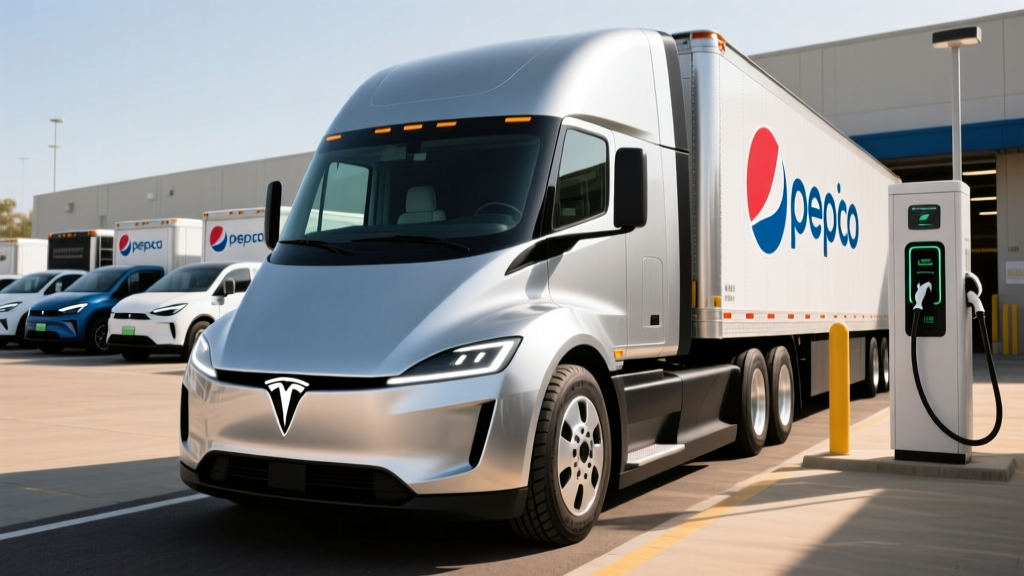
When PepsiCo took delivery of its first Tesla Semi units in late 2022, the beverage giant became the most high-profile fleet operator of Tesla's all-electric Class 8 truck. By 2026, PepsiCo operates one of the largest Tesla Semi fleets in North America, using the trucks for regional distribution runs across California, Nevada, and the broader West Coast. These so-called Tesla Pepsi trucks have generated millions of real-world hauling miles, providing the clearest picture yet of how the Tesla Semi performs under daily commercial duty.
This profile examines what PepsiCo's Tesla Semi deployment reveals about the truck's capabilities — from range and charging infrastructure to total cost of ownership — and what fleet operators and EV watchers should know about the platform's trajectory heading into the 2026 model year.
2026 Tesla Semi: Core Specifications
| Spec | 300-Mile Variant | 500-Mile Variant |
|---|---|---|
| EPA Estimated Range | ~300 mi (loaded) | ~500 mi (loaded) |
| Battery Capacity (est.) | ~500 kWh (NMC/NCA) | ~900 kWh (NMC/NCA) |
| Max DC Fast Charge | ~1.0 MW (MCS connector) | ~1.2 MW (MCS connector) |
| 10-80% Charge Time | ~30 min (at Megacharger) | ~40-45 min (at Megacharger) |
| Motors | Tri-motor AWD (1 steer, 2 drive) | Tri-motor AWD (1 steer, 2 drive) |
| Peak Horsepower | ~1,000+ hp (combined) | ~1,000+ hp (combined) |
| 0-60 mph (loaded, 80k lbs GCW) | ~20 sec | ~20 sec |
| 0-60 mph (unloaded) | ~5 sec | ~5 sec |
| GCW Rating | 82,000 lbs | 82,000 lbs |
| Efficiency | < 2 kWh/mi (est.) | < 2 kWh/mi (est.) |
| Base MSRP (est.) | ~$250,000 | ~$290,000 |
Note: Tesla has not published full EPA certification data for the Semi as of early 2026. Range and battery figures above reflect Tesla's announced specifications and fleet-operator reports. Treat as estimates until formal EPA/fueleconomy.gov data is published.
Real-World Range: What PepsiCo's Routes Reveal
Real-World Expectation: PepsiCo has reported runs exceeding 500 miles on a single charge in favorable conditions (lighter loads, flat terrain, moderate temps). However, expect 15-25% range loss on steep grades, fully loaded 82,000-lb runs, or in cold weather below 32°F. Highway-speed runs at 70 mph also reduce range vs. 55 mph fleet-average speeds.
PepsiCo's Frito-Lay division has been the most public operator of Tesla Semi trucks, running regional distribution routes from Sacramento, Modesto, and other California facilities. The company confirmed in 2023 that a Tesla Semi completed a 500-mile trip on a single charge while carrying a full load — a figure that exceeded even Tesla's own 500-mile variant claims under certain conditions.
But real-world fleet data tells a more nuanced story. Range varies significantly based on:
- Payload weight: A fully loaded 82,000-lb GCW trailer consumes substantially more energy than a half-load or empty return trip.
- Terrain: Mountain passes (e.g., Grapevine/Tejon Pass in California) can reduce range by 20-30%, though regenerative braking recovers some energy on descents.
- Temperature: Battery efficiency drops in cold weather. Fleet operators in colder climates report 15-25% range reduction below freezing, consistent with Class 8 EV behavior broadly.
- Speed: Aerodynamic drag scales with the square of speed. Running at 70 mph vs. 55 mph can cut range by 10-15%.
For PepsiCo's typical regional routes — 150 to 300 miles round-trip with depot charging — both the 300-mile and 500-mile variants provide adequate buffer for daily operations without en-route charging.
Charging: Megacharger Infrastructure and Speed
Tesla Semi Charging Levels
| Level | Power (kW) | Connector | Charge Rate | Notes |
|---|---|---|---|---|
| Level 2 (Depot AC) | ~40-80 kW | J1772 / CCS (adapter) | ~20-40 mi/hr | Overnight depot charging; 8-12 hr full charge |
| DC Fast (CCS) | Up to 350 kW | CCS1 | ~150-175 mi/hr | Public infrastructure; limited availability for Class 8 |
| Tesla Megacharger | Up to 1,000-1,200 kW (1.0-1.2 MW) | MCS (Megawatt Charging System) | ~400+ mi/hr | Tesla proprietary; 10-80% in ~30-45 min |
The Tesla Semi's charging story is defined by the Megacharger — Tesla's proprietary high-power DC charging solution designed specifically for the Semi's massive battery pack. At up to 1.2 MW (1,200 kW), Megachargers can add roughly 400 miles of range per hour of charging, enabling a 10-80% top-up in approximately 30 to 45 minutes depending on the variant.
However, Megacharger availability remains extremely limited as of 2026. PepsiCo and other early fleet operators have invested in depot-based charging infrastructure, installing a combination of Tesla-provided and third-party high-power chargers at their distribution centers. This depot-charging model works well for predictable regional routes but limits the Semi's viability for long-haul, over-the-road operations where public charging access is essential.
The broader industry is moving toward the SAE MCS (Megawatt Charging System) standard, which Tesla's Megacharger aligns with. Companies like Electrify America and WattLogic-backed corridor projects are beginning to deploy MCS-capable stations along key freight corridors, but widespread public MCS coverage remains years away.
Charging curve reality: Like all lithium-ion packs, the Semi's battery charges fastest at low state-of-charge (SoC) and tapers significantly above 80%. Fleet operators targeting quick turnarounds typically charge from 10-80% and avoid topping to 100% unless overnight depot charging allows it. The ~30-minute 10-80% figure assumes peak Megacharger availability and optimal battery preconditioning.
Performance and Powertrain: Tri-Motor Muscle
The Tesla Semi uses a tri-motor all-wheel-drive configuration: one motor on the steer axle and two motors on the drive axles. Combined output exceeds 1,000 horsepower — a staggering figure for a Class 8 truck. Tesla claims the Semi can accelerate from 0-60 mph in approximately 20 seconds while fully loaded at 82,000 lbs GCW, and around 5 seconds when unloaded. For context, a typical diesel Class 8 truck takes 45-60 seconds to reach 60 mph at full load.
This performance advantage matters commercially. Faster acceleration from stops and highway on-ramps improves route efficiency and reduces merge-related safety risks. The Semi's instant torque also eliminates the gear-hunting behavior common in automated manual transmissions found on diesel trucks.
The tri-motor system also enables regenerative braking at a scale that meaningfully extends range on hilly routes. PepsiCo's California routes, which include moderate grades, benefit from energy recovery on descents — a scenario where diesel trucks simply waste energy as heat through friction brakes.
Pricing, Tax Credits, and Total Cost of Ownership
Tesla Semi Pricing and Federal Incentives
| Item | 300-Mile Variant | 500-Mile Variant |
|---|---|---|
| Base MSRP (est.) | $250,000 | $290,000 |
| Federal §30D Tax Credit | Not eligible (GVWR > 14,000 lbs) | Not eligible (GVWR > 14,000 lbs) |
| Commercial Clean Vehicle Credit (§45W) | Up to $40,000 | Up to $40,000 |
| Estimated Net Cost (after §45W) | ~$210,000 | ~$250,000 |
| Depot Charging Install (est.) | $50,000-$150,000+ per stall | |
Important tax credit distinction: The Tesla Semi does not qualify for the consumer-facing IRS §30D Clean Vehicle Credit, which is capped at vehicles under 14,000 lbs GVWR. Instead, fleet buyers may qualify for the §45W Commercial Clean Vehicle Credit, which offers up to $40,000 for qualifying commercial EVs above 14,000 lbs GVWR. Eligibility depends on battery sourcing, domestic content requirements, and the buyer's tax situation. Consult IRS guidance on §45W and a qualified tax professional for your specific fleet.
Beyond purchase price, the Semi's total cost of ownership (TCO) is where Tesla makes its strongest case:
- Fuel savings: At less than 2 kWh/mile and commercial electricity rates of $0.10-$0.20/kWh, the Semi costs roughly $0.20-$0.40/mile to "fuel." A comparable diesel truck at 6.5 mpg and $4.00/gallon diesel costs ~$0.62/mile — a savings of $0.22-$0.42/mile, or $22,000-$42,000 per year at 100,000 miles/year.
- Maintenance: No oil changes, no diesel particulate filter (DPF) service, no transmission fluid, far fewer brake replacements (thanks to regen). Tesla estimates maintenance savings of $0.10-$0.20/mile vs. diesel.
- Payback period: PepsiCo and other operators have reported payback timelines of 3-5 years depending on route mileage, electricity rates, and incentive stacking (federal + state + utility rebates).
California's Advanced Clean Trucks regulation and various state/federal incentive programs further improve the economics for West Coast fleet operators.
Tech, Driver Experience, and Limitations
The Tesla Semi's cab is unlike any conventional Class 8 truck. The driver sits in a center-mounted seat (similar to the McLaren F1 supercar), flanked by two large touchscreen displays running Tesla's commercial vehicle software. Key tech features include:
- Tesla Autopilot (SAE Level 2): Adaptive cruise control, lane-keeping, and automatic emergency braking. This is a driver-assist system — the driver must remain fully engaged and attentive at all times. It is not self-driving.
- Over-the-air (OTA) updates: Tesla regularly pushes software improvements covering efficiency optimization, safety features, and fleet management integrations.
- Regenerative braking profiles: Multiple regen settings allow drivers to tune one-pedal-driving behavior to route conditions.
- Fleet telematics: Real-time energy consumption, route optimization, and remote diagnostics via Tesla's fleet management portal.
- Jackknife prevention: Tesla claims independent motor control on the drive axles enables electronic stability control that actively prevents trailer jackknifing — a significant safety advantage over mechanical systems.
- Charging infrastructure gap: Public MCS/Megacharger availability is minimal in 2026. The Semi is viable primarily for depot-based regional routes, not long-haul OTR.
- Production volume: Tesla Semi production at the Nevada Gigafactory remains limited. Order-to-delivery timelines can stretch 12-18+ months.
- Service network: Tesla's commercial truck service infrastructure is still maturing. Breakdown support and parts availability lag established OEMs like Freightliner and Volvo.
- Weight penalty: The Semi's battery pack adds significant curb weight, reducing available payload capacity vs. a diesel day cab — a concern for weight-sensitive freight.
- GVWR > 14,000 lbs: Disqualifies the Semi from the consumer §30D credit; fleet buyers must navigate §45W rules instead.
PepsiCo's Fleet: Lessons from the Largest Tesla Semi Operator
PepsiCo's deployment offers the most comprehensive public dataset on Tesla Semi operations. Key takeaways from the company's public statements and filings:
- Route suitability: The Semi excels on predictable, hub-and-spoke distribution routes of 150-350 miles — exactly the profile of PepsiCo's Frito-Lay and beverage distribution network.
- Driver acceptance: PepsiCo has reported strong driver satisfaction, citing the quiet cab, smooth acceleration, and reduced vibration compared to diesel trucks.
- Reliability: Public data is mixed. Early reports suggested some units experienced downtime for software and drivetrain issues, though Tesla's OTA update model allows rapid iteration on fixes.
- Expansion plans: PepsiCo has signaled intent to expand its Tesla Semi fleet as production scales, though the company is also evaluating competitors like the Freightliner eCascadia and Volvo VNR Electric.
The PepsiCo deployment validates the Tesla Semi as a viable regional haul truck — not a long-haul replacement for diesel, but a compelling solution for fleet operators with predictable routes and depot charging access.
Tesla Semi vs. Key Class 8 EV Competitors
| Spec | Tesla Semi (500 mi) | Freightliner eCascadia | Volvo VNR Electric |
|---|---|---|---|
| Range (loaded) | ~500 mi (est.) | ~230 mi | ~275 mi |
| Battery (kWh) | ~900 (est.) | ~475 | ~565 |
| Max DC Charge | ~1.2 MW | ~250 kW | ~250 kW |
| 10-80% Time | ~40-45 min | ~90 min | ~90 min |
| HP | ~1,000+ | ~470 | ~455 |
| Base Price (est.) | ~$290,000 | ~$300,000+ | ~$280,000+ |
| Production Status | Limited / scaling | In production | In production |
| Dealer/Service Network | Emerging | Extensive (Daimler Truck) | Extensive (Volvo Group) |
The Tesla Semi leads on paper in range, charging speed, and performance. But the Freightliner eCascadia and Volvo VNR Electric benefit from established dealer networks, higher production volumes, and broader service infrastructure. For fleet operators prioritizing uptime and support, the legacy OEMs remain compelling. For operators prioritizing range and energy cost, the Tesla Semi is the benchmark — if you can secure a delivery slot.
- Choose the Tesla Semi if: You operate high-mileage regional routes (200-400 mi/day), have depot charging infrastructure or can invest in it, prioritize fuel-cost savings, and can tolerate limited service network maturity.
- Choose Freightliner eCascadia or Volvo VNR Electric if: Your routes are shorter (under 250 mi/day), you need immediate production availability, and you rely on established dealer service networks for uptime guarantees.
Pros
- Class-leading range (up to 500 mi estimated)
- Fastest charging in Class 8 segment (~1.2 MW Megacharger)
- Tri-motor AWD with 1,000+ hp; 0-60 in ~20 sec loaded
- Significant per-mile fuel savings vs. diesel ($0.20-$0.40/mi)
- OTA software updates and fleet telematics
- Jackknife prevention via independent motor control
- Up to $40,000 federal §45W commercial credit
Cons
- Extremely limited production; long order wait times
- Megacharger / MCS public infrastructure nearly nonexistent
- Nascent commercial service and parts network
- Battery weight reduces payload vs. diesel
- Not eligible for consumer §30D credit (GVWR > 14,000 lbs)
- High upfront cost + depot charging investment ($50K-$150K+/stall)
- Full EPA certification data still pending
Frequently Asked Questions
What is the real-world range of the Tesla Semi in PepsiCo's fleet?
PepsiCo has reported runs exceeding 500 miles on a single charge under favorable conditions. However, typical loaded operations on hilly or cold-weather routes should expect 300-400 miles for the 500-mile variant, with the 300-mile variant best suited for routes under 250 miles with a margin of safety.
How fast does the Tesla Semi charge?
At a Tesla Megacharger (up to 1.2 MW), the Semi can charge from 10-80% in approximately 30-45 minutes depending on the variant. At a standard 350 kW CCS public charger, expect 90+ minutes for the same range. Depot Level 2 charging (40-80 kW) requires 8-12 hours for a full charge — ideal for overnight turnaround.
Does the Tesla Semi qualify for the federal EV tax credit?
Not the consumer §30D credit, which caps at 14,000 lbs GVWR. The Semi qualifies for the §45W Commercial Clean Vehicle Credit of up to $40,000, subject to battery sourcing and domestic content rules. Consult IRS §45W guidance and a tax professional.
Is the Tesla Semi worth buying vs. the Freightliner eCascadia or Volvo VNR Electric?
If your routes are 300+ miles and you can invest in depot charging, the Semi's range and energy savings justify the premium and wait. For shorter routes where service network uptime is paramount, the eCascadia or VNR Electric offer proven support infrastructure today.
How many Tesla Semi trucks does PepsiCo operate?
PepsiCo has taken delivery of dozens of Tesla Semi units as of 2026, primarily deployed across Frito-Lay and beverage distribution operations in California and the Western U.S. Exact fleet counts are not publicly disclosed in real time, but PepsiCo remains the Semi's most visible and largest fleet operator.
What is the battery warranty on the Tesla Semi?
Tesla has not published detailed commercial warranty terms for the Semi's battery pack as publicly as it does for consumer vehicles. Industry-standard Class 8 EV battery warranties typically cover 5-7 years or 300,000-500,000 miles with a capacity retention threshold of 70-80%. Confirm specific terms with Tesla Commercial before purchasing.