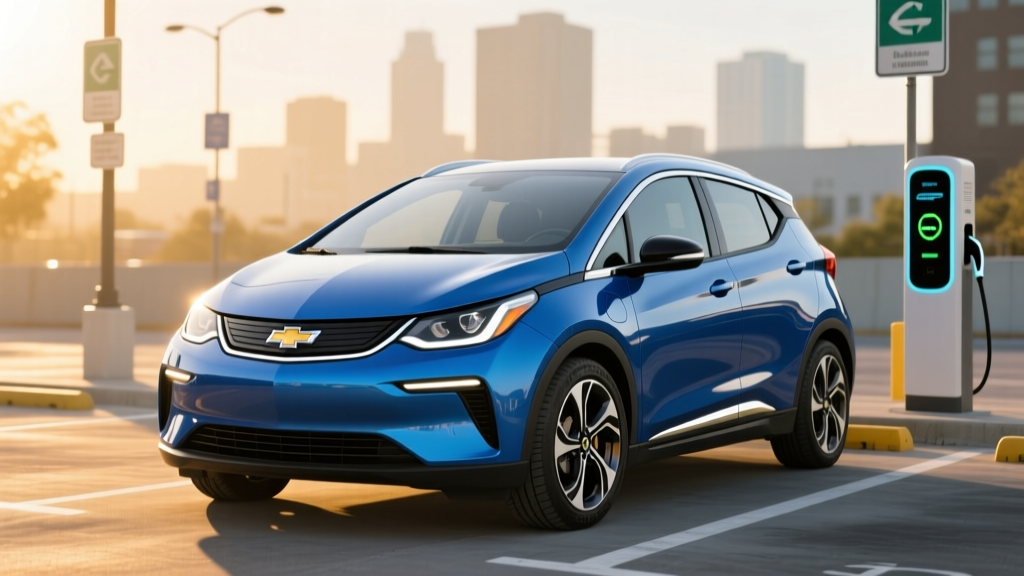
Is the Chevrolet Bolt EV Still the Smartest Budget EV Play in 2026?
The Chevrolet Bolt EV occupies a rare position in the 2026 EV market: a sub-$30,000 electric vehicle with over 250 miles of EPA range. But whether you're eyeing one of the aggressive Chevrolet Bolt EV lease deals popping up at dealers or considering an outright purchase, the sticker price tells only part of the story. Real affordability lives in the total cost of ownership — the sum of fuel, insurance, maintenance, depreciation, and incentives over five years.
This guide breaks down the exact numbers behind owning a 2026 Chevrolet Bolt EV, including the federal tax credit rules that may (or may not) put $7,500 back in your pocket, and how leasing compares to buying when the math is fully worked out.
| EPA Range | 259 miles |
| Battery | 65 kWh usable, NMC lithium-ion |
| Motor | 200 hp, 266 lb-ft torque |
| 0-60 mph | ~6.5 seconds |
| DC Fast Charge (Peak) | ~55 kW (CCS) |
| 10-80% DC Charge | ~55 minutes |
| Level 2 Charge (11.5 kW) | ~7 hours (0-100%) |
| MPGe (Combined) | 120 MPGe |
| Base MSRP (2LT) | ~$28,800 (incl. destination) |
| Battery Warranty | 8 years / 100,000 miles |
How Much Does It Really Cost to Own a Bolt EV Over 5 Years?
Total cost of ownership (TCO) accounts for every dollar that leaves your wallet over five years and 75,000 miles of driving. Below is a realistic breakdown for the 2026 Bolt EV compared against a comparable gas-powered subcompact (think Hyundai Elantra or Toyota Corolla at ~$24,000 MSRP, 33 MPG combined).
| Category | Bolt EV (2LT) | Gas Subcompact |
|---|---|---|
| Purchase Price (MSRP) | $28,800 | $24,000 |
| Federal Tax Credit (§30D) | -$0 to -$7,500* | $0 |
| Fuel / Electricity (75k mi) | $2,810 | $8,180 |
| Maintenance (5 yr) | $1,200 | $3,500 |
| Insurance (5 yr avg.) | $9,750 | $7,500 |
| Depreciation (est.) | $14,400 | $10,800 |
| Net 5-Year Cost | $29,460 – $36,960* | $33,180 |
*The federal tax credit eligibility depends on battery sourcing, your income, and MSRP caps — detailed below. With the full $7,500 credit, the Bolt EV's 5-year cost drops to roughly $29,460, undercutting the gas alternative by ~$3,700.
Federal Tax Credit: Do You Actually Qualify?
The IRS §30D Clean Vehicle Credit can reduce your federal tax liability by up to $7,500 — and since 2024, it can be transferred to the dealer as a point-of-sale discount, effectively lowering your purchase price or down payment at signing. But eligibility is not automatic. The rules have tightened considerably since the Inflation Reduction Act reshaped the credit structure.
- MSRP Cap: Vehicle must have an MSRP at or below $55,000 (cars) or $80,000 (SUVs/trucks). The Bolt EV at ~$28,800 clears this easily.
- Buyer Income Cap: Modified AGI must not exceed $150,000 (single), $225,000 (head of household), or $300,000 (joint filers).
- Battery Component Sourcing: A percentage of battery components must be manufactured or assembled in North America. This threshold increases annually — check the current year requirement on IRS.gov.
- Critical Minerals: A percentage of critical minerals in the battery must be sourced from the U.S. or a free-trade-agreement country. This threshold also increases annually.
- Point-of-Sale Transfer: You can elect to transfer the credit to the dealer at purchase, reducing your out-of-pocket cost immediately — even if you owe less than $7,500 in taxes.
- Vehicle Assembly: Final assembly must occur in North America. The Bolt EV is assembled in Orion Township, Michigan.
The Bolt EV's credit situation in 2026: GM has worked to reshore battery sourcing for the Ultium-based Bolt platform. However, the exact credit amount ($3,750, $7,500, or $0) depends on whether the specific battery batch meets both the critical-minerals and component-sourcing thresholds for the current tax year. Always verify the VIN on fueleconomy.gov before signing paperwork. If you're leasing rather than buying, the credit technically goes to the lessor (the finance company), not to you — though competitive Bolt EV lease deals often pass the savings through as a capitalized-cost reduction.
Charging vs. Gas: The $/Mile Reality
The Bolt EV's efficiency advantage shows up most clearly at the "pump." Here's the exact math using real-world energy costs:
| Scenario | Bolt EV | Gas Car (33 MPG) |
|---|---|---|
| Energy Cost | $0.14/kWh (home avg.) | $3.60/gallon |
| Efficiency | 3.4 mi/kWh (120 MPGe) | 33 mi/gal |
| Cost Per Mile | $0.041 | $0.109 |
| Annual (15,000 mi) | $615 | $1,636 |
| Annual Savings | $1,021/year (home charging) | |
Note: DC fast charging at public stations ($0.30-$0.50/kWh) narrows the gap to ~$0.088-$0.147/mile. If you rely exclusively on public charging, fuel savings shrink significantly. Source: fueleconomy.gov
The Bolt EV's 65 kWh battery charged at home from 0-100% at the national average of $0.14/kWh costs roughly $9.10 and delivers about 230 real-world miles. That's the equivalent of filling a 7-gallon tank for under $10. The savings compound: over 75,000 miles, you'll spend roughly $2,810 on electricity at home versus $8,180 on gasoline — a $5,370 difference.
Maintenance: Where EVs Quietly Win
The Bolt EV's single-speed reduction gear and permanent-magnet motor have a fraction of the moving parts found in a gasoline powertrain. No oil changes, no transmission fluid, no spark plugs, no timing belts, no exhaust system. Regenerative braking also dramatically reduces brake pad wear — many EV owners report original brake pads at 80,000+ miles.
| Service Item | Bolt EV | Gas Subcompact |
|---|---|---|
| Oil Changes (5 yr / 10 changes) | $0 | $600 |
| Brake Pads (1 replacement) | $0 (regen wear reduction) | $400 |
| Transmission Fluid | $0 | $200 |
| Coolant / Misc. Fluids | $150 | $350 |
| Tire Rotation & Replacement | $900 | $800 |
| Cabin Air Filter | $150 | $200 |
| Wiper Blades, 12V Battery, Misc. | $0 (covered under warranty or negligible) | $950 |
| 5-Year Total | ~$1,200 | ~$3,500 |
One caveat: EV tires tend to wear faster due to the vehicle's heavier curb weight (the Bolt EV weighs ~3,589 lbs) and instant torque delivery. Budget for one set of replacement tires around year 3-4. The Bolt EV's battery thermal management system also requires periodic coolant checks, though this is typically covered during scheduled dealer visits.
Insurance Cost Reality: The Uncomfortable Truth
EV insurance premiums run 15-30% higher than equivalent gas vehicles, and the Bolt EV is no exception. Expect to pay roughly $1,800-$2,100 per year for full coverage, versus $1,400-$1,600 for a gas subcompact — adding roughly $2,250 over five years.
The reasons are structural, not arbitrary:
- Repair costs: Battery-integrated structural components are expensive to replace after a collision. Even minor rear-end damage can trigger a battery safety inspection that adds thousands to a claim.
- Specialized labor: High-voltage system repairs require certified EV technicians, and fewer shops have them.
- Parts scarcity: EV-specific body panels and battery modules have longer lead times and higher prices than mass-market ICE components.
- Total-loss thresholds: Insurers may total an EV more readily if battery damage is suspected, raising their average payout.
Shop multiple insurers — some (like Progressive and State Farm) have introduced EV-specific policies with bundling discounts for home charger installation. If you lease, gap insurance is typically included, which protects you if the vehicle is totaled and the insurance payout is less than the remaining lease balance.
Depreciation and Resale Value Trends
EV depreciation has been volatile. The Bolt EV historically suffered steeper depreciation than average — partly because GM's 2021-2022 battery recall and temporary sales halt damaged consumer confidence, and partly because aggressive new-vehicle pricing and incentives depress used values.
For the 2026 model year, expect the Bolt EV to retain roughly 45-50% of its purchase price after five years and 75,000 miles. On a $28,800 purchase, that translates to ~$14,400 in depreciation. A comparable gas subcompact typically retains 50-55%, or about $10,800 in depreciation on a $24,000 purchase.
Leasing advantage: When you lease, depreciation risk belongs to the lessor, not to you. Your lease payment is partly based on the residual value GM Financial assigns. If the Bolt EV depreciates more than projected, you simply return the car at lease end and walk away. If you're risk-averse about future resale value, a competitive Bolt EV lease deal effectively insulates you from EV depreciation volatility.
Beyond the federal credit, many states and utilities offer additional rebates: California's CVRP (up to $7,000 for income-qualified buyers), Colorado's state tax credit (up to $5,000), utility rebates for home charger installation ($250-$1,500), and HOV lane access. These vary by ZIP code and change frequently. Check afdc.energy.gov and your local utility for current programs in your area.
Lease vs. Buy Decision Framework
Choose a Bolt EV lease deal if:
- You want the lowest monthly payment with minimal down payment
- You're uncertain about long-term EV depreciation and want to offload that risk
- You drive under 10,000-12,000 miles per year (typical lease limit)
- You prefer to upgrade to a newer EV with better charging tech in 3 years
- The Bolt EV's ~55 kW DC fast-charge speed feels limiting and you want an exit plan
Choose to buy the Bolt EV if:
- You drive 15,000+ miles per year (lease overage penalties add up fast)
- You qualify for the full $7,500 federal credit and want it as a direct price reduction
- You plan to keep the vehicle 7-10 years to amortize the higher upfront cost
- You want to modify the vehicle (window tint, wraps, wheels) without lease restrictions
- You have home Level 2 charging and your daily commute is under 100 miles round-trip
Frequently Asked Questions
How much does it really cost to own a Chevrolet Bolt EV over 5 years?
Between $29,460 and $36,960 over five years and 75,000 miles, depending on whether you qualify for the full $7,500 federal tax credit. That includes purchase price, electricity, insurance, maintenance, and depreciation. With the full credit, the Bolt EV undercuts a comparable gas car by roughly $3,700. Without it, the EV costs about $3,800 more over the same period.
Do I qualify for the $7,500 federal EV tax credit on the Bolt EV?
You may — but it depends on three factors: (1) your modified adjusted gross income must be below $150K single / $300K joint, (2) the Bolt EV's battery must meet current-year critical-mineral and component-sourcing thresholds per IRS rules, and (3) you must have sufficient tax liability or elect the point-of-sale transfer. Verify your specific VIN's eligibility at fueleconomy.gov and consult a tax professional before relying on the credit.
How much do I save on fuel and maintenance with the Bolt EV?
Assuming home charging at $0.14/kWh and 15,000 miles per year, you'll save roughly $1,021 annually on fuel versus a 33-MPG gas car — $5,100 over five years. Maintenance savings add another ~$2,300 over five years thanks to eliminated oil changes, reduced brake wear from regenerative braking, and fewer mechanical components. Combined, that's approximately $7,400 in operational savings.
Are EVs more expensive to insure than gas cars?
Yes, typically 15-30% more. For the Bolt EV, expect $1,800-$2,100 per year for full coverage versus $1,400-$1,600 for a gas equivalent. Higher repair costs, specialized labor, and battery-integrated structures drive the premium. Shop at least three insurers and ask about EV-specific discounts.
How well does the Chevrolet Bolt EV hold its value?
The Bolt EV retains approximately 45-50% of its value after five years — below the industry average for gas compacts (50-55%). Aggressive new-vehicle pricing, rapid EV tech advancement, and historical recall impacts contribute. Leasing transfers this depreciation risk to the lessor and is worth considering if resale uncertainty concerns you.
What's the Bolt EV's biggest ownership drawback?
DC fast-charging speed. The Bolt EV peaks at ~55 kW on CCS chargers, meaning a 10-80% charge takes roughly 55 minutes. Competitors like the Hyundai Kona Electric or Hyundai Ioniq 5 charge at 100-240 kW and complete the same session in 18-40 minutes. If you road-trip frequently, this is a meaningful limitation. For daily commuting and home charging, it's irrelevant.