Why There Is No Apple CarPlay in Tesla (2026 Update)
If you've searched for CarPlay in Tesla, you already know the short answer: Tesla does not support Apple CarPlay or Android Auto in any 2026 model — not the Model 3, Model Y, Model S, Model X, or the refreshed Cybertruck. Tesla has kept its proprietary infotainment ecosystem closed to third-party phone projection since the company's founding, and that stance has not changed for the 2026 model year.
For buyers migrating from a BMW, Hyundai, or Ford where CarPlay is a baseline expectation, this is often the single biggest friction point in a Tesla purchase. The question isn't really "does Tesla have CarPlay?" — it's whether Tesla's native software stack is good enough to make you stop caring. This review evaluates the 2026 Tesla Model Y (the highest-volume Tesla and the model where the CarPlay question comes up most) across range, charging, performance, pricing, and tech to help you decide.
2026 Tesla Model Y: Core Specs at a Glance
| Spec | Value |
|---|---|
| EPA Estimated Range | 320 miles |
| Battery Capacity | ~75 kWh usable (NMC / LFP depending on build) |
| Drivetrain | Dual-Motor AWD |
| Horsepower | ~384 hp (combined) |
| 0-60 mph | 4.8 seconds |
| Peak DC Fast Charge | 250 kW |
| 10-80% DC Fast Charge Time | ~25 minutes |
| Level 2 Home Charge Rate | 11.5 kW (~44 mi/hr) |
| MPGe (Combined) | 122 MPGe |
| Efficiency | 28 kWh/100 mi |
| Cargo Volume (rear seats up / folded) | 30.2 / 72.1 cu ft |
| Rear Legroom | 41.6 in |
| Base MSRP (Long Range AWD) | $47,990 |
| Battery & Drive Unit Warranty | 8 years / 120,000 miles |
Source: fueleconomy.gov and Tesla.com. Specs reflect 2026 Model Y Long Range AWD. Performance and trims vary by model year.
Real-World Range vs. EPA Sticker: What to Actually Expect
EPA Estimated Range: 320 miles
Real-World Highway (70-80 mph, 65°F): ~260–280 miles
Cold Weather (30°F, mixed driving): ~220–250 miles
City / Moderate Climate: ~290–310 miles
The EPA number is a laboratory-derived blended cycle. In real-world highway driving at 75 mph, aerodynamic drag cuts into the Model Y's efficiency more than you'd expect from its 0.23 Cd drag coefficient. Plan for roughly 260–280 miles on a warm-weather road trip before you're hunting for a Supercharger.
Cold weather compounds the issue. Lithium-ion batteries lose efficiency in low temperatures, and cabin heating (even with Tesla's heat pump, which is standard on 2026 models) draws significant energy. In sustained sub-30°F conditions, expect 220–250 miles of usable range. Preconditioning the battery while plugged in — a feature accessible through the Tesla app — recovers some of this loss by warming the pack before you drive.
For context, the Model Y Long Range's 75 kWh usable battery with NMC chemistry (some 2026 builds use LFP for the standard-range variant) provides strong energy density but is more sensitive to extreme cold than LFP. If you live in Minnesota or Montana, budget 30% off the EPA sticker for winter planning.
Charging Speed: Supercharger Network and Home Level 2
| Charge Level | Power (kW) | Miles Added per Hour | Notes |
|---|---|---|---|
| Level 1 (120V household) | ~1.4 kW | ~3–5 mi/hr | Emergency/trickle only |
| Level 2 (240V home / destination) | 11.5 kW | ~44 mi/hr | Full overnight charge in ~7 hrs |
| DC Fast (Tesla Supercharger V3) | Up to 250 kW peak | ~175 mi in 15 min | 10-80% in ~25 min; tapers above 80% |
| DC Fast (CCS via adapter) | Up to 150 kW (varies) | Varies by station | Requires Tesla CCS adapter (sold separately) |
Tesla's Supercharger network remains the strongest public charging infrastructure in the U.S. as of 2026, with over 6,000 stations and 65,000+ individual chargers. The Model Y peaks at 250 kW on a V3 Supercharger, but understand that peak is not sustained. The charge curve tapers meaningfully above 50% state of charge and drops sharply past 80%. A 10–80% session takes roughly 25 minutes; going from 80–100% can add another 20+ minutes. Plan road-trip stops around the 10–80% window for efficiency.
At home, the Model Y's onboard charger accepts up to 11.5 kW on a 48-amp Level 2 circuit (requiring a 60-amp breaker). A full 0–100% charge takes about 7 hours. If your home has a standard NEMA 14-50 outlet (50-amp circuit), you'll see about 32 amps / 7.7 kW, adding roughly 30 miles per hour — still sufficient for overnight charging for most commuters.
Important for non-Tesla charging: Since Tesla transitioned to the NACS connector standard, the Model Y ships with a native NACS port. To use legacy CCS stations (Electrify America, EVgo, etc.), you'll need Tesla's CCS adapter (~$175). As of 2026, most major networks are adding NACS cables, reducing this friction over time.
Tesla's Native Infotainment vs. CarPlay: The Real Comparison
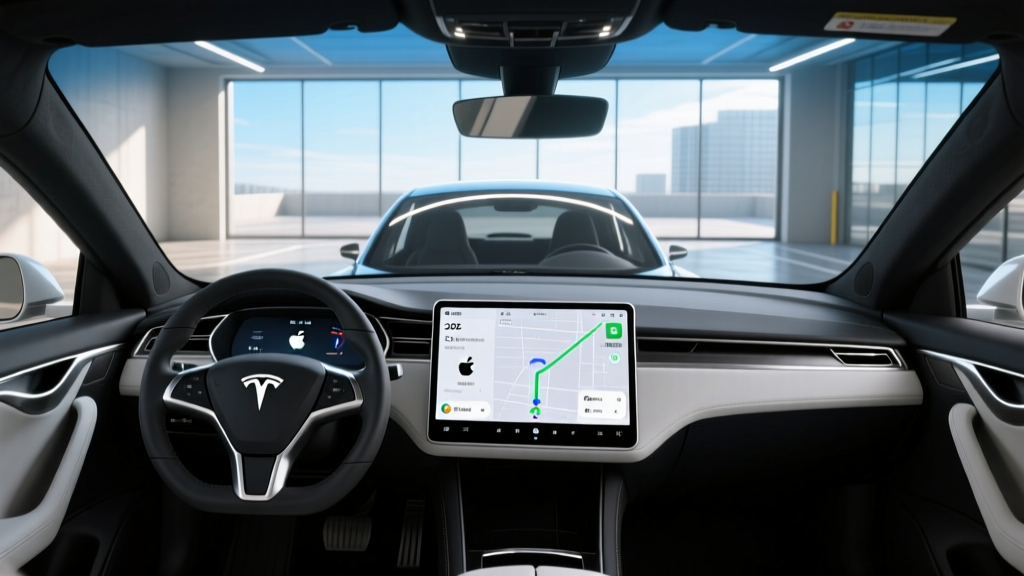
Here's where the CarPlay question gets substantive. Tesla's 15.4-inch center touchscreen (in the 2026 Model Y refresh) runs a custom Linux-based OS that integrates navigation, media, climate, vehicle controls, and driver-assist settings into a single interface. There is no secondary instrument cluster — everything routes through this screen.
What Tesla's Native System Does Well
- Navigation with live Supercharger routing: The built-in nav automatically routes through Superchargers on long trips, preconditions the battery for optimal charge speed on arrival, and shows real-time stall availability. No CarPlay-based nav app replicates this integration.
- Over-the-air updates: Tesla pushes software updates that add features (theater mode, new games, UI refinements) without a dealer visit.
- Sentry Mode and Dashcam: Native camera recording with no third-party hardware required.
- Spotify, Apple Music, Tidal integration: Streaming apps run natively, so you don't need your phone connected for music.
- Tesla app integration: Remote preconditioning, location sharing, service scheduling, and phone-as-key all work without CarPlay.
Where CarPlay Users Feel the Gap
- Familiar UI muscle memory: CarPlay's simplified grid and Siri integration feel intuitive. Tesla's UI requires a learning curve, especially for climate controls buried in menus.
- Waze and Google Maps preference: Some drivers strongly prefer Waze for real-time police/hazard alerts. Tesla's native nav doesn't offer crowd-sourced hazard reporting at Waze's level.
- Message dictation and Siri: CarPlay's Siri integration for texts and calls is more seamless than Tesla's Bluetooth-based phone handling, which can be inconsistent with voice commands.
- App ecosystem lock-in: If you rely on specific CarPlay-compatible apps (Audible with specific controls, certain podcast apps), they won't run on Tesla's native system.
Workarounds for CarPlay in Tesla (2026)
Third-party companies like Carlinkit and Hansshow have offered aftermarket CarPlay adapter boxes that feed CarPlay into Tesla's browser or video input. In practice, these solutions introduce latency, require the browser to remain open (draining some compute), and often break with Tesla OTA updates. As of early 2026, no aftermarket solution provides a seamless, reliable CarPlay experience that we'd recommend for daily use. The honest answer: if CarPlay is non-negotiable, Tesla may not be the right vehicle for you.
Performance, Efficiency, and Driving Dynamics
The 2026 Model Y Long Range AWD puts down approximately 384 hp across its dual motors, reaching 0-60 mph in 4.8 seconds. That's brisk for a compact SUV and quicker than most competitors in the segment (the Ford Mustang Mach-E Premium AWD does it in ~5.1 seconds; the Hyundai Ioniq 5 AWD in ~5.2 seconds).
Efficiency is a Tesla strong suit. At 122 MPGe combined (28 kWh per 100 miles), the Model Y is among the most efficient electric SUVs available. The heat pump, regenerative braking (now with blended braking feel in the 2026 refresh), and thermal management system all contribute. For comparison, the Mach-E Extended Range AWD achieves roughly 101 MPGe combined.
Ride quality in the 2026 Model Y has improved with the refresh — revised dampers and a slightly softer tune reduce the crashiness over sharp bumps that plagued pre-2025 models. It's still firmer than an Ioniq 5 but no longer punishing. Road noise remains noticeable at highway speeds, a trade-off of the low-drag body and frameless windows.
Pricing, Tax Credits, and Total Cost
| Trim | Base MSRP | Estimated Federal Credit (§30D) | Effective Price (if eligible) |
|---|---|---|---|
| Long Range RWD | $44,990 | Up to $7,500 (point-of-sale) | ~$37,490 |
| Long Range AWD | $47,990 | Up to $7,500 (point-of-sale) | ~$40,490 |
| Performance AWD | $52,490 | Up to $7,500 (point-of-sale) | ~$44,990 |
Federal tax credit caveats: The §30D credit of up to $7,500 is subject to IRS rules that change frequently. As of 2026, eligibility depends on:
- Buyer income caps: AGI ≤ $150,000 (single) / $300,000 (joint) — per IRS.gov
- MSRP cap: SUVs/vans/pickups must be ≤ $80,000 (all Model Y trims qualify)
- Battery sourcing requirements: Critical minerals and battery components must meet escalating domestic-content thresholds. Tesla's U.S.-built battery cells (from the Nevada and Texas Gigafactories) generally satisfy these requirements, but specific build batches can vary. Always verify the VIN's credit eligibility on the IRS portal before purchase.
- Point-of-sale transfer: As of 2024+, the credit can be transferred to the dealer at purchase, reducing your out-of-pocket cost immediately rather than waiting for tax filing.
Destination fees (~$1,390) and optional paint/interior/wheel upgrades add to the as-tested price. A Long Range AWD in a premium color with 20-inch wheels can push $53,000+ before credit. Consult a tax professional to confirm your personal eligibility.
Warranty, Ownership Costs, and Longevity
Tesla's battery and drive unit warranty covers 8 years or 120,000 miles (whichever comes first) on the Long Range AWD, with a minimum 70% capacity retention threshold. The basic vehicle limited warranty is 4 years / 50,000 miles.
Real-world battery degradation data from Tesla's fleet reports and third-party aggregators like Recurrent Auto suggest the Model Y's NMC pack typically retains 88–92% capacity at 100,000 miles under normal use. LFP-equipped Standard Range models show even slower degradation curves but carry lower energy density (and thus less range).
Insurance costs for the Model Y tend to run 15–25% higher than comparable gas-powered compact SUVs, driven by repair costs for the aluminum-intensive structure and sensor suite. Shop quotes before committing — Tesla's own insurance product (available in most states) can sometimes undercut third-party quotes for clean-record drivers.
Pros, Cons, and Who Should Buy
- Best-in-class Supercharger network access
- Top-tier efficiency (122 MPGe combined)
- Strong real-world range (320 mi EPA)
- Excellent OTA software updates
- Spacious cargo area (72.1 cu ft folded)
- Quick 0-60 (4.8s) for the class
- Heat pump standard for cold-climate efficiency
- No Apple CarPlay or Android Auto
- All climate/vehicle controls on single touchscreen
- Aftermarket CarPlay solutions unreliable
- Road noise at highway speeds
- Insurance premiums above class average
- CCS adapter required for non-Tesla DC chargers
- Build quality variability between factories
Who the Model Y Suits Best
Commuters and road-trippers who can charge at home and value Supercharger routing will find the Model Y hard to beat. Families benefit from the generous cargo space and strong safety ratings (NHTSA 5-Star overall). Tech-forward buyers who prefer integrated systems over phone projection will appreciate the native stack.
Not ideal for: Drivers who consider CarPlay a dealbreaker, those without reliable home charging access, or buyers in rural areas far from Supercharger corridors.
Frequently Asked Questions
Can I get Apple CarPlay in a 2026 Tesla?
No. Tesla does not support Apple CarPlay or Android Auto in any 2026 model. The company's proprietary infotainment system handles navigation, media, and phone integration natively. Third-party adapter boxes exist but are unreliable and not recommended for daily use.
What is the real-world range of the 2026 Model Y?
The EPA rates the Long Range AWD at 320 miles. Expect 260–280 miles on warm highway trips, 220–250 miles in sustained cold weather, and up to 310 miles in moderate city driving with regenerative braking.
How fast does the Model Y charge at home and on the road?
On a Level 2 home charger (11.5 kW), the Model Y adds about 44 miles of range per hour, with a full charge taking roughly 7 hours. On a Tesla V3 Supercharger, it peaks at 250 kW and charges from 10–80% in approximately 25 minutes.
Does the 2026 Tesla Model Y qualify for the $7,500 federal tax credit?
The Model Y is generally eligible for up to $7,500 under IRS §30D, provided the buyer meets income caps ($150K single / $300K joint), the MSRP is under $80,000 (all trims qualify), and the battery meets critical-mineral and component sourcing requirements. The credit can be applied at point of sale. Always verify VIN eligibility on the IRS portal and consult a tax professional.
Is the Tesla Model Y worth buying over the Ford Mach-E or Hyundai Ioniq 5?
The Model Y wins on efficiency, Supercharger access, and cargo volume. The Mach-E offers CarPlay and a more traditional driving feel. The Ioniq 5 charges faster (800V architecture, 10–80% in ~18 min) and also supports CarPlay. If CarPlay is essential, the Mach-E or Ioniq 5 are stronger choices. If charging infrastructure and efficiency are your priorities, the Model Y leads.
How does Tesla's Autopilot compare to CarPlay for navigation?
Tesla's Autopilot is an SAE Level 2 driver-assist system (not self-driving) that includes adaptive cruise, lane centering, and automatic lane changes with the optional Enhanced Autopilot or FSD (Supervised) packages. It uses Tesla's native navigation — CarPlay is not involved. The driver must remain engaged and hands-on at all times. FSD (Supervised) adds stop-light recognition and city-street steering assist but still requires full driver supervision.