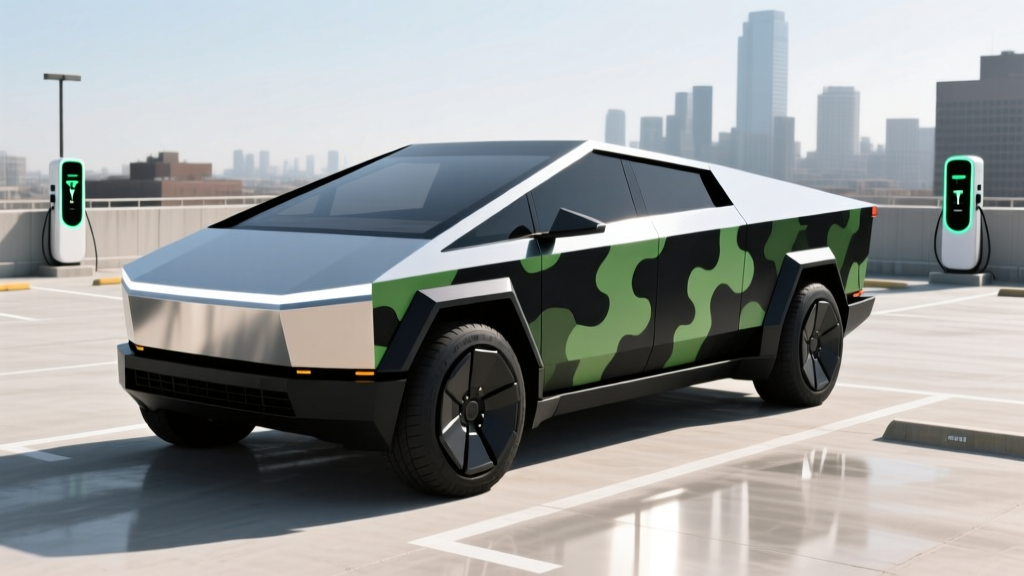
If you've scrolled through EV forums or spotted a stainless-steel pickup wrapped in matte-black geometric patterns on the highway, you've likely searched for "Cybertruck camouflage" and wondered what's going on. The camouflage wraps appearing on Tesla Cybertrucks in 2025 and 2026 aren't hiding a secret redesign — they're owner-applied paint protection films (PPF), stealth aesthetic wraps, and in some cases, factory-applied protective transport wraps seen on pre-delivery units. Beneath the wrap, the 2026 Tesla Cybertruck remains one of the most polarizing and technically ambitious electric pickups on the market.
This review strips away the wraps — literal and figurative — to give you the exact numbers that matter: real-world range, charging speeds, pricing after tax credits, and whether the Cybertruck actually delivers as a daily driver, tow rig, or off-road tool in 2026.
2026 Tesla Cybertruck: Core Specifications at a Glance
| Spec | AWD (Dual-Motor) | Cyberbeast (Tri-Motor) |
|---|---|---|
| EPA Range | 340 miles | 320 miles |
| Battery (usable) | ~123 kWh (NMC) | ~123 kWh (NMC) |
| Peak DC Fast Charge | 250 kW | 250 kW |
| 10–80% Charge Time | ~28 min | ~28 min |
| Level 2 Home Charging | 11.5 kW (~34 mi/hr) | 11.5 kW (~34 mi/hr) |
| 0–60 mph | 3.9 sec | 2.6 sec |
| Horsepower | 600 hp | 845 hp |
| Drivetrain | Dual-Motor AWD | Tri-Motor AWD |
| Towing Capacity | 11,000 lbs | 11,000 lbs |
| Efficiency | ~56 MPGe / 58 kWh/100mi | ~52 MPGe / 62 kWh/100mi |
| Base MSRP | $79,990 | $99,990 |
| Battery/Drive Unit Warranty | 8 yr / 120,000 mi | 8 yr / 120,000 mi |
Sources: Tesla Cybertruck specs, fueleconomy.gov. Figures reflect 2026 model-year data.
Real-World Range: What the EPA Sticker Doesn't Tell You
EPA Estimate: 340 mi (AWD) / 320 mi (Cyberbeast)
Real-World Highway (70 mph): ~270–295 mi
Real-World Mixed Driving: ~290–315 mi
Cold Weather (below 32°F): Expect 20–30% reduction (~225–260 mi)
The Cybertruck's angular stainless-steel exoskeleton looks futuristic, but that flat-front windshield and boxy profile create a drag coefficient that hurts highway efficiency. In real-world testing at sustained 70–75 mph speeds, the AWD model typically returns 270–295 miles before needing a charge stop — a meaningful drop from the 340-mile EPA sticker. The Cyberbeast, with its tri-motor powertrain and higher energy consumption, falls to roughly 255–280 miles at highway speed.
Cold weather compounds the issue. The Cybertruck uses a heat pump for cabin and battery thermal management, which helps, but lithium-ion chemistry in the ~123 kWh NMC pack still loses efficiency below freezing. Plan for 20–30% range reduction in sub-32°F conditions, especially on short trips where the battery doesn't reach optimal operating temperature. Preconditioning the battery before driving (automatically triggered when a Supercharger is set as your navigation destination) mitigates some of this loss.
For context, the EPA's official fueleconomy.gov listing shows combined MPGe figures, but highway-only driving at speed is where most EV range estimates diverge from reality — and the Cybertruck's aerodynamic profile makes that gap wider than in sleeker sedans.
Charging Speed: 250 kW Peak, But Mind the Curve
| Charging Level | Power | Speed (approx.) |
|---|---|---|
| Level 1 (120V) | ~1.4 kW | ~3–4 mi/hr |
| Level 2 (240V, 48A) | 11.5 kW | ~34 mi/hr |
| DC Fast Charge (Supercharger V4) | Peak 250 kW | 10–80% in ~28 min |
The Cybertruck charges at a peak rate of 250 kW on Tesla V3 and V4 Superchargers. That peak rate is typically sustained from roughly 10% to 35% State of Charge (SoC), after which the charge curve tapers progressively. By 60% SoC, you're looking at roughly 150 kW; above 80%, the rate drops sharply to protect battery longevity, falling below 50 kW. This is standard behavior for NMC chemistry and is managed by the vehicle's battery management system (BMS).
A 10–80% session takes approximately 28 minutes under ideal conditions (battery preconditioned, ambient temperature 60–80°F). In cold weather without preconditioning, expect that time to stretch to 40+ minutes.
At home on a Level 2 Wall Connector (hardwired, 60A circuit), the Cybertruck adds about 34 miles of range per hour. A full overnight charge from 20% to 100% takes roughly 10–11 hours. The Cybertruck uses the NACS (North American Charging Standard) connector natively — it is, after all, Tesla's own truck — so it accesses the full Supercharger network without adapters. For non-Tesla DC fast chargers using CCS, an adapter is required, though Tesla's NACS adoption by other automakers has reduced the relevance of this concern in 2026.
Performance: Tri-Motor Cyberbeast vs. Dual-Motor AWD
The dual-motor AWD Cybertruck delivers 600 horsepower and a 3.9-second 0–60 mph time — numbers that would embarrass most sports cars, let alone a 6,800-pound stainless-steel pickup. The tri-motor Cyberbeast pushes 845 hp and a 2.6-second 0–60, placing it in hypercar territory. Both models feature torque vectoring, adaptive air suspension (with up to 16 inches of ground clearance in Off-Road mode), and rear-wheel steering for a surprisingly tight turning radius.
The Cybertruck's steer-by-wire system — which eliminates the mechanical connection between the steering yoke and the wheels — remains one of its most debated features. At low speeds, it requires fewer turns lock-to-lock, making parking easy. At highway speeds, the ratio adjusts for stability. Most owners adapt within a week, but it's worth a test drive before committing.
Towing capacity is rated at 11,000 pounds for both trims. However, towing at or near max capacity cuts range roughly in half — expect 140–170 miles between charges when pulling a heavy trailer. This is consistent with all electric pickups, including the Ford F-150 Lightning and Rivian R1T.
Pricing, Trims, and Federal Tax Credit Eligibility
| Trim | Base MSRP | Est. After §30D Credit* |
|---|---|---|
| AWD (Dual-Motor) | $79,990 | ~$72,490 |
| Cyberbeast (Tri-Motor) | $99,990 | ~$92,490 |
*Tax credit estimates assume full $7,500 eligibility. Actual credit depends on IRS §30D rules — see checklist below.
- MSRP Cap: Trucks/vans/SUVs must have MSRP ≤ $80,000. The AWD trim qualifies; the Cyberbeast ($99,990) does not.
- Buyer Income Cap: Modified AGI ≤ $150,000 (single) / $225,000 (head of household) / $300,000 (joint).
- Battery Sourcing: Critical minerals and battery components must meet phased-in domestic/free-trade sourcing thresholds. Verify current compliance on irs.gov.
- Point-of-Sale Transfer: Eligible buyers can transfer the credit to the dealer for an upfront price reduction at purchase.
- Assembly: Vehicle must undergo final assembly in North America (Cybertruck is built in Austin, TX — qualifies).
The Cybertruck AWD at $79,990 squeaks under the $80,000 MSRP cap for trucks, making it potentially eligible for the full $7,500 federal tax credit — bringing the effective price to roughly $72,490. The Cyberbeast, at $99,990, exceeds the cap and does not qualify. State incentives vary by jurisdiction; check your local DMV or energy office for additional rebates.
Consult a tax professional before relying on credit eligibility, as IRS rules around battery sourcing and critical minerals have tightened through 2025–2026, and not every vehicle that previously qualified continues to do so.
Interior, Cargo, and Daily Livability
The Cybertruck seats five across two rows, though the rear bench is tighter than a full-size F-150 or Silverado. Rear legroom measures approximately 38 inches — adequate for adults on moderate trips but not class-leading. The front trunk (frunk) offers roughly 7 cubic feet of lockable storage, useful for charging cables or groceries.
The 6-foot bed provides about 72 cubic feet of cargo volume with the motorized tonneau cover closed. The bed features built-in 120V and 240V outlets, enabling the Cybertruck to serve as a mobile power source (V2L — vehicle-to-load) for tools, camping gear, or tailgating. Tesla claims up to 11.5 kW of continuous power export, enough to run most household appliances or power tools simultaneously.
The minimalist interior centers on an 18.5-inch touchscreen with no physical buttons. Climate controls, mirror adjustments, and glovebox release are all screen-based. This design choice is polarizing — some owners appreciate the clean aesthetic, while others find it distracting. The Cybertruck also includes a rear touchscreen for back-seat passengers.
Driver Assistance and Autonomy: Autopilot and FSD (Supervised)
Tesla Autopilot and Full Self-Driving (Supervised) are Level 2 driver-assistance systems. The driver must remain fully engaged, hands on the yoke, eyes on the road. These systems are not self-driving. Only Level 4 robotaxi services like Waymo operate without a human driver in geofenced areas.
The Cybertruck ships with Tesla's Autopilot suite: Traffic-Aware Cruise Control, Autosteer (lane centering), and automatic emergency braking. Full Self-Driving (Supervised) is available as a $8,000 add-on or $99/month subscription and adds features like automatic lane changes, Navigate on Autopilot (highway on/off-ramp handling), and traffic-light/stop-sign recognition.
As of 2026, FSD (Supervised) has improved significantly in urban environments but still requires active supervision. It handles most routine scenarios competently but can struggle with construction zones, faded lane markings, and unprotected left turns. NHTSA continues to monitor Tesla's Autopilot-related incidents, and buyers should approach FSD as a convenience feature, not a replacement for attentive driving.
What's Behind the Cybertruck Camouflage Wraps?
The "Cybertruck camouflage" trend deserves direct address. Most camouflage-wrapped Cybertrucks you see fall into three categories:
- Paint Protection Film (PPF): The stainless-steel body doesn't need paint protection in the traditional sense, but owners apply PPF to prevent fingerprints, minor scratches, and the "smudge magnet" effect of bare stainless steel. Camouflage-pattern PPF has become a popular aesthetic choice.
- Stealth/Aesthetic Vinyl Wraps: Matte-black or geometric-camo vinyl wraps change the Cybertruck's appearance and protect the steel from environmental staining. These are aftermarket, typically costing $3,000–$6,000 installed.
- Factory Transport Wraps: Pre-delivery Cybertrucks are sometimes spotted in white or black protective wraps during transit from Giga Texas. These are removed before customer delivery and aren't a production option.
Tesla does not currently offer a factory camouflage wrap or special-edition camo trim. If you see a camo Cybertruck, it's almost certainly an owner modification.
Pros and Cons: The Honest Assessment
- Class-leading 0–60 performance (2.6s Cyberbeast)
- 11,000-lb towing capacity with 240V bed outlet
- Native NACS connector — full Supercharger access
- Stainless-steel exoskeleton: dent and corrosion resistant
- Adaptive air suspension with 16" ground clearance
- Strong V2L capability (up to 11.5 kW export)
- Highway range falls well short of EPA (270–295 mi real-world)
- Cyberbeast exceeds $80K MSRP cap — no federal tax credit
- Steer-by-wire yoke requires adaptation period
- Rear-seat space is tight vs. full-size pickups
- Stainless steel shows fingerprints and smudges heavily
- No Apple CarPlay / Android Auto support
- Insurance premiums run 20–40% higher than comparable trucks
Who Should Buy the 2026 Tesla Cybertruck?
- Choose the Cybertruck AWD if: You want a fast, tech-forward electric truck for daily driving and weekend towing, your budget is ~$75K–$85K (after credit), and you rely on the Supercharger network for road trips.
- Choose the Cyberbeast if: Performance is the priority, budget is flexible ($100K+), and you accept the loss of federal tax credit eligibility.
- Look at the Ford F-150 Lightning if: You need a more conventional truck layout, better rear-seat comfort, and lower starting prices (~$55K).
- Look at the Rivian R1T if: You want a more refined interior, better off-road capability (quad-motor), and a more traditional steering wheel.
The Cybertruck is best suited for tech-savvy owners who prioritize performance and Tesla's charging ecosystem over traditional truck practicality. It's an excellent tow vehicle for moderate loads, a capable daily commuter (if you can charge at home), and a conversation starter at every stop. It's not the best truck for families who need maximum rear-seat space, nor is it the most efficient highway cruiser in the EV truck segment.
Frequently Asked Questions
What is the real-world range of the Tesla Cybertruck?
The EPA rates the AWD at 340 miles and the Cyberbeast at 320 miles. Real-world highway driving at 70 mph typically yields 270–295 miles (AWD) and 255–280 miles (Cyberbeast). Cold weather below freezing can reduce range by 20–30%.
How fast does the Cybertruck charge at home and on the road?
On a Level 2 home charger (11.5 kW), it adds ~34 miles of range per hour, with a full charge taking 10–11 hours. On a 250 kW Tesla Supercharger, a 10–80% session takes approximately 28 minutes under ideal conditions.
Does the Cybertruck qualify for the $7,500 federal EV tax credit?
The AWD trim ($79,990 MSRP) is potentially eligible, as it falls under the $80,000 MSRP cap for trucks. The Cyberbeast ($99,990) is not eligible. Buyer income caps and battery-sourcing rules also apply — verify on irs.gov and consult a tax professional.
Why do some Cybertrucks have camouflage wraps?
Most are aftermarket paint protection film (PPF) or vinyl wraps applied by owners to protect the stainless-steel body from fingerprints and smudges, or for aesthetic preference. Tesla does not offer a factory camouflage option.
Is the Cybertruck worth buying over the F-150 Lightning or Rivian R1T?
It depends on priorities. The Cybertruck offers the fastest performance and best Supercharger access. The F-150 Lightning is more affordable and practical for families. The Rivian R1T offers superior off-road capability and a more refined interior. Test-drive all three before deciding.
What is the Cybertruck's battery warranty?
Tesla covers the battery and drive unit for 8 years or 120,000 miles (whichever comes first), with a minimum 70% capacity retention threshold during the warranty period.