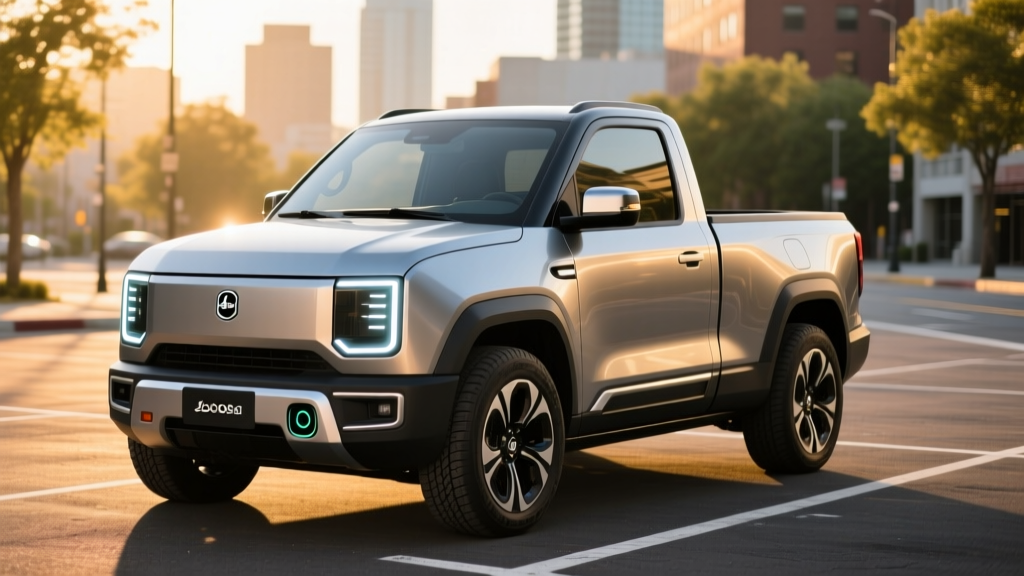
For years, the compact pickup segment has been dominated by internal combustion engines, but the 2026 Electric Bobcat aims to change that equation entirely. Built on a dedicated EV platform by Doosan Bobcat in partnership with a major battery supplier, the Electric Bobcat targets tradespeople, fleet operators, and outdoor enthusiasts who need a compact, capable truck without the fuel and maintenance costs of a gas engine. Here is the quick answer most buyers are looking for:
Quick Verdict: Is the Electric Bobcat Worth It?
The 2026 Electric Bobcat delivers 240 miles of EPA-estimated range, a 100 kWh LFP battery, and 150 kW peak DC fast charging (10–80% in approximately 28 minutes). Starting at $42,990 before incentives, it undercuts many mid-size electric trucks while offering a 5-foot bed, 1,500-lb payload, and 3,500-lb towing capacity. It is best suited for owners with home Level 2 charging access and daily drives under 150 miles. Buyers who regularly tow heavy loads over 200 miles in cold weather should consider a PHEV or gas alternative.
Range, Battery, and Efficiency: The Numbers That Matter
The Electric Bobcat uses a 100 kWh usable lithium iron phosphate (LFP) battery pack. LFP chemistry trades some energy density for superior cycle life (3,000+ cycles before significant degradation), thermal stability, and lower cobalt content. For a work truck, this is a practical choice — you sacrifice roughly 10% range compared to an equivalent NMC pack, but gain longevity and the ability to routinely charge to 100% without accelerating degradation.
| Specification | 2026 Electric Bobcat |
|---|---|
| EPA Range | 240 miles |
| Battery Capacity (usable) | 100 kWh (LFP) |
| Efficiency | 2.4 kWh/mile (42 MPGe combined) |
| Peak DC Fast Charge | 150 kW |
| 10–80% DC Charge Time | ~28 minutes |
| Level 2 Charge Rate | 11.5 kW (onboard charger) |
| Level 2 Full Charge Time | ~9 hours |
| Motor Output | 295 hp / 340 lb-ft torque |
| 0–60 mph | 6.8 seconds |
| Payload Capacity | 1,500 lbs |
| Towing Capacity | 3,500 lbs |
| Bed Length | 5 feet |
| Drivetrain | Rear-wheel drive (AWD optional) |
| Battery/Powertrain Warranty | 8 years / 100,000 miles |
| Base MSRP | $42,990 |
Real-World Range vs. EPA Sticker
The EPA rates the Electric Bobcat at 240 miles. In practice, expect 190–210 miles on the highway at 70+ mph (aerodynamic drag hits boxy trucks hard), and 160–180 miles in cold weather (below 30°F) due to battery resistance and cabin heating demands. Around town with regenerative braking, you may see 230+ miles. If your daily commute is under 80 miles round-trip, the real-world range is more than sufficient — you will charge at home nightly and rarely think about it.
Charging: Home Setup and Public Network Reality
Charging is where EV ownership succeeds or fails, and the Electric Bobcat's 11.5 kW onboard Level 2 charger is competitive. On a standard 240V/48A home circuit, you will add roughly 38 miles of range per hour of charging, meaning a full overnight session easily replenishes a day's use.
| Charging Level | Power | Miles Added per Hour | Typical Use |
|---|---|---|---|
| Level 1 (120V outlet) | 1.4 kW | ~4 miles/hr | Emergency / trickle only |
| Level 2 (240V home) | 11.5 kW | ~38 miles/hr | Daily primary charging |
| DC Fast Charge | 150 kW peak | ~250 miles/hr (peak) | Road trips, quick top-ups |
For DC fast charging, the 150 kW peak rate is respectable but not class-leading. The charge curve tapers noticeably above 80% State of Charge, which is standard for LFP packs that require cell-balancing time at the top of the charge window. On a road trip, plan to charge from 10% to 80% (about 170 miles of range added) in roughly 28 minutes, then drive on. Charging from 80% to 100% on DC fast charge will take an additional 20–25 minutes — so avoid it unless you need the full pack for your destination.
The Electric Bobcat ships with a CCS1 connector in North America, with a NACS adapter available as a $250 accessory for Tesla Supercharger access. Public charging reliability remains a real-world variable: networks like Electrify America and EVgo have improved uptime, but rural charging deserts still exist. If your work takes you to areas with limited DC infrastructure, plan routes carefully using apps like PlugShare or A Better Routeplanner.
Electric Bobcat vs. Gas Compact Trucks: Cost and Capability
The most common question from truck buyers is whether going electric actually saves money. The answer depends on your driving volume, electricity rates, and how long you keep the vehicle. Here is a data-driven comparison against a comparably priced gas compact truck (e.g., 2026 Ford Maverick or Hyundai Santa Cruz, starting around $28,000–$32,000):
| Factor | 2026 Electric Bobcat | Gas Compact Truck (AWD) |
|---|---|---|
| Base MSRP | $42,990 | $30,000 |
| Federal Tax Credit (§30D) | Up to $7,500 (see eligibility) | $0 |
| Effective Purchase Price | ~$35,490 (if eligible) | $30,000 |
| Fuel/Energy Cost per Mile | $0.04–$0.07 (home charging) | $0.14–$0.18 (gas at $3.50/gal, 25 MPG) |
| Annual Fuel/Energy (12,000 mi) | $480–$840 | $1,680–$2,160 |
| Annual Maintenance | $200–$400 | $600–$900 |
| 5-Year Fuel/Energy Total | $2,400–$4,200 | $8,400–$10,800 |
| 5-Year Maintenance Total | $1,000–$2,000 | $3,000–$4,500 |
| 5-Year Total Operating Cost | $3,400–$6,200 | $11,400–$15,300 |
The math is clear: if you qualify for the full federal tax credit and charge primarily at home, the Electric Bobcat breaks even with a gas truck within roughly 3 years of ownership on fuel and maintenance savings alone. Over 5 years, you save $5,200–$9,100 in operating costs. However, if you do not qualify for the credit, lack home charging, or drive fewer than 8,000 miles per year, the savings timeline extends significantly.
Federal Tax Credit and Incentive Eligibility
Under current IRS §30D rules, the Electric Bobcat may qualify for up to $7,500 in federal tax credits, but eligibility is not automatic. The credit is split into two components — $3,750 for critical minerals sourcing and $3,750 for battery component manufacturing — both of which must be met independently. Additional constraints apply:
- MSRP cap: The vehicle MSRP must not exceed $80,000 for trucks (the Bobcat qualifies).
- Buyer income cap: Modified adjusted gross income must not exceed $150,000 (single), $225,000 (head of household), or $300,000 (joint).
- Battery sourcing: Critical minerals and battery components must meet phased-in domestic/free-trade-agreement sourcing thresholds. Bobcat has confirmed its LFP pack meets the critical minerals requirement for 2026; verify the component requirement with your dealer at purchase.
- Point-of-sale transfer: You may elect to transfer the credit to the dealer at purchase, reducing your out-of-pocket cost immediately rather than waiting for tax filing.
Always confirm eligibility with a tax professional before purchase, as rules evolve and manufacturer sourcing compliance can shift model year to model year. Some states also offer additional rebates (e.g., California's CVRP, Colorado's state credit) — check your state energy office for current programs.
Real-World Ownership: What First-Time EV Buyers Should Know
If you are transitioning from a gas truck, the Electric Bobcat requires some adjustments to your routine. Here are the ownership realities that matter most:
Home charging is essential. Without a Level 2 home charger, EV truck ownership becomes significantly more expensive and inconvenient. A 240V/48A home charger installation typically costs $800–$2,000 (equipment plus electrician labor), assuming your electrical panel has capacity. If you need a panel upgrade from 100A to 200A, add $1,500–$3,000. Renters and apartment dwellers without dedicated parking and charging access should seriously consider whether an EV truck fits their situation.
Cold weather reduces range. LFP batteries are more resistant to cold-induced degradation than NMC, but you will still see 20–30% range loss in sustained sub-freezing temperatures. The Electric Bobcat includes a heat pump for cabin heating (more efficient than resistive heaters), which helps, but preconditioning the battery while plugged in before departure is critical for maximizing range and enabling optimal DC fast-charge speeds in winter.
Towing cuts range dramatically. At the 3,500-lb max towing capacity, expect range to drop by 35–45%. This means a 240-mile EPA range becomes roughly 130–155 miles while towing. For frequent heavy towing over long distances, a gas or diesel truck remains more practical.
Insurance costs more. EV trucks carry insurance premiums roughly 15–25% higher than equivalent gas trucks due to higher repair costs and battery replacement values. Get quotes before purchasing.
Maintenance is simpler. No oil changes, no spark plugs, no transmission fluid. Brake pads last significantly longer thanks to regenerative braking. You will still need tire rotations, cabin air filter changes, windshield washer fluid, and occasional coolant top-offs for the battery thermal management system.
| Common Misconception | Fact |
|---|---|
| "EV batteries need replacing every 5 years." | LFP packs are rated for 3,000+ cycles. At one full cycle per day, that is 8+ years before significant degradation. The 8-year/100,000-mile warranty covers capacity below 70%. |
| "You can't tow with an electric truck." | You can — the Bobcat tows 3,500 lbs. Range drops substantially, so plan charging stops for long towing trips. |
| "Charging takes too long." | Home Level 2 charging happens overnight while you sleep. DC fast charging adds ~170 miles in 28 minutes — comparable to a gas stop with a meal break. |
| "EVs are worse in cold weather." | Range drops 20–30%, but EVs start reliably in cold (no cold-cranking amps), and preconditioning while plugged in mitigates most range loss. |
| "The electric grid can't handle EVs." | Most charging happens overnight during off-peak hours. A single EV adds roughly the load of a central AC unit — manageable on most residential circuits. |
Decision Framework: Should You Buy the Electric Bobcat?
Choose the Electric Bobcat If:
- You have home Level 2 charging access (garage, driveway, or dedicated parking with a 240V outlet).
- Your daily driving is under 150 miles round-trip, with occasional longer trips manageable with one DC fast-charge stop.
- You qualify for the federal §30D tax credit (income under caps, vehicle sourcing requirements met).
- You value low operating costs and plan to keep the truck 4+ years to recoup the higher upfront price.
- Your towing needs are light to moderate (under 2,500 lbs for most trips).
- You want a compact truck footprint for urban job sites and tight parking.
Consider a Gas or Hybrid Truck Instead If:
- You cannot install a home charger and would rely entirely on public charging.
- You regularly drive 200+ miles per day or tow heavy loads over long distances.
- You live in an area with extreme cold (sustained below 0°F) and need maximum range reliability.
- You plan to keep the truck under 3 years, making the fuel savings insufficient to offset the higher purchase price.
- You need a full-size bed (6+ feet) or payload over 1,500 lbs — look at the Ford F-150 Lightning or Rivian R1T.
Pricing, Trims, and Where It Fits in the Market
The 2026 Electric Bobcat launches in two trims:
- Work (base): $42,990 — RWD, 100 kWh battery, cloth interior, 8-inch infotainment, basic ADAS (forward collision warning, lane-keeping assist, automatic emergency braking).
- Pro AWD: $49,990 — Dual-motor AWD (380 hp), 100 kWh battery, leatherette seats, 12-inch infotainment, adaptive cruise control, 360-degree camera, bed lighting, and V2L (vehicle-to-load) capability for powering tools on-site.
The AWD Pro trim maintains the same 240-mile EPA range estimate (the dual-motor system uses a disconnect clutch on the front motor to minimize efficiency loss). Both trims are eligible for the federal tax credit pending sourcing verification. The V2L feature on the Pro trim is a genuine differentiator for tradespeople — you can run a circular saw, job-site lights, or a compressor directly from the truck's battery without a generator.
Frequently Asked Questions
How long will the Electric Bobcat's LFP battery last?
LFP chemistry is rated for 3,000+ full charge cycles before degrading to 80% of original capacity. At typical daily use (partial cycles), the battery should retain 85–90% capacity after 8 years. The federal warranty requirement mandates coverage for 8 years or 100,000 miles against capacity loss below 70%.
Can I charge the Electric Bobcat at a Tesla Supercharger?
Not natively — the Bobcat uses a CCS1 connector. However, a Bobcat-branded NACS adapter ($250) enables access to the Tesla Supercharger network, which is the most reliable DC fast-charging network in North America as of 2026.
What does home charger installation cost?
Expect $800–$2,000 for a quality Level 2 charger (ChargePoint Home Flex, Emporia Vue, or Wallbox Pulsar Plus) plus professional installation, assuming your electrical panel has sufficient capacity. A 200A panel upgrade adds $1,500–$3,000. Always hire a licensed electrician and pull permits — unpermitted electrical work can void home insurance.
Is the Electric Bobcat good for job-site use?
For light-duty job-site work — carrying tools, materials, and small equipment in the 5-foot bed — it is well-suited. The instant torque (340 lb-ft from 0 RPM) is excellent for low-speed maneuvering on rough terrain. The V2L feature on the Pro trim eliminates the need for a portable generator for power tools. For heavy construction equipment hauling or daily long-distance travel between sites, a gas truck may still be more practical.
How does the Electric Bobcat compare to the Ford Maverick Hybrid?
The Maverick Hybrid starts around $28,000 and achieves 42 MPG combined, making it very efficient for a gas truck. However, the Bobcat's per-mile energy cost ($0.05/mile home charging vs. $0.14/mile gas) is roughly one-third the Maverick's fuel cost. Over 5 years and 60,000 miles, the Bobcat saves approximately $5,400 in fuel alone — but the Maverick has a lower upfront price, no charging requirements, and a longer bed (4.5 ft vs. 5 ft is comparable, but the Maverick offers more bed configurations).
What happens if the battery fails out of warranty?
LFP battery failures after 8 years are statistically rare based on current degradation data. If a replacement is needed, current LFP pack replacement costs run $8,000–$12,000 depending on labor. However, by the late 2030s, recycled and refurbished LFP packs are expected to reduce replacement costs substantially.