Why the Camo Tesla Trend Is Taking Over EV Culture
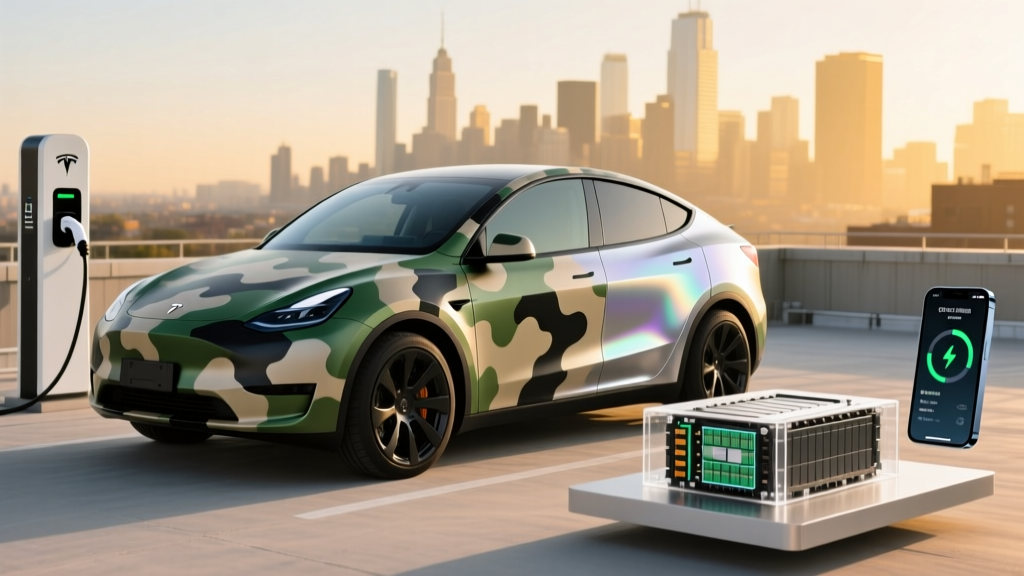
Search interest in the camo Tesla aesthetic has surged as owners look to personalize vehicles that, from the factory, come in a limited palette of solid colors. Vinyl wraps in woodland, digital urban, and desert camouflage patterns have become one of the most visible ways to distinguish a Model Y, Model 3, Model X, or Cybertruck on the road. Unlike a traditional paint job, a high-quality vinyl wrap is reversible, protects the underlying clear coat, and can be applied without affecting the vehicle's aerodynamics or range in any measurable way.
But before you commit to a full-body camo wrap, you need to understand the vehicle you're wrapping. A wrap adds cost on top of the purchase price, and the underlying EV's range, charging speed, tax-credit eligibility, and body-panel composition all influence whether the investment makes sense. This guide pairs the most popular Tesla models for camo wraps with the hard specs buyers need to evaluate the platform underneath the vinyl.
Which Tesla Models Are Most Popular for Camo Wraps?
Not every Tesla is equally wrap-friendly. Panel count, body curvature, and material all affect installation difficulty and cost. Here's how the lineup stacks up for camo treatments:
- Model Y (2026 Long Range & Performance): The best-selling EV in the U.S. Its relatively flat, slab-sided rear quarter panels and large hood make it ideal for large-format camo prints. Most wrap shops quote $3,500–$5,500 for a full-body job.
- Model 3 (2026 Highland Refresh): Sleeker body lines mean more stretching and seaming, but the smaller surface area keeps costs lower—typically $2,800–$4,500. The Highland's revised front fascia actually simplified wrap installation compared to the pre-2024 model.
- Cybertruck: The stainless-steel exoskeleton is a unique case. Vinyl adheres well to the flat angular panels, and the Cybertruck's geometry is practically designed for geometric and digital camo patterns. However, stainless steel cannot be paint-corrected the same way as aluminum or steel if the wrap is removed after years of UV exposure. Expect $4,000–$6,500 for a full wrap due to panel complexity around the bed and sail pillars.
- Model X: The falcon-wing doors add significant labor—each door has multiple hinges and seals that require careful cutting and tucking. Full wraps run $5,000–$7,500.
2026 Tesla Model Y Long Range: The Camo Wrap Favorite
The 2026 Model Y Long Range AWD remains the default choice for buyers who want a practical family EV with maximum range. Here are the numbers that matter:
| Spec | Value |
|---|---|
| EPA Estimated Range | 320 miles |
| Battery Capacity | ~79 kWh usable (NMC chemistry) |
| Drivetrain | Dual-motor AWD |
| Horsepower | 384 hp combined |
| 0–60 mph | 4.8 seconds |
| Max DC Fast Charge | 250 kW peak |
| 10–80% DC Fast Charge | ~25 minutes |
| Level 2 Home Charging | 11.5 kW (~44 mi/hr) |
| Efficiency | 122 MPGe combined / 28 kWh/100 mi |
| Cargo Volume | 76.2 cu ft (rear seats folded) |
| Rear Legroom | 41.6 inches |
| Battery Warranty | 8 years / 120,000 miles |
| Base MSRP | $48,990 |
Charging Speed: What Camo Tesla Owners Actually Experience
Wrapping your Tesla doesn't change its charging behavior, but understanding the charge curve is essential for road-trip planning—especially if your camo-wrapped Model Y or Cybertruck is your primary adventure vehicle.
| Charging Level | Power | Miles Added per Hour | Typical Use Case |
|---|---|---|---|
| Level 1 (120V) | ~1.4 kW | ~4–5 mi/hr | Emergency / overnight trickle |
| Level 2 (240V, 48A) | 11.5 kW | ~44 mi/hr | Home daily charging |
| DC Fast (V3 Supercharger) | 250 kW peak | ~1,000 mi/hr (peak) | Road trips; 10–80% in ~25 min |
| DC Fast (V4 Supercharger) | Up to 350 kW* | Varies by model | Available at select corridors |
*V4 Supercharger 350 kW capability requires compatible vehicle architecture. As of 2026, the Cybertruck supports higher peak rates; Model Y/3 remain capped at 250 kW on the existing 400V architecture.
Charge-curve reality: The 250 kW peak on the Model Y Long Range is sustained only between approximately 10–30% state of charge. Above 50%, the rate tapers significantly—dropping to around 100 kW by 60% and below 50 kW above 80%. This is why Tesla's quoted 10–80% time is the most useful metric, not peak kW alone.
Pricing, Trims, and Federal Tax Credit Eligibility
A camo wrap adds $3,000–$7,500 to your total investment, so understanding the base vehicle cost and available incentives is critical.
| Model / Trim | Base MSRP | §30D Credit Eligible? | Effective Price (with max credit) |
|---|---|---|---|
| Model 3 RWD | $38,990 | Yes (if sourcing rules met) | ~$31,490 |
| Model 3 Long Range AWD | $45,990 | Yes | ~$38,490 |
| Model Y Long Range AWD | $48,990 | Yes | ~$41,490 |
| Model Y Performance | $53,990 | Yes | ~$46,490 |
| Cybertruck AWD | $79,990 | No (exceeds $80K SUV/truck cap) | $79,990 |
| Model X Long Range | $79,990 | No (exceeds $80K SUV cap) | $79,990 |
Critical §30D tax credit caveats (2026 rules):
- Income caps: Modified AGI must not exceed $150,000 (single), $225,000 (head of household), or $300,000 (joint filers).
- MSRP caps: Vans, SUVs, and pickup trucks must have an MSRP at or below $80,000; sedans at or below $55,000.
- Battery sourcing: A percentage of critical minerals and battery components must be sourced from the U.S. or free-trade-agreement countries. This requirement tightens annually. Tesla's U.S.-built models have generally met these thresholds, but always verify the specific VIN's eligibility at fueleconomy.gov.
- Point-of-sale transfer: As of 2024, buyers can transfer the credit to the dealer at purchase, reducing the out-of-pocket cost immediately rather than waiting for a tax refund. Confirm with your Tesla advisor at delivery.
- Full rules are published at IRS.gov. Consult a tax professional for your specific situation.
Cybertruck: The Ultimate Camo Canvas?
No discussion of camo Teslas is complete without the Cybertruck. Its angular stainless-steel body is a natural fit for bold geometric and digital camouflage patterns, and the wrap community has embraced it enthusiastically. But the Cybertruck's specs deserve the same scrutiny as any other EV purchase.
| Spec | Value |
|---|---|
| EPA Estimated Range | 340 miles |
| Battery Capacity | ~123 kWh usable (NMC, 4680 cells) |
| Drivetrain | Dual-motor AWD |
| Horsepower | 600 hp combined |
| 0–60 mph | 3.9 seconds |
| Max DC Fast Charge | ~350 kW peak (800V architecture) |
| 10–80% DC Fast Charge | ~18 minutes |
| Level 2 Home Charging | 11.5 kW (~34 mi/hr due to larger battery) |
| Efficiency | ~58 MPGe combined / ~57 kWh/100 mi |
| Towing Capacity | 11,000 lbs |
| Battery Warranty | 8 years / 150,000 miles |
| Base MSRP | $79,990 |
Standout Tech & Notable Drawbacks
- Access to the Tesla Supercharger network—over 60,000 stalls globally, with the highest reliability rate among DC fast-charging networks
- Over-the-air updates continuously add features and refine performance
- Autopilot standard; FSD (Supervised) available as a $8,000 option or $99/month subscription—note this is SAE Level 2 driver assist, requiring full driver attention at all times
- Minimalist interior reduces wear-prone physical controls
- Frunk (front trunk) adds cargo versatility on Model Y, Model 3, and Cybertruck
- Cybertruck's 11,000-lb towing and 800V architecture are class-leading
- Build quality variability remains a concern—panel gaps, paint imperfections, and interior trim inconsistencies are more common than on legacy automakers
- 250 kW peak charging on Model Y/3 trails competitors like the Hyundai Ioniq 5 (350 kW capable on 800V architecture)
- No Apple CarPlay or Android Auto—Tesla's proprietary infotainment is the only option
- Insurance premiums tend to be higher than comparable non-Tesla EVs due to repair costs and parts availability
- Cybertruck's $79,990 MSRP disqualifies it from the §30D federal tax credit
- Wrap removal after 3–5 years may reveal paint oxidation differences on exposed vs. covered panels, particularly on the Cybertruck's stainless steel
Who Should Buy (and Wrap) a Tesla?
Choose a camo-wrapped Cybertruck if: You need serious towing capacity, want the most visually dramatic camo platform on the road, and can absorb the $79,990+ price without a federal tax credit. Budget an additional $4,000–$6,500 for the wrap.
Choose a camo-wrapped Model 3 if: You want the most affordable entry into the Tesla ecosystem and prefer a sportier, lower-profile vehicle. The Highland refresh improved interior quality and ride comfort. At $38,990, it offers the best value for a wrap project.
Look elsewhere if: You want Apple CarPlay, prefer traditional dealer service experiences, need a vehicle with proven long-term build-quality consistency, or want faster DC charging from a non-Tesla platform.
Frequently Asked Questions
Does a vinyl wrap affect Tesla range or efficiency?
No measurable impact. A quality vinyl wrap adds approximately 20–30 lbs to the vehicle and does not alter the aerodynamic profile. Any range difference is negligible—well within normal day-to-day variance from tire pressure, temperature, and driving style.
Will wrapping my Tesla void the warranty?
A professionally installed vinyl wrap does not void Tesla's vehicle or battery warranty. However, if wrap installation damages wiring, sensors, or trim, those specific repairs won't be covered. Choose a shop experienced with Tesla's sensor locations (cameras, ultrasonic sensors, and radar where equipped).
How long does a camo wrap last on a Tesla?
High-quality cast vinyl (3M, Avery Dennison, KPMF) lasts 5–7 years with proper care. Garage parking and ceramic coating over the wrap extend longevity. Avoid automated car washes with abrasive brushes—touchless or hand wash only.
Can I get the federal tax credit and then wrap my Tesla?
Yes. The §30D credit applies to the vehicle purchase. Wrapping is an aftermarket modification and does not affect credit eligibility. Just ensure your VIN qualifies before purchase—verify at fueleconomy.gov and confirm with your tax advisor.
Does the Cybertruck's stainless steel body require a special wrap?
Not necessarily a special material, but the installation requires a shop familiar with stainless steel. The surface must be thoroughly cleaned and decontaminated. Stainless steel doesn't corrode like painted steel, but adhesive residue after long-term wrap removal can be more difficult to clean from bare stainless surfaces compared to clear-coated paint.
Is Autopilot or FSD worth adding to a camo-wrapped Tesla?
Autopilot (standard) handles adaptive cruise control and lane centering adequately for highway commuting. FSD (Supervised) at $8,000 or $99/month adds city-street navigation but remains an SAE Level 2 system—you must monitor the road at all times. For most buyers, the standard Autopilot is sufficient, and the $8,000 FSD purchase is difficult to justify unless you regularly drive in complex urban environments and accept the supervision requirement.
What's the best camo pattern for a Tesla?
This is subjective, but the most popular patterns in 2026 include digital urban camo (gray/black/white pixels that complement Tesla's minimalist design), traditional woodland green/brown for adventure-oriented builds, and desert tan for Cybertruck owners. Geometric and hex-based patterns pair especially well with the Cybertruck's angular body. Most wrap shops offer digital mockups before installation.