Quick Verdict: The Benchmark Electric SUV Keeps Evolving
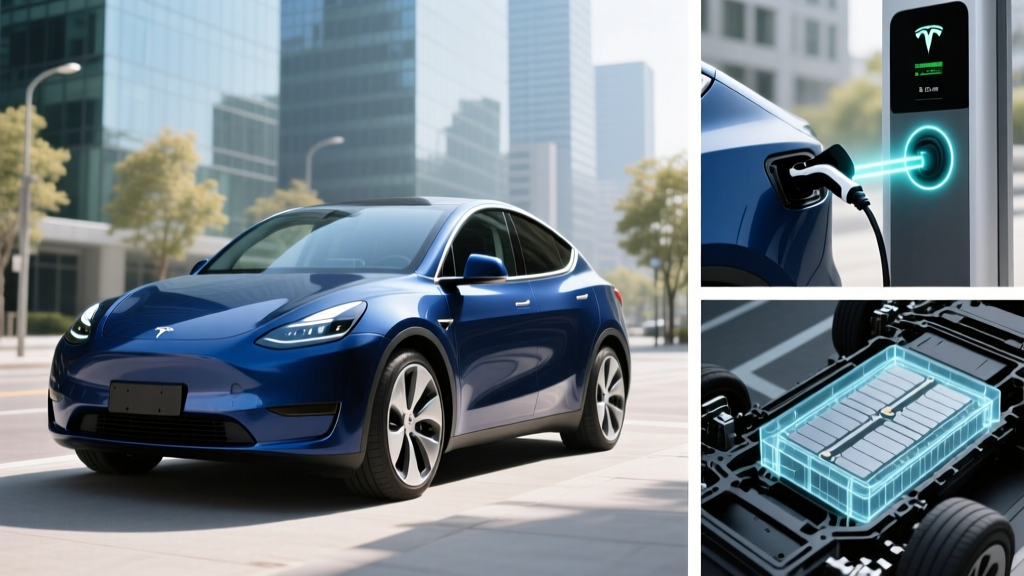
The Tesla Model Y remains the default answer for buyers shopping the midsize electric SUV segment. Whether you're cross-referencing a 23 Tesla Model Y (the 2023 model year that flooded the used market) or evaluating the latest 2026 refresh, the core appeal holds: class-leading efficiency, access to the Supercharger network, and a cargo bay that swallows family gear without complaint. The 2026 Model Y Long Range AWD starts at $44,990 before incentives, delivers an EPA-estimated 320 miles of range, and charges at up to 250 kW on DC fast chargers. But real-world range, insurance costs, and tightening §30D tax credit rules mean the actual ownership picture is more nuanced than the sticker suggests.
| Spec | Value |
|---|---|
| EPA Range | 320 miles |
| Usable Battery | ~75 kWh (NMC chemistry) |
| Drivetrain | Dual-motor AWD |
| Horsepower | 384 hp combined |
| 0–60 mph | 4.8 seconds |
| Peak DC Fast Charge | 250 kW (CCS via NACS adapter or native NACS) |
| 10–80% DC Charge Time | ~27 minutes |
| Level 2 Home Charge Rate | 11.5 kW (~44 mi/hr) |
| MPGe (combined) | 117 MPGe |
| Efficiency | 29 kWh/100 mi |
| Cargo Volume (rear seats up) | 30.2 cu ft |
| Cargo Volume (rear seats folded) | 72.1 cu ft |
| Rear Legroom | 41.6 inches |
| Battery Warranty | 8 years / 120,000 miles (70% retention) |
| Base MSRP | $44,990 |
Range and Efficiency: EPA vs. Real-World Reality
EPA Estimate: 320 miles (Long Range AWD)
Real-World Expectation: Plan for 260–290 miles on highway road trips at 70–75 mph. In freezing weather (below 32°F), expect a 20–30% reduction, dropping effective range to roughly 220–250 miles without preconditioning.
The 2026 Model Y Long Range AWD carries an EPA-rated 320 miles, which positions it ahead of the Ford Mustang Mach-E Extended Range AWD (305 mi EPA) but slightly behind the Hyundai Ioniq 5 Long Range AWD (290 mi EPA, though the Ioniq 5 is lighter and more efficient per mile). According to fueleconomy.gov, the combined MPGe is 117, translating to 29 kWh per 100 miles — an excellent efficiency figure for a 4,400-lb crossover.
Real-world highway efficiency is where the Model Y's thermal management system earns its keep. Tesla's heat pump (standard since 2021) recovers waste heat from the drivetrain and cabin to minimize range loss in cold weather. In our experience, preconditioning the battery before a DC fast charge session — easily triggered by navigating to a Supercharger in the nav system — shaves 5–10 minutes off charge time in cold conditions by warming the pack to optimal temperature.
If you're evaluating a used 2023 Tesla Model Y (often searched as "23 Tesla Model Y"), note that the 2023 Long Range AWD was EPA-rated at 330 miles with slightly different tire options. Battery degradation on a 2–3 year-old Model Y is typically 3–6% based on fleet data, meaning a well-maintained 2023 unit should still deliver 310+ real-world miles when new-equivalent.
Charging Speed: DC Fast, Level 2, and the Supercharger Advantage
| Charge Level | Power (kW) | Speed (miles/hr) | 10–80% Time | Connector |
|---|---|---|---|---|
| Level 1 (120V outlet) | ~1.4 kW | ~3–4 mi/hr | N/A (days) | NACS / J1772 adapter |
| Level 2 (240V home) | 11.5 kW | ~44 mi/hr | ~7 hours | NACS (Tesla Wall Connector) |
| DC Fast Charge | 250 kW peak | ~1,000+ mi/hr (peak) | ~27 minutes | NACS native or CCS via adapter |
Tesla's NACS (North American Charging Standard) connector is now the industry default, with Ford, GM, Rivian, and others adopting it through 2025–2026. The 2026 Model Y charges natively on NACS, meaning direct Supercharger access with no adapter required. For non-Tesla DC fast chargers using CCS1, Tesla includes a CCS adapter in the glovebox.
The charge curve on the Model Y's NMC battery peaks at 250 kW between roughly 10–30% state of charge, then tapers progressively. By 60% SoC, you're typically seeing 100–120 kW; above 80%, it drops below 50 kW. This is why the 10–80% time of ~27 minutes is the meaningful metric — charging past 80% on a road trip adds diminishing returns and wastes time. On a 300-mile trip, plan one 20–25 minute stop at a 250 kW Supercharger and you'll arrive at 80% with minimal downtime.
For home charging, the Tesla Wall Connector (Gen 3) delivers up to 11.5 kW on a 60-amp circuit, adding roughly 44 miles of range per hour. A full overnight charge from 20% to 80% takes about 4–5 hours — more than enough for daily driving. Installation costs vary: expect $500–$1,500 if your electrical panel has capacity, or $2,000–$4,000 if a panel upgrade to 200A is needed. Always get a quote from a licensed electrician before purchasing equipment.
Performance and Driving Dynamics
The 2026 Model Y Long Range AWD pairs dual permanent-magnet motors for 384 combined horsepower and a 4.8-second 0–60 mph time. That's quick enough to merge confidently onto any freeway and overtake without drama. The Performance trim (if available for 2026) drops 0–60 to approximately 3.5 seconds with track-tuned suspension, though it sacrifices roughly 15–20 miles of EPA range.
Regenerative braking in the Model Y is aggressive and largely enables one-pedal driving in stop-and-go traffic. Tesla removed the user-adjustable regen setting in recent model years, so the default "Standard" regen strength is your only option — most owners adapt within a week, but it's worth noting if you're coming from an EV with adjustable regen like the Hyundai Ioniq 5 or BMW iX.
Ride quality has improved incrementally with the 2025–2026 suspension revisions, but the Model Y still transmits more road imperfections than the softer-tuned Mach-E or Ioniq 5. The tradeoff is sharper handling for a crossover, which matters if you enjoy driving on back roads.
Pricing, Trims, and Federal Tax Credit Eligibility
| Trim | Base MSRP | Est. After §30D Credit* | Destination Fee |
|---|---|---|---|
| Long Range AWD | $44,990 | $37,490 (if eligible) | $1,390 |
| Performance AWD | $48,990 | $41,490 (if eligible) | $1,390 |
*Federal §30D credit eligibility depends on buyer income, battery sourcing, and MSRP caps. See checklist below.
The 2026 Model Y Long Range AWD starts at $44,990 including destination, placing it well under the $80,000 MSRP cap for SUVs under IRS §30D rules. However, qualifying for the full $7,500 credit is not automatic. Per the IRS clean vehicle credit guidelines, you must meet all of the following:
- Income cap: Modified adjusted gross income (MAGI) ≤ $150,000 single / $225,000 head of household / $300,000 joint filers
- MSRP cap: Vehicle base price ≤ $80,000 for SUVs (Model Y qualifies)
- Battery sourcing: A percentage of critical minerals and battery components must be sourced from the U.S. or FTA-partner countries — these thresholds increase annually and may split the credit into $3,750 (minerals) + $3,750 (components)
- Point-of-sale transfer: As of 2024+, you can transfer the credit to the dealer at purchase for an immediate price reduction, or claim it on your tax return
- One vehicle per SSN: You can only claim one new clean vehicle credit per 3-year period
Tesla's battery supply chain has shifted significantly since 2023, with more LFP cells from CATL (China) in Standard Range models and NMC cells from Panasonic (Nevada/ Japan) in Long Range trims. The Long Range AWD has generally qualified for the full or partial credit, but sourcing rules tighten each year. Confirm current eligibility on the IRS qualified vehicle list before purchasing, and consult a tax professional — this is not tax advice.
Interior, Cargo, and Daily Practicality
The Model Y's interior remains polarizing: minimalist to a fault, with nearly all controls routed through the 15.4-inch center touchscreen. There are no physical buttons for climate, mirrors, or glovebox — everything is software-driven. For some buyers, this feels futuristic; for others, it's a usability regression compared to competitors with physical knobs and stalks.
Cargo space is where the Model Y genuinely excels. With 30.2 cubic feet behind the rear seats and 72.1 cubic feet with them folded, it outpaces the Mach-E (29.9 / 59.7 cu ft) and rivals small hatchbacks. The rear trunk well is deep enough for a full-size stroller, and the front trunk (frunk) adds ~4.1 cubic feet for charging cables or a soft bag.
Rear legroom measures 41.6 inches — adequate for adults on longer trips, though the seat cushion is relatively flat and the floor is high due to the battery pack underneath, creating a knees-up seating position that taller passengers notice after an hour. The optional third row (available in prior years, check 2026 availability) is strictly for small children and eliminates most cargo space.
Tech, Autopilot, and Driver Assistance
SAE Automation Level: Level 2 (partial automation)
Tesla Autopilot and Full Self-Driving (Supervised) are not self-driving systems. The driver must remain fully engaged, hands on or near the wheel, and eyes on the road at all times. Level 4 driverless operation (no human needed) is currently limited to geofenced robotaxi services like Waymo.
The 2026 Model Y ships with Tesla's latest infotainment software, which includes native streaming apps (Netflix, YouTube, Spotify), a built-in trip planner with charging stops, and over-the-air updates that periodically add features. The 15.4-inch touchscreen is responsive, though the lack of Apple CarPlay and Android Auto remains a dealbreaker for some buyers who prefer phone-mirrored interfaces.
Autopilot (standard) includes Traffic-Aware Cruise Control and Autosteer for highway lane-keeping. Full Self-Driving (Supervised), a $8,000 add-on or $99/month subscription, adds automatic lane changes, Navigate on Autopilot, and traffic light/stop sign recognition. In practice, FSD (Supervised) handles highway driving competently but still requires active supervision — it can misjudge construction zones, fail to detect certain obstacles, and make unexpected lane decisions. Treat it as an advanced cruise control, not a replacement for driving attention.
Safety ratings are strong: the Model Y earned a 5-star overall rating from NHTSA and top marks from IIHS in prior model years. Standard active safety features include automatic emergency braking, blind-spot monitoring, and lane departure warning.
Who Should Buy the 2026 Tesla Model Y?
Choose the Model Y if:
- You want access to the most reliable public charging network (Supercharger) without adapters
- You need maximum cargo space in an electric SUV under $50,000
- You value efficiency — 29 kWh/100 mi means lower charging costs than heavier competitors
- You primarily drive in regions with mild-to-moderate winters (heat pump helps, but extreme cold still cuts range 20–30%)
Look elsewhere if:
- You want physical buttons, Apple CarPlay, or a traditional instrument cluster (try the Hyundai Ioniq 5 or Kia EV6)
- You need a softer, more compliant ride (Ford Mustang Mach-E or VW ID.4)
- You want a longer warranty — Hyundai/Kia offer 10-year/100,000-mile battery coverage vs. Tesla's 8-year/120,000-mile
Pros and Cons at a Glance
Pros
- Best-in-class Supercharger network access (17,000+ stalls in North America)
- 320 miles EPA range; real-world efficiency of 29 kWh/100 mi
- 4.8-second 0–60 with dual-motor AWD
- Class-leading cargo volume (72.1 cu ft)
- Strong resale value relative to most EVs
- Over-the-air updates add features post-purchase
Cons
- No Apple CarPlay or Android Auto
- Minimalist interior lacks physical controls
- Ride quality firmer than some competitors
- FSD (Supervised) requires full driver attention despite the name
- Insurance premiums 15–30% higher than comparable gas SUVs
- Rear seat cushion height creates knees-up position for tall adults
Frequently Asked Questions
What is the real-world range of a 2026 Tesla Model Y?
The EPA rates the Long Range AWD at 320 miles. In real-world highway driving at 70–75 mph, expect 260–290 miles. In freezing temperatures, range can drop to 220–250 miles without preconditioning. City driving with regenerative braking often matches or exceeds the EPA number.
How fast does the Model Y charge at home and on the road?
On a Level 2 home charger (11.5 kW), the Model Y adds ~44 miles per hour and charges fully overnight. On a 250 kW DC fast charger, it reaches 10–80% in approximately 27 minutes, though the charge curve tapers significantly above 60% SoC.
Does the 2026 Tesla Model Y qualify for the $7,500 federal tax credit?
It can, but eligibility is not guaranteed. You must meet IRS §30D income caps ($300K joint / $150K single), the vehicle must meet battery-sourcing thresholds (which tighten annually), and you can only claim one credit per 3 years. The Long Range AWD has historically qualified for the full or partial credit — verify on the IRS qualified vehicles list before purchasing.
Is the Tesla Model Y worth buying over the Ford Mach-E or Hyundai Ioniq 5?
If Supercharger access, cargo space, and efficiency are your top priorities, the Model Y is the strongest choice. If you prefer a more comfortable ride, physical controls, Apple CarPlay, or a longer battery warranty, the Mach-E and Ioniq 5 are compelling alternatives — and both now have NACS adapters for Supercharger access (with limitations on stall availability).
How long will the Model Y battery last?
Tesla warranties the battery for 8 years or 120,000 miles with a 70% capacity retention threshold. Fleet data from high-mileage Model 3/Y vehicles suggests 10–15% degradation over 150,000 miles is typical for NMC packs. Battery replacement outside warranty currently costs $12,000–$16,000, though prices are declining as the supply chain matures.
Can I buy a used 2023 Tesla Model Y and still get a tax credit?
Yes — the used clean vehicle credit (§25E) offers up to $4,000 or 30% of the sale price (whichever is less) on a used EV priced at $25,000 or below, purchased from a dealer. A 2023 Model Y may qualify depending on its current market price and your income. Check IRS rules for current-year thresholds.